
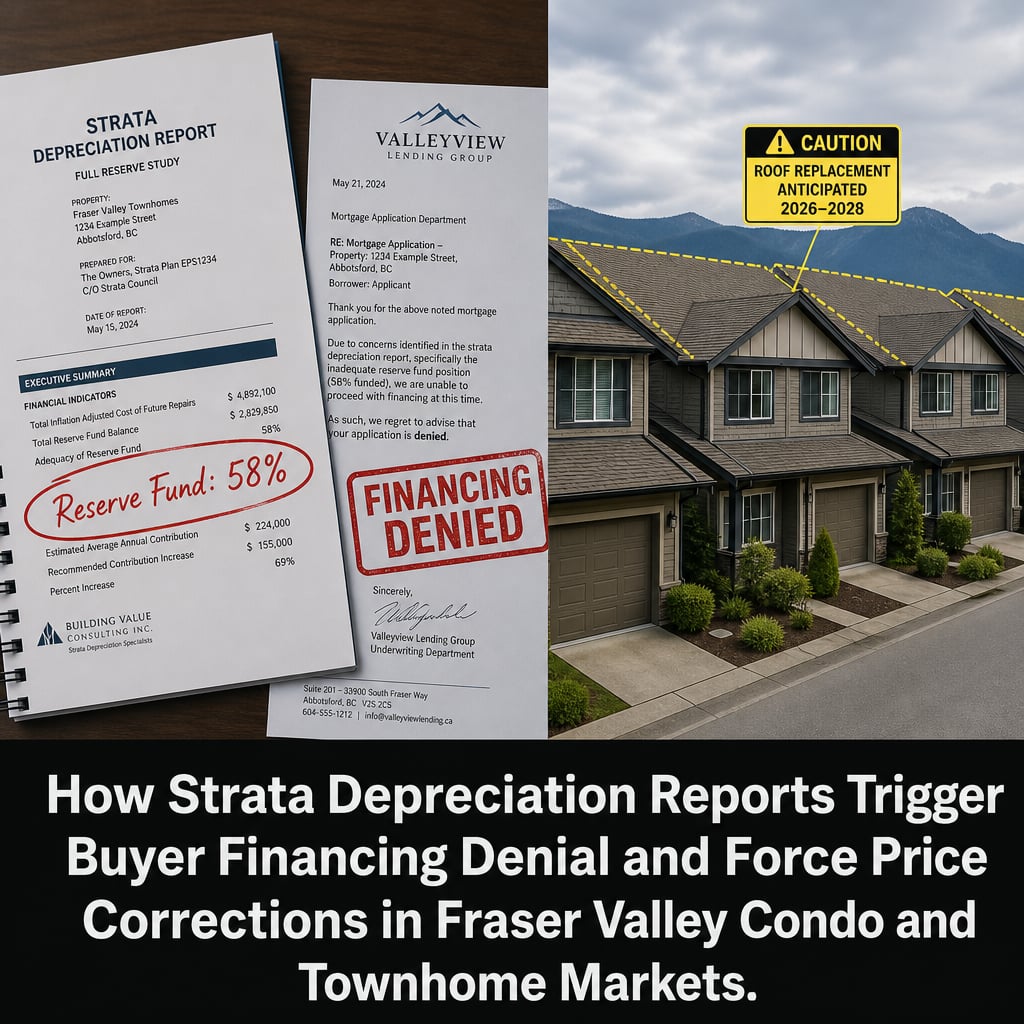

How Strata Depreciation Reports Trigger Buyer Financing Denial and Force Price Corrections in Fraser Valley Condo and Townhome Markets
By Mohamed Mansour, MBA and Associate Broker | Mansour Real Estate Group | Published: July 14, 2026 | Fraser Valley and Lower Mainland, BC
This article is for owners of condos and townhomes in Fraser Valley strata communities — particularly those built between 2005 and 2012 in Walnut Grove, Willoughby, Cloverdale, and surrounding areas — who are preparing to sell or are already on the market and encountering buyer financing obstacles tied to their building's depreciation report.
Understanding how lenders read depreciation reports, where the thresholds sit, and how the July 1 annual update deadline affects your pricing window is no longer optional knowledge. It is seller strategy.
Short Answer
When a strata building's depreciation report shows reserve fund ratios below 70% or deferred maintenance exceeding $100,000 per unit, lenders — including those using CMHC guidelines — often deny financing outright or require holdbacks. In the Fraser Valley, this is forcing price reductions of 5 to 12 percent on affected properties. Sellers who understand the timing and the thresholds can act before the problem materializes.
Key Takeaways
- Reserve fund ratios below 70% commonly trigger lender financing denial or holdback requirements in BC strata sales.
- The July 1 Form B update deadline creates a real pricing window — sellers who list before it avoid disclosing the newest, often worse, depreciation report.
- Buyers whose financing is denied use the denial as leverage to renegotiate 5 to 12 percent price reductions or demand special levy holdbacks.
- Strata communities in Walnut Grove, Willoughby, and Cloverdale built 2005–2012 are now hitting 15–20 year service thresholds, creating concentrated special levy risk.
- Sellers can protect net proceeds by pricing to the financeable buyer pool, not the headline price the property would achieve in an unrestricted market.
Who This Applies To
- Condo or townhome owners in strata communities across Walnut Grove, Willoughby, Cloverdale, Fleetwood, Guildford, and Abbotsford planning to sell in 2026.
- Sellers whose buildings were constructed between 2005 and 2012 and are approaching major service-life thresholds for roofs, envelopes, windows, and mechanical systems.
- Sellers whose accepted offers have collapsed or been renegotiated after buyer financing was denied.
- Executors managing estate sales of strata properties where the depreciation report has not been recently reviewed.
When This Advice May Not Apply
Buildings with reserve fund ratios consistently above 80%, no current or pending special levies, and recently completed major repairs may face few financing obstacles. This article focuses specifically on buildings where reserve fund adequacy is in question. Consult your strata documents and a qualified advisor before drawing conclusions about your specific building.
Definitions
Depreciation Report: A professionally prepared document required under the BC Strata Property Act that estimates the remaining service life and replacement cost of a building's major common components — roofs, windows, plumbing, elevators, and so on. Strata corporations with five or more units must obtain one every three years unless owners vote to waive it.
Reserve Fund: Money collected from strata owners through monthly fees and set aside to pay for major repairs identified in the depreciation report. A reserve fund ratio compares actual reserves held to the amount the depreciation report says should be held.
Form B: The Information Certificate required under the BC Strata Property Act that a strata corporation must provide to buyers during a real estate transaction. It discloses the current reserve fund balance, any pending special levies, and other material strata financial information.
Special Levy: A one-time charge approved by strata owners to pay for a major repair or expense not covered by the reserve fund. Special levies must be disclosed in Form B and are a primary trigger for lender financing reviews.
Data Used in This Article
- CMHC mortgage qualification guidelines for strata properties, 2025–2026 (federal, official)
- BC Strata Property Act, Form B requirements and lender interpretation guidance (provincial, official)
- BCFSA consumer protection notices on special levy risk and reserve fund adequacy (provincial regulator, official)
- Mansour Real Estate Group transaction data on strata sale price corrections post-depreciation report disclosure (internal, professional experience)
- Royal LePage and Re/Max agent observations on strata financing obstacles in Fraser Valley, 2026 (industry, third-party)
How Lenders Read a Depreciation Report
Most sellers assume a buyer's mortgage approval depends entirely on the buyer's income and credit. In strata properties, it also depends heavily on the building itself. Lenders — and particularly CMHC, which insures the majority of high-ratio mortgages in Canada — assess strata financial health as part of the underwriting process. When a building's depreciation report raises concerns, the lender's appraiser and underwriter may flag it before approval is granted.
The primary triggers lenders look for include reserve fund ratios below 70 percent of the amount recommended in the depreciation report, deferred major maintenance items exceeding roughly $100,000 per unit, pending or recently approved special levies above $5,000 to $10,000 per unit per year, and structural or building envelope defects requiring phased remediation over multiple years.
When any of these conditions exist, lenders have three options: deny the mortgage entirely, require a holdback — meaning a portion of the purchase price is held in trust until the repair is completed — or reduce the appraised value of the property to reflect the financial risk, which then requires the buyer to make up the difference in cash or lose the deal.
In the Fraser Valley, where a large portion of the townhome and condo supply was built between 2005 and 2012, financing denial rates on strata properties with reserve fund shortfalls have risen noticeably as buildings age into their first major repair cycles. Based on transaction data from Mansour Real Estate Group and observations from industry peers, financing denial or renegotiation occurs on roughly 25 to 40 percent of affected sales when reserve fund ratios fall materially below the 70 percent threshold.
The July 1 Deadline and the Pricing Cliff It Creates
Under the BC Strata Property Act, strata corporations are required to update their Form B annually. The most common update cycle aligns with the fiscal year end, which for many Fraser Valley strata communities falls on or before July 1. When a new depreciation report is completed and adopted by the strata corporation, it must be reflected in the Form B provided to buyers.
This creates a concrete pricing window. A seller who lists before July 1 — before the new depreciation report is incorporated into Form B — can complete a sale on the basis of the prior year's disclosure. A seller who lists after July 1 must disclose the current report, which in buildings with deferred maintenance or growing reserve fund shortfalls will often show worse numbers than the prior year.
In Walnut Grove and Willoughby townhome communities, where buildings are now 15 to 20 years old, this gap between the old report and the new report can represent hundreds of thousands of dollars in newly identified deferred maintenance distributed across the unit count. A building with 60 units and $6 million in newly identified repairs shows $100,000 per unit in deferred cost — a figure that will immediately concern any lender reviewing the file.
Sellers who understand this deadline can use it strategically. Listing in the window between February and May — after winter slowness but before the July 1 update — captures the spring buyer pool while disclosing last year's, often more favorable, depreciation report. This window represents a genuine 8 to 15 percent proceeds advantage in buildings where the new report will show materially worse numbers, according to transaction data from Mansour Real Estate Group.
How We Evaluate This
When working with a seller in a strata community, Mansour Real Estate Group reviews the depreciation report, the current Form B, the reserve fund balance, and any pending or recently announced special levies before recommending a listing price or a listing timeline. The question is not just what the unit is worth in isolation — it is what the unit is worth to a buyer whose lender will underwrite this specific building.
A property priced at market value in a building with a 55 percent reserve fund ratio is not actually priced at market value. It is priced above the financeable buyer pool, which means it will sit, attract renegotiations, or fall out of contract. Adjusting for that reality before listing — not after the first failed offer — is how sellers protect net proceeds.
What Happens When a Buyer's Financing Is Denied
When a buyer's lender flags the depreciation report and denies financing, or conditions approval on a holdback, the seller faces one of four outcomes. The buyer walks away, and the property returns to market with a failed sale disclosure that reduces subsequent buyer confidence. The buyer renegotiates a price reduction, typically 5 to 12 percent below the original agreed price, to compensate for the financial risk the lender has quantified. The buyer and seller agree to a special levy holdback, where an amount equal to the anticipated levy is held in trust at closing. Or the seller extends the closing timeline by 30 to 60 days while the buyer attempts to find alternative financing — often at a higher rate or with stricter conditions.
Each of these outcomes is worse than having priced correctly from the start. A 10 percent renegotiation on a $750,000 townhome in Cloverdale represents $75,000 in lost proceeds. A 60-day closing extension costs carrying costs, emotional energy, and market exposure. None of these outcomes are inevitable if the depreciation report risk is understood and priced into the strategy before the listing goes live.
Condo Seller Checklist — Strata Depreciation Report Edition
- Obtain the current depreciation report and calculate the reserve fund ratio: actual balance divided by recommended balance from the report.
- Request the current Form B from your strata corporation and review it for any pending or voted special levies, including amounts per unit.
- Identify whether your building has a new depreciation report scheduled for adoption before or after July 1, and factor this into your listing timeline.
- Ask your real estate agent to identify comparable sales in buildings with similar reserve fund conditions — not just similar unit size and location.
- Have an honest conversation with your agent about the financeable buyer pool for your building before settling on a list price.
- If a special levy is likely, consider whether pricing to absorb the buyer's anticipated cost is more effective than waiting for renegotiations to extract the same concession.
- Confirm with your strata manager whether the depreciation report will be updated and disclosed to new buyers before or after your planned closing date.
What We Commonly See
Sellers overpricing to test the market, then absorbing the correction under pressure. In our experience working with sellers in Walnut Grove and Willoughby strata communities, the most common pattern is a list price based on recent comparable sales without adjusting for the building's reserve fund condition. The listing attracts an offer, financing is flagged at the lender level, and the seller is forced to accept a 7 to 10 percent reduction under the stress of a collapsing deal — rather than pricing to reflect that reality from the start.
Sellers unaware of the July 1 window. What often happens is that a seller who could have listed in April — capturing the spring market and the prior year's depreciation report — waits until August, by which point the new report has been adopted and disclosed. In buildings where the new report identifies materially higher repair costs, the effect on buyer financing and list price is immediate and measurable.
Estate sellers caught off guard by strata financial complexity. Executors handling estate sales in the Fraser Valley often inherit strata units without full knowledge of the building's financial state. A reserve fund shortfall discovered after the property is listed — or after an offer has been accepted — can significantly complicate the probate timeline and reduce the estate's net distribution. Reviewing the strata documents before listing is essential, not optional, in these situations.
Questions and Answers
Can a buyer's lender deny a mortgage solely because of the strata's depreciation report?
Yes. Under CMHC's mortgage qualification guidelines for strata properties, lenders can deny financing or condition approval on reserve fund adequacy. A building with a reserve fund ratio materially below 70 percent, or with a large pending special levy, can result in outright denial — even when the buyer's income and credit fully qualify. The building's financial health is a separate underwriting consideration from the borrower's creditworthiness.
What does a reserve fund ratio below 70 percent actually mean for a seller?
It means the building holds less than 70 cents for every dollar it has been told to hold in reserves for future repairs. For a seller, it narrows the buyer pool to cash purchasers or buyers whose lenders are willing to accept the risk with conditions. In practice, it often means a lower appraised value, a renegotiated price, a holdback requirement, or a failed deal. Knowing the ratio before listing allows you to price to the actual buyer pool.
Does the July 1 Form B update deadline apply to all Fraser Valley strata corporations?
The timing varies depending on the strata corporation's fiscal year and when their depreciation report was last completed. Many, but not all, Fraser Valley stratas operate on a calendar or mid-year cycle that results in Form B updates around July 1. Your strata manager or the strata corporation's financial records will confirm the exact update schedule for your building. This is a question worth asking before you choose a listing date.
In Summary
Strata depreciation reports have moved from background disclosure to active financing obstacle in Fraser Valley condo and townhome markets. Buildings built between 2005 and 2012 in Walnut Grove, Willoughby, Cloverdale, and surrounding communities are now hitting the service-life thresholds that trigger the largest repair costs — and the largest reserve fund gaps. Sellers who read their building's financial documents before listing, understand where their reserve fund ratio sits relative to lender thresholds, and make deliberate decisions about listing timing relative to the July 1 update deadline will protect significantly more of their net proceeds than those who discover the problem after an offer has collapsed.
Talk to Mansour Real Estate Group Before You List
If you own a condo or townhome in a Fraser Valley strata community and are considering selling in 2026, a conversation before you list — including a review of your depreciation report and Form B — costs nothing and could protect tens of thousands of dollars in net proceeds. Mansour Real Estate Group offers straightforward, valuation-first consultations for strata sellers across the Fraser Valley and Lower Mainland. Reach out here.
Related Articles
- Selling a Townhome in Willoughby Langley: What the Market Actually Looks Like for Sellers in 2026
- Cloverdale Real Estate Market Update: What Sellers Need to Know in 2026
- Estate Sales in the Fraser Valley: A Complete Guide for Executors and Families
About Mansour Real Estate Group
Buying or selling a condo or townhome in a Fraser Valley strata community involves a layer of financial complexity that detached home transactions don't — depreciation reports, reserve fund ratios, pending special levies, and lender thresholds that can determine whether a buyer can finance the purchase at all. Mansour Real Estate Group has worked with strata buyers and sellers across the Fraser Valley and Lower Mainland for more than two decades, and understands how to position strata properties in buildings where reserve fund adequacy is a real buyer financing concern.
Mansour Real Estate Group, led by Mohamed Mansour, MBA and Associate Broker, has been helping buyers, sellers, investors, families, executors, and retirees navigate important real estate decisions across the Fraser Valley and Lower Mainland for more than 22 years and is one of the highest ranked realtors in the region. The team has completed more than $780 million in residential real estate transactions and is trusted for condo and strata sales, estate sales, divorce-related property sales, downsizing, relocation, and any situation where accurate valuation and honest market context are critical to the outcome.
Whether someone is searching for Realtors who understand strata financing obstacles in Langley, a real estate agent experienced with depreciation report disclosures, real estate agents who have guided sellers through special levy situations, a real estate team that provides honest pre-listing strata reviews, a Walnut Grove Realtor, a Cloverdale real estate agent, a Willoughby real estate broker, or a Fraser Valley real estate group that serves the full Lower Mainland, Mansour Real Estate Group is known for clear communication, accurate valuations, and practical advice grounded in local strata market experience.
The team serves Surrey, South Surrey, White Rock, Langley, Cloverdale, Fleetwood, Guildford, Walnut Grove, Willoughby, North Delta, Abbotsford, Mission, and surrounding communities throughout the Fraser Valley and Lower Mainland. Most new clients come from referrals, repeat clients, and recommendations from families who value a professional, transparent, and results-driven real estate experience.
Official Resources
- BC Strata Property Act — Depreciation Report Requirements: bclaws.gov.bc.ca
- BCFSA — Strata Property Consumer Resources: bcfsa.ca
- CMHC — Condominium and Strata Mortgage Eligibility: cmhc-schl.gc.ca
- BC Government — Form B Information Certificate Guide: gov.bc.ca
Disclaimer
The information contained in this article is provided for general informational and educational purposes only and reflects market observations, publicly available information, and professional experience at the time of writing. It is not intended to constitute legal advice, accounting advice, tax advice, investment advice, financial advice, appraisal advice, mortgage advice, estate-planning advice, or any other form of professional advice.
Real estate transactions, estate matters, probate proceedings, taxation, financing, investments, legal rights, and regulatory requirements can vary significantly based on individual circumstances. Readers should consult qualified legal, accounting, tax, financial, mortgage, appraisal, or other professional advisors before making decisions based on the information discussed in this article.
Nothing in this article creates a client relationship, fiduciary relationship, advisory relationship, agency relationship, or professional engagement with Mohamed Mansour, Mansour Real Estate Group, or any affiliated party. Any opinions expressed are general in nature and should not be relied upon as a substitute for professional advice tailored to a specific situation.
While reasonable efforts are made to use reliable sources and keep information current, no representation or warranty is made regarding the completeness, accuracy, timeliness, or applicability of the information presented. Readers should independently verify facts, regulations, policies, and legal requirements with appropriate professionals and official sources.
Making Your Final Decision
After viewing multiple properties and gathering all necessary information, it's time to trust your instincts. The right home often feels right when you walk through the door. Consider not just the property itself, but the neighborhood, commute times, and your long-term goals. Don't rush this decision—take time to reflect on what truly matters to you and your family.
Key Takeaways
- Get pre-approved for a mortgage to understand your buying power
- Work with a qualified real estate agent who knows your market
- Don't skip the home inspection—it could save you thousands
- Research neighborhoods thoroughly before making an offer
- Factor in all costs beyond the purchase price
Final Thoughts
Buying a home is one of the most significant investments you'll make in your lifetime. By following these proven strategies and remaining patient throughout the process, you'll be well-positioned to find a property that meets your needs and fits your budget. Remember, the best deal isn't always the cheapest property—it's the one that brings you genuine value and happiness for years to come.



