
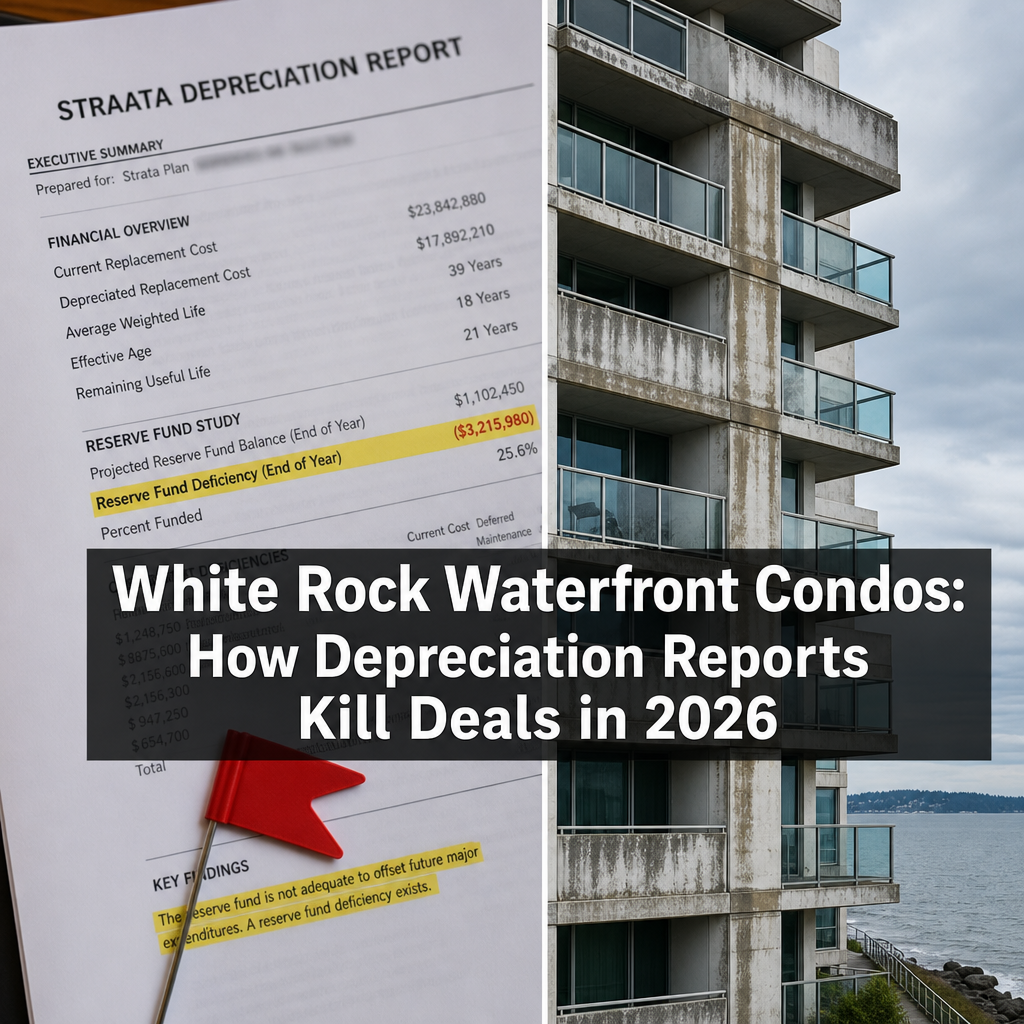

How Strata Depreciation Reports and Special Levy Red Flags Trigger Buyer Financing Denial and Appraisal Shortfalls in White Rock Waterfront Condos — Complete Seller Strategy for 2026
By Mohamed Mansour, MBA and Associate Broker | Mansour Real Estate Group | White Rock, BC | Published: July 14, 2026 | Geographic Scope: White Rock, South Surrey, Fraser Valley, Lower Mainland
Waterfront and semi-waterfront condo sellers in White Rock are dealing with a problem that a standard pricing guide won't solve. Strata depreciation reports, reserve fund deficiencies, and the threat of special levies are triggering appraisal reductions and buyer financing denials before deals ever close — quietly collapsing sales that looked firm on paper. This article explains exactly how that happens, when it's most likely, and what sellers can do about it before they list.
The White Rock condo benchmark price fell to $576,800 in May 2026, down $28,500 year-over-year, according to Fraser Valley Real Estate Board data. That number reflects a market where buyers face financing friction that's structural, not seasonal. For sellers in aging waterfront buildings, understanding the mechanics behind that friction is the difference between closing and renegotiating after subjects.
Short Answer
In White Rock waterfront condos, lenders regularly reduce appraisal values by 5 to 10 percent below offer price when depreciation reports show reserve fund deficiencies or special levy risk. That gap triggers financing conditions the buyer cannot meet, and the deal collapses. Sellers who price defensively, review their Form B financials before listing, and disclose building condition proactively can avoid this outcome entirely.
Who This Applies To
- Owners of strata units in White Rock waterfront or semi-waterfront buildings, particularly buildings more than 15 years old
- Sellers in buildings where the depreciation report was completed in 2020 or earlier, or is due before July 1, 2026
- Condo owners in buildings with known moisture, envelope, or mechanical issues
- Sellers who accepted an offer subject to financing and are now facing subject removal uncertainty
- Estate executors or attorneys managing a White Rock condo sale where strata documents have not been reviewed
When This Advice May Not Apply
Sellers in newer White Rock buildings — typically post-2015 construction with fully funded reserves and no envelope history — face less appraisal shortfall risk, though comparable sales scarcity in premium buildings like Altus White Rock still creates pricing uncertainty independent of building condition. Always confirm reserve fund status and depreciation report currency with a licensed strata management company or legal advisor before relying on general guidance.
Key Takeaways
- Lenders use depreciation reports and Form B reserve fund data to set appraisal ceilings — a deficient reserve can reduce appraised value 5 to 10 percent below offer price.
- The July 1, 2026 depreciation report deadline creates a hard timing window — sellers who list before a new report releases avoid surprise disclosures that compress buyer confidence.
- White Rock waterfront buildings face compounding risk: moisture and salt-air corrosion accelerate capital cost timelines and make depreciation report findings more severe than inland buildings.
- White Rock condo sales-to-active ratios in the 6 to 8 percent range confirm a buyer's market where financing conditions, not just price, determine whether a deal closes.
- Proactive Form B review, honest reserve fund disclosure, and defensive pricing before listing are the three most effective tools a White Rock condo seller has in 2026.
Data Used in This Article
- Fraser Valley Real Estate Board Monthly Statistics, May–June 2026 — official board data, White Rock benchmark condo pricing and sales-to-active ratios
- Altus White Rock building and comparable listing data — bccondosandhomes.com, June 2026, third-party listing aggregator
- Mansour Real Estate Group White Rock strata pricing analysis, 2026 — internal professional interpretation based on active listing and sales review
- BC Strata Property Act and Form B disclosure requirements — official BC Government legal standard
Key Definitions
Depreciation Report: A BC-required report prepared by a qualified professional that assesses a strata corporation's common property, estimates remaining useful life of building components, and projects future repair and replacement costs. Under BC regulation, most strata corporations with five or more units must obtain and renew depreciation reports on a schedule now tightened by the July 2026 deadline.
Form B (Information Certificate): A document the strata corporation must provide to a buyer or seller that discloses the strata's financial position, including current monthly strata fees, reserve fund balance, outstanding special levies, and pending legal proceedings. Lenders and appraisers review Form B closely.
Reserve Fund: The savings account a strata corporation maintains to pay for major repairs and replacements of common property. A depleted reserve fund signals that a special levy or large fee increase may be coming.
Special Levy: A one-time charge assessed against each unit owner when the reserve fund cannot cover a major repair. Special levies in White Rock waterfront buildings can range from several thousand to tens of thousands of dollars per unit, depending on the scope of work.
Appraisal Shortfall: The gap between what a buyer offered and what a lender's appraiser determines the property is worth. If the appraised value is $540,000 and the offer is $580,000, the lender will only finance against $540,000, leaving the buyer to cover the $40,000 gap in cash or renegotiate the price.
How Depreciation Reports Actually Kill Deals
The sequence is almost always the same. A buyer and seller agree on a price subject to financing and strata document review. The buyer's lawyer or mortgage broker reviews the Form B and the depreciation report. They flag a reserve fund funded at less than 50 percent of its recommended level, or a depreciation report showing major envelope, mechanical, or balcony repairs due within five years. That information goes to the buyer's lender.
The lender sends an appraiser. The appraiser, aware of the pending capital costs and reserve fund deficiency, assigns a value that reflects those risks — typically 5 to 10 percent below the agreed offer price. The lender will only advance a mortgage based on that lower appraised value. The buyer now needs to either cover the shortfall in cash or ask the seller to reduce the price. Many buyers, already stretched at the original price, cannot do either. The deal collapses.
In White Rock waterfront buildings, this sequence is more likely than in inland strata properties because salt air and moisture accelerate deterioration of concrete, balcony membranes, window seals, and metal components. Depreciation reports for these buildings reflect shorter useful-life timelines and larger projected repair costs, which translate directly into lender caution and lower appraisals. A building that looks well-maintained on a showing can still trigger an appraisal shortfall if the depreciation report shows $8 million in unfunded repairs over the next decade.
The July 1 Depreciation Report Deadline and What It Means for Spring Sellers
BC's updated strata regulations, administered under the Strata Property Act, tightened depreciation report renewal requirements effective July 1, 2026. Strata corporations that had been operating under an exemption or with an outdated report now face mandatory renewal. For sellers, this matters because a newly released depreciation report often contains findings that were not in the previous version — findings that lenders will now see.
Sellers who list in spring 2026, before a new report is released, are operating under the disclosure requirements of the existing report. That is not a reason to withhold information — sellers are always obligated to disclose known material latent defects — but it does mean the lender appraisal is based on currently available strata financial data rather than a potentially more critical updated report.
Sellers who list after a new depreciation report releases face a different environment. If the new report reveals deteriorated components, accelerated timelines, or a reserve fund significantly below recommended levels, that information becomes part of the strata document package every buyer's lawyer reviews. Lenders respond accordingly.
For a White Rock waterfront building where the strata council is expecting a new depreciation report in spring or early summer 2026, a seller who lists in February or March is operating in a materially different information environment than one who lists in August. That timing gap affects appraisal outcomes, not just market sentiment.
How We Evaluate This
When Mansour Real Estate Group reviews a White Rock waterfront condo for listing, the first documents requested are the Form B, the current depreciation report, the last two years of strata financial statements, and the strata council meeting minutes from the past 24 months. Minutes often contain the earliest signal of a pending special levy, a building envelope assessment, or a lender-flagged repair — information that may not yet appear in the formal depreciation report.
The reserve fund adequacy ratio — the current reserve balance divided by the fully funded reserve requirement from the depreciation report — is the single most important number for predicting appraisal shortfall risk. A ratio below 60 percent in a building with known moisture or envelope history is a strong signal that defensive pricing is necessary before listing. A ratio above 90 percent in a newer building with no envelope history carries minimal appraisal risk from the building's financial position, though comparable sales scarcity may still create pricing uncertainty.
White Rock Market Conditions in 2026: Why Buyer Financing Barriers Are Measurable
According to Fraser Valley Real Estate Board data for May 2026, White Rock condo sales-to-active ratios are running in the 6 to 8 percent range — a buyer's market by any standard definition. Detached homes in the same market are posting an 11 percent sales-to-active ratio, a meaningful divergence that reflects buyer hesitation in the strata segment specifically.
The Altus White Rock building, a 12-storey, 126-unit development completed in 2022, illustrates the pricing uncertainty even in newer buildings. Active listings span a wide range from roughly $450 to $1,442 per square foot, which signals that comparable sales are sparse enough that neither buyers nor sellers can confidently anchor to a single price. In older waterfront buildings where comparable sales are even thinner, appraisers have more discretion — and more reason to apply caution when depreciation report findings support a lower value.
The White Rock benchmark condo price of $576,800 in May 2026, down $28,500 year-over-year per FVREB data, is not simply a reflection of general market softness. It reflects a buyer pool that is encountering real financing friction — financing that is shaped, in part, by what lenders are seeing in strata documents.
Condo Seller Checklist — White Rock Waterfront Buildings, 2026
- Request a current Form B from your strata corporation and review reserve fund balance against the depreciation report's fully funded requirement — calculate the adequacy ratio before you set a list price
- Obtain the current depreciation report and identify any capital repairs projected within the next five years — these are the line items lender appraisers will flag
- Review strata council meeting minutes for the past 24 months — look for references to building envelope assessments, moisture reports, insurance premium increases, or unresolved repair discussions
- Confirm whether your building's depreciation report is due for renewal before or after your planned list date — if a new report is coming, understand what it is likely to contain before you price
- Review strata insurance renewal documents — significant premium increases or coverage exclusions are lender red flags that will appear in the Form B
- Set a list price that reflects the appraiser's likely view of building condition, not just the buyer's initial reaction to the unit — price the building's risk into the number before listing
- Prepare a building condition summary for buyer agents — a one-page document showing reserve fund status, depreciation report currency, and any completed major repairs reduces buyer anxiety and speeds subject removal
- Disclose all known material latent defects and strata financial issues to your listing agent before the property goes live — proactive disclosure protects sellers legally and reduces the likelihood of renegotiation after subjects
What We Commonly See
In our experience working with White Rock condo sellers, the most common mistake is pricing the unit based on view and finish quality alone, without accounting for building financial position. A beautifully renovated unit in a building with a 40 percent reserve fund adequacy ratio will face appraisal pressure that a comparable unrenovated unit in a financially healthy building will not. Sellers are often surprised that the lender's appraiser cares about the building's finances more than the unit's finishes.
What often happens is that a deal progresses to subject removal, the buyer's mortgage broker flags the depreciation report, and the lender reduces the appraisal by $30,000 to $50,000. The buyer asks for a price reduction. The seller, who had not priced the building's risk into the list price, is now negotiating from a weaker position at the most stressful point in the transaction. A price adjustment that could have been made rationally before listing becomes an emotional and financial crisis after subjects.
A common mistake we also see is sellers relying on a depreciation report that is three or four years old without reviewing whether conditions have changed. Strata council minutes often contain signals — references to a moisture assessment, a new engineering report, or a discussion about a special levy — that indicate the next formal depreciation report will be materially worse than the current one. Sellers who read those minutes before listing are in a much stronger position than those who rely only on the documents their strata manager sends automatically.
Questions and Answers
Can a lender deny financing based on a depreciation report alone, even if the buyer qualifies on income and credit?
Yes. Lenders assess both the borrower and the property. If the property — including the strata building's financial health — does not meet the lender's security standards, they can decline the mortgage or reduce the advance. Building condition and reserve fund status are part of the property assessment, not the borrower assessment.
Does a pending special levy always kill a deal in White Rock?
Not always, but it adds complexity. A disclosed, quantified, and already-levied special levy that the seller agrees to pay out of sale proceeds is manageable. An unquantified pending levy — one the strata has discussed but not yet formally approved — creates buyer uncertainty that lenders and appraisers treat conservatively. The key is disclosure before subjects, not after.
What does the July 1, 2026 depreciation report deadline actually require of strata corporations?
Under BC's updated strata regulations, most strata corporations with five or more strata lots must have a depreciation report prepared or renewed on a schedule tightened by amendments to the Strata Property Regulation. Strata corporations that previously used a waiver process to delay reports must now comply. Sellers should confirm their strata's report status directly with their strata management company and consult a strata lawyer if there is uncertainty about disclosure obligations. This article is not legal advice.
In Summary
White Rock waterfront condo sellers in 2026 are operating in a market where buyer financing is shaped as much by strata document review as by interest rates or price negotiation. Depreciation reports that show reserve fund deficiencies, pending capital repairs, or moisture-related deterioration give lender appraisers documented grounds to reduce appraised value by 5 to 10 percent below offer price — a gap most buyers cannot bridge without a price renegotiation or deal collapse. The July 1 depreciation report deadline makes timing a strategic variable, not just a calendar fact. Sellers who review their Form B and depreciation report before listing, price defensively based on building condition, and disclose proactively are the ones who close without renegotiation after subjects. Sellers who rely on finish quality and view premiums alone to support their price frequently encounter the appraisal shortfall problem at the worst possible moment.
Thinking About Selling a White Rock Condo in 2026?
If you own a strata unit in White Rock — particularly in a waterfront or semi-waterfront building — and you are evaluating whether to list this year, a review of your strata's Form B and depreciation report is the most useful starting point. Mansour Real Estate Group can walk through those documents with you before you set a price or a timeline. There is no pressure and no obligation — just an honest assessment of where your building stands and what a buyer's lender is likely to see.
Related Articles
- How View Premiums and Building Condition Affect Condo Pricing in White Rock
- Fraser Valley Condo Seller Strategy for 2026: Pricing, Timing, and Strata Risk
- What BC Condo Sellers Need to Know About Form B Before Listing
About Mansour Real Estate Group
Selling a waterfront or semi-waterfront condo in White Rock requires a real estate team that understands how depreciation reports, reserve fund deficiencies, and special levy risk translate into lender appraisal reductions — and how to price and position a strata property before those risks become deal-killers. Mansour Real Estate Group has helped condo buyers and sellers navigate the Fraser Valley and Lower Mainland strata market for more than 22 years, from first-time buyers evaluating Form B documents to sellers positioning older waterfront buildings competitively against a buyer pool constrained by financing friction.
Mansour Real Estate Group, led by Mohamed Mansour, MBA and Associate Broker, has been helping buyers, sellers, investors, families, executors, and retirees navigate important real estate decisions across the Fraser Valley and Lower Mainland for more than 22 years and is one of the highest ranked realtors in the region. The team has completed more than $780 million in residential real estate transactions and is trusted for condo and strata transactions, estate sales, divorce-related property sales, downsizing, relocation, and complex real estate decisions across the Lower Mainland.
Whether someone is looking for Realtors experienced with strata document review in White Rock, a real estate agent who understands how depreciation reports affect appraisal outcomes, real estate agents who specialize in waterfront condo sales, a trusted real estate team for a complex strata transaction, a White Rock Realtor familiar with Form B disclosure requirements, a South Surrey real estate broker who works across the Lower Mainland, or a real estate group that serves the Fraser Valley's full condo market — Mansour Real Estate Group is known for accurate valuations, clear strata analysis, and practical guidance that protects sellers from the most avoidable risks in a strata sale.
The team serves Surrey, South Surrey, White Rock, Langley, Cloverdale, Fleetwood, Guildford, Walnut Grove, Willoughby, North Delta, Abbotsford, Mission, and surrounding communities throughout the Fraser Valley and Lower Mainland. Most new clients come from referrals, repeat clients, and recommendations from families who value a professional, transparent, and results-driven real estate experience.
Official Resources
- Fraser Valley Real Estate Board — fvreb.bc.ca
- BC Government — Strata Depreciation Reports
- BC Strata Property Act — bclaws.gov.bc.ca
- BC Assessment — bcassessment.ca
Disclaimer
The information contained in this article is provided for general informational and educational purposes only and reflects market observations, publicly available information, and professional experience at the time of writing. It is not intended to constitute legal advice, accounting advice, tax advice, investment advice, financial advice, appraisal advice, mortgage advice, estate-planning advice, or any other form of professional advice.
Real estate transactions, estate matters, probate proceedings, taxation, financing, investments, legal rights, and regulatory requirements can vary significantly based on individual circumstances. Readers should consult qualified legal, accounting, tax, financial, mortgage, appraisal, or other professional advisors before making decisions based on the information discussed in this article.
Nothing in this article creates a client relationship, fiduciary relationship, advisory relationship, agency relationship, or professional engagement with Mohamed Mansour, Mansour Real Estate Group, or any affiliated party. Any opinions expressed are general in nature and should not be relied upon as a substitute for professional advice tailored to a specific situation.
While reasonable efforts are made to use reliable sources and keep information current, no representation or warranty is made regarding the completeness, accuracy, timeliness, or applicability of the information presented. Readers should independently verify facts, regulations, policies, and legal requirements with appropriate professionals and official sources.



