
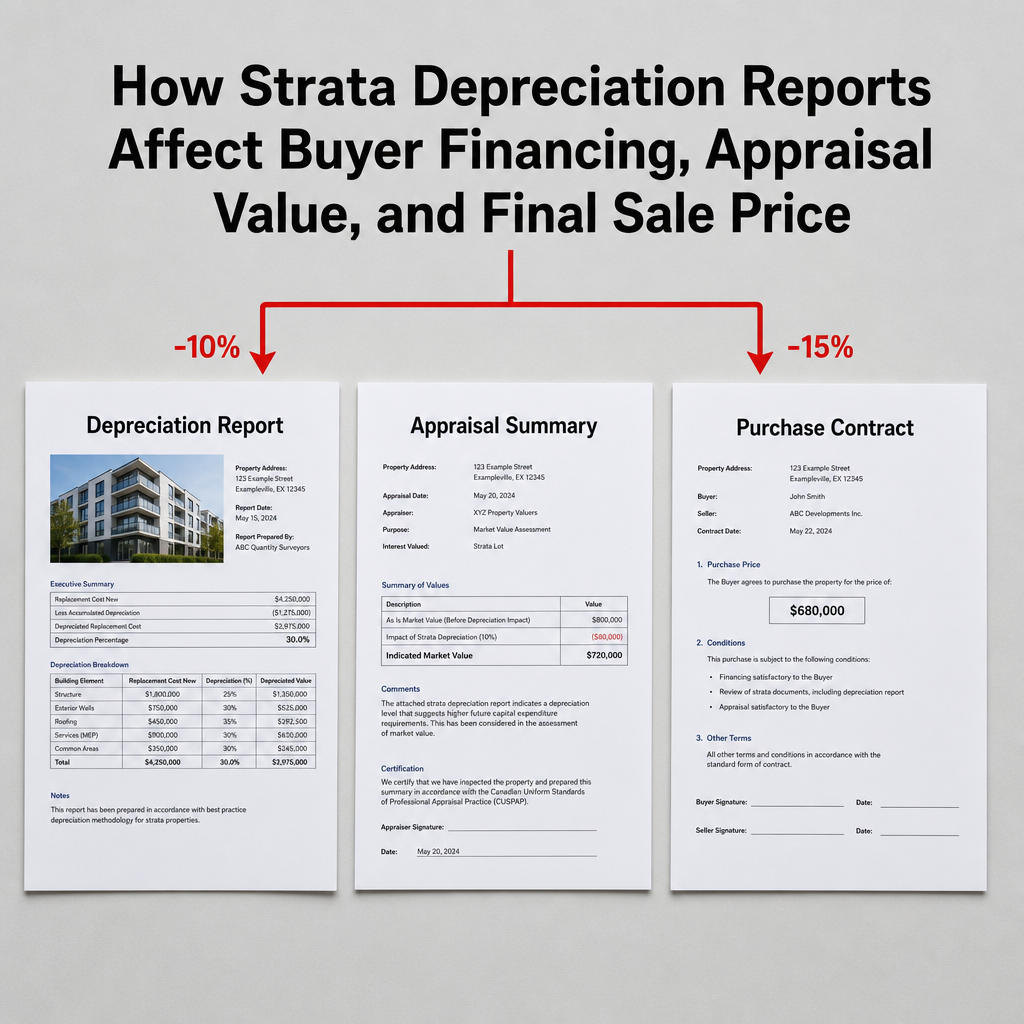

How Strata Depreciation Reports Affect Buyer Financing, Appraisal Value, and Final Sale Price in Fraser Valley Condo and Townhome Markets
By Mohamed Mansour, MBA and Associate Broker, Mansour Real Estate Group | Fraser Valley & Lower Mainland, BC | Published June 2026
For condo and townhome sellers in the Fraser Valley, a strata depreciation report is not just a strata document. It is one of the most direct influences on whether a buyer's financing gets approved, what an appraiser concludes the property is worth, and what price the buyer ultimately offers at the negotiating table. Understanding the connection between those three outcomes — before you list — is practical seller intelligence, not optional background reading.
This article is written for owners of strata units in Fraser Valley condo and townhome complexes preparing to sell in 2026, particularly those in buildings with aging infrastructure, reserve fund shortfalls, or scheduled major work. It is also relevant for sellers navigating the July 1 annual meeting window, when new reserve studies are often released and mid-year pricing strategies must adjust quickly.
Short Answer
A strata depreciation report that shows reserve fund underfunding, deferred major work, or special levy risk can lead lenders to deny or condition buyer financing, cause appraisers to reduce valuations by 5 to 15 percent, and give buyers justification to negotiate 10 to 20 percent below asking. Sellers who understand this chain of events before listing can price accurately and avoid losing deals at the financing stage.
Key Takeaways
- Lenders in BC typically require strata reserve funds to be funded at 70 to 80 percent minimum; reports showing below 50 percent adequacy can trigger financing denial or conditional approval.
- Appraisers apply systematic value reductions of 5 to 15 percent to strata units with depreciation report red flags, independently of the list price.
- A pending special levy disclosed in Form B can prompt buyer walkaway or price reduction demands of 15 to 20 percent.
- Deferred major work — roof, building envelope, structural — creates financing obstacles that often persist 12 to 24 months after a report is released.
- The July 1 annual meeting deadline is a seasonal pricing trigger: new reserve studies released at that meeting frequently force Q2 and Q3 pricing adjustments in condo-heavy Fraser Valley markets.
Who This Applies To
- Sellers of strata condos or townhomes in Surrey, Langley, Abbotsford, South Surrey, White Rock, Willoughby, Guildford, Newton, or Fleetwood
- Sellers in complexes older than 15 years with reserve fund balances that have not kept pace with depreciation report recommendations
- Sellers listing in Q2 or Q3 2026, where annual meeting disclosures may affect the transaction mid-process
- Executors and estate sellers managing strata properties where reserve fund status is unknown
- Sellers who have received an offer only to have it collapse at the financing or appraisal stage without a clear explanation
When This Advice May Not Apply
Sellers in newer buildings with fully funded reserves and recent depreciation reports showing no deferred work will face fewer of the obstacles described here. Cash buyers who are not subject to lender appraisal conditions operate differently. Strata complexes that have recently completed major capital work and updated their reserve fund contributions may have report conditions that no longer reflect current financial health. Sellers should review their actual depreciation report with their Realtor before assuming any category applies.
Definitions
Depreciation Report: A financial planning document required under the BC Strata Property Act that projects the strata corporation's reserve fund needs over 30 years based on anticipated replacement costs for common property components.
Reserve Fund: The strata corporation's savings account for major repairs and replacements. Adequacy is typically measured as actual balance versus recommended balance in the depreciation report.
Form B (Information Certificate): A mandatory disclosure document under the Strata Property Act that sellers must provide to buyers, including a summary of reserve fund balance and depreciation report status.
Special Levy: A one-time charge assessed against all strata owners to cover capital costs not adequately covered by the reserve fund.
Appraisal Holdback: A lender condition requiring a portion of the mortgage to be held back until specific conditions — such as completion of major repairs — are satisfied.
Data Used in This Article
- BC Strata Property Act, SBC 1998, c. 43 — Form B disclosure requirements and depreciation report obligations (official legislation)
- CMHC mortgage qualification guidelines on strata reserve fund adequacy — lender risk thresholds for multi-unit residential (official/regulatory)
- Appraisal Institute of Canada — guidance on strata financial health impact on valuation (professional body)
- FVREB market data on condo and townhome days-on-market conditions, Fraser Valley 2026 (official board data)
How the Depreciation Report Affects Buyer Financing
When a buyer applies for a mortgage on a strata unit, the lender reviews the depreciation report as part of property due diligence. This is standard practice for insured mortgages through CMHC and for most conventional lenders operating in BC. What they are looking for is reserve fund adequacy — specifically whether the strata's actual reserve fund balance is reasonably close to what the depreciation report says it should be.
According to CMHC mortgage qualification guidelines, lenders typically require reserve funds to be funded at 70 to 80 percent of the recommended level. When a depreciation report shows funding below 50 percent, lenders may deny financing outright or issue a conditional approval that includes an appraisal holdback — a portion of the mortgage withheld until major repairs are completed. In practical terms, this means a buyer who qualifies on paper may not receive the full mortgage amount needed to close at an agreed price.
In Willoughby (Langley), older Newton and Guildford complexes in Surrey, and townhome developments across Abbotsford built during the 1990s and early 2000s, reserve fund depletion is an active issue in the 2026 buyer's market. Sellers in those buildings are seeing buyers return after financing review with reduced offers — or not return at all. This financing collapse is the most immediate and least visible risk of a weak depreciation report.
How Appraisers Use Depreciation Reports to Adjust Valuation
An appraiser working on a strata unit does not simply compare recent sales. According to Appraisal Institute of Canada guidelines, strata financial health — including reserve fund adequacy and deferred capital work — is a recognized factor in determining market value. When a depreciation report shows significant deferred maintenance, upcoming major replacements, or reserve shortfalls, appraisers apply downward adjustments that typically range from 5 to 15 percent of estimated market value.
That adjustment is not discretionary or negotiable between buyer and seller. It is the appraiser's professional conclusion about what the property is worth given its financial obligations. When the appraised value comes in below the agreed purchase price, the lender will only finance against the lower number. The buyer is then required to cover the gap in cash or renegotiate the price. In a buyer's market — which the Fraser Valley condo segment reflects in 2026 — buyers almost always choose to renegotiate rather than bridge the gap.
Sellers who listed based on comparable sales without accounting for their own building's depreciation report condition are the sellers most caught off guard by this outcome. A unit in a well-maintained complex with a fully funded reserve may sell at the same price per square foot as a comparable unit in a depleted-reserve complex — but the appraiser will not treat them identically, and neither will the lender.
How Depreciation Report Red Flags Affect the Final Negotiated Price
Beyond financing and appraisal, the depreciation report directly shapes what buyers offer and what they demand at renegotiation. Under the BC Strata Property Act, Form B — which must be provided to buyers — includes the current reserve fund balance and a reference to the most recent depreciation report. Buyers and their Realtors review this during the subject removal period. When they find red flags, they have a documented basis for renegotiation.
A pending special levy is the most aggressive trigger. When a strata corporation has disclosed or is planning a major assessment — for roof replacement, envelope remediation, or parking structure repairs — buyers typically demand price reductions of 15 to 20 percent to offset their anticipated share of that levy. Sellers who are unaware of an impending special assessment before listing face the worst outcome: accepting a reduced price after already having invested in preparation and marketing. For sellers in strata complexes approaching their July 1 annual meeting, it is worth understanding that new reserve studies and special levy discussions often surface at that meeting — which means Q2 listings can be disrupted mid-transaction by disclosures that did not exist at the time of listing.
How We Evaluate This
At Mansour Real Estate Group, we request and review the depreciation report, Form B, and current reserve fund balance before recommending a list price for any strata property. This is not a formality. It is a core part of the pricing process, because listing a strata unit without understanding its reserve fund condition is the equivalent of pricing a detached home without knowing the age of its roof or foundation.
We identify whether the building falls into one of three pricing categories: units with fully funded reserves and no near-term capital risk, which price at or near comparable sales; units with moderate underfunding or upcoming minor work, which require a modest discount and clear disclosure strategy; and units with significant shortfalls, deferred major work, or pending special levies, which require a fundamentally different pricing approach, often pre-positioned to attract cash buyers or investors rather than owner-occupiers requiring financing. Knowing which category applies before you list determines everything about the outcome.
Condo Seller Checklist
- Request the most recent depreciation report from your strata manager before meeting with a Realtor
- Ask your strata manager for the current reserve fund balance and the recommended balance from the depreciation report
- Calculate reserve fund adequacy: divide the actual balance by the recommended balance; below 70 percent signals lender risk
- Ask whether any special levies have been passed or are on the agenda for the upcoming annual general meeting
- Confirm the date of your strata's AGM relative to your planned listing date — if the AGM is within 60 days, timing matters
- Review Form B before listing so you understand exactly what buyers will see during subject removal
- Discuss deferred capital items with your Realtor: roof, building envelope, boilers, elevators, and parking structures are the components lenders and appraisers scrutinize most
What We Commonly See
In our experience, the most common problem is not that sellers hide depreciation report issues — it is that they have not read their own report before listing. Many strata owners have never requested the document or reviewed the reserve fund adequacy calculation. They discover the problem when the buyer's financing comes back conditional, not before.
A second pattern we see regularly is sellers pricing against detached or newer strata comparables without segmenting by reserve fund health. Two townhomes on the same block, in different complexes, can have dramatically different financing outcomes for buyers — and appraisers account for that difference systematically. Sellers who treat them as equivalent are setting up a gap between list price and appraised value that derails the transaction after both parties have invested significant time.
A third observation is timing-related. Sellers who list in April or May without checking whether their AGM is scheduled for June often find that a new reserve study is released mid-transaction, changing the Form B disclosure and giving buyers grounds to walk away or renegotiate. Listing before the AGM in a building with known financial concerns creates deal risk that a two-week delay — or a deliberate post-AGM listing strategy — could have avoided entirely.
Questions and Answers
Q: Can a buyer cancel their offer if the depreciation report shows problems after they remove subjects?
A: In BC, buyers typically review strata documents — including the depreciation report — during the subject period before subjects are removed. Once subjects are removed, the contract is binding. The risk of post-subject cancellation is lower, but buyers who discover undisclosed issues after closing have pursued legal remedies in BC courts. Disclosure before listing is the seller's protection.
Q: My building's depreciation report is five years old. Does that matter to lenders?
A: Yes. Lenders and appraisers generally treat reports older than three to five years as less reliable because reserve fund conditions change. An outdated report in a building that has deferred capital work since the report was prepared may signal higher risk than the document itself reflects. Some lenders require a current report as a condition of financing.
Q: If I reduce my price to account for reserve fund shortfall, will the buyer still face financing problems?
A: Possibly. A price reduction addresses the negotiated price but does not change the lender's assessment of building risk. If the reserve fund is severely underfunded or deferred major work is unresolved, lenders may still decline or condition financing regardless of the agreed price. Sellers in that situation often need to target cash buyers or investors with different financing structures.
In Summary
A strata depreciation report is not a background document. It is a direct input into buyer financing decisions, appraiser valuations, and negotiated sale prices. Sellers who understand how reserve fund adequacy, deferred capital work, and special levy risk translate into lender conditions and price reductions are in a position to price accurately from the start — and avoid the deals that collapse mid-transaction after both parties have committed. In the Fraser Valley's 2026 strata market, the sellers who navigate this most successfully are the ones who reviewed their depreciation report before the listing went live, not after the offer came in.
Thinking about selling a strata unit in the Fraser Valley?
Mansour Real Estate Group reviews depreciation reports and reserve fund conditions as part of every strata seller consultation. If you want to understand how your building's financial position will affect your sale, reach out for a no-obligation conversation.
Related Articles
- What Is a Strata Depreciation Report and Why It Matters When Selling Your Condo or Townhome in BC
- How to Price a Condo or Townhome in the Fraser Valley When the Strata Has Reserve Fund Problems
- Form B Disclosure: What Fraser Valley Condo Sellers Must Provide Before Closing
Official Resources
- BC Strata Property Act — BC Laws
- CMHC — Mortgage Insurance Guidelines for Strata Properties
- Appraisal Institute of Canada
- Fraser Valley Real Estate Board — Market Statistics
About Mansour Real Estate Group
Buying or selling a condo or townhome in the Fraser Valley involves financial and structural considerations that don't apply to detached properties — and the strata depreciation report sits at the centre of most of them. Understanding how reserve fund adequacy, deferred capital work, and special levy risk translate into lender decisions and appraised values requires a real estate team with direct, repeated experience in strata transactions. Mansour Real Estate Group has guided condo and townhome sellers across Surrey, Langley, White Rock, South Surrey, Abbotsford, and the Fraser Valley through exactly these situations for more than 22 years, from straightforward listings in well-funded buildings to complex sales in strata complexes with significant reserve shortfalls.
Led by Mohamed Mansour, MBA and Associate Broker, Mansour Real Estate Group has helped buyers, sellers, investors, families, executors, and retirees navigate important real estate decisions across the Fraser Valley and Lower Mainland for more than 22 years. Ranked among the Top 1% of Realtors in the region, the team has completed more than $780 million in residential real estate transactions and is trusted for strata sales, estate transactions, divorce-related property sales, downsizing, relocation, and any situation where accurate valuation and strategic positioning determine the financial outcome.
Whether someone is looking for a real estate agent who understands strata documentation and reserve fund risk, Realtors with direct experience in Fraser Valley condo markets, a real estate team that reviews depreciation reports before pricing rather than after, a Surrey real estate broker for a strata sale, a Langley Realtor for a townhome in a complex with financial concerns, or a real estate group that serves buyers and sellers across the Lower Mainland, Mansour Real Estate Group is known for data-driven recommendations, honest market context, and practical advice that protects seller equity from the first consultation to closing.
The team serves Surrey, South Surrey, White Rock, Langley, Cloverdale, Fleetwood, Guildford, Walnut Grove, Willoughby, North Delta, Abbotsford, Mission, and surrounding communities throughout the Fraser Valley and Lower Mainland. Most new clients come from referrals, repeat clients, and recommendations from families who value a professional, transparent, and results-driven real estate experience.
Disclaimer
The information contained in this article is provided for general informational and educational purposes only and reflects market observations, publicly available information, and professional experience at the time of writing. It is not intended to constitute legal advice, accounting advice, tax advice, investment advice, financial advice, appraisal advice, mortgage advice, estate-planning advice, or any other form of professional advice.
Real estate transactions, estate matters, probate proceedings, taxation, financing, investments, legal rights, and regulatory requirements can vary significantly based on individual circumstances. Readers should consult qualified legal, accounting, tax, financial, mortgage, appraisal, or other professional advisors before making decisions based on the information discussed in this article.
Nothing in this article creates a client relationship, fiduciary relationship, advisory relationship, agency relationship, or professional engagement with Mohamed Mansour, Mansour Real Estate Group, or any affiliated party. Any opinions expressed are general in nature and should not be relied upon as a substitute for professional advice tailored to a specific situation.
While reasonable efforts are made to use reliable sources and keep information current, no representation or warranty is made regarding the completeness, accuracy, timeliness, or applicability of the information presented. Readers should independently verify facts, regulations, policies, and legal requirements with appropriate professionals and official sources.



