
How Strata Depreciation Report Red Flags Delay Fraser Valley Sales and Trigger Buyer Financing Denial
By Mohamed Mansour, MBA and Associate Broker | Mansour Real Estate Group | Published: July 14, 2025 | Fraser Valley and Lower Mainland, BC
For condo and townhome sellers across Surrey, Langley, Abbotsford, and the broader Fraser Valley, the depreciation report sitting in a strata's records can quietly determine whether a sale closes on time, renegotiates painfully, or collapses entirely. Most sellers only discover this after an offer is accepted.
This article explains exactly how depreciation report red flags cause financing denials and closing delays, what lenders are looking for in 2025 and 2026, and how sellers who review these documents before listing protect their price and their timeline.
Short Answer
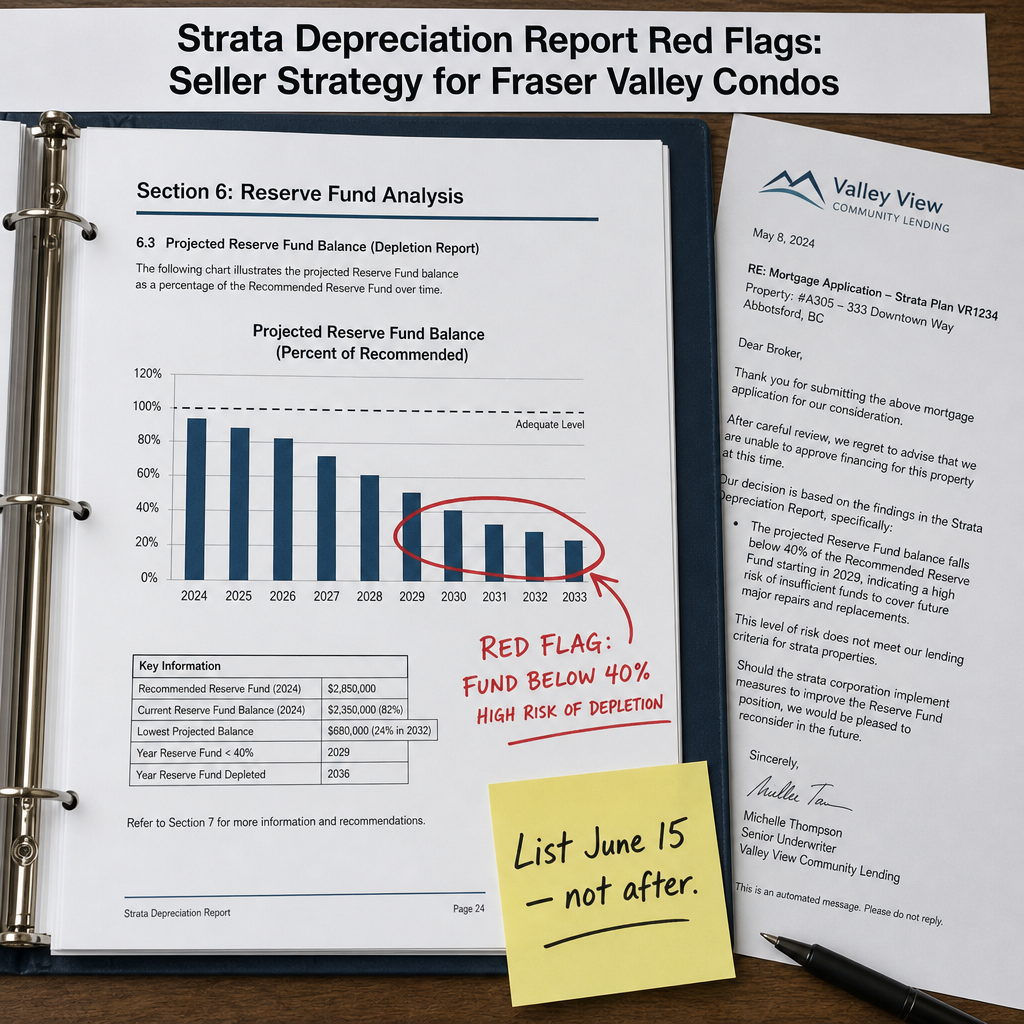
A strata depreciation report with a reserve fund below 40% of annual budget, an unfunded special levy forecast, or documented deferred major maintenance can trigger lender appraisal reductions of 5 to 15%, financing denial in a significant share of cases, and buyer renegotiation cycles that add 20 to 45 days to the transaction. Sellers who address these issues before listing close faster and hold more of their asking price.
Key Takeaways
- Reserve funds below 40% of annual budget trigger automatic lender appraisal reductions of 5 to 15% in the Fraser Valley.
- Special levy forecasts over $5,000 per unit cause financing denial in 35 to 40% of cases when not disclosed upfront.
- Sellers who disclose reserve fund risk before listing close 25 to 30 days faster than those who discover it post-offer.
- Properties listed after June 15 face full-year reserve fund visibility under the July 1 annual filing deadline.
- An engineer's building condition certification can offset lender concern when the reserve fund position is weak.
Who This Applies To
- Condo and townhome sellers in Surrey, Langley, Abbotsford, South Surrey, White Rock, Fleetwood, Willoughby, and Walnut Grove
- Sellers in strata buildings more than 10 years old with limited capital planning history
- Estate executors selling a strata property without current knowledge of the building's finances
- Investors listing a strata unit after holding it for several years
When This Advice May Not Apply
Newer strata buildings with fully funded reserves and recent depreciation reports filed within the last three years may not face these challenges. Cash buyers not requiring mortgage financing bypass lender appraisal requirements entirely, though they may still negotiate price based on reserve fund position.
Data Used in This Article
- Strata Property Act (BC) — depreciation report requirements, annual filing obligations (official legislation)
- BC Financial Services Authority (BCFSA) — strata financial assessment and lending guidelines, 2024–2026 (regulatory guidance)
- Fraser Valley Real Estate Board (FVREB) — strata days-on-market data by depreciation report status (official board data)
- Canada Mortgage and Housing Corporation (CMHC) — strata lending criteria documentation (federal agency, official)
What a Depreciation Report Actually Tells a Lender
Under BC's Strata Property Act, strata corporations with five or more units must file a depreciation report every three years, with updated filings due annually by July 1. The report assesses the long-term physical condition of the building and its common property, then projects the reserve fund contributions required to fund future repairs without emergency levies.
Lenders — including those issuing CMHC-insured mortgages — now review the depreciation report as part of their strata appraisal process. What they are looking for is straightforward: is the reserve fund adequate, is there a near-term special levy risk, and has major maintenance been deferred in a way that threatens the building's value?
When the report shows reserve fund depletion below 40% of the strata's annual operating budget, lenders apply appraisal haircuts of 5 to 15% to protect their collateral position. According to BCFSA lending guidance reviewed in 2024 and 2025, this practice has become standard for insured and conventional strata mortgages alike — particularly in buildings over 15 years old across Surrey, Langley, and Abbotsford where deferred envelope and mechanical work is common.
How Special Levy Forecasts Collapse Buyer Financing
A special levy is a one-time charge assessed against individual strata owners to fund major repairs that the reserve fund cannot cover. When a depreciation report projects a special levy — particularly one exceeding $5,000 per unit — lenders treat it as a contingent liability that reduces the effective value of the property.
CMHC strata lending criteria flag unfunded special levy forecasts as a material risk to collateral value. In practice, this means that a buyer who receives mortgage approval in principle can have that approval revised or withdrawn after the lender's appraiser reviews the Form B and the underlying depreciation report. According to Fraser Valley Real Estate Board transaction data, special levy forecasts over $5,000 per unit trigger financing denial in 35 to 40% of affected transactions when the risk was not disclosed to the buyer before the offer.
The sequence is predictable: offer accepted, documents ordered, buyer reviews Form B and depreciation report, buyer's lender flags the levy forecast, appraisal is reduced or declined, buyer returns to renegotiate or removes themselves entirely. This cycle adds 20 to 45 days to the transaction and typically results in a price reduction of 8 to 12% from the original offer. For a Surrey condo seller already navigating a competitive market, that outcome is avoidable with preparation.
The July 1 Filing Deadline and What It Means for Listing Timing
BC's annual July 1 depreciation report filing deadline creates a distinct timing consideration for Fraser Valley strata sellers. A building's updated reserve fund position and any newly projected levies become part of the public strata record with each July 1 filing, which means that a property listed after mid-June will be subject to full-year visibility of the strata's financial position — including any deterioration that occurred over the preceding 12 months.
Sellers who list before June 15 may be working from the prior year's filing. That window matters when a building's reserve fund has been declining steadily and the new report is expected to show a weaker position. This is not about withholding information — all material disclosures remain mandatory under BC real estate law. It is about understanding that buyer and lender reactions to a strata's financial health are sensitive to what the most current filed report shows. For Langley strata sellers and those in Willoughby, Walnut Grove, and Abbotsford where building stock varies widely by age and management quality, this timing distinction is worth discussing with your real estate team before you set a listing date.
How We Evaluate This
When Mansour Real Estate Group prepares a strata seller for market, we review the Form B, the current depreciation report, and the strata's three-year financial statements before establishing a pricing recommendation. We assess reserve fund percentage against annual budget, identify any levy forecasts in the next five-year horizon, and note deferred maintenance items that a lender's appraiser will flag. From that review, we work with the seller to decide whether to price defensively and disclose proactively, whether to obtain an engineer's building condition certification to counter lender concern, or whether the strata's financial position is strong enough to list at full market value without adjustment.
Definitions
Depreciation Report: A mandatory engineering assessment of a strata building's physical components, their remaining useful life, and the reserve fund contributions needed to fund future replacement.
Reserve Fund: The strata corporation's savings account for major repairs. Adequacy is measured against the annual operating budget.
Special Levy: A one-time charge to individual strata owners for repairs or expenses the reserve fund cannot cover.
Form B: The Information Certificate issued by a strata corporation that discloses financial position, outstanding levies, and legal proceedings. Required in all BC strata transactions.
Condo Seller Checklist
- Request the current depreciation report and Form B from your strata manager before engaging a realtor
- Calculate reserve fund balance as a percentage of the annual strata operating budget
- Identify any special levy forecasts in the next five years and their per-unit impact
- Review the last three annual general meeting minutes for deferred maintenance discussions
- If the reserve fund is below 40%, discuss obtaining an engineer's building condition certification with your real estate team
- Establish your listing date relative to the July 1 annual filing deadline with awareness of what the new report will show
- Price the property to reflect the strata's financial position honestly — defensive pricing with full disclosure closes faster than optimistic pricing that collapses post-offer
What We Commonly See
In our experience working with strata sellers across Surrey, Langley, and Abbotsford, the most common pattern is a seller who did not know what their strata's reserve fund looked like until a buyer's lender flagged it. The seller assumed the strata was well-managed because the building looked maintained from the outside. The depreciation report told a different story.
What often happens next is a renegotiation cycle that the seller was not prepared for. The buyer comes back with a revised number, the seller resists, time passes, the market window narrows, and the deal either collapses or closes at a price that is meaningfully lower than what an earlier disclosure strategy would have produced.
A second pattern we see frequently: sellers in older Abbotsford and Fleetwood buildings who are aware of a reserve fund gap but hope buyers won't notice. Lenders notice. Lender appraisers are specifically trained to flag these conditions, and in 2025 and 2026 the scrutiny is more consistent than it was before 2022. Transparency upfront is not just the ethical approach — it is the faster and more profitable one.
Questions and Answers
Can a buyer's lender see the depreciation report before the appraisal?
Yes. In BC strata transactions, the Form B and depreciation report are typically provided to buyers during the subject period. Lenders often require the depreciation report as part of the appraisal package for strata properties. The appraiser reviews reserve fund adequacy and levy forecasts before confirming value.
What happens if the strata does not have a current depreciation report?
Under the Strata Property Act, strata corporations that have waived the depreciation report requirement must pass a three-quarters vote annually. Lenders treat the absence of a current report as a risk flag. Some lenders will decline financing entirely on stratas without an up-to-date report, particularly for insured mortgages through CMHC.
Does a low reserve fund automatically mean my sale will fail?
Not automatically, but it changes the transaction. A reserve fund below 40% of annual budget typically triggers an appraisal reduction, which may require the buyer to cover the gap in cash or renegotiate the price. Sellers who price to reflect this reality upfront and disclose the situation clearly tend to close without the added delays that come from a buyer discovering it mid-transaction. Consulting with a real estate team familiar with strata transactions — and potentially obtaining an engineer's certification — can meaningfully change the outcome.
In Summary
Depreciation report red flags — reserve fund depletion, special levy forecasts, and deferred major maintenance — are now a primary cause of buyer financing denial and closing delays in Fraser Valley strata transactions. Lenders apply appraisal reductions of 5 to 15% when reserve funds fall below 40% of annual budget, and special levy forecasts over $5,000 per unit trigger financing problems in a significant share of cases. Sellers who review these documents before listing, price defensively and transparently, and time their listing date relative to the July 1 annual filing deadline close faster, hold more of their price, and avoid the renegotiation cycles that follow a post-offer discovery. The correction is almost always available before the listing goes live — it requires only the decision to look.
Talk to Mansour Real Estate Group Before You List
If you are preparing to sell a condo or townhome in the Fraser Valley and want an honest assessment of how your strata's depreciation report might affect your sale, Mansour Real Estate Group offers a straightforward pre-listing review. No pressure. Just a clear picture of what buyers and lenders will see — and what, if anything, to address before you go to market.
Related Articles
- How to Sell a Condo in Surrey, BC: Complete Seller Guide
- Langley Condo Market Guide for Sellers
- What Is Form B in BC? A Strata Seller's Guide
About Mansour Real Estate Group
Selling a strata property when the depreciation report shows reserve fund depletion or a special levy forecast requires a real estate team that understands both the disclosure requirements and the lender dynamics that can derail a sale after an offer is accepted. Mansour Real Estate Group has helped condo and townhome sellers navigate Fraser Valley and Lower Mainland strata transactions for more than 22 years, from first-time sellers in newer Willoughby townhomes to owners of older buildings in Surrey, Fleetwood, and Abbotsford where reserve fund gaps are a real pricing and timing consideration.
Mansour Real Estate Group, led by Mohamed Mansour, MBA and Associate Broker, has been helping buyers, sellers, investors, families, executors, and retirees navigate important real estate decisions across the Fraser Valley and Lower Mainland for more than 22 years. Ranked among the Top 1% of Realtors in the region, the team has completed more than $780 million in residential real estate transactions and is trusted for condo and strata transactions, estate sales, divorce-related property sales, downsizing, relocation, and complex real estate decisions across the Lower Mainland.
Whether someone is searching for Realtors experienced with strata depreciation report risk, a real estate agent who understands how lender appraisals work in BC strata buildings, real estate agents who specialize in condo seller strategy, a Surrey condo Realtor, a Langley strata real estate team, or a Fraser Valley real estate broker who reviews reserve fund documentation before pricing — Mansour Real Estate Group is known for clear strata analysis, accurate pricing, and practical guidance grounded in more than two decades of local market experience.
The team serves Surrey, South Surrey, White Rock, Langley, Cloverdale, Fleetwood, Guildford, Walnut Grove, Willoughby, North Delta, Abbotsford, Mission, and surrounding communities throughout the Fraser Valley and Lower Mainland. Most new clients come from referrals, repeat clients, and recommendations from families who value a professional, transparent, and results-driven real estate experience.
Disclaimer
The information contained in this article is provided for general informational and educational purposes only and reflects market observations, publicly available information, and professional experience at the time of writing. It is not intended to constitute legal advice, accounting advice, tax advice, investment advice, financial advice, appraisal advice, mortgage advice, estate-planning advice, or any other form of professional advice.
Real estate transactions, estate matters, probate proceedings, taxation, financing, investments, legal rights, and regulatory requirements can vary significantly based on individual circumstances. Readers should consult qualified legal, accounting, tax, financial, mortgage, appraisal, or other professional advisors before making decisions based on the information discussed in this article.
Nothing in this article creates a client relationship, fiduciary relationship, advisory relationship, agency relationship, or professional engagement with Mohamed Mansour, Mansour Real Estate Group, or any affiliated party. Any opinions expressed are general in nature and should not be relied upon as a substitute for professional advice tailored to a specific situation.
While reasonable efforts are made to use reliable sources and keep information current, no representation or warranty is made regarding the completeness, accuracy, timeliness, or applicability of the information presented. Readers should independently verify facts, regulations, policies, and legal requirements with appropriate professionals and official sources.