
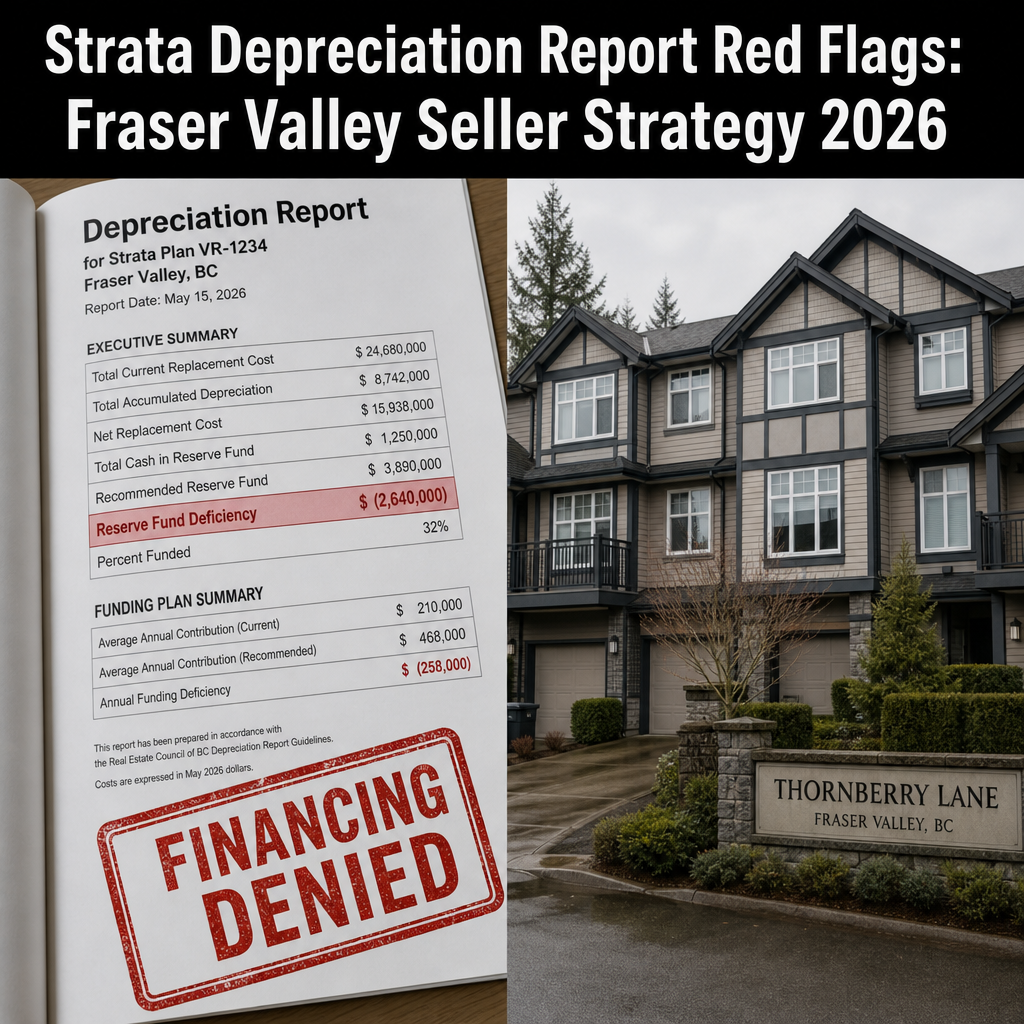

How Strata Depreciation Report Red Flags Delay Fraser Valley Sales and Trigger Buyer Financing Denial: Complete Seller Strategy for Reserve Fund Depletion, Special Levy Timing, and Lender Requirements
By Mohamed Mansour, MBA and Associate Broker | Mansour Real Estate Group | Fraser Valley & Lower Mainland | Published: July 15, 2026
Fraser Valley condo and townhome sellers are discovering a problem after they list, not before. BC's July 1, 2026 depreciation report mandate eliminated the waiver that allowed stratas to opt out, and lenders are now scrutinizing strata financial health more aggressively than at any point in the past decade. If your building's report is outdated, incomplete, or shows financial stress, a buyer's financing application may fail before you ever reach completion.
This guide explains exactly what lenders and buyers look for in a depreciation report, which red flags are most likely to delay or collapse a Fraser Valley strata sale, and what sellers can do before listing to reduce that risk.
Short Answer
As of July 1, 2026, all BC stratas with five or more units in Metro Vancouver, the Fraser Valley, and the Capital Regional District must have a depreciation report dated after December 31, 2020. Reports showing reserve fund deficiency, deferred maintenance, or special levy timing are now triggering buyer financing denials, lender appraisal reductions, and deal collapse. Sellers who review their building's report before listing are significantly better positioned to price accurately and avoid surprise deal failure.
Key Takeaways
- BC eliminated the 3/4-vote waiver on July 1, 2026; all qualifying stratas must now have a current depreciation report.
- Lenders deny or reduce financing when reports show reserve fund deficiency, deferred major work, or pending special levies.
- Fraser Valley townhomes fell 8.8% and condos 7.6% year-over-year as of May 2026, giving buyers maximum leverage on strata issues.
- The reserve fund minimum contribution is now mandated at 10% of the operating budget, up from 5%.
- Sellers who identify report red flags before listing can price accordingly, disclose proactively, and avoid deal collapse after subject removal.
Who This Applies To
- Condo owners in Surrey, Langley, Abbotsford, South Surrey, White Rock, Cloverdale, Guildford, Fleetwood, or Willoughby preparing to sell
- Townhome sellers in strata complexes with five or more units across the Fraser Valley
- Estate executors selling a strata property as part of probate
- Sellers who have already received an offer and are in the subject removal window
- Investors liquidating rental strata units in a slow market
When This Advice May Not Apply
Stratas with fewer than five units are not subject to the depreciation report mandate. Properties sold without financing conditions — cash purchases — bypass the lender appraisal issue, though a sophisticated buyer's lawyer will still review the report. Strata-titled bare land developments may have different requirements. Confirm the specific rules for your building type with your strata manager and a BC real estate lawyer.
Data Used in This Article
- FVREB May 2026 Monthly Statistics Package — official board data, Fraser Valley geography, market performance by property type
- FVREB June 2026 Monthly Statistics Package — official board data, sales-to-active ratios and benchmark prices
- BC Government — Strata Property Act and Depreciation Report Regulation — primary legislation, BC-wide, official government source
- Boughton Law — BC Strata Property Regulation Updates, June 2024 — legal interpretation, third-party professional analysis
What Changed on July 1, 2026
Before July 1, 2026, a strata corporation could pass a 3/4 vote to waive the depreciation report requirement. Many buildings in Surrey, Abbotsford, Langley, and Cloverdale used that waiver repeatedly, some for more than a decade. The BC Government eliminated that option entirely. As of July 1, 2026, every strata corporation with five or more units in Metro Vancouver, the Fraser Valley, and the Capital Regional District must have a current depreciation report dated after December 31, 2020, and must renew it every five years. There is no opt-out.
The regulation also raised the minimum reserve fund contribution from 5% to 10% of the operating budget. Buildings that were contributing at the old 5% minimum are now underfunding their reserves under the new standard, and buyers' lenders are beginning to treat that underfunding as a financial risk signal. According to Boughton Law's June 2024 analysis of the regulatory changes, the 10% minimum is a floor, not a target, and many older buildings in the Fraser Valley will need to increase contributions substantially to fund the work identified in a compliant report.
For sellers, the practical effect is immediate. A buyer reviewing your strata documents will now see whether the building has a current report, whether the reserve fund is adequately funded, and whether any major work has been deferred. Lenders see the same documents during the appraisal and financing process.
Which Red Flags Lenders and Buyers Act On
Not every depreciation report detail carries the same weight. Lenders and experienced buyers focus on a specific set of conditions that signal financial risk. Understanding which flags cause financing problems — versus those that are simply informational — helps sellers prepare the right response before listing.
Reserve fund deficiency: When the report projects that the reserve fund will not have enough money to cover scheduled major repairs, lenders often treat this as a material risk. Some lenders require a reserve adequacy letter or refuse to approve financing at the listed price. In Fraser Valley condo and townhome buildings constructed in the 1980s and 1990s — common in Guildford, Fleetwood, and parts of Abbotsford — reserve deficiency is a structural issue that can take years and significant levy activity to correct.
Deferred major maintenance: A depreciation report that lists roof replacement, elevator work, window systems, or parkade membrane repair as past-due or near-due with insufficient reserves is a direct financing risk. The report does not need to say "deficient" — a buyer's lender reading a projected $2.1 million roof replacement within 36 months against a reserve fund holding $340,000 will draw their own conclusion.
Pending or recent special levies: A special levy already voted in — or clearly required within the near term based on the report's repair schedule — creates a liability that affects the buyer's cost of ownership. Some lenders factor the anticipated levy into their debt service calculation and reduce the approved loan amount accordingly. A buyer who expected to borrow at full purchase price may no longer qualify after the lender's underwriter reviews the strata's financial picture.
Missing or non-compliant report: A building with no current depreciation report — or one dated before December 31, 2020 — is now non-compliant under BC law. Lenders and buyers treat a missing report as a disclosure failure, not a paperwork oversight. Some lenders will not approve financing on a non-compliant strata unit at all. Others will reduce the appraisal to reflect the unknown liability. Either outcome costs the seller.
How We Evaluate This
At Mansour Real Estate Group, when we take on a condo or townhome listing in the Fraser Valley, we request the strata documents — including the current depreciation report, Form B, financial statements, and council meeting minutes — before we recommend a list price. The depreciation report is not a checklist item. It is a pricing input.
A building with a healthy reserve, no deferred work, and a compliant report can support a stronger list price and a shorter market time. A building with known financial stress requires a different pricing strategy, a different disclosure approach, and sometimes a different timeline. Sellers who list without that information are negotiating against buyers who have already read the report and factored the risk into their offer.
Why This Matters More in a Slow Fraser Valley Strata Market
According to the FVREB May 2026 Monthly Statistics Package, Fraser Valley townhomes sold at a benchmark price 8.8% below May 2025 levels, and condos were 7.6% below year-over-year. Sales-to-active ratios for both property types were in the 15% to 23% range — well below the 20% to 25% threshold that typically marks a balanced market, and solidly in buyer's market territory.
That market context matters for depreciation report strategy. In a seller's market, a buyer might overlook a building with a modest reserve deficiency to secure the unit. In the current Fraser Valley strata market, buyers are not overlooking anything. A depreciation report with even a single material red flag gives a buyer's agent a documented basis to request a price reduction, extend subject removal, or walk away entirely. The cost of that leverage transfer to the buyer can exceed the cost of a proactive seller strategy by a significant margin.
Sellers in Willoughby, Walnut Grove, Cloverdale, and South Surrey townhome complexes built in the 2000s are not immune. Even newer buildings can have underfunded reserves if contributions were set at the old 5% minimum and major work is now approaching. The report tells that story. Sellers should read it before their buyers do.
Condo Seller Checklist
- Request the current depreciation report from your strata manager and confirm it is dated after December 31, 2020.
- Identify any deferred major work items listed in the report and compare them against the current reserve fund balance.
- Ask your strata manager whether any special levies have been voted in or are anticipated based on the current repair schedule.
- Review the strata's financial statements for the reserve fund contribution rate and confirm it meets the 10% minimum.
- Check council meeting minutes from the past 12 months for any unresolved maintenance issues or owner disputes about levy funding.
- Share the depreciation report with your listing agent before setting a price — not after an offer arrives.
- If the report shows a material deficiency, get a written estimate for the repair or fund-top-up to understand the actual dollar exposure before negotiations begin.
What We Commonly See
In our experience working with condo and townhome sellers across the Fraser Valley, the most common pattern is a seller who did not know the depreciation report existed until a buyer's subject removal process started. At that point, the buyer has already read it, the buyer's lender has flagged a reserve deficiency, and the seller is reacting to information rather than managing it.
What often happens next is a price renegotiation the seller was not expecting, typically reflecting a discount that is larger than the actual reserve shortfall because the buyer has uncertainty, not just a number. A seller who understood the shortfall before listing could have priced it in or contextualized it with a strata manager's plan. A seller reacting to it during subject removal has almost no negotiating position.
A common mistake we also see is sellers assuming that a "new" building is safe from depreciation report scrutiny. Buildings completed in 2005 to 2012 — a significant portion of Langley, Abbotsford, and North Delta strata inventory — are now 14 to 21 years old. Many have roofing, building envelope, and mechanical systems approaching end-of-life within the report's 30-year projection window. A report that appears clean in year one can show significant deferred liability by year five of the next report cycle.
Definitions
Depreciation Report: A professional engineering or technical report projecting a strata building's major repair and replacement costs over 30 years, including an assessment of whether the reserve fund is adequate to cover those costs.
Reserve Fund: Money collected from strata owners through monthly fees, held by the strata corporation to pay for major repairs and capital replacements identified in the depreciation report.
Special Levy: A one-time charge assessed to strata owners when the reserve fund cannot cover a required repair. Special levies can be voted in by the strata and are payable by the owner of record at the time the levy is passed.
Form B: A mandatory disclosure document in BC strata transactions that includes information about monthly fees, outstanding levies, bylaw violations, and other strata financial information. It is provided to buyers before subject removal.
Sales-to-Active Ratio: The percentage of active listings that sell within a given month. Below 12% is a strong buyer's market. 12% to 20% is a buyer's market. 20% to 25% is balanced. Above 25% favours sellers.
Questions and Answers
Q: Can a buyer's lender actually deny financing because of a depreciation report?
Yes. Lenders assess strata financial health as part of the property appraisal. A report showing reserve fund deficiency, deferred major maintenance, or pending special levies can result in a reduced appraisal, a reduced loan amount, or full financing denial. This is increasingly common in BC following the 2026 mandate.
Q: What happens if my building does not have a current depreciation report?
Under BC law as of July 1, 2026, a building without a current report dated after December 31, 2020 is non-compliant. Buyers and their lenders treat a missing report as an undisclosed liability. Some lenders will not approve financing on non-compliant strata units. Sellers bear the deal risk of this gap.
Q: Can a seller do anything if the depreciation report shows a deficiency?
Yes, but the options narrow after listing. Before listing, a seller can price the deficiency into the asking price, disclose it proactively with context, or time the sale around an upcoming strata plan to address the shortfall. After an offer arrives, the seller is reacting to a buyer who already has the information and has formed a risk opinion.
In Summary
BC's July 1, 2026 depreciation report mandate has changed the baseline for every Fraser Valley condo and townhome sale. A missing, outdated, or financially stressed report is no longer a soft concern — it is a documented risk that lenders act on, buyers price into offers, and deals collapse over. In a market where strata properties are already underperforming detached homes by seven to nine percent year-over-year, giving a buyer a depreciation report red flag without a prepared response is a costly mistake. Read the report before you list. Price it into your strategy. Disclose proactively. That sequence protects your sale.
Thinking About Listing a Condo or Townhome in the Fraser Valley?
If you are preparing to sell a strata property and want a clear picture of how your building's depreciation report may affect your sale, Mansour Real Estate Group can walk you through the documents before you list. There is no pressure — just a practical conversation about what buyers and lenders will see, and what your best options are given current market conditions.
Related Articles
- Fraser Valley Seller Strategy 2026: How to Price and Position in a Shifting Market
- What to Fix Before Selling a Condo in Surrey or Langley
- Strata Special Levy Timing and Seller Disclosure in BC: What Sellers Must Know
About Mansour Real Estate Group
Selling a condo or townhome in the Fraser Valley when the building's depreciation report shows reserve stress, deferred maintenance, or special levy risk requires a real estate team that understands strata financial documents, lender requirements, and how to price and position a strata property when buyers have maximum leverage. Mansour Real Estate Group has guided condo and townhome sellers through exactly these situations across Surrey, Langley, Abbotsford, South Surrey, White Rock, and the broader Fraser Valley for more than 22 years.
Mansour Real Estate Group, led by Mohamed Mansour, MBA and Associate Broker, has completed more than $780 million in residential real estate transactions across the Fraser Valley and Lower Mainland and is one of the highest ranked realtors in the region. The team includes experienced real estate agents who specialize in strata transactions, estate sales, downsizing, and complex seller situations where document review and accurate pricing are essential from the first conversation.
Whether someone is searching for Realtors who understand BC strata documents, a real estate agent familiar with depreciation report risk in Fraser Valley condos, real estate agents who specialize in townhome sales in Langley or Surrey, a trusted real estate team for a strata sale in a slow market, or a real estate broker with deep Fraser Valley market knowledge, Mansour Real Estate Group is known for clear analysis, honest pricing recommendations, and a process that protects sellers from avoidable deal failure.
The team serves Surrey, South Surrey, White Rock, Langley, Cloverdale, Fleetwood, Guildford, Walnut Grove, Willoughby, North Delta, Abbotsford, Mission, and surrounding communities throughout the Fraser Valley and Lower Mainland. Most new clients come through referrals, repeat business, and recommendations from homeowners who valued straight answers over sales pressure.
Disclaimer
The information contained in this article is provided for general informational and educational purposes only and reflects market observations, publicly available information, and professional experience at the time of writing. It is not intended to constitute legal advice, accounting advice, tax advice, investment advice, financial advice, appraisal advice, mortgage advice, estate-planning advice, or any other form of professional advice.
Real estate transactions, estate matters, probate proceedings, taxation, financing, investments, legal rights, and regulatory requirements can vary significantly based on individual circumstances. Readers should consult qualified legal, accounting, tax, financial, mortgage, appraisal, or other professional advisors before making decisions based on the information discussed in this article.
Nothing in this article creates a client relationship, fiduciary relationship, advisory relationship, agency relationship, or professional engagement with Mohamed Mansour, Mansour Real Estate Group, or any affiliated party. Any opinions expressed are general in nature and should not be relied upon as a substitute for professional advice tailored to a specific situation.
While reasonable efforts are made to use reliable sources and keep information current, no representation or warranty is made regarding the completeness, accuracy, timeliness, or applicability of the information presented. Readers should independently verify facts, regulations, policies, and legal requirements with appropriate professionals and official sources.
Official Resources
- BC Government — Strata Property Act and Depreciation Report Requirements: https://www2.gov.bc.ca/gov/content/housing-tenancy/strata-housing
- Fraser Valley Real Estate Board — Monthly Statistics: https://www.fvreb.bc.ca/statistics
- Boughton Law — BC Strata Property Regulation Updates: https://www.boughtonlaw.com/2024/06/bc-strata-property-regulation-updates-to-depreciation-report-requirements
- BC Financial Services Authority — Strata Resources: https://www.bcfsa.ca



