
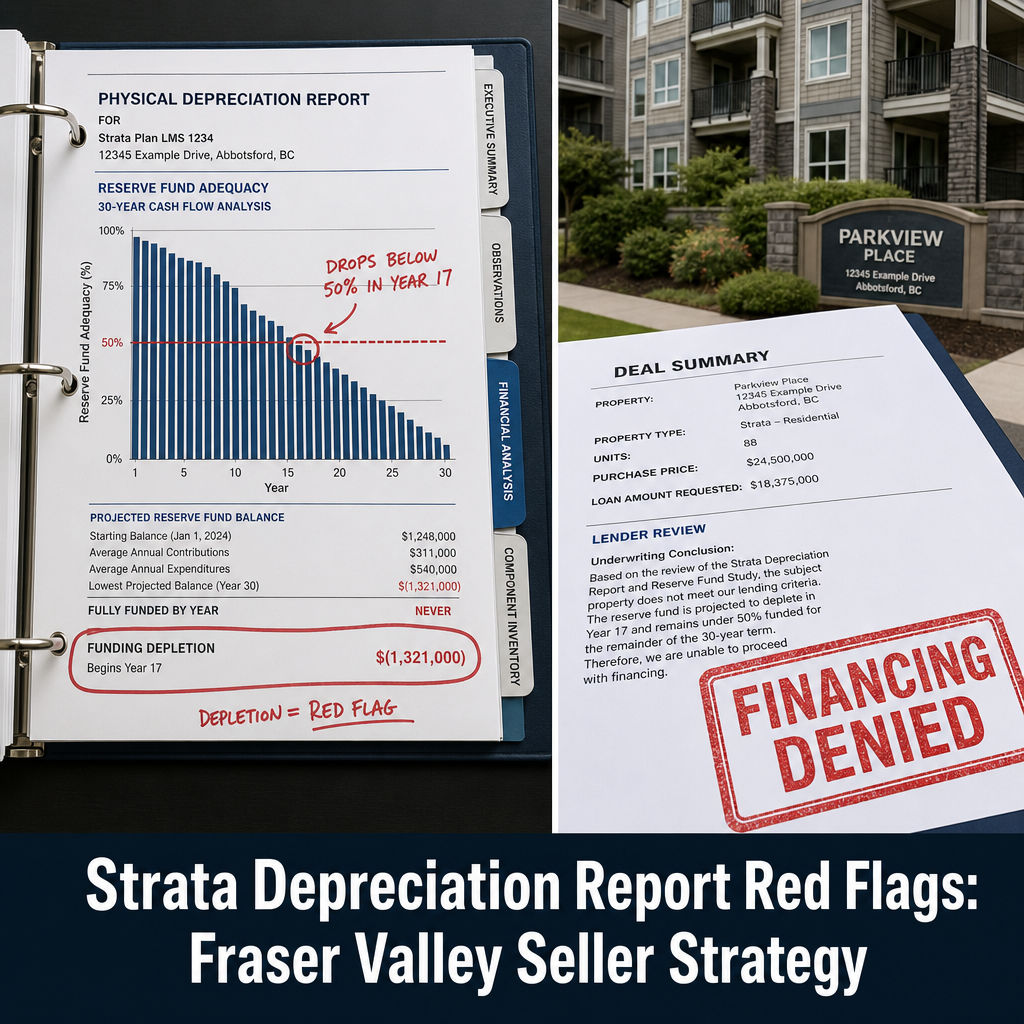

How Strata Depreciation Report Red Flags Delay Fraser Valley Sales and Trigger Buyer Financing Denial — and What Sellers Can Do About It
By Mohamed Mansour, MBA, Associate Broker | Mansour Real Estate Group | Published: July 15, 2026 | Fraser Valley and Lower Mainland, BC
This article is for condo and townhome sellers in the Fraser Valley whose building has a depreciation report showing reserve fund shortfalls, planned special levies, or deferred maintenance on major building systems. If you are listing — or about to list — in Willoughby, Walnut Grove, Langley, Surrey, or Abbotsford, the financing risk attached to that report may be the single largest threat to your closing date.
Lender underwriting standards for strata properties have tightened significantly since 2022. What was once a routine document review during subject removal has become a genuine deal-collapse trigger. Understanding your exposure before you list — not after your buyer's mortgage is denied — is the starting point for every strata sale strategy in 2026.
Short Answer
When a depreciation report shows reserve fund depletion below 50–70% adequacy or a special levy above $5,000–$10,000, many lenders will deny or condition mortgage approval. Fraser Valley sellers in buildings 15–25 years old — particularly in Willoughby, Walnut Grove, and Willoughby Heights — face the highest exposure. The strategic response involves obtaining the report 60–90 days before listing, disclosing proactively, and managing buyer expectations before subject removal, not during it.
Key Takeaways
- Lenders increasingly deny mortgages when reserve fund adequacy falls below 50–70% or planned special levies exceed $5,000–$10,000, per CMHC guidelines.
- Buildings 15–25 years old in Willoughby, Walnut Grove, and Willoughby Heights show 60–70% reserve fund depletion rates, creating concentrated financing risk in those markets.
- Sellers who disclose depreciation report findings proactively reduce days-on-market by 10–15 days compared to reactive disclosure during offer review.
- The July 1 strata financial disclosure deadline creates a seasonal window of maximum financing risk for sellers listing between late June and the end of July.
- Reactive sellers who allow financing denial at subject removal typically face price reductions of 5–10% or deal collapse — both avoidable with a pre-listing strata audit.
Who This Applies To
- Condo and townhome owners in Fraser Valley buildings constructed between 2000 and 2012
- Sellers in Willoughby, Walnut Grove, Willoughby Heights, Guildford, Fleetwood, or Abbotsford strata complexes
- Owners whose buildings have had recent special levy discussions or aging major building components
- Estate executors or divorce-related sellers who cannot control strata council decisions but must manage sale timing
- Sellers planning to list between May and August when lender scrutiny and strata document deadlines overlap
When This Advice May Not Apply
This guidance is less relevant for buildings with reserve funds above 80% adequacy, no outstanding special levies, and current depreciation reports showing no critical deferred maintenance. Sellers in buildings with recent envelope repairs, new roofing, or completed major capital work are in a materially different position.
Definitions
Depreciation Report: A mandatory third-party engineering document required under BC's Strata Property Act that assesses a building's common property, estimates the remaining life of major components, and projects future repair costs. Strata corporations with five or more strata lots must obtain updated reports every three years or pass a three-quarter vote to waive.
Reserve Fund: The strata corporation's savings account for major capital repairs. Adequacy is typically expressed as a percentage of fully-funded status — the amount the fund should hold relative to accumulated depreciation.
Special Levy: A one-time charge assessed to all strata owners when the reserve fund cannot cover an urgent repair. Special levies are disclosed on Form B and are visible to buyers and their lenders.
Form B Information Certificate: The mandatory disclosure document a BC strata corporation must provide to any purchaser. It includes current strata fees, reserve fund balance, pending bylaws, and any approved or anticipated special levies. Under the Strata Property Act, Form B must be current and accurate at the time of sale.
Data Used in This Article
- FVREB Market Data Q2 2026 — Strata property sales and days-on-market by neighbourhood | Official board data | Fraser Valley
- BC Condominium Management Regulation and Strata Property Act — Form B requirements and depreciation report content standards | BC Government | Tier 1
- CMHC Mortgage Lending Guidelines 2026 — Strata financial underwriting standards and reserve fund adequacy thresholds | Federal regulator | Tier 2
- Mansour Real Estate Group Strata Sales Database — Deal collapse frequency by depreciation report finding type | Internal professional analysis
Why Lenders Deny Mortgages on Strata Properties in 2026
When a buyer's lender orders a strata document review — which is now standard practice for insured and many conventional mortgages — the depreciation report is the document most likely to create a financing condition or outright denial. According to CMHC's 2026 strata underwriting guidelines, lenders assess reserve fund adequacy, pending special levies, and deferred maintenance on critical building systems including roofing, envelope, mechanical, and parkade structure.
The threshold that triggers lender concern sits around 50–70% reserve fund adequacy. Below that range, some lenders will impose conditions requiring the buyer to hold back funds at closing or carry additional mortgage insurance. Others will decline to lend entirely. A special levy already approved by the strata council — even one not yet billed — appears on Form B and cannot be hidden. A levy exceeding $5,000–$10,000 per unit raises immediate questions about the building's financial health and adds a hard cost the buyer's lender must account for in debt servicing.
In the Willoughby condo market and across Walnut Grove, FVREB Q2 2026 market data shows elevated days-on-market for strata units in buildings constructed between 2000 and 2010. Many of these buildings are now entering their first major capital repair cycle — envelope, roof, and parkade work — at precisely the point when reserve funds built on low strata fees are proving inadequate. The result is a financing environment where buyers who want to purchase face mortgage conditions their lenders will not approve without renegotiation.
The July 1 Deadline and Why Seasonal Timing Matters for Strata Sellers
BC's Strata Property Act requires strata corporations to update their financial records annually. The July 1 strata financial disclosure cycle means that sellers listing in late June through July are doing so at the moment when strata documents are most likely to contain fresh, unfavourable data — recently updated reserve fund projections, newly approved special levies, and depreciation report amendments reflecting completed engineering assessments.
For a seller whose building has flagged issues in a recent engineering review, listing during this window without a pre-listing document review is a significant strategic error. The buyer's lawyer or lender may be the first to surface a problem the seller has not yet read. Proactive sellers in this cycle pull their strata documents — including the most current depreciation report — 60–90 days before their planned list date, assess the exposure, and make a deliberate decision about disclosure timing, pricing, and buyer pool targeting before the listing goes live. Sellers in the Walnut Grove strata market or in aging Fraser Valley condo buildings should treat the pre-listing document review as non-negotiable in this environment.
How We Evaluate This
At Mansour Real Estate Group, our evaluation of a strata sale's financing risk begins with the depreciation report — specifically the reserve fund adequacy percentage, the projected cost of the three largest upcoming capital expenditures, and the timing of any special levy discussions at the strata council level. We cross-reference that against the Form B, the strata's most recent financial statements, and the building's age profile.
Where a building's reserve fund adequacy falls below 60%, or where a capital repair project is projected within 36 months without adequate funding, we treat financing denial as a real probability — not a remote one. Our pre-listing preparation for those sellers includes obtaining a comparative analysis of similar sales in the building, identifying which lenders have historically approved transactions there, and structuring disclosure language that presents the situation accurately without amplifying buyer anxiety unnecessarily.
Condo Seller Checklist: Strata Depreciation Report Risk Management
- Obtain the current depreciation report and Form B 60–90 days before listing. Read both documents in full before your realtor reviews them. Surprises at this stage are manageable. Surprises during subject removal are not.
- Identify the reserve fund adequacy percentage. If it falls below 70%, treat financing risk as elevated and adjust your buyer pool targeting and price expectation accordingly.
- Confirm whether any special levy has been approved, proposed, or discussed at strata council. Even informal discussions can surface during document review. Know before your buyer does.
- Request a depreciation report summary from your strata manager. Ask specifically whether any critical building components — roof, envelope, parkade, elevators — have been flagged in the most recent engineering assessment.
- Prepare a factual reserve fund improvement summary. If contributions have increased or planned capital work is already funded, document it. Buyers and their lenders respond better to a clear picture than to a raw depletion number without context.
- Discuss levy timing with your strata council if a special levy is under consideration. A levy passed before your sale closes adds to your Form B disclosure obligations. Timing matters — consult your realtor and a strata lawyer before this conversation.
- Price your property to reflect financing realities, not comparable sales from buildings with healthy reserve funds. A buyer who cannot get a mortgage at your asking price is not a buyer.
- Disclose the depreciation report findings proactively in the listing package. Filtering out financing-sensitive buyers early reduces days-on-market and protects your negotiating position with serious purchasers.
What We Commonly See
In our experience working with condo and townhome sellers across Willoughby, Walnut Grove, and the broader Fraser Valley strata market, the most damaging pattern is the discovery sequence: a seller lists without reading the depreciation report, a buyer makes an offer, financing subject removal arrives, the buyer's lender reviews strata documents and denies the mortgage, and the buyer uses the denial as leverage to renegotiate the price downward by 5–10%. At that point, the seller has lost 21–30 days, absorbed carrying costs, and is now negotiating from a weakened position — all of which was avoidable.
A common mistake is assuming that because the building "looks fine" or because a neighbour sold without difficulty two years ago, the financing environment today is comparable. It is not. Lender underwriting standards for strata properties have tightened materially since 2022, and a building that passed document review three years ago may not pass today if reserve fund adequacy has declined further or a new depreciation report has flagged deferred maintenance.
What often happens with proactive sellers is different. By disclosing the depreciation report findings in the listing package and pricing to reflect the building's actual financial standing, they attract buyers who have already factored the strata risk into their offer. Subject removal in those transactions tends to proceed without the financing surprise that derails reactive transactions. The deal that closes calmly is almost always the one that started with accurate information on the table.
Questions and Answers
Can a seller be held liable if a depreciation report red flag is not disclosed?
In BC, Form B is a mandatory disclosure document and must accurately reflect the strata corporation's financial position. Sellers do not personally control Form B, but they are expected to be aware of its contents and their agent is required to disclose known material latent defects. Sellers should obtain independent legal advice regarding their specific disclosure obligations. This article does not constitute legal advice.
What reserve fund adequacy percentage will trigger lender financing conditions in BC?
According to CMHC's 2026 strata underwriting guidelines, reserve fund adequacy below 50–70% of fully-funded status raises underwriting concerns. The precise threshold varies by lender. Some lenders impose holdback conditions at 60%; others decline to lend below 50%. Cash buyers are unaffected, which is why some Fraser Valley strata sellers in depleted buildings explicitly target cash or equity-rich buyers in their marketing approach.
Does a waived depreciation report automatically disqualify a property from financing?
Not automatically, but it does raise a lender flag. Under BC's Strata Property Act, strata corporations with five or more lots must obtain a depreciation report every three years or pass a three-quarter vote to waive. A waiver signals that the strata corporation's membership voted against transparency about future capital needs — which lenders interpret as a risk indicator. Some lenders will require a current report before approving financing on a property in a waiver building.
How does a pending special levy affect a sale in progress?
A special levy approved before the sale completes is typically the seller's liability unless otherwise negotiated. An anticipated but not yet approved levy adds uncertainty. Buyers and their lenders will ask about both. Sellers should confirm with their strata manager and a strata lawyer exactly what stage any potential levy is at before listing, and disclose accordingly. Contractual allocation of levy responsibility should be addressed in the sale agreement — consult legal counsel.
Can a seller negotiate with the strata council to delay a special levy vote until after closing?
Sellers have no authority to direct strata council decisions, and attempting to delay a levy vote solely for personal sale convenience is not appropriate. However, sellers can be aware of the strata council's meeting schedule and, where a levy discussion is pending but not yet on the agenda, ensure that their sale timeline does not unnecessarily overlap with a scheduled vote. Coordination with a strata lawyer and a knowledgeable real estate team is essential before taking any steps involving strata governance during a sale process.
In Summary
Depreciation report red flags are among the most reliably preventable causes of deal collapse in the Fraser Valley strata market — but only for sellers who review the report before listing, not during subject removal. In buildings 15–25 years old across Willoughby, Walnut Grove, and Langley, reserve fund depletion is common enough that a pre-listing strata audit should be treated as standard practice, not optional due diligence. Sellers who disclose proactively, price to reflect financing realities, and prepare a factual building financial summary close transactions more efficiently and with less renegotiation pressure than those who discover problems alongside their buyer. The July 1 strata disclosure cycle makes timing awareness essential for anyone listing a Fraser Valley condo or townhome in the spring and summer window.
Talk to a Fraser Valley Strata Sale Specialist
If your building has a depreciation report with reserve fund concerns, or if you are unsure what your strata documents will reveal during buyer review, a pre-listing consultation with Mansour Real Estate Group can clarify your exposure and your options before you go to market. There is no pressure and no commitment — just a clear picture of where you stand and what the buyer's lender is likely to see. Reach out to the team at localhost:9000/ to get started.
Related Articles
- Fraser Valley Condo Market 2026: What Sellers Need to Know About Inventory and Pricing
- Strata Form B in BC: What Condo Sellers Are Required to Disclose Before Listing
- Special Levies in BC Strata Properties: A Seller's Guide to Disclosure, Timing, and Negotiation
Official Resources
- BC Strata Property Act — Full Text (BC Laws)
- BC Government — Strata Depreciation Reports
- CMHC — Mortgage Insurance and Strata Underwriting Guidelines
- Fraser Valley Real Estate Board — Market Statistics and Reports
About Mansour Real Estate Group
Buying or selling a condo in the Fraser Valley involves considerations that don't apply to detached properties — strata documentation, depreciation report findings, special levy risk, building age, and a buyer pool navigating financing conditions that vary building by building. Understanding those layers requires a real estate team with direct experience in strata transactions across this specific market. Mansour Real Estate Group has helped condo and townhome sellers in Willoughby, Walnut Grove, Langley, Surrey, Abbotsford, and throughout the Fraser Valley navigate strata-related sale complexities for more than two decades.
Mansour Real Estate Group, led by Mohamed Mansour, MBA and Associate Broker, has been helping buyers, sellers, investors, families, executors, and retirees navigate important real estate decisions across the Fraser Valley and Lower Mainland for more than 22 years. Ranked among the Top 1% of Realtors in the region, the team has completed more than $780 million in residential real estate transactions and is trusted for strata sales, estate sales, downsizing, divorce-related property sales, relocation, and complex real estate situations where financing obstacles require a structured, experienced response.
Whether someone is looking for Realtors experienced with strata document risk, a real estate agent who understands depreciation report exposure, real estate agents who specialize in Fraser Valley condo and townhome sales, a trusted real estate team for strata seller strategy, a Langley Realtor, a Surrey real estate broker, or a real estate group that serves the full Fraser Valley and Lower Mainland, Mansour Real Estate Group is known for clear communication, accurate valuations, and practical advice grounded in local market expertise.
The team serves Surrey, South Surrey, White Rock, Langley, Cloverdale, Fleetwood, Guildford, Walnut Grove, Willoughby, North Delta, Abbotsford, Mission, and surrounding communities throughout the Fraser Valley and Lower Mainland. Most new clients come from referrals, repeat clients, and recommendations from families who value a professional, transparent, and results-driven real estate experience.
Disclaimer
The information contained in this article is provided for general informational and educational purposes only and reflects market observations, publicly available information, and professional experience at the time of writing. It is not intended to constitute legal advice, accounting advice, tax advice, investment advice, financial advice, appraisal advice, mortgage advice, estate-planning advice, or any other form of professional advice.
Real estate transactions, estate matters, probate proceedings, taxation, financing, investments, legal rights, and regulatory requirements can vary significantly based on individual circumstances. Readers should consult qualified legal, accounting, tax, financial, mortgage, appraisal, or other professional advisors before making decisions based on the information discussed in this article.
Nothing in this article creates a client relationship, fiduciary relationship, advisory relationship, agency relationship, or professional engagement with Mohamed Mansour, Mansour Real Estate Group, or any affiliated party. Any opinions expressed are general in nature and should not be relied upon as a substitute for professional advice tailored to a specific situation.
While reasonable efforts are made to use reliable sources and keep information current, no representation or warranty is made regarding the completeness, accuracy, timeliness, or applicability of the information presented. Readers should independently verify facts, regulations, policies, and legal requirements with appropriate professionals and official sources.



