
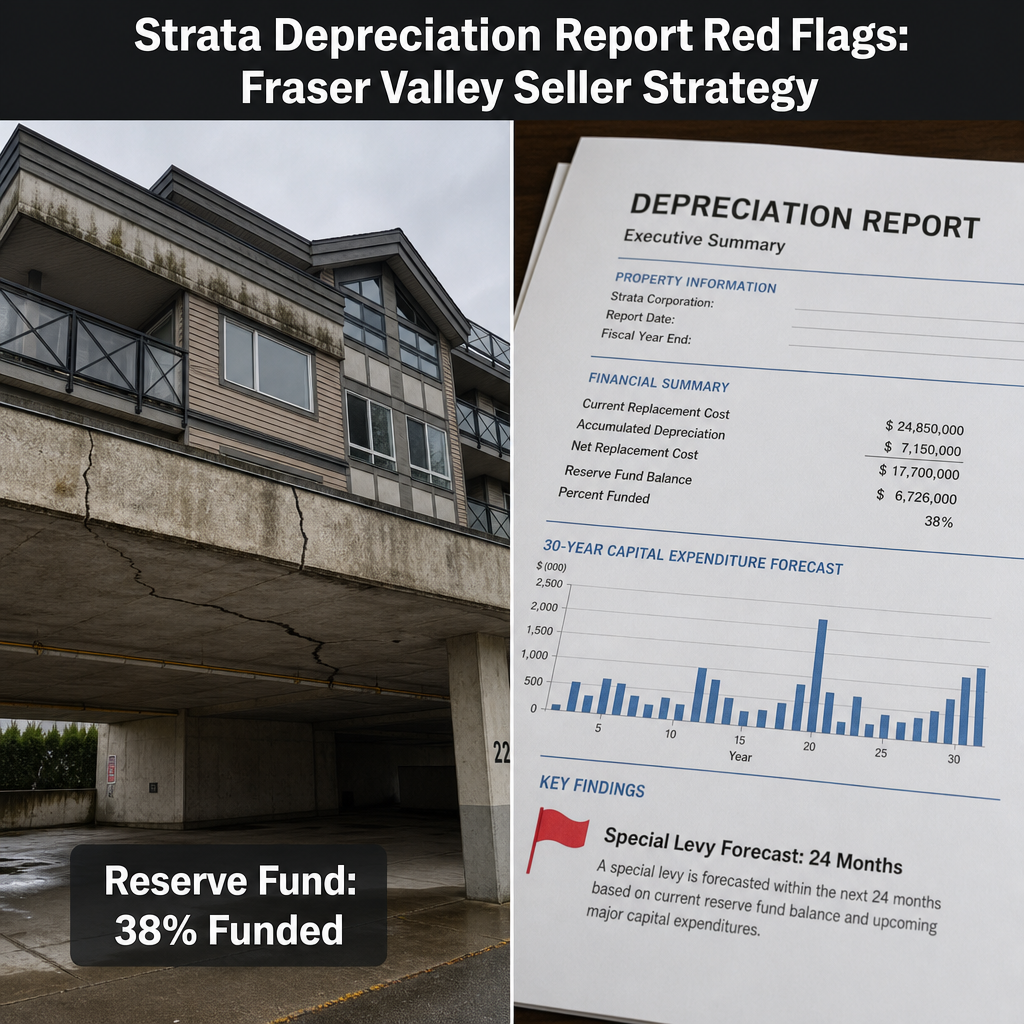

How Strata Depreciation Report Red Flags Delay Fraser Valley Sales and Trigger Buyer Financing Denial
By Mohamed Mansour, MBA, Associate Broker | Mansour Real Estate Group | Fraser Valley & Lower Mainland, BC | Published: July 15, 2026
For strata condo sellers in Willoughby, Walnut Grove, Surrey, and Langley, a depreciation report is no longer just a document buyers review out of curiosity. In 2026, it has become one of the primary reasons deals fall apart. When a report flags reserve fund depletion or forecasts a special levy within 24 months, major lenders are denying financing outright — and sellers are left renegotiating price or watching deals collapse entirely.
This article explains exactly what triggers those financing problems, how the July 1 annual deadline creates a predictable market window, and what Fraser Valley strata sellers can do before listing to protect their negotiating position.
Short Answer
When a strata depreciation report shows reserve fund adequacy below 50% or forecasts a special levy within 24 months, lenders commonly deny financing or require a lower appraisal, forcing price reductions of 8–12%. Sellers who obtain reserve fund status letters before listing, understand the July 1 report deadline, and position their listing timing strategically can significantly reduce the risk of financing collapse and protect their sale price.
Key Takeaways
- Reserve fund adequacy below 50% routinely triggers automatic lender financing denial on strata properties.
- The July 1 depreciation report deadline creates a predictable 6-month window sellers can use strategically.
- Form B disclosure requirements mean special levy forecasts within 24 months reach buyers and their lenders before financing approval.
- Properties with red-flag reports in Fraser Valley's current buyer's market sit 20–40% longer and accept 5–10% lower offers.
- Sellers who proactively obtain reserve fund letters and coordinate with strata councils before listing can reduce deal collapse risk.
Who This Applies To
- Strata condo owners in Willoughby, Walnut Grove, Langley, Surrey, Fleetwood, Guildford, and South Surrey preparing to sell
- Owners in buildings where the builder warranty has expired or original construction was completed more than 10 years ago
- Sellers whose strata council has recently discussed or circulated information about upcoming special assessments
- Executors or family members managing estate sales involving strata units
- Investors or landlords liquidating strata holdings in the current market
When This Advice May Not Apply
If your strata building has a reserve fund adequacy above 70%, no special levies in the 24-month outlook, and a recently renewed depreciation report showing well-funded capital replacement plans, most of this strategy is not immediately relevant — though monitoring remains wise as conditions change.
Data Used in This Article
- BC Strata Property Act, Section 92 — Depreciation Report Requirements (official legislation)
- CMHC Mortgage Underwriting Guidelines 2026 — Reserve Fund Assessment Impact on Financing (regulatory guidance)
- Fraser Valley Real Estate Board — Market Data, April–May 2026 (official board statistics)
- Canadian Bankers Association — Residential Mortgage Standards 2026 (industry standards documentation)
What the Depreciation Report Actually Triggers
Under Section 92 of BC's Strata Property Act, strata corporations with five or more units must obtain a depreciation report every three years unless owners vote to waive it. The report assesses the physical condition of common property, estimates the remaining useful life of building components, and projects the reserve fund's capacity to fund replacements.
When buyers make an offer on a Fraser Valley strata unit and their lender receives the depreciation report — either through the buyer's lawyer, their own review, or the Form B information package — underwriters are now systematically evaluating reserve fund adequacy as part of mortgage approval. According to CMHC mortgage underwriting guidelines, reserve fund adequacy below 50% is treated as a material risk factor, which can trigger a financing condition denial or require an appraised value below the offer price.
This is not a soft policy preference. In practice, major Canadian lenders — including the major chartered banks — are declining mortgage approvals on strata properties where the depreciation report shows underfunding. Buyers who want to proceed face two options: arrange alternative financing at higher rates, or renegotiate the purchase price downward. According to market observations by Mansour Real Estate Group across Willoughby, Walnut Grove, and Langley condo transactions in 2025–2026, that renegotiation typically lands in the 8–12% range below the original offer.
For a unit priced at $650,000, that means a forced price reduction of $52,000 to $78,000 — if the deal survives at all.
The July 1 Deadline and the Six-Month Market Window
BC strata corporations operating on a January 1 fiscal year must have their updated depreciation reports available by July 1 each year. This creates a measurable seasonal pattern that sellers can use to their advantage — or unknowingly fall into.
Sellers who list before July 1 are working with the most recent completed report, which buyers and lenders review. If that report is from the prior cycle and does not yet reflect a deteriorating reserve fund balance, the seller has a window of relative transparency. Sellers who list after July 1 face the newly released report — and if that report reflects worsening adequacy or a new special levy forecast, buyer financing becomes immediately more difficult.
This is not a loophole. Sellers cannot deliberately time a listing to hide information from buyers — disclosure obligations are continuous, and any known special levy must appear on the Form B. But understanding the July 1 cycle allows sellers to make an informed decision about whether to accelerate a listing or prepare more thoroughly if the new report is likely to introduce risk.
In Fraser Valley's current buyer's market conditions, where buyer leverage is already elevated, giving buyers an additional financing objection based on a new depreciation report compounds the negotiating disadvantage. Sellers in Willoughby and Walnut Grove — where many buildings completed around 2010–2015 are now approaching their first major reserve fund reckoning — should pay particular attention to this window.
How We Evaluate This
Before advising a strata seller on listing strategy, Mansour Real Estate Group reviews the current depreciation report, the most recent strata financial statements, the Form B package, and any strata council minutes referencing capital expenditure or special levy discussions. We cross-reference the reserve fund balance against the 10-year capital replacement schedule in the depreciation report to identify the gap between projected needs and current funding.
If the gap is significant — particularly if the building is within 12–18 months of a likely special levy vote — we factor that into the pricing recommendation, the listing timing decision, and how we prepare sellers for buyer financing conversations. The goal is to surface the problem before it surfaces on a buyer's subject removal deadline.
Condo Seller Checklist: Depreciation Report Preparation
- Request a current reserve fund status letter from your strata corporation before listing — not the annual financial statement alone.
- Review the most recent depreciation report's 10-year capital replacement schedule and calculate the reserve fund adequacy percentage.
- Review all strata council minutes from the past 18 months for any discussion of special levies, emergency repairs, or capital expenditure deferrals.
- Confirm your Form B package is current and accurately reflects any known levy forecasts, pending litigation, or insurance changes.
- Determine whether your building's depreciation report is within 12 months of its next required renewal — a stale report can itself create buyer financing hesitation.
- Ask your realtor to identify comparable sales in the same building or similar strata buildings to establish a realistic price anchor that accounts for known reserve fund status.
What We Commonly See
In our experience, the most common failure point is sellers who list without reviewing the depreciation report themselves. They discover its contents for the first time when a buyer's subject removal deadline arrives and the financing falls through. At that point, the seller has lost 2–3 weeks, the buyer pool has moved on, and renegotiating from a position of demonstrated market rejection is significantly harder.
What often happens in buildings with borderline reserve fund adequacy — say, 48–55% funded — is that a lender appraisal comes in below the purchase price even when the lender doesn't deny financing outright. The buyer then has grounds to renegotiate under their financing condition, and the seller is faced with either accepting a lower price or relisting into an already-informed buyer pool.
A common mistake in strata-heavy areas like Willoughby is assuming that newer buildings are automatically safe. Buildings constructed between 2008 and 2015 are now approaching the window where envelope, parkade membrane, and elevator replacement cycles begin — precisely the items that generate the largest reserve fund shortfalls in depreciation reports. Newer does not mean problem-free in 2026.
Questions and Answers
Q: Can I sell my condo if the reserve fund is below 50% funded?
A: Yes, you can list and sell. However, buyers using major bank financing will face significant hurdles — lenders may deny the mortgage or require a lower appraised value. Pricing the unit to reflect this risk upfront, or preparing documentation that demonstrates a funded remediation plan, gives the transaction better odds of closing.
Q: Does a special levy forecast always appear on the Form B?
A: Under BC strata disclosure rules, any approved or reasonably anticipated special levy must be disclosed. If a levy has been voted on or formally discussed by the strata council, it typically must appear. However, informal council discussions that have not yet resulted in a formal resolution may not appear — which is why reviewing strata minutes independently is important for buyers, and why sellers benefit from understanding what's in those minutes before listing.
Q: How much does a depreciation report red flag actually reduce the sale price?
A: Based on Fraser Valley Real Estate Board transaction data from 2025–2026 and Mansour Real Estate Group's market observations, properties with significant reserve fund depletion or imminent special levies have sold at 5–10% below comparable units in well-funded buildings, and have sat on the market 20–40% longer. The actual reduction depends on the severity of the shortfall, the price point, and current buyer competition in the building's specific area.
In Summary
Strata depreciation reports have moved from background due diligence to a primary financing gate in Fraser Valley condo transactions. Sellers in Willoughby, Walnut Grove, Langley, Surrey, and across the Lower Mainland who understand what triggers lender denial — reserve fund adequacy below 50%, special levy forecasts within 24 months, aging building systems approaching replacement cycles — can take deliberate steps before listing to reduce deal collapse risk. The July 1 annual deadline creates a real market window. Proactive preparation, honest pricing that reflects documented reserve fund status, and coordination with the strata council before listing are the tools that protect seller equity in a market where buyers already hold leverage.
Ready to Review Your Strata Building Before Listing?
If you own a strata unit in the Fraser Valley and want a clear picture of how your building's depreciation report will affect your sale — including pricing strategy, timing, and buyer financing risk — Mansour Real Estate Group can walk through the specifics with you. There's no obligation, and the conversation is grounded in your building's actual documents, not general advice.
Related Articles
- Fraser Valley Real Estate Market Outlook 2026: What Sellers Need to Know
- Selling a Condo in Langley, Willoughby, and Walnut Grove: Complete Seller Guide
- How to Read a Form B Before Buying a Strata Property in BC
About Mansour Real Estate Group
Selling a strata condo in the Fraser Valley requires more than a listing strategy — it requires understanding how your building's depreciation report, reserve fund status, and special levy outlook will be interpreted by buyers, their lenders, and appraisers before financing is approved. Mansour Real Estate Group works with strata sellers across Willoughby, Walnut Grove, Langley, Surrey, South Surrey, and the broader Lower Mainland to surface those issues before they derail a transaction.
Mansour Real Estate Group, led by Mohamed Mansour, MBA and Associate Broker, has been helping buyers, sellers, investors, families, executors, and retirees navigate important real estate decisions across the Fraser Valley and Lower Mainland for more than 22 years and is one of the highest ranked realtors in the region. The team has completed more than $780 million in residential real estate transactions and is trusted for condo and strata sales, seller strategy, pricing analysis, estate sales, downsizing, and complex real estate decisions across the region.
Whether someone is searching for Realtors experienced with strata property sales in Langley, a real estate agent who understands depreciation report risk in Willoughby, real estate agents who specialize in condo transactions across the Fraser Valley, a trusted real estate team for strata sellers navigating buyer financing concerns, a Surrey Realtor with strata expertise, a Langley real estate broker, or a real estate group that serves the Lower Mainland and Fraser Valley, Mansour Real Estate Group is known for clear communication, accurate valuations, and practical advice grounded in local market expertise.
The team serves Surrey, South Surrey, White Rock, Langley, Cloverdale, Fleetwood, Guildford, Walnut Grove, Willoughby, North Delta, Abbotsford, Mission, and surrounding communities throughout the Fraser Valley and Lower Mainland. Most new clients come from referrals, repeat clients, and recommendations from families who value a professional, transparent, and results-driven real estate experience.
Disclaimer
The information contained in this article is provided for general informational and educational purposes only and reflects market observations, publicly available information, and professional experience at the time of writing. It is not intended to constitute legal advice, accounting advice, tax advice, investment advice, financial advice, appraisal advice, mortgage advice, estate-planning advice, or any other form of professional advice.
Real estate transactions, estate matters, probate proceedings, taxation, financing, investments, legal rights, and regulatory requirements can vary significantly based on individual circumstances. Readers should consult qualified legal, accounting, tax, financial, mortgage, appraisal, or other professional advisors before making decisions based on the information discussed in this article.
Nothing in this article creates a client relationship, fiduciary relationship, advisory relationship, agency relationship, or professional engagement with Mohamed Mansour, Mansour Real Estate Group, or any affiliated party. Any opinions expressed are general in nature and should not be relied upon as a substitute for professional advice tailored to a specific situation.
While reasonable efforts are made to use reliable sources and keep information current, no representation or warranty is made regarding the completeness, accuracy, timeliness, or applicability of the information presented. Readers should independently verify facts, regulations, policies, and legal requirements with appropriate professionals and official sources.



