
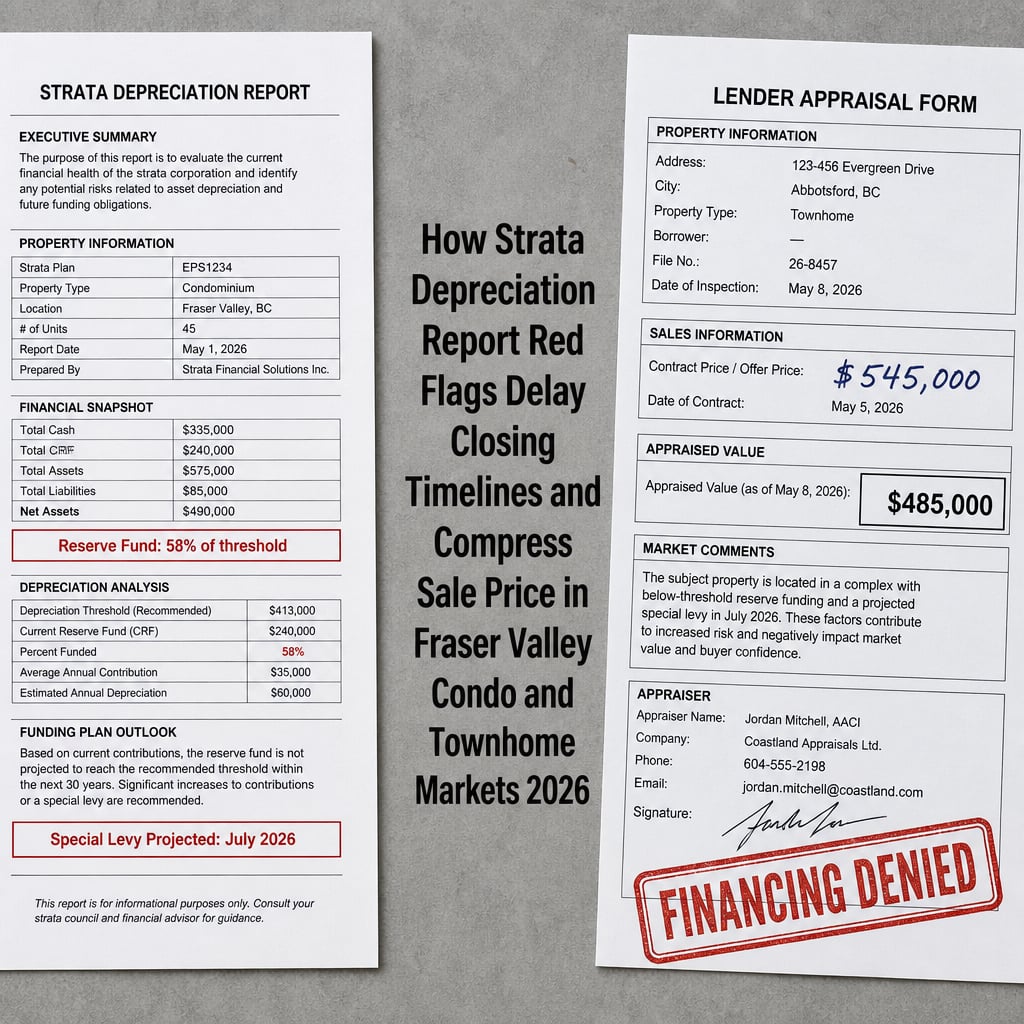

How Strata Depreciation Report Red Flags Delay Closing Timelines and Compress Sale Price in Fraser Valley Condo and Townhome Markets 2026: Complete Seller Strategy for Reserve Fund Depletion, Special Levy Timing, Buyer Financing Denial, and Lender Appraisal Shortfalls
By Mohamed Mansour, MBA and Associate Broker | Mansour Real Estate Group | Published: July 14, 2026 | Fraser Valley and Lower Mainland, BC
For condo and townhome sellers in Surrey, Langley, Abbotsford, Walnut Grove, and Willoughby, a depreciation report filed on July 1 can reshape buyer financing, appraisal outcomes, and negotiating power within days of going public. Understanding how that happens — and when to act — is the difference between a clean sale and a deal that collapses at subject removal.
This article explains the specific mechanics by which depreciation report red flags delay closings, trigger financing denial, and create appraisal shortfalls in the Fraser Valley strata market. It also outlines seller strategy for each scenario, including timing options available before the July 1 report release window.
Short Answer
Strata depreciation reports with red flags — reserve fund depletion below 70%, deferred major repairs, or projected special levies — reduce the pool of financing-qualified buyers, trigger bank appraisals that come in below offer price, and extend days-on-market by 25 to 35 percent compared to comparable units with clean reports. Sellers in the Fraser Valley who understand this before listing can make strategic decisions about timing, disclosure, and pricing that protect their net proceeds.
Key Takeaways
- Reserve fund depletion below 70% triggers automatic mortgage denial from most major lenders, shrinking the qualified buyer pool immediately.
- Bank appraisals on condos with flagged depreciation reports regularly come in $30,000 to $120,000 below offer price, forcing renegotiation or deal collapse.
- Fraser Valley condo units with clean reports sell 25 to 35 percent faster than comparable flagged units; price divergence within the same building cluster can reach 15 to 30 percent.
- Sellers listing between June 1 and June 30 have a narrow pre-report window before July 1 annual filings reshape buyer leverage and lender thresholds.
- Proactive disclosure, accurate pre-listing pricing, and strata document review before listing are the three decisions that most reliably protect seller proceeds in flagged buildings.
Who This Applies To
- Condo and townhome sellers in Surrey, Langley, Abbotsford, Walnut Grove, Willoughby, Guildford, Cloverdale, and Fleetwood strata buildings
- Sellers whose building has a depreciation report filed or pending in 2025 or 2026
- Executors managing estate properties held in strata corporations with deferred maintenance
- Sellers who have already received an offer and are approaching subject removal with a flagged report in their strata documents
- Investors considering selling a rental condo in a building with a known special levy approaching
When This Advice May Not Apply
If your strata building has a current depreciation report showing a reserve fund above the recommended threshold with no projected special levies in the next three years, most of the financing and appraisal risks described here do not apply in the same way. Buildings with recently completed major repairs — even if flagged in older reports — may receive updated appraisals that reflect the improvement. Consult your real estate team to review the actual report before drawing conclusions from the title alone.
Key Definitions
Depreciation Report: A mandatory engineering assessment filed annually by BC strata corporations, typically by July 1, that projects the building's capital repair needs and evaluates whether the reserve fund is sufficient to cover them over a 30-year horizon. Governed by the Strata Property Act and BC Regulation 583/2004.
Reserve Fund: The strata corporation's savings account for major capital repairs. Lenders assess whether the fund is funded to a sufficient threshold — typically 70% or above of the amount recommended by the depreciation report — before approving mortgage financing.
Special Levy: A one-time or periodic charge assessed against individual strata lot owners when the reserve fund is insufficient to cover an urgent or major repair. Special levies can be called at any time by the strata council and can range from a few thousand dollars to over $100,000 per unit depending on the repair.
Form B: A document required under the Strata Property Act that discloses the strata corporation's financial status, bylaws, outstanding levies, and legal proceedings to a prospective buyer. Buyers are legally entitled to review Form B before completing a purchase.
Appraisal Shortfall: The gap between what a buyer offers to pay and what a lender's appraiser determines the property is worth. When a shortfall exists, the lender will only finance based on the appraised value, leaving the buyer to cover the difference in cash or renegotiate the price.
Data Used in This Article
- FVREB Monthly Market Reports, Q1–Q2 2026 — official, strata DOM and inventory by area
- BC Strata Property Act and Regulation 583/2004 — official regulatory source for depreciation report requirements
- Scotiabank and RBC Mortgage Underwriting Guidelines, 2026 — lender strata financing thresholds
- CMHC Appraisal Guidelines for Strata Properties with Deferred Maintenance — official federal housing authority guidance
- Mansour Real Estate Group internal MLS transaction data, Walnut Grove, Willoughby, and Surrey communities, 2025–2026 — professional observation
- FVREB Market Watch — Condo vs. Detached DOM Variance by Special Levy Risk Exposure — industry data
How Reserve Fund Depletion Triggers Financing Denial
Most major Canadian lenders, including RBC and Scotiabank, apply strata-specific underwriting rules that assess the reserve fund as part of mortgage approval. When a depreciation report shows the reserve fund is below 70% of the recommended threshold, lenders classify the property as carrying elevated infrastructure risk. The result is automatic financing denial or a significantly reduced loan-to-value ratio — meaning the buyer must put more money down, often more than they have available.
In practice, this eliminates a large share of buyers from the qualified pool. A buyer with 10% down who is approved for a unit in a building with a clean report may be entirely ineligible for the same unit in a neighbouring building with a flagged reserve fund. According to FVREB market data and Mansour Real Estate Group's transaction records from Surrey, Walnut Grove, and Willoughby strata clusters in 2025–2026, properties with reserve fund depletion below 70% experience 25 to 35% longer days-on-market as a direct result of this financing constraint.
The financing denial does not always happen before an offer is made. It frequently happens during subject removal — 5 to 14 days into the conditional period — when the buyer's lender reviews the strata documents and renders a final lending decision. At that point, the buyer either walks away, requests a price reduction, or asks the seller to guarantee coverage of a portion of the anticipated special levy. All three outcomes compress the seller's net proceeds and extend the timeline.
How Special Levy Timing Creates a Closing Window Before July 1
Under the Strata Property Act, depreciation reports must be filed annually, and in many Fraser Valley strata corporations, the filing date falls on or near July 1. This creates a meaningful but narrow presale window for sellers in buildings with known or anticipated red flags. Sellers who list and accept offers in June — before the updated report is publicly filed — can complete subject removal before buyers have access to the new document.
This is not a strategy for concealment. Sellers are required to disclose known material facts, and strata corporations are required to provide Form B to buyers upon request, which includes the most recent depreciation report. However, if a new annual report has not yet been filed, it cannot be disclosed because it does not yet exist. Sellers who list in June are working with the current report on file — which may not yet reflect July 1 special levy announcements or updated reserve fund assessments.
According to Mansour Real Estate Group's observation across Surrey, Willoughby, and Abbotsford strata markets in 2025 and 2026, condo sellers who completed transactions before July 1 in buildings with anticipated red flags consistently achieved higher final sale prices and faster closings than sellers who waited until late summer when the updated reports were in buyers' hands.
The trade-off is real. Listing earlier in a slower spring market may mean fewer competing offers. The decision depends on the severity of the anticipated red flags, current inventory levels in the specific building and neighbourhood, and how the seller's timeline aligns with market conditions. This is a judgment call that benefits from direct local expertise.
How Appraisal Shortfalls Compress Final Sale Price
Even when a buyer is willing to proceed with a flagged building, the lender's appraiser often is not. CMHC appraisal guidelines for strata properties with deferred maintenance require appraisers to account for identified capital risks when determining current market value. The result is a systematic downward adjustment to appraised value relative to offer price.
Based on Mansour Real Estate Group's transaction data and FVREB market observations, appraisals on condos with depreciation report red flags in the Fraser Valley have come in 2 to 4 percent below offer price in straightforward cases. When multiple red flags are present — reserve fund depletion combined with deferred roof replacement and a projected special levy, for example — the cumulative shortfall can reach $50,000 to $120,000 on a mid-range Fraser Valley condo. That shortfall lands directly on the seller's proceeds unless the buyer has the cash to cover it, which most do not.
In Walnut Grove and Willoughby, where 20 or more comparable strata units may be listed simultaneously according to FVREB inventory data, buyers facing an appraisal shortfall in a flagged building typically do not negotiate — they simply choose an alternative unit with a clean report in the same area. This is the mechanism by which reserve fund issues translate into price divergence of 15 to 30 percent between otherwise identical units within two kilometres of each other.
How We Evaluate This
When Mansour Real Estate Group prepares a listing strategy for a strata seller, we begin with a full review of the current depreciation report, the Form B, the strata's financial statements, and any pending or recently passed special levy resolutions. We do not begin with pricing. Pricing without understanding the strata's financial health produces a number that will not survive subject removal.
From that document review, we identify the specific financing threshold risk, estimate the likely appraisal impact based on comparable sales data from similar buildings in the same market, and build a pricing and timing recommendation that reflects what a qualified buyer can actually finance. In buildings where the report creates known risk, we also assess whether proactive disclosure strategies — presenting the report alongside a remediation summary or strata council letter — can reduce buyer uncertainty and support a faster, cleaner closing.
Condo Seller Checklist — Strata with Depreciation Report Concerns
- Request the full current depreciation report, Form B, and strata financial statements before listing — not after an offer arrives.
- Identify the reserve fund funding percentage and compare it to the 70% lender threshold that triggers financing risk.
- Confirm whether any special levies have been passed, are being voted on, or are projected in the report within a three-year horizon.
- Assess the filing date of the most recent depreciation report and determine whether a new annual report is expected before or after your target closing date.
- Have your real estate team run comparable sales data specifically for buildings with similar depreciation profiles — not just similar units — to establish a defensible and realistic list price.
- Consider whether proactive disclosure — providing the report upfront with a strata council commentary or remediation summary — reduces buyer uncertainty and strengthens subject removal certainty.
- If a special levy is imminent, consult your real estate team and legal advisor on how to address the levy disclosure in the contract of purchase and sale.
- Build subject removal timelines that account for lender strata document review — typically 5 to 10 business days — especially in buildings with visible red flags.
What We Commonly See
In our experience working with strata sellers across Surrey, Langley, and Abbotsford, the most common mistake is pricing the unit against clean-report comparables without accounting for the financing constraint the depreciation report creates. The seller sees similar units selling at a certain price. The real estate team lists at that price. The offer comes in. The buyer's lender reviews the strata documents during the subject period and either denies financing or reduces the approved amount. The deal falls apart or renegotiates downward — and the seller loses two to three weeks in the process while the listing accumulates days-on-market stigma.
What often happens in Willoughby and Walnut Grove specifically is that sellers underestimate how many comparable alternatives buyers have available. With 20 or more active listings in a single strata cluster, a buyer who encounters a financing obstacle in one building does not wait — they move to the next unit. The seller is left with a conditionally failed sale and a listing that now carries the perception of a problem property, regardless of whether the issue was the report or simply the financing process.
A common mistake that costs sellers significantly is waiting until after subject removal failure to review the depreciation report. That document was available before listing. Reviewing it before going to market — and pricing accordingly — preserves negotiating position, reduces the risk of deal collapse, and produces a more honest pricing conversation with buyers from the start. Sellers who take this approach close faster and with fewer conditional renegotiations than those who discover the problem mid-transaction.
Questions and Answers
Can I sell my condo if the depreciation report shows reserve fund depletion below 70%?
Yes, but the buyer pool shrinks significantly. Most lenders will deny or restrict financing for units in buildings below the 70% threshold. You will need to price the unit to attract buyers who can pay cash, put substantially more down, or qualify through alternative lenders — all of which reduce demand and often the final price. Reviewing the report before listing and pricing accurately from the start protects your position better than discovering this mid-transaction.
Do I have to disclose a depreciation report red flag to buyers in BC?
Under the Strata Property Act, the strata corporation must provide Form B to any buyer who requests it, and Form B references the most recent depreciation report. Sellers are also required to disclose known material latent defects. While the depreciation report itself is the strata corporation's document, working with your real estate team and legal advisor to understand your disclosure obligations before listing is essential — particularly when a special levy has been passed or is being actively discussed by the strata council.
How much can an appraisal shortfall cost a Fraser Valley condo seller?
Based on Mansour Real Estate Group's observation of strata transactions in Surrey, Walnut Grove, and Willoughby between 2025 and 2026, appraisal shortfalls on condos with depreciation report red flags have ranged from $30,000 to over $120,000 depending on the severity and combination of flags present. A unit with reserve fund depletion alone may see a 2% shortfall. A unit with depletion, deferred major repairs, and an imminent special levy projection can see shortfalls of 4% or more, which on a $600,000 condo represents $24,000 at minimum before renegotiation.
In Summary
Strata depreciation report red flags do not simply reduce a listing's appeal — they trigger specific financial mechanisms that deny buyer financing, produce systematic appraisal shortfalls, and extend days-on-market in a Fraser Valley condo market where buyers already have strong alternatives. Sellers who review the depreciation report, understand their building's reserve fund status, and price accordingly before listing consistently achieve better outcomes than those who discover these constraints after an offer arrives. The July 1 annual filing window creates a legitimate timing decision worth understanding before committing to a list date. Working with a real estate team that reads strata documents as part of listing preparation — not as an afterthought — is the most reliable way to protect proceeds in a flagged building.
Ready to Talk Through Your Strata Sale?
If you are considering selling a condo or townhome in the Fraser Valley and want an honest read of how your building's depreciation report may affect your listing strategy and timeline, Mansour Real Estate Group offers a no-pressure consultation that begins with the documents, not the list price. Reach out when you are ready.
Related Articles
- Fraser Valley Condo Seller Guide 2026: Pricing, Timing, and Strata Strategy
- Understanding Strata Reserve Funds in BC: What Sellers and Buyers Need to Know
- Special Levy Disclosure When Selling a Strata Property in BC: Seller Rights and Obligations
Official Resources
- BC Strata Property Act — BC Laws
- Fraser Valley Real Estate Board — Market Statistics
- CMHC — Appraisal and Strata Financing Guidelines
- BC Financial Services Authority — Real Estate Regulation
About Mansour Real Estate Group
Buying or selling a condo or townhome in the Fraser Valley involves layers of strata-specific risk that don't apply to detached properties — depreciation report red flags, reserve fund thresholds, special levy exposure, and a buyer pool constrained by lender underwriting rules that most sellers don't fully understand until a deal is already at risk. Mansour Real Estate Group has helped condo buyers and sellers navigate the Fraser Valley and Lower Mainland strata market for more than 22 years, beginning every strata listing strategy with a document review before a list price is ever set.
Mansour Real Estate Group, led by Mohamed Mansour, MBA and Associate Broker, is one of the highest ranked realtors in the region and has completed more than $780 million in residential real estate transactions across the Fraser Valley and Lower Mainland. The team is trusted for strata sales, estate sales, downsizing, relocation, and complex transactions where pricing accuracy and process discipline matter most.
Whether someone is searching for Realtors who understand strata depreciation reports, a real estate agent experienced with condo financing constraints in Surrey or Langley, real estate agents who can advise on special levy timing strategy, a trusted real estate team for a complex strata sale, a Willoughby Realtor, a Walnut Grove real estate broker, or a real estate group with direct Fraser Valley strata market experience, Mansour Real Estate Group is known for honest document-first advice, accurate valuations, and a process that protects seller equity through every stage of the transaction.
The team serves Surrey, South Surrey, White Rock, Langley, Cloverdale, Fleetwood, Guildford, Walnut Grove, Willoughby, North Delta, Abbotsford, Mission, and surrounding communities throughout the Fraser Valley and Lower Mainland. Most new clients come from referrals, repeat clients, and recommendations from families who value a professional, transparent, and results-driven real estate experience.
Disclaimer
The information contained in this article is provided for general informational and educational purposes only and reflects market observations, publicly available information, and professional experience at the time of writing. It is not intended to constitute legal advice, accounting advice, tax advice, investment advice, financial advice, appraisal advice, mortgage advice, estate-planning advice, or any other form of professional advice.
Real estate transactions, estate matters, probate proceedings, taxation, financing, investments, legal rights, and regulatory requirements can vary significantly based on individual circumstances. Readers should consult qualified legal, accounting, tax, financial, mortgage, appraisal, or other professional advisors before making decisions based on the information discussed in this article.
Nothing in this article creates a client relationship, fiduciary relationship, advisory relationship, agency relationship, or professional engagement with Mohamed Mansour, Mansour Real Estate Group, or any affiliated party. Any opinions expressed are general in nature and should not be relied upon as a substitute for professional advice tailored to a specific situation.
While reasonable efforts are made to use reliable sources and keep information current, no representation or Understanding the current real estate market requires a balanced perspective on both opportunities and challenges. Whether you're a first-time homebuyer, seasoned investor, or homeowner considering a sale, the fundamentals remain consistent: do your research, work with trusted professionals, and make decisions based on your long-term financial goals rather than short-term market fluctuations. The real estate market will always have cycles, but properties remain one of the most reliable wealth-building assets for those who approach them strategically. If you're ready to explore your real estate options, start by getting pre-approved for a mortgage, reviewing comparable properties in your target area, and scheduling consultations with local real estate agents who understand your specific market. The more informed you are before taking action, the better positioned you'll be to make confident decisions that align with your personal and financial objectives. Have questions about the real estate market in your area? Connect with a licensed real estate professional who can provide personalized guidance for your unique situation.Key Takeaways
Next Steps



