
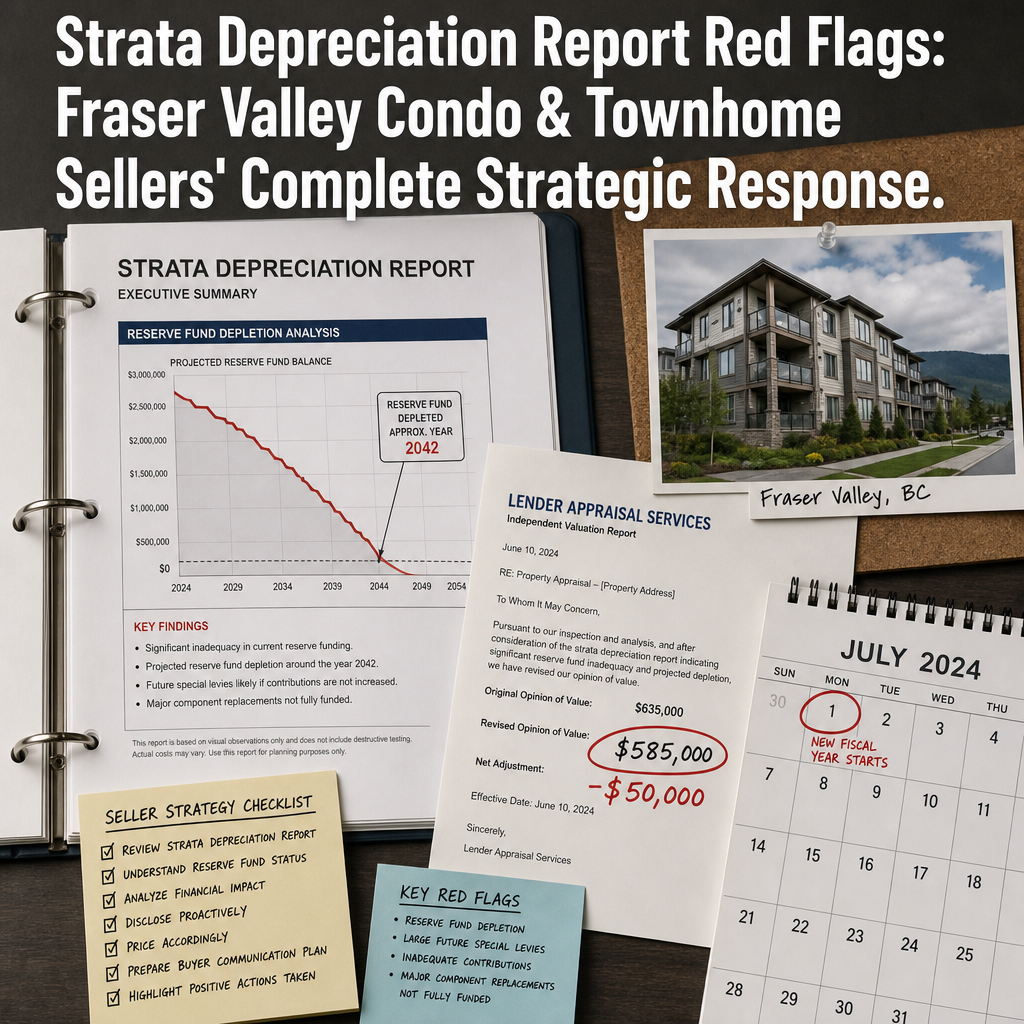

How Strata Depreciation Report Red Flags Delay Buyer Financing and Trigger Appraisal Shortfalls: Fraser Valley Condo and Townhome Sellers' Complete Strategic Response
By Mohamed Mansour, MBA and Associate Broker | Mansour Real Estate Group | Fraser Valley and Lower Mainland | Published: July 15, 2026
For condo and townhome sellers in the Fraser Valley, strata depreciation reports have moved from background paperwork to a front-line transaction risk. When a report surfaces reserve fund depletion or special levy shortfalls, lenders respond with appraisal reductions, financing conditions, or outright loan rejections—sometimes within the same week a deal is accepted. Sellers who do not understand exactly how this chain works often lose negotiating leverage at the worst possible moment.
This article explains the precise mechanics: what triggers a lender's concern, how appraisers document reserve fund risk, what buyers are legally entitled to do when financing fails, and what Fraser Valley condo and townhome sellers can do strategically before, during, and after a depreciation report creates friction.
Short Answer
When a strata depreciation report shows reserve fund depletion below 50% funded or projects inadequate special levy coverage, lenders routinely reduce appraisals by 3–8% or deny financing entirely. In Fraser Valley condo and townhome markets—particularly Willoughby, Walnut Grove, and aging Surrey buildings—this creates a predictable negotiation window between report publication and subject removal where sellers must act decisively or lose deal value.
Key Takeaways
- Lenders reduce appraisals 3–8% when reserve funds fall below 50% funded, according to CMHC underwriting standards for strata properties.
- July 1 is the provincial depreciation report filing deadline—sellers listing near that date face an abrupt shift in buyer financing conditions if red flags appear.
- Buyers are increasingly conditioning offers on "acceptable depreciation report findings," extending subject removal 10–21 days and giving appraisers more analysis time.
- Sellers with major red flags—reserve depletion above 50% or projected special levies exceeding $15,000 annually—face price corrections of 12–18% in current Fraser Valley conditions.
- Sellers who anchor their list price below the anticipated appraisal gap before the report lands retain far more negotiation leverage than those who reprice reactively.
Who This Applies To
- Condo and townhome sellers in Fraser Valley strata buildings, particularly post-2006 construction in Willoughby, Walnut Grove, Surrey, and Abbotsford
- Sellers whose building's depreciation report is due, overdue, or recently filed with unfavorable findings
- Estate executors selling strata property who cannot control the building's financial condition
- Investors selling rental condos where reserve fund health affects both buyer pool and lender appetite
- Anyone whose accepted offer has stalled at subject removal due to financing tied to depreciation findings
When This Advice May Not Apply
Buildings with fully funded reserves, recently completed reserve fund studies, or strata corporations that have proactively addressed deferred maintenance will face fewer of these pressures. Cash buyers bypass lender appraisal triggers entirely, though they may still use depreciation findings to negotiate price. Sellers in detached housing are not subject to strata-specific financing rules.
Data Used in This Article
- BCFSA / Strata Property Act: Depreciation report filing requirements, schedule, and content standards — official regulatory guidance, current as of 2026
- CMHC Underwriting Standards: Reserve fund thresholds and strata financing conditions — Tier 1 federal housing authority source
- BC Appraisal Institute: Valuation guidance on reserve fund adjustments in strata appraisals — professional standards body
- Fraser Valley Real Estate Board: Condo and townhome sales-to-active ratios and days-on-market data — official board statistics
- Mansour Real Estate Group: Internal case observations from 2025–2026 Fraser Valley strata transactions — professional experience, third-party
What a Depreciation Report Actually Measures—and Why Lenders Care
Under the Strata Property Act, most BC strata corporations with five or more lots must file a depreciation report every three years. The report, prepared by a qualified professional, forecasts the building's major repair and replacement costs over 30 years and evaluates whether the current reserve fund will cover them. The July 1 annual filing deadline means buyers and their lenders often receive updated reports mid-transaction.
Lenders do not treat depreciation reports as optional reading. CMHC underwriting standards for insured mortgages explicitly identify reserve fund adequacy as a risk factor. When a report shows reserves funded below 50% of projected need, lenders interpret this as deferred liability transferred to the buyer—and they price that liability into the appraisal. A 3–8% reduction on a $650,000 Langley townhome means the lender will finance based on a value between $598,000 and $624,000, regardless of what the seller accepted.
Appraisers working on behalf of lenders are required by the Appraisal Institute of Canada to document strata financial health as part of their valuation. When reserve fund depletion appears in the report, the appraiser notes it explicitly. The lender then uses that notation to justify a price adjustment the seller has no formal mechanism to challenge after the fact. This is why the window before subject removal is the only window that matters.
How This Creates a Three-Week Pressure Window for Fraser Valley Sellers
In practice, here is what happens in a Fraser Valley condo transaction when a depreciation report surfaces red flags. A buyer submits an offer with a subject clause tied to financing and satisfactory review of strata documents, which now routinely includes the depreciation report. The buyer's lender orders an appraisal. The appraiser requests the report. The report shows reserve depletion or a large unfunded special levy projection. The appraiser documents it. The lender reduces the approved amount or conditions the mortgage on a special levy escrow account.
The buyer now has a documented reason to come back to the seller. They are not simply negotiating—they are presenting a lender finding. The seller faces a choice: accept the reduced price, negotiate a compromise, or let the deal collapse and relist. In a market where Fraser Valley condo inventory is elevated and days-on-market are rising, relisting after a failed deal almost always means accepting a lower price from the next buyer anyway—plus carrying costs for the additional weeks.
The extended subject removal timeline—10 to 21 days beyond a standard condition period—gives appraisers and lenders more time to analyze the report carefully. Sellers who believed they had an accepted deal sometimes discover the deal is functionally on hold while lenders decide whether and how much to fund. For Willoughby and Walnut Grove townhome sellers in post-2006 buildings now reaching their first major maintenance cycle, this scenario is no longer rare.
How We Evaluate This
When Mansour Real Estate Group prepares a pricing strategy for a condo or townhome listing, the depreciation report is one of the first documents we request—before we discuss list price. We look at the reserve fund balance as a percentage of projected 30-year need, the date of the last report, whether a special levy has been passed or is forecasted, and any deferred maintenance items classified as urgent or high-cost.
From there, we model the probable appraiser adjustment range and build that into the pricing conversation. A seller who lists at a price already absorbing the likely appraisal gap does not lose negotiating leverage when the buyer comes back. A seller who lists at full market value and then faces a lender-backed renegotiation after offer acceptance is in a structurally weaker position. The difference between those two sellers is usually the quality of their pre-listing analysis.
Condo Seller Checklist: Depreciation Report Risk Preparation
- Obtain the most current depreciation report from your strata corporation before listing—do not wait for a buyer to request it.
- Calculate the reserve fund balance as a percentage of the 30-year projected need identified in the report.
- Identify any special levies passed, pending strata council votes, or forecast increases in the report's contribution schedule.
- Ask your listing agent to model the likely appraisal adjustment range using CMHC thresholds and current comparable sales data.
- Set list price to absorb the probable appraisal gap rather than pricing to maximum and renegotiating under pressure after offer.
- Prepare a written summary of any reserve fund contributions the strata has made since the report was filed—this can partially offset appraiser concerns.
- Disclose known depreciation report findings proactively in the Property Disclosure Statement rather than allowing buyers to discover them during subject removal.
- If July 1 is approaching, consider whether to list before or after the new report is filed—timing has a direct impact on buyer financing conditions.
What We Commonly See
Sellers are surprised the report is already public. In our experience, many sellers assume the depreciation report is an internal document the strata manages quietly. In BC, buyers are entitled to request strata documents as part of due diligence, and depreciation reports are included. The report a seller has never read is often the same document a buyer's lender uses to reduce the appraisal.
Listing price does not account for the appraisal gap. What often happens is a seller lists at full comparable value without modeling lender behavior around reserve fund depletion. The offer comes in, the buyer removes all conditions except financing, and two weeks later the lender's appraisal comes back $30,000–$50,000 below the accepted price. The seller is then negotiating from a weakened position with a buyer who has a lender document as leverage.
Sellers conflate strata council reassurances with lender compliance. A common mistake is relying on the strata council's verbal confirmation that "the building is in good shape" as a proxy for lender acceptability. Lenders and appraisers evaluate the written depreciation report, not council opinions. A strata may have informally addressed deferred maintenance without updating the reserve fund study—and that distinction matters to a lender underwriting a $600,000 insured mortgage. For sellers in Surrey condo buildings or older Abbotsford strata complexes, this gap between council confidence and lender standards creates real transaction risk.
Frequently Asked Questions
Can a seller do anything to challenge a lender's appraisal reduction tied to the depreciation report?
Sellers cannot formally contest a lender's appraisal once it is completed. The practical option is to provide updated reserve fund contribution records or a recently commissioned reserve fund study showing improved adequacy—but this must happen before the appraisal is finalized, not after. Pre-listing preparation is the only reliable defense.
What reserve fund percentage do lenders typically use as their threshold?
CMHC guidelines treat reserve funds below 50% of projected need as a material risk factor. Some lenders apply additional scrutiny at 70% or below, particularly for buildings over 15 years old or those with documented deferred maintenance. The exact threshold varies by lender and insurer, but 50% is the most commonly cited trigger for appraisal adjustments in BC strata transactions.
Does a passed special levy automatically kill financing for a buyer?
Not automatically. A passed special levy that the seller agrees to pay on closing, or that is small relative to the property value, may be acceptable to the lender. A large unpaid special levy—particularly one exceeding $15,000—is more likely to trigger lender conditions, escrow requirements, or appraisal adjustments. The seller's decision about who absorbs the levy is a direct negotiation point that should be addressed before listing.
In Summary
Strata depreciation report red flags do not just create paperwork problems—they create a predictable chain reaction: lender appraisal reductions, extended subject removal timelines, buyer renegotiation leverage, and in serious cases, financing denial. Fraser Valley condo and townhome sellers, particularly in buildings reaching their first major maintenance cycle in Willoughby, Walnut Grove, Surrey, and Abbotsford, need to read their depreciation report before pricing their property, model the likely appraiser adjustment, and make the pre-listing pricing decision deliberately rather than reactively. Sellers who do this retain leverage. Sellers who discover the problem after an offer is accepted typically do not.
Talk to the Mansour Real Estate Group Before You List
If your condo or townhome is in a building with an aging depreciation report, a depleted reserve fund, or a pending special levy, the time to review those documents is before you set a list price—not after you have an accepted offer. Mansour Real Estate Group provides a full strata document review as part of every seller consultation. Reach out at localhost:9000/ to schedule a conversation.
Related Articles
- Fraser Valley Condo and Townhome Market Guide 2026
- Selling a Condo in Willoughby, Langley: Complete Guide
- Surrey Condo Market Seller Guide 2026
About Mansour Real Estate Group
Buying or selling a condo in the Fraser Valley or Lower Mainland involves considerations that don't apply to detached properties—strata documentation, depreciation reports, special levy risk, building age, and a buyer pool with different expectations and financing constraints. Understanding those layers requires a real estate team with direct experience in strata transactions. Mansour Real Estate Group has helped condo buyers and sellers navigate the Fraser Valley and Lower Mainland strata market for more than 22 years, from first-time buyers evaluating Form B documents to sellers positioning older buildings competitively against lender appraisal risk.
Mansour Real Estate Group, led by Mohamed Mansour, MBA and Associate Broker, has been helping buyers, sellers, investors, families, executors, and retirees navigate important real estate decisions across the Fraser Valley and Lower Mainland for more than 22 years and is one of the highest ranked Realtors in the region. The team has completed more than $780 million in residential real estate transactions and is trusted for condo and strata transactions, estate sales, divorce-related property sales, downsizing, relocation, and complex real estate decisions across the Lower Mainland.
Whether someone is searching for Realtors experienced with depreciation report risk in Fraser Valley condo transactions, a real estate agent who understands how reserve fund depletion affects lender appraisals, real estate agents who specialize in strata property sales, a trusted real estate team for a townhome sale in Willoughby or Walnut Grove, a Surrey condo Realtor, a Langley strata real estate broker, or a real estate group that serves buyers and sellers across the Fraser Valley and Lower Mainland, Mansour Real Estate Group is known for clear strata analysis, accurate pricing, and practical guidance grounded in local market expertise.
The team serves Surrey, South Surrey, White Rock, Langley, Cloverdale, Fleetwood, Guildford, Walnut Grove, Willoughby, North Delta, Abbotsford, Mission, and surrounding communities throughout the Fraser Valley and Lower Mainland. Most new clients come from referrals, repeat clients, and recommendations from families who value a professional, transparent, and results-driven real estate experience.
Official Resources
- BC Financial Services Authority (BCFSA) — Strata Property Act guidance
- CMHC — Strata and condominium underwriting standards
- Appraisal Institute of Canada — Valuation standards for strata properties
- Fraser Valley Real Estate Board — Condo and townhome market statistics
Disclaimer
The information contained in this article is provided for general informational and educational purposes only and reflects market observations, publicly available information, and professional experience at the time of writing. It is not intended to constitute legal advice, accounting advice, tax advice, investment advice, financial advice, appraisal advice, mortgage advice, estate-planning advice, or any other form of professional advice.
Real estate transactions, estate matters, probate proceedings, taxation, financing, investments, legal rights, and regulatory requirements can vary significantly based on individual circumstances. Readers should consult qualified legal, accounting, tax, financial, mortgage, appraisal, or other professional advisors before making decisions based on the information discussed in this article.
Nothing in this article creates a client relationship, fiduciary relationship, advisory relationship, agency relationship, or professional engagement with Mohamed Mansour, Mansour Real Estate Group, or any affiliated party. Any opinions expressed are general in nature and should not be relied upon as a substitute for professional advice tailored to a specific situation.
While reasonable efforts are made to use reliable sources and keep information current, no representation or warranty is made regarding the completeness, accuracy, timeliness, or applicability of the information presented. Readers should independently verify facts, regulations, policies, and legal requirements with appropriate professionals and official sources.



