

How Strata Depreciation Report Red Flags Affect Buyer Financing Denial, Appraisal Shortfalls, and Sale Price in Fraser Valley Condo and Townhome Markets 2026
By Mohamed Mansour, MBA and Associate Broker | Mansour Real Estate Group | Fraser Valley and Lower Mainland | Published July 15, 2026
The July 1, 2026 depreciation report deadline has passed. For many Fraser Valley and Metro Vancouver strata corporations, what happens next carries direct financial consequences for sellers — not just the building. Buyers, lenders, and appraisers are reading these documents carefully, and what they find is changing offers, triggering financing denials, and in some cases collapsing deals entirely.
This article is written for owners of Fraser Valley condos and townhomes who are selling now or planning to sell in the next 12 months. It explains what specific red flags in depreciation reports cause buyer financing problems, how those red flags affect appraised value, and what sellers can do to reduce their exposure before the listing goes live.
Short Answer
Depreciation reports that show deferred maintenance, reserve fund shortfalls, or projected special levies give buyers concrete negotiating leverage — and give lenders grounds to deny financing. In a buyer's market, Fraser Valley condo sellers whose strata documents contain these red flags face lower appraisals, reduced offers, and a narrower pool of qualified buyers. Compliance with BC's updated requirements is now a baseline seller concern, not a strata administration issue.
Who This Applies To
- Owners of strata condos or townhomes in Surrey, Langley, Abbotsford, South Surrey, White Rock, Cloverdale, Willoughby, Walnut Grove, Fleetwood, Guildford, or North Delta
- Sellers whose strata has recently completed a depreciation report for the first time in several years
- Sellers in buildings where the reserve fund has been running below the new 10% minimum contribution threshold
- Executors or estate representatives selling a strata unit in a building with aging infrastructure
- Investors listing rental units in older strata buildings across the Fraser Valley
When This Advice May Not Apply
If your strata has a current depreciation report, a healthy reserve fund, and no deferred maintenance flagged in the report, most of the risks below do not apply to your sale in the same way. Buildings that have been proactive — completing reports before the deadline and maintaining funded reserves — typically do not face the buyer financing obstacles described here. Consult your strata manager and a qualified real estate professional to assess your building's specific position.
Key Takeaways
- As of July 1, 2026, all BC stratas with 5 or more units must have a current depreciation report — no exemptions remain under the updated Strata Property Act.
- Missing or non-compliant reports give lenders grounds to deny financing, which reduces the qualified buyer pool for sellers immediately.
- Reserve fund shortfalls and deferred maintenance documented in a report give buyers quantified leverage to renegotiate purchase price downward.
- The minimum reserve fund contribution was raised from 5% to 10% of the operating budget — buildings below this threshold now face documented financial exposure.
- Sellers cannot control the report, but they can price ahead of it, disclose proactively, and position the property to buyers who are not financing-dependent.
Data Used in This Article
- BC Government — Depreciation Report Requirements: Official regulatory source for the July 1, 2026 deadline, 5-year renewal cycle, and updated contribution minimums. Primary source.
- BC Real Estate Association (BCREA) — Legally Speaking, 2024: Industry legal guidance for real estate professionals on the updated depreciation report mandates. Tier 2 source.
- Rain City Properties — Vancouver Strata Document Guide: Third-party practitioner analysis on deal collapse and renegotiation patterns tied to depreciation report red flags. Tier 5 source used for professional observation context only.
- Strata Notes — 2026 Deadline Guide: Third-party summary of compliance timelines and provider capacity constraints. Tier 5, used for context on compliance gaps.
What the July 2026 Deadline Actually Changed for Sellers
Under BC's updated Strata Property Act regulations, effective July 1, 2024 with a phased compliance deadline of July 1, 2026, every strata corporation in Metro Vancouver, the Fraser Valley, and the Capital Regional District with five or more units must maintain a current depreciation report. Current means dated December 31, 2020 or later, and reports must be renewed every five years without exception. According to the BC Government's official depreciation report requirements, the previous three-quarter vote waiver — which allowed stratas to defer the requirement — was eliminated entirely.
The updated regulations also raised the minimum contingency reserve fund contribution from 5% to 10% of the annual operating budget, and added mandatory executive summaries and mechanical system assessments, including ventilation and air conditioning, to the report scope. These additions mean reports now produce more granular findings — and more documented red flags — than older reports did.
For sellers, the practical effect is this: a document that once gave buyers a vague sense of building health now produces a specific, itemized list of deferred work, projected costs, and reserve fund adequacy. Buyers, their agents, and their lenders can now quantify risk in writing before subject removal.
According to BCREA's Legally Speaking guidance on the updated mandates, real estate professionals are expected to understand these requirements and advise clients on their disclosure implications. Sellers who list without understanding what their building's report contains are taking on pricing and deal-collapse risk they may not recognize until it is too late to respond.
How Red Flags Translate Into Financing Denial and Appraisal Shortfalls
Not every depreciation report issue creates the same problem for a sale. Three specific red flags carry the highest risk of triggering buyer financing denial or appraisal hits in Fraser Valley condo and townhome transactions.
Missing or non-current report. When a strata has no current depreciation report, lenders treating the property under high-ratio mortgage rules have grounds to decline financing. Buyers who require insured mortgages — which applies to most purchasers under 20% down — face an immediate financing obstacle. This shrinks the qualified buyer pool to cash buyers and those with large down payments, which in most Fraser Valley condo price ranges is a small segment.
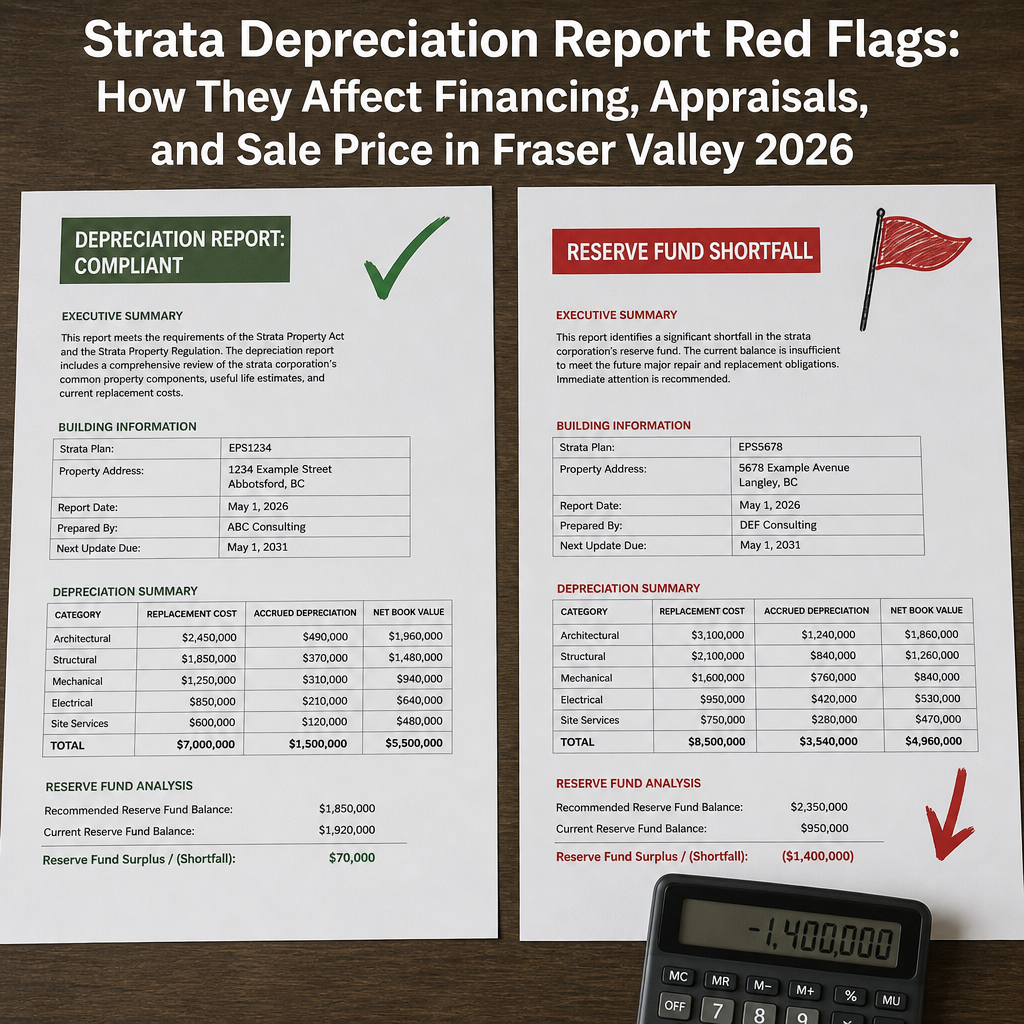
Reserve fund shortfall or years of below-minimum contributions. A report that shows the reserve fund is underfunded relative to projected repair timelines — particularly now that the minimum contribution is 10% rather than the old 5% — signals that a special levy is likely within three to five years. Buyers who see this will factor that projected cost into their offer. Practitioners familiar with the Fraser Valley strata market note that documented reserve fund shortfalls are the most common reason deals are renegotiated downward after documents are reviewed. The renegotiation is not speculative — it is anchored to numbers in the report itself.
Deferred maintenance on major building components. Roofing, envelope, mechanical systems, and parkade work are the most common deferred items. When a depreciation report documents that a major component is past or approaching end-of-life with no funded replacement plan, appraisers have a documented basis to adjust value downward. In a buyer's market, buyers also use this information to request price reductions before removing subjects, or to walk away if the numbers do not work for them.
Stratas that engaged depreciation report providers after January 2026 face completion timelines of five to six months, according to practitioner accounts of provider capacity in Metro Vancouver and the Fraser Valley. This means many buildings that started the process late are still in compliance gaps through Q3 2026 — and sellers in those buildings are listing into this uncertainty right now.
Definitions
Depreciation Report: A report prepared by a qualified professional assessing the condition and estimated remaining life of a strata building's major components, and projecting repair and replacement costs over 30 years.
Contingency Reserve Fund (CRF): A strata's savings account for major repairs and replacements. BC regulations now require annual contributions of at least 10% of the operating budget.
Special Levy: A one-time charge to strata owners when the reserve fund cannot cover a required repair. Special levies can range from a few thousand to over $100,000 per unit depending on the scope of work.
Subject Removal: The point in a BC real estate transaction when the buyer confirms all conditions — including document review and financing — are satisfied and the sale becomes firm.
Condo Seller Checklist
- Obtain a copy of your strata's current depreciation report before listing — do not wait for a buyer to find problems you could have anticipated.
- Confirm the report is dated December 31, 2020 or later and was prepared by a qualified professional under the updated Strata Property Act regulations.
- Review the reserve fund balance and compare it against the report's recommended funding levels — note any shortfall in dollar terms.
- Identify any components the report flags as deferred, past end-of-life, or underfunded, and ask your strata manager whether the corporation has a remediation plan.
- Discuss with your realtor how to price the unit to reflect documented building risk without underpricing unnecessarily — the goal is an accurate, defensible price, not a distressed sale.
- Prepare for buyers to use the report in subject-removal negotiations — have a clear position on what price adjustment, if any, you are willing to consider before receiving an offer.
What We Commonly See
In our experience with Fraser Valley condo and townhome transactions, the sellers who face the most disruption at subject removal are the ones who listed without reading the depreciation report themselves. The report is available to them — they just did not treat it as a pricing input.
What often happens is that a buyer receives the strata documents, identifies a reserve fund shortfall or a deferred envelope repair, and returns to the seller with a price reduction request backed by line items from the report. The seller, unprepared, either accepts a worse price than necessary or loses the buyer entirely when negotiations break down under pressure.
A common mistake in older Fraser Valley strata buildings — particularly those built in the 1980s and 1990s in areas like Guildford, Fleetwood, and central Langley — is assuming the reserve fund is adequate because the strata has been functioning without a special levy for years. A new or updated depreciation report often reveals that contributions have been insufficient for a decade, and the projected remediation costs are larger than the entire current reserve balance. That finding, when it appears for the first time in a report completed just before a sale, creates a difficult disclosure and pricing situation that could have been managed with more lead time.
How We Evaluate This at Mansour Real Estate Group
When we prepare a pricing strategy for a condo or townhome listing in the Fraser Valley, we treat the depreciation report as a core input — not an administrative document to be passed along in the disclosure package. We review the reserve fund adequacy ratio, the deferred maintenance schedule, and any special levy history or projections before recommending a list price.
Our approach is to price ahead of the documented risk rather than price optimistically and absorb a renegotiation at subject removal. A sale that closes at a price both parties understood from the beginning is better for the seller's timeline, equity, and stress than one that reopens after subjects are in and a buyer has leverage.
Questions and Answers
Can a buyer walk away from a Fraser Valley condo purchase because of a depreciation report red flag?
Yes. If the purchase contract includes a subject to review of strata documents — which is standard in BC — the buyer can remove themselves from the deal if the documents reveal conditions they are not comfortable accepting. A depreciation report showing a large reserve fund shortfall or imminent special levy is a documented and commonly cited reason for buyers to not remove subjects.
Does a missing depreciation report automatically disqualify a buyer from getting a mortgage?
Not automatically, but it does give lenders and mortgage insurers grounds to require additional documentation or decline the application. CMHC and other mortgage insurers have internal guidelines for strata document adequacy. A strata without a current report creates a documentation gap that lenders may treat as an unacceptable risk for insured mortgages, reducing the financing-eligible buyer pool.
As a seller, am I responsible for the strata's reserve fund shortfall?
You are not responsible for the shortfall itself — the strata corporation manages the fund collectively. However, if a special levy is approved before your sale completes, the obligation may follow the unit depending on the timing and the terms of your purchase contract. More practically, a documented shortfall affects your sale price and buyer pool regardless of legal responsibility. Speak with a real estate lawyer about any special levy timing relative to your completion date.
In Summary
BC's July 1, 2026 depreciation report deadline has moved strata financial health from a background concern to a front-line deal factor in Fraser Valley condo and townhome sales. Sellers in buildings with missing reports, depleted reserves, or documented deferred maintenance face a narrower buyer pool, appraisal pressure, and renegotiation risk at the worst possible moment — after subjects are in and the buyer has read the documents. The sellers who manage this best are the ones who read the report before listing, price to reflect what is in it, and work with a real estate team that treats strata document review as part of pricing strategy rather than disclosure paperwork.
Talk to Mansour Real Estate Group Before You List
If you own a condo or townhome in the Fraser Valley and are not certain how your building's depreciation report will land with buyers and lenders, we can walk through the documents with you before you set a price. The goal is to go into the listing with a clear, defensible position — not to discover problems after a buyer has leverage. Reach out to Mansour Real Estate Group for a straightforward conversation about your building and your options.
Related Articles
- What to fix — and what to skip — before selling a Fraser Valley condo
- How to price a strata condo correctly in Surrey, Langley, and Abbotsford in 2026
- Fraser Valley condo market conditions and what they mean for sellers in 2026
Official Resources
- BC Government — Depreciation Report Requirements
- BCREA — Legally Speaking: Strata Depreciation Report Mandates
- Rain City Properties — Vancouver Strata Document Guide
- Strata Notes — 2026 Depreciation Report Deadline Guide
About Mansour Real Estate Group
Buying or selling a strata condo or townhome in the Fraser Valley involves risks that don't appear on the surface — deferred maintenance, reserve fund shortfalls, and compliance gaps that can derail financing, shrink the buyer pool, and force price renegotiations at the worst possible moment. Understanding those risks before listing requires a real estate team with direct, current experience in strata transactions. Mansour Real Estate Group has been helping condo and townhome buyers and sellers navigate the Fraser Valley and Lower Mainland strata market for more than 22 years, from sellers in buildings with aging envelopes to buyers evaluating Form B documents before removing subjects.
Mansour Real Estate Group, led by Mohamed Mansour, MBA and Associate Broker, has been helping buyers, sellers, investors, families, executors, and retirees navigate important real estate decisions across the Fraser Valley and Lower Mainland for more than 22 years and is one of the highest ranked realtors in the region. The team has completed more than $780 million in residential real estate transactions and is trusted for condo and strata sales, pricing strategy, estate sales, divorce-related property sales, downsizing, and any situation where accurate valuation is essential to a successful outcome.
Whether someone is looking for Realtors who understand strata document risk in the Fraser Valley, a real estate agent with experience in depreciation report disclosures, real estate agents who specialize in condo and townhome sales, a real estate team that treats strata documents as part of pricing strategy, a Surrey Realtor familiar with older strata buildings, a Langley real estate broker with townhome transaction experience, or a real estate group that serves buyers and sellers across the Lower Mainland, Mansour Real Estate Group is known for clear communication, accurate valuations, and practical advice grounded in local market knowledge.
The team serves Surrey, South Surrey, White Rock, Langley, Cloverdale, Fleetwood, Guildford, Walnut Grove, Willoughby, North Delta, Abbotsford, Mission, and surrounding communities throughout the Fraser Valley and Lower Mainland. Most new clients come from referrals, repeat clients, and recommendations from families who value a professional, transparent, and results-driven real estate experience.
Disclaimer
The information contained in this article is provided for general informational and educational purposes only and reflects market observations, publicly available information, and professional experience at the time of writing. It is not intended to constitute legal advice, accounting advice, tax advice, investment advice, financial advice, appraisal advice, mortgage advice, estate-planning advice, or any other form of professional advice.
Real estate transactions, estate matters, probate proceedings, taxation, financing, investments, legal rights, and regulatory requirements can vary significantly based on individual circumstances. Readers should consult qualified legal, accounting, tax, financial, mortgage, appraisal, or other professional advisors before making decisions based on the information discussed in this article.
Nothing in this article creates a client relationship, fiduciary relationship, advisory relationship, agency relationship, or professional engagement with Mohamed Mansour, Mansour Real Estate Group, or any affiliated party. Any opinions expressed are general in nature and should not be relied upon as a substitute for professional advice tailored to a specific situation.
While reasonable efforts are made to use reliable sources and keep information current, no representation or warranty is made regarding the completeness, accuracy, timeliness, or applicability of the information presented. Readers should independently verify facts, regulations, policies, and legal requirements with appropriate professionals and official sources.



