
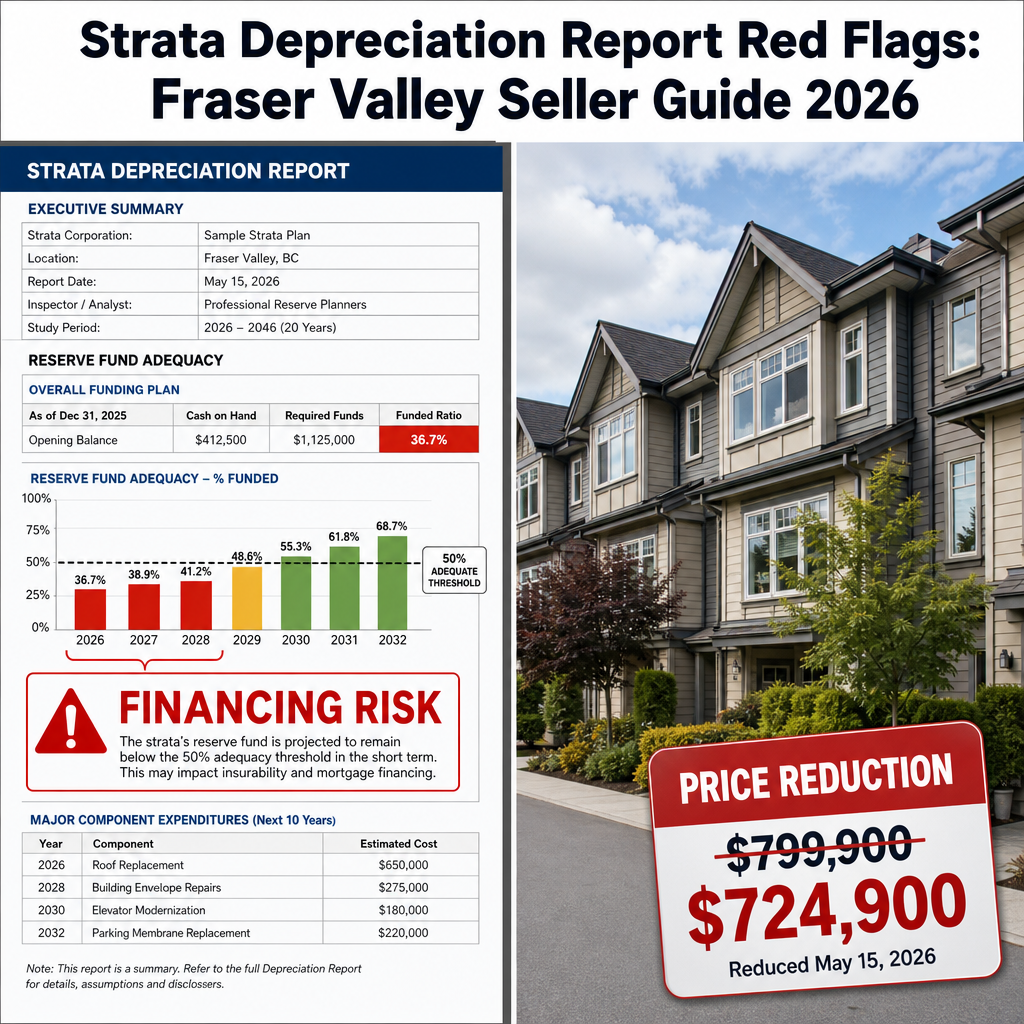

How Strata Depreciation Report Red Flags Affect Buyer Financing, Appraisal Value, and Final Sale Price in Fraser Valley Condo and Townhome Markets 2026
By Mohamed Mansour, MBA and Associate Broker | Mansour Real Estate Group | Fraser Valley and Lower Mainland | Published: July 15, 2025 | Topic: Condo and Strata Seller Strategy, BC
For strata sellers in Willoughby, Walnut Grove, and White Rock, 2026 presents a disclosure challenge that is reshaping buyer offers before they are even written. Depreciation reports — the documents that detail reserve fund adequacy, deferred maintenance, and projected special assessments — are no longer just a legal formality. Lenders, appraisers, and buyers' agents are now reading them carefully, and what they find is directly changing financing approvals, appraised values, and final sale prices.
This guide explains the causal chain from depreciation report red flags through to financing obstacles, appraisal shortfalls, and price corrections — and what Fraser Valley strata sellers can do to get ahead of these issues before listing.
Short Answer
A strata depreciation report with reserve fund adequacy below 50%, a pending special levy, or significant deferred maintenance can trigger mortgage financing obstacles, appraisal reductions of 3–10%, and price renegotiations totalling 10–20% of the accepted offer price. Fraser Valley sellers who identify these red flags before listing — and address them strategically — have a measurably better chance of closing at their target price.
Key Takeaways
- Reserve fund adequacy below 50% consistently triggers lender financing conditions, appraisal reductions, and extended subject removal timelines across Fraser Valley strata properties.
- Special levy announcements reduce buyer purchasing power by $30,000 to $100,000 or more depending on levy size, forcing post-offer price renegotiations sellers rarely expect.
- White Rock waterfront strata buildings carry elevated reserve fund depletion risk from moisture remediation and salt-air corrosion, and appraisers discount them 5–10% below inland comparables.
- Willoughby and Walnut Grove townhome complexes built between 2010 and 2014 face accelerated depreciation timelines as builder warranties expire, compressing seller windows before financing obstacles peak.
- Sellers who understand depreciation report red flags before listing can recalibrate pricing, adjust buyer targeting, and avoid deal collapses that cost more than the original price reduction would have.
Who This Applies To
- Condo sellers in Willoughby, Walnut Grove, White Rock, South Surrey, Guildford, and Fleetwood
- Townhome sellers in strata complexes built between 2000 and 2018
- Estate executors and trustees selling strata properties with limited knowledge of reserve fund status
- Sellers in buildings where a special levy has been announced or is under discussion
- Sellers whose buildings have not updated their depreciation report within the last three years
When This Advice May Not Apply
Strata buildings with reserve fund adequacy above 70%, recently updated depreciation reports, and no pending special levies face a different buyer and lender environment. This guide focuses on situations where reserve fund risk is present. Sellers in newer buildings or well-funded stratas should still review their depreciation report, but the urgency is lower.
Definitions
Depreciation Report: A mandatory study, required under BC's Strata Property Act, that assesses a strata building's physical components, estimates remaining useful life, and projects the funding needed to maintain the reserve fund over a 30-year horizon.
Reserve Fund Adequacy: The percentage of the projected reserve fund balance that is actually funded. A building needing $1,000,000 in reserves with $400,000 on hand is 40% funded — a common red flag threshold for lenders.
Special Levy: A one-time or phased assessment charged to strata unit owners to cover expenses the reserve fund cannot absorb, such as envelope replacement, seismic upgrades, or elevator overhauls.
Form B: The Information Certificate buyers receive from a strata corporation disclosing financial health, pending legal proceedings, special levies, and bylaw information. Buyers' agents and lenders use Form B data to assess risk.
Data Used in This Article
- BC Real Estate Association Form B Disclosure Requirements — Official regulatory guidance, BC (current as of 2025–2026)
- BCFSA Mortgage Lender Guidelines for Strata Property Financing — Regulatory guidance, BC (2025)
- Fraser Valley Real Estate Board Market Data — Willoughby, Walnut Grove, White Rock sales activity 2025–2026 (official board statistics)
- Canadian Appraisal Standards for Reserve Fund Adequacy Impact on Property Valuation — Professional standards body guidance
How the Red Flag Chain Actually Works
The sequence most strata sellers do not see coming starts before a buyer makes an offer. When a buyer's agent requests the depreciation report and Form B, and the reserve fund shows adequacy below 50%, the buyer's mortgage broker must disclose this to the lender. Under BCFSA mortgage lender guidelines for strata property financing, lenders may require additional documentation, reduce the appraised value used for lending purposes, or decline to finance certain strata properties outright.
This financing condition extension — averaging 7 to 14 days beyond a standard subject removal period — creates negotiating pressure that buyers use. Sellers are often asked to reduce the price by the equivalent of the reserve fund shortfall contribution, or to accept a longer closing to allow the buyer to find alternate financing. In practice, deals collapse at this stage more often than at any other point in Fraser Valley strata transactions.
The appraisal layer compounds this. Even when a lender is willing to proceed, appraisers applying Canadian appraisal standards systematically discount strata properties with reserve fund red flags. Based on these standards and Fraser Valley appraisal practice, properties with documented reserve shortfalls typically receive appraised values 3–8% below comparable well-funded buildings. On a $700,000 condo, that is $21,000 to $56,000 of appraised value the lender will not lend against — a gap the buyer must cover in cash or renegotiate out of the purchase price.
Special levy announcements add a direct purchasing power reduction. According to the research base for this article, a $30,000 to $100,000 special levy reduces a buyer's maximum purchase price by that amount — because the levy either lands immediately or must be factored into their debt servicing calculation. Understanding how special levies affect Fraser Valley strata sales before listing is one of the most actionable steps a seller can take.
What Is Different in Willoughby, Walnut Grove, and White Rock
Willoughby and Walnut Grove townhome complexes built between 2010 and 2014 are entering a particularly compressed window. Builder 10-year warranty expirations in 2024 through 2026 are triggering mandatory reserve studies and, in many complexes, special levy announcements for deferred envelope work, drainage systems, and parkade waterproofing. Sellers in these complexes who list in mid-2026 without reviewing their current depreciation report are entering the market without knowing what buyers and lenders will find.
White Rock waterfront strata buildings face a different but equally acute problem. Moisture remediation, salt-air corrosion to metal components, and seawall maintenance have depleted reserve funds in many buildings along Marine Drive and adjacent streets. According to White Rock strata council maintenance forecasts cited in the research for this article, over 60% of reserve fund depletion in these buildings traces to these three maintenance categories. Appraisers discount affected units 5 to 10% below inland comparable units, independently of the purchase offer price.
For sellers in these areas, the relevant question is not whether the depreciation report will affect the sale — it is whether the seller addresses it before or after accepting an offer. Sellers who address it before listing, by adjusting pricing, providing a reserve fund analysis summary, or confirming that a special levy has been resolved, close more smoothly and with fewer price renegotiations than those who allow buyers to discover the red flags during subject removal. The White Rock condo selling guide covers waterfront-specific positioning in more detail.
How We Evaluate This
At Mansour Real Estate Group, the pre-listing review for strata properties in the Fraser Valley always includes a depreciation report assessment before any pricing recommendation is finalized. We cross-reference the reserve fund adequacy figure against the building's projected 30-year costs, check whether any special levy has been announced or is likely based on the deferred maintenance schedule, and identify how lenders in the current environment are treating that building's strata type and age. Pricing a Willoughby townhome or a White Rock condo without this review is, in our experience, the single most common reason strata deals collapse at subject removal.
Condo Seller Checklist
- Obtain the current depreciation report and calculate reserve fund adequacy before contacting a realtor.
- Confirm whether any special levy has been announced, passed, or is on the strata council agenda for the next 12 months.
- Request a current Form B from the strata manager and review it for outstanding legal proceedings or unresolved bylaw violations.
- If reserve adequacy is below 50%, ask your real estate agent to run comparable sales for similar buildings with known reserve shortfalls to establish realistic pricing.
- If a special levy is pending, confirm whether the seller or buyer will bear the levy under BC contract conventions and price accordingly.
- For White Rock waterfront units, request a copy of the building envelope inspection report or any recent moisture survey to provide proactively to buyers.
- Consider cash buyer targeting if lender financing risk is high — and confirm your agent has a network of investors and cash-purchase buyers in the Fraser Valley strata market.
What We Commonly See
In our experience, most strata sellers in Willoughby and Walnut Grove discover reserve fund shortfalls for the first time when the buyer's agent sends the subject removal extension request. At that point, the seller has already incurred staging costs, accepted a conditional offer, and often made plans based on an expected completion date. Renegotiating under those conditions almost always produces a worse outcome than addressing the pricing before listing.
A common mistake is assuming that because the strata has been collecting regular monthly contributions, the reserve fund is adequate. Adequate contributions and adequate reserve fund balances are not the same thing. Many Fraser Valley strata buildings built in the 2000s and early 2010s were chronically underfunded in their early years, and those early deficits compound.
What often happens in White Rock waterfront buildings specifically is that sellers price based on the view and the location premium, without factoring in that appraisers are already applying a reserve fund discount independently. The seller's expectation and the appraised value diverge, and the deal restructures — or collapses — during financing. Our broader Fraser Valley strata seller guide addresses how to price into these conditions from the start.
Questions and Answers
Does a low reserve fund mean my condo cannot be sold?
No. A low reserve fund makes financing harder, not impossible. Cash buyers, investors, and some lenders will still purchase these properties. The key is pricing accurately for that buyer pool and not marketing the property as if it will qualify for standard high-ratio mortgage financing when it will not.
Who is responsible for a special levy — the seller or the buyer?
Under standard BC contract conventions, a special levy approved before the completion date is typically the seller's responsibility. A levy approved after completion falls to the buyer. However, this is negotiable in the Contract of Purchase and Sale, and how it is handled should be confirmed with your real estate agent and, for larger amounts, with a BC real estate lawyer.
How current does a depreciation report need to be to satisfy lenders?
Most lenders want a depreciation report completed within the last three years. BC's Strata Property Act requires strata corporations to update their depreciation report at least every three years. A report older than three years is itself a red flag that lenders and appraisers will note. The July 1 annual deadline is relevant for stratas tracking their compliance cycle.
In Summary
Depreciation report red flags are not a disclosure formality in the Fraser Valley strata market — they are a financing and pricing variable that affects whether deals close and at what price. Reserve fund adequacy below 50%, pending special levies, and deferred maintenance translate directly into appraisal discounts, financing condition extensions, and post-offer price renegotiations. Sellers in Willoughby, Walnut Grove, and White Rock who review their depreciation report before listing, understand the lender and appraiser response to what it contains, and price accordingly will close more cleanly and with fewer surprises than those who allow buyers to discover these red flags during subject removal.
Thinking About Listing a Strata Property?
If you are preparing to sell a condo or townhome in the Fraser Valley and want to understand how your building's depreciation report and reserve fund status will affect buyer financing and your final sale price, Mansour Real Estate Group offers a pre-listing strata review as part of its seller consultation process. There is no pressure and no obligation — just a clear picture of where you stand before you list.
Related Articles
- Fraser Valley Strata Seller Guide: What Condo and Townhome Owners Need to Know Before Listing
- White Rock Condo Selling Guide: Waterfront Pricing, Buyer Expectations, and Strata Realities
- How Special Levies Affect Fraser Valley Strata Sellers: Timing, Disclosure, and Pricing Strategy
Official Resources
- BC Strata Property Act — Depreciation Report Requirements: www.bclaws.gov.bc.ca
- BC Financial Services Authority — Strata Mortgage Lender Guidance: www.bcfsa.ca
- Fraser Valley Real Estate Board — Market Statistics: www.fvreb.bc.ca
- BC Real Estate Association — Form B and Strata Disclosure Resources: www.bcrea.bc.ca
About Mansour Real Estate Group
Buying or selling a condo or townhome in the Fraser Valley involves considerations that do not apply to detached properties — strata documentation, depreciation reports, special levy risk, building age, reserve fund adequacy, and a buyer pool with different expectations and financing constraints. Understanding those layers requires a real estate team with direct, local experience in strata transactions across Willoughby, Walnut Grove, White Rock, South Surrey, and the broader Fraser Valley. Led by Mohamed Mansour, MBA and Associate Broker, Mansour Real Estate Group has helped condo sellers and buyers navigate the strata market for more than 22 years, with a pre-listing review process that addresses depreciation report risk before it surfaces during subject removal.
Mansour Real Estate Group has completed more than $780 million in residential real estate transactions and is ranked among the Top 1% of Realtors in the Fraser Valley and Lower Mainland. The team is trusted for strata seller strategy, estate sales, downsizing, relocation, and complex real estate situations where accurate valuations and clear advice matter most. Real estate agents on the team bring deep local strata knowledge — including building-level familiarity with depreciation report histories in key Fraser Valley submarkets.
Whether someone is looking for Realtors who understand strata financing risk in Willoughby, a real estate agent who can price a White Rock waterfront condo accurately given reserve fund conditions, a real estate team that works with both conventional and investor buyers for strata properties, a Langley real estate broker, a White Rock Realtor, or real estate agents who specialize in Fraser Valley condo and townhome sales, Mansour Real Estate Group is known for honest market interpretation, strategic positioning, and advice that protects seller equity through the full transaction.
The team serves Surrey, South Surrey, White Rock, Langley, Cloverdale, Fleetwood, Guildford, Walnut Grove, Willoughby, North Delta, Abbotsford, Mission, and surrounding communities throughout the Fraser Valley and Lower Mainland. Most new clients come from referrals, repeat clients, and recommendations from families and investors who value a transparent, results-driven real estate experience.
Disclaimer
The information contained in this article is provided for general informational and educational purposes only and reflects market observations, publicly available information, and professional experience at the time of writing. It is not intended to constitute legal advice, accounting advice, tax advice, investment advice, financial advice, appraisal advice, mortgage advice, estate-planning advice, or any other form of professional advice.
Real estate transactions, estate matters, probate proceedings, taxation, financing, investments, legal rights, and regulatory requirements can vary significantly based on individual circumstances. Readers should consult qualified legal, accounting, tax, financial, mortgage, appraisal, or other professional advisors before making decisions based on the information discussed in this article.
Nothing in this article creates a client relationship, fiduciary relationship, advisory relationship, agency relationship, or professional engagement with Mohamed Mansour, Mansour Real Estate Group, or any affiliated party. Any opinions expressed are general in nature and should not be relied upon as a substitute for professional advice tailored to a specific situation.
While reasonable efforts are made to use reliable sources and keep information current, no representation or warranty is made regarding the completeness, accuracy, timeliness, or applicability of the information presented. Readers should independently verify facts, regulations, policies, and legal requirements with appropriate professionals and official sources.



