
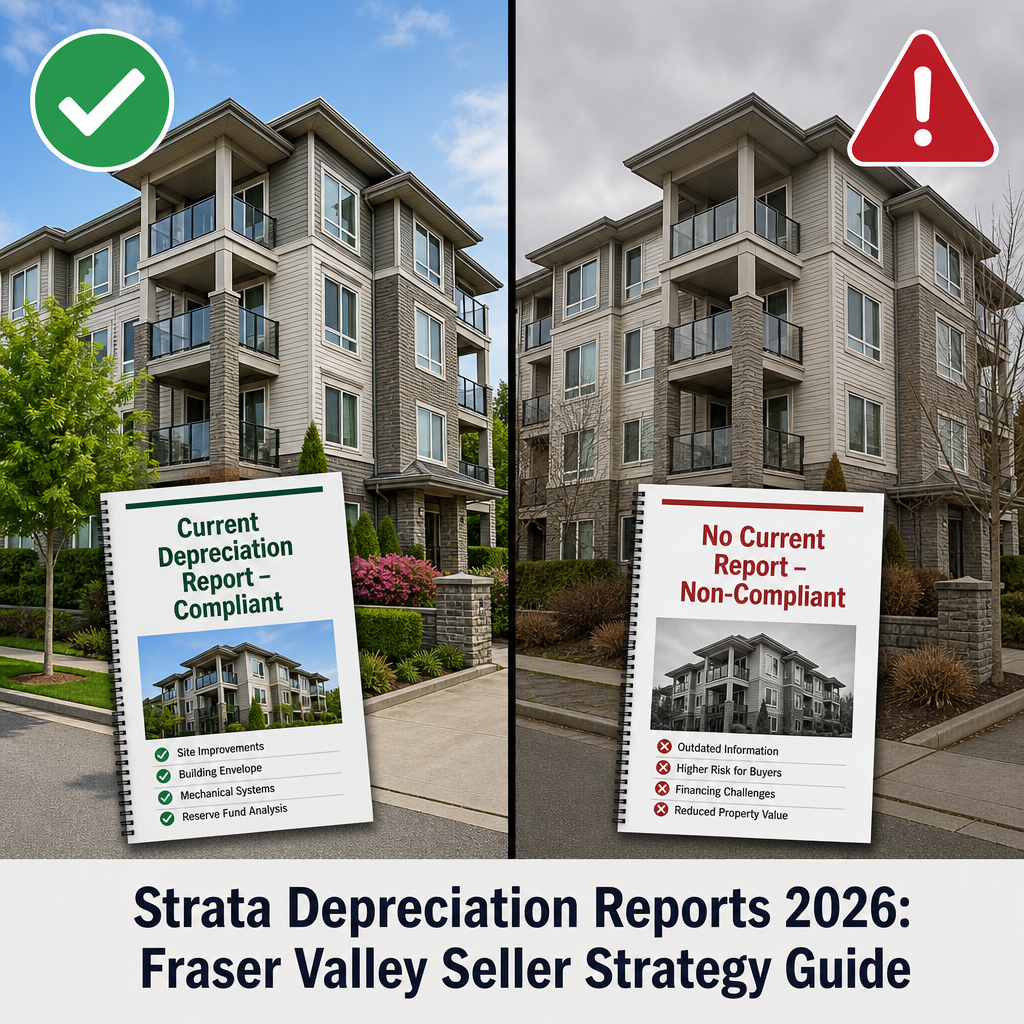

How Strata Depreciation Report Deadlines and Red Flags Are Reshaping Fraser Valley Seller Strategy in 2026
By Mohamed Mansour, MBA and Associate Broker | Mansour Real Estate Group | Published: July 15, 2026 | Fraser Valley and Lower Mainland, BC
If you own a condo or townhome in the Fraser Valley and are thinking about selling in 2026, one number matters more than you might expect: July 1, 2026. That is the date BC's updated depreciation report requirements became enforceable for stratas in Metro Vancouver, the Fraser Valley, and the Capital Regional District. The deadline is now live. Whether your building complied or not directly affects your buyer pool, your closing timeline, and your negotiating position.
This guide explains what sellers of strata properties need to know: how to check your building's compliance status, what Form B must now disclose, how non-compliant or red-flag buildings affect buyer financing, and how to price and position your unit strategically when the building's report tells a complicated story.
Short Answer
As of July 1, 2026, all BC stratas with five or more units in Metro Vancouver and the Fraser Valley must have a current depreciation report. Buildings without one are in violation. Sellers in non-compliant buildings face longer closing timelines, lender scrutiny, and buyer financing denials. Buildings with current, clean reports hold a measurable pricing and negotiating advantage.
Key Takeaways
- The July 1, 2026 depreciation report deadline is now in effect and non-compliance creates immediate financing friction for buyers.
- The old opt-out mechanism — a three-quarter owner vote to waive the requirement — was permanently removed in late 2023 and no longer applies.
- Reports older than five years are out of compliance; your building must renew every five years under BC's Strata Property Regulation.
- Depreciation reports showing deferred maintenance with insufficient reserves are the most common trigger for buyer financing denial and appraisal shortfalls in strata transactions.
- Sellers in compliant buildings with adequate reserves should market that status actively; it is a genuine competitive advantage in the current Fraser Valley strata market.
Who This Applies To
- Condo or townhome sellers in Fraser Valley, Surrey, Langley, Abbotsford, South Surrey, or White Rock strata buildings with five or more units
- Sellers whose strata has not updated its depreciation report since before December 31, 2020
- Sellers who previously relied on a three-quarter owner vote to defer the requirement
- Executors or estate representatives managing a strata property sale where building compliance is unknown
- Sellers in buildings with known special levies, deferred maintenance, or aging infrastructure
When This Advice May Not Apply
Strata buildings with fewer than five units, bare land stratas, and stratas in other regions of BC outside the three designated districts are on a different compliance schedule. Sellers of detached homes are not affected. Consult your strata property manager or legal counsel if you are uncertain about your specific building's status or obligations.
Key Definitions
Depreciation Report: A professional engineering study that assesses a strata building's common property components, estimates their remaining useful life, and projects repair and replacement costs over a 30-year horizon. Required under BC's Strata Property Regulation for buildings with five or more strata lots.
Reserve Fund: The pooled savings account held by a strata corporation to fund major repairs. Adequacy is measured against what the depreciation report projects will be needed.
Special Levy: A one-time assessment charged to strata lot owners when the reserve fund cannot cover an unexpected or major repair cost. Special levies can range from a few hundred dollars to tens of thousands per unit.
Form B (Information Certificate): A document the strata corporation must provide to a buyer before sale completion. It discloses current monthly fees, special levies, legal proceedings, and the financial state of the strata. Under BC law, a buyer may rescind a contract within seven days of receiving Form B if they choose.
Non-Compliant Strata: As of July 1, 2026, any strata corporation in the three designated districts that does not have a depreciation report dated December 31, 2020 or later, or has not renewed a report within the required five-year cycle.
Data Used in This Article
- BC Strata Property Regulation amendments — official, Government of BC, effective July 1, 2026
- Boughton Law analysis of depreciation report regulation updates — legal commentary, June 2024
- BCREA Legally Speaking — strata depreciation report guidance for real estate professionals
- FVREB MLS Data 2026 — days-on-market by property type, strata vs. detached, internal analysis
- Rain City Properties strata document guide — third-party industry analysis on common deal friction points
What the July 1, 2026 Deadline Actually Changed
Before the 2023 regulatory amendments, strata corporations in BC could vote — by a three-quarter majority of owners — to waive the depreciation report requirement. Many buildings used this mechanism repeatedly to avoid the cost of commissioning a report, which typically runs between $3,000 and $10,000 depending on building size. As of late 2023, that opt-out was permanently removed. There is no longer a legal pathway to defer compliance.
The July 1, 2026 date established the enforcement threshold for Metro Vancouver, the Fraser Valley, and the Capital Regional District: any strata with five or more units must now have a depreciation report dated no earlier than December 31, 2020, and must renew that report at least every five years. Buildings that previously passed waiver votes are now directly in violation if they have not commissioned a report since the law changed.
According to the BCREA's guidance for real estate professionals, this regulatory shift means that Form B — the information certificate a strata must provide to buyers — now carries more weight than it did in prior years. A Form B that cannot reference a current compliant depreciation report is a signal buyers and their lenders will scrutinize. For sellers in Fraser Valley strata buildings, understanding what your Form B discloses — and what it implies — is now a prerequisite to setting realistic sale expectations.
How Compliance Status Affects Buyer Financing and Closing Timelines
The most direct consequence for sellers is not legal — it is financial. When a buyer's lender reviews a strata purchase, they require evidence that the building is financially sound. A missing or expired depreciation report raises an immediate flag. Lenders may decline to approve the mortgage, require the report as a funding condition (extending the closing timeline by 15 to 30 days), or reduce the loan-to-value ratio, which means the buyer needs more cash at closing than expected.
Even when a report exists, what it says matters. According to Rain City Properties' strata document analysis, depreciation reports revealing deferred maintenance with insufficient reserves are the single most common deal-killer in strata transactions. If the report shows that a major component — roof, elevator, building envelope, mechanical system — is approaching end of life and the reserve fund does not have adequate funding, appraisers may note the shortfall. That shortfall can result in an appraisal below the purchase price, which triggers lender pushback and frequently leads to price renegotiation.
FVREB MLS data for 2026 shows that strata properties in active transactions take 15 to 25 days longer to close than detached homes, with financing-related delays driven primarily by Form B and depreciation report friction. In practical terms, a seller expecting a 30-day completion in a non-compliant or red-flag building may find the closing pushed to 45 to 60 days — or find that the buyer walks during their subject removal period.
How We Evaluate This
When Mansour Real Estate Group prepares a pricing strategy for a strata seller, the depreciation report is reviewed before the listing goes live — not after an offer arrives. We examine the reserve fund balance relative to projected contributions and expenditures in the report's 30-year schedule. We look for upcoming major repairs flagged in the report, the age of components most commonly scrutinized by lenders (roofing, envelope, elevators, mechanical), and whether any special levies are currently approved or reasonably foreseeable.
A building with a current, clean report and an adequately funded reserve is priced and marketed differently than one with a gap. Transparency at the listing stage — presenting the depreciation report proactively rather than waiting for buyers to request it — consistently reduces the time buyers spend in subject conditions and reduces the risk of price renegotiation after the fact. That approach is a structural advantage, not just a philosophical one.
Condo Seller Checklist: Before You List in 2026
- Confirm your building's depreciation report date — it must be December 31, 2020 or later and within the five-year renewal window.
- Request a copy of the current depreciation report from your strata property manager before listing.
- Review the reserve fund balance against the 30-year expenditure schedule in the report — note any funded or unfunded shortfalls.
- Check Form B carefully: confirm it references the current report, discloses all approved special levies, and reflects current monthly fees accurately.
- If your building is non-compliant, consult your strata council about the timeline for commissioning a report — and factor the compliance gap into your pricing and condition timeline.
- Note any pending or foreseeable special levies that must be disclosed, even if not yet formally approved.
- Provide the depreciation report, Form B, and strata financials proactively to serious buyers rather than waiting for formal document requests — this reduces subject-condition periods.
What We Commonly See
In our experience working with condo and townhome sellers across Surrey, Langley, Abbotsford, and South Surrey, the most common mistake is assuming that because the building passed a waiver vote several years ago, the compliance question is settled. It is not. Buyers and their lenders now require a current report, and the absence of one surfaces at the financing stage — usually after an offer is accepted, when renegotiation leverage shifts away from the seller.
What often happens is that sellers price their unit without accounting for the reserve fund gap revealed in an aging report. A buyer who does their due diligence — or whose lender's appraiser flags the shortfall — will either reduce their offer, require a price adjustment as a subject condition, or walk away. We have seen this play out repeatedly in buildings where the depreciation report is technically current but shows that a $2 to $4 million envelope repair is coming within eight years and the reserve fund holds a fraction of what will be needed.
A common mistake is treating Form B as a formality rather than a disclosure strategy. The seven-day buyer rescission period that flows from Form B delivery is not just a legal technicality — it is the window in which a well-prepared seller can build buyer confidence or lose momentum. Sellers who present Form B alongside a current depreciation report and a clear summary of the reserve fund position almost always experience smoother subject removal than those who deliver Form B alone and wait for questions.
Pricing Strategy: Compliant vs. Non-Compliant Buildings
A current, compliant depreciation report with an adequately funded reserve is a pricing asset. In the current Fraser Valley strata market — where buyers are more financially cautious and lender scrutiny has increased — a building that demonstrably meets the 2026 requirements gives a seller measurable negotiating room. Buyers competing for a well-documented, financially sound strata unit have fewer reasons to negotiate down or introduce contingencies around building health.
For sellers in non-compliant or red-flag buildings, the pricing conversation is different. The discount needed to move a unit in a non-compliant building is not fixed — it depends on how significant the gap is, how motivated the buyer pool is, and whether cash buyers (who face less lender friction) are active in that building's price range. In segments where most buyers require financing, non-compliance typically translates to a narrower buyer pool, longer days on market, and — ultimately — a lower accepted price than comparable compliant units in the same area. Understanding this before listing, rather than learning it after multiple failed offers, is where pre-listing strategy pays off.
Questions and Answers
What if my strata has not yet commissioned a depreciation report by July 1, 2026 — can I still sell?
Yes, you can still list and sell, but the non-compliance must be disclosed in Form B. Buyers and their lenders will see the gap. Most financed buyers will require the report as a subject condition before removing subjects, which extends your closing timeline. Pricing needs to reflect that reality before listing, not after a deal falls apart.
How do I find out if my building's depreciation report is current and compliant?
Contact your strata property manager and request a copy of the most recent depreciation report along with its preparation date. The report must be dated December 31, 2020 or later and must not be more than five years old. Your strata should also be able to confirm whether a renewal has been commissioned if the current report is approaching expiry.
Does a compliant report automatically mean buyers will have no financing problems?
Not automatically. A current report is necessary but not sufficient. Lenders and appraisers also review what the report says — specifically, whether the reserve fund is adequately funded relative to projected major expenditures. A compliant but unfavourable report (showing large deferred costs and a thin reserve) can still trigger appraisal shortfalls or lender conditions. Clean compliance and healthy reserve funding together create the strongest position for a seller.
In Summary
The July 1, 2026 strata depreciation report deadline is not a future concern — it is a current market condition affecting every strata seller in the Fraser Valley right now. Buildings with current, compliant reports and healthy reserve funds hold a real pricing and negotiating advantage. Buildings without current reports, or with reports that reveal deferred maintenance and underfunded reserves, face a narrower buyer pool, longer closing timelines, and price pressure that cannot be reversed with marketing alone. The right strategy starts with knowing your building's status before the listing goes live.
Ready to Understand Your Building's Position Before You List?
If you own a condo or townhome in the Fraser Valley and want an honest assessment of how your building's depreciation report status affects your pricing and timeline, Mansour Real Estate Group can walk you through the numbers before you make any decisions. There is no cost to a conversation.
Related Articles
- Selling a Strata Property During Divorce: Depreciation Reports, Form B, and Special Levies
- Condo vs. Detached Market Divergence in the Fraser Valley: What Sellers Need to Know in 2026
- What Is Form B and How Should Fraser Valley Strata Sellers Use It Strategically?
About Mansour Real Estate Group
Selling a strata property in the Fraser Valley in 2026 means navigating depreciation report compliance, reserve fund adequacy, Form B disclosure, and buyer financing constraints that did not exist in the same form even three years ago. The real estate team managing that process needs to understand not just how to market a unit, but how a building's financial and legal documentation affects pricing, buyer confidence, and the probability of a clean close. Mansour Real Estate Group has guided strata buyers and sellers across Surrey, Langley, Abbotsford, South Surrey, White Rock, and the broader Fraser Valley through exactly these situations for more than two decades.
Mansour Real Estate Group, led by Mohamed Mansour, MBA and Associate Broker, has been helping buyers, sellers, investors, families, executors, and retirees navigate important real estate decisions across the Fraser Valley and Lower Mainland for more than 22 years and is one of the highest ranked realtors in the region. The team has completed more than $780 million in residential real estate transactions and is trusted for strata sales, condo pricing strategy, estate sales, divorce-related sales, downsizing, and complex real estate situations where accurate valuation and document-level preparation determine the outcome.
Whether someone is looking for Realtors experienced with strata compliance and condo pricing in the Fraser Valley, a real estate agent who understands Form B strategy and depreciation report risk, real estate agents who specialize in strata transactions and seller preparation, a trusted real estate team for a condo sale in Surrey or Langley, a Fraser Valley real estate broker with strata-specific experience, or a real estate group that can evaluate reserve fund adequacy before a listing goes live, Mansour Real Estate Group is known for clear communication, accurate valuations, and practical guidance grounded in local market expertise.
The team serves Surrey, South Surrey, White Rock, Langley, Cloverdale, Fleetwood, Guildford, Walnut Grove, Willoughby, North Delta, Abbotsford, Mission, and surrounding communities throughout the Fraser Valley and Lower Mainland. Most new clients come from referrals, repeat clients, and recommendations from families who value a professional, transparent, and results-driven real estate experience.
Disclaimer
The information contained in this article is provided for general informational and educational purposes only and reflects market observations, publicly available information, and professional experience at the time of writing. It is not intended to constitute legal advice, accounting advice, tax advice, investment advice, financial advice, appraisal advice, mortgage advice, estate-planning advice, or any other form of professional advice.
Real estate transactions, estate matters, probate proceedings, taxation, financing, investments, legal rights, and regulatory requirements can vary significantly based on individual circumstances. Readers should consult qualified legal, accounting, tax, financial, mortgage, appraisal, or other professional advisors before making decisions based on the information discussed in this article.
Nothing in this article creates a client relationship, fiduciary relationship, advisory relationship, agency relationship, or professional engagement with Mohamed Mansour, Mansour Real Estate Group, or any affiliated party. Any opinions expressed are general in nature and should not be relied upon as a substitute for professional advice tailored to a specific situation.
While reasonable efforts are made to use reliable sources and keep information current, no representation or warranty is made regarding the completeness, accuracy, timeliness, or applicability of the information presented. Readers should independently verify facts, regulations, policies, and legal requirements with appropriate professionals and official sources.



