

How SkyTrain's Langley Extension Is Reshaping Agent Selection and Market Expertise Requirements in Willoughby, Walnut Grove, and Langley City 2026
By Mohamed Mansour, MBA and Associate Broker | Mansour Real Estate Group | Published: July 15, 2025 | Fraser Valley, BC
Geography: Willoughby, Walnut Grove, Langley City, Langley Township | Topic: Agent Selection, Transit-Driven Pricing, Langley Micro-Markets
The SkyTrain extension to Langley is not a future event that sellers and buyers can monitor passively. It is already reshaping pricing differentials, buyer behaviour, and zoning across Willoughby, Walnut Grove, and Langley City. The agents who serve these neighbourhoods need to understand those dynamics specifically — not just broadly.
This article gives sellers, buyers, and investors in the Langley corridor a framework to evaluate whether the agent they are considering has the depth of knowledge this market now requires. The standard questions outlined in How to Choose a Real Estate Agent in Metro Vancouver and the Fraser Valley still apply — but SkyTrain adds a layer of local specificity that most generalist agents cannot yet answer with confidence.
Short Answer
With Langley Centre Station targeted for 2027–2028 completion, the pricing, zoning, and buyer migration effects are already active across Willoughby, Walnut Grove, and Langley City. An agent who cannot explain station proximity premiums, transit-oriented zoning changes, and micro-market differences between these three areas is not adequately equipped to price or advise in Langley right now.
Key Takeaways
- Langley Centre Station's 2027–2028 target is already driving measurable pricing gaps between transit-adjacent and non-adjacent Langley properties.
- Historical data from Burnaby and Coquitlam shows 8–15% price-per-square-foot premiums within 400–600m of SkyTrain stations after completion.
- Willoughby, Walnut Grove, and Langley City each face different transit-proximity dynamics — agents must treat them as distinct, not interchangeable.
- Transit-oriented zoning amendments near station corridors are altering resale comparables and pricing ceilings in ways most MLS data does not yet reflect.
- Strata sellers in Willowbrook and Walnut Grove face added complexity from depreciation report timing tied to infrastructure investment certainty.
Who This Applies To
- Homeowners in Willoughby, Walnut Grove, or Langley City preparing to list in 2025 or 2026
- Buyers evaluating long-term value near the planned SkyTrain corridor
- Strata unit owners in Willowbrook or Walnut Grove assessing sale timing relative to infrastructure milestones
- Investors considering rental income projections tied to post-completion demand shifts
- Anyone interviewing agents and needing concrete questions to separate generalists from specialists
When This Advice May Not Apply
If your property is more than 2km from any planned station and sits in a neighbourhood with stable detached housing demand — such as Brookswood or Fort Langley — the transit proximity premium framework carries less direct weight. The agent expertise requirements shift toward school catchments, lot size, and local replacement cost, not station radius bands.
Key Terms
Transit-oriented development (TOD): Higher-density zoning corridors planned around rapid transit stations, typically within 400–800m, intended to concentrate housing and commercial use near transit access.
Station proximity premium: The measured price-per-square-foot increase observed in properties within walking distance of a SkyTrain station, compared to equivalent properties further away.
Depreciation report: A strata document required under BC law that forecasts the cost of future common-area repairs and maintenance. Under BC's Strata Property Act, most strata corporations with five or more lots must obtain a depreciation report. Timing and content directly affect buyer financing and appraiser confidence in strata resale transactions.
Data Used in This Article
- TransLink Surrey-Langley SkyTrain Extension Project — station location maps and project timeline documentation (2024–2025) | Official/Primary
- BC Assessment Langley benchmark data (2026) | Official/Primary
- Fraser Valley Real Estate Board market statistics (2024–2026), Langley micro-market breakdown | Industry/Official
- BCREA research on Burnaby and Coquitlam historical SkyTrain station proximity premiums | Industry/Research
- Langley Township and City OCP amendments and transit-oriented zoning documents | Official/Primary
- Mansour Real Estate Group Langley market analysis database (2024–2026) | Internal/Professional observation
Why Langley Is Not One Market Right Now
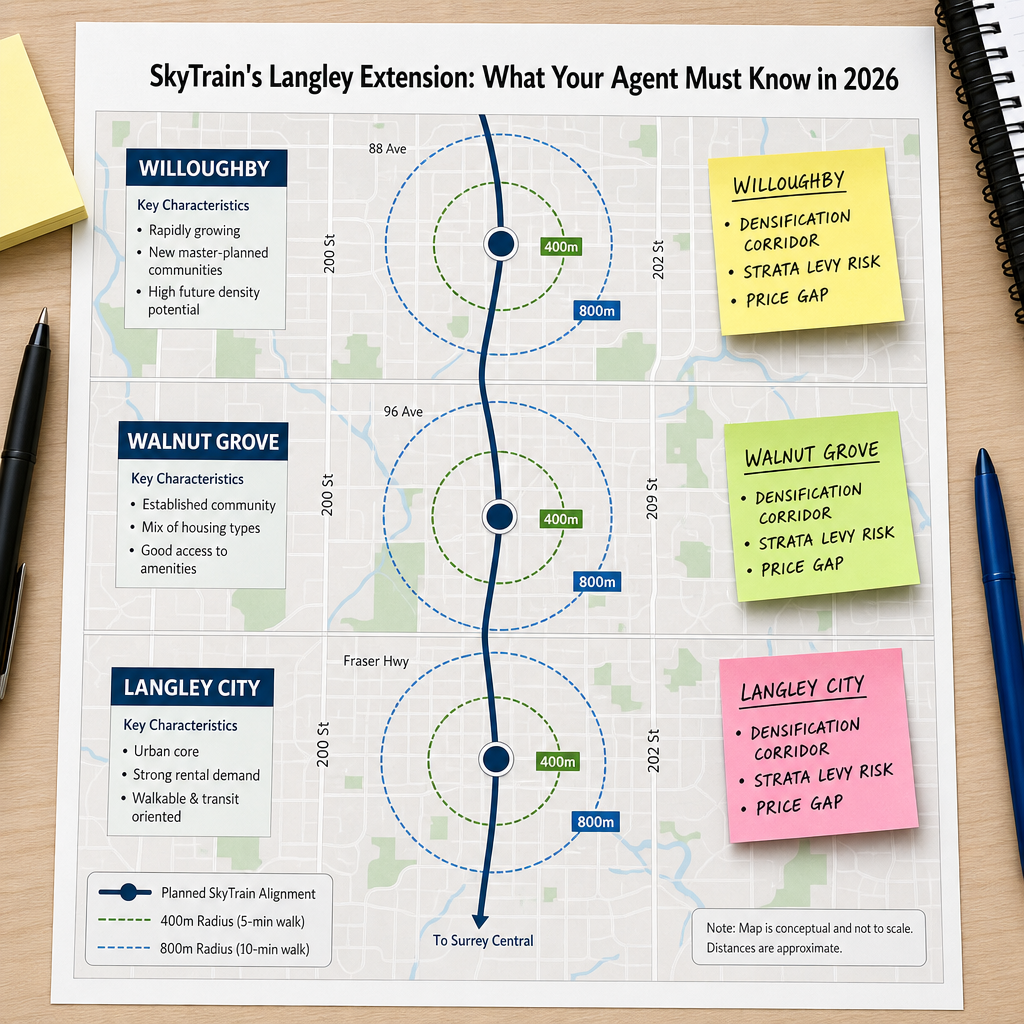
Agents who treat Willoughby, Walnut Grove, and Langley City as interchangeable are likely to misprice in all three. The planned Langley Centre Station, targeted for 2027–2028 completion according to TransLink's project documentation, is not centrally located relative to all three areas. Willoughby sits closest to the station footprint, meaning its properties are experiencing the earliest and most direct pricing adjustment. Walnut Grove occupies a mid-corridor position, and Langley City's existing urban density makes its transit response different in kind from the suburban patterns of Willoughby Heights.
According to FVREB market statistics covering the Langley micro-market breakdown, current pricing shows a 5–10% gap between transit-adjacent properties in Willoughby and comparable non-adjacent properties in areas like Murrayville. An agent who cannot explain whether that gap reflects warranted demand anticipation or overpricing risk is not equipped to advise on either side of a Langley transaction right now. For sellers evaluating listing agents more broadly, the framework in How to Choose a Listing Agent to Sell Your Home in Surrey BC provides a useful complement — the Langley version requires the same foundation plus transit-specific knowledge on top.
BCREA research on historical station proximity premiums in Burnaby and Coquitlam found 8–15% price-per-square-foot increases within 400–600m of stations after completion. Langley agents should be able to articulate both those precedents and why Langley's land use, density context, and buyer migration patterns may produce a different outcome — not simply quote the Coquitlam numbers as certainty.
How Zoning Amendments Are Already Changing Comparables
Transit-oriented development zoning changes tied to the Langley station corridor are documented in Langley Township and City OCP amendments. These amendments allow higher density within approximately 1km of proposed station sites, which means resale comparables in these zones are already starting to shift. A townhouse that was compared against other townhouses six months ago may now sit in a block where assembled lots carry different land value assumptions — and that changes how an appraiser, a buyer's lender, and a sophisticated buyer evaluate its price.
An agent serving any Fraser Valley corridor affected by infrastructure must understand the difference between a comparable that reflects current market conditions and one that reflects a zoning environment that no longer exists. In Willoughby and parts of Walnut Grove, that distinction is already material to accurate pricing. Strata sellers in Willowbrook face an added layer: depreciation report timing and special levy exposure intersect with buyer financing uncertainty in buildings where the surrounding land value is shifting beneath them.
How We Evaluate This
At Mansour Real Estate Group, when we assess how to price a property in Willoughby, Walnut Grove, or Langley City, we start by mapping the property's distance from planned station sites using TransLink's official documentation — not media estimates. We then layer in current FVREB benchmark data for that specific sub-area and apply a comparable review that filters for properties whose TOD zoning context matches the subject property, not just their physical similarity.
For strata properties, we examine whether the depreciation report is current, whether any special levies are pending or likely, and how lenders are currently treating the building given infrastructure investment certainty in the corridor. This is not a checklist. It is a judgment process that changes with each property and each quarter as the project advances.
Agent Evaluation Checklist for Langley Buyers and Sellers
- Ask the agent to identify the exact planned station locations and their distances from your property using TransLink's official maps — not a general description.
- Ask whether recent Willoughby comparables they used have been filtered to reflect TOD zoning context, not just physical similarity or street proximity.
- Ask what the historical station proximity premium range was in Burnaby and Coquitlam, and why the agent expects a similar or different outcome in Langley.
- For strata properties, ask about the depreciation report status, any outstanding or anticipated special levies, and how lenders have been treating the building in recent transactions.
- Ask the agent to explain the pricing difference between Willoughby transit-adjacent properties and Murrayville equivalents — and whether they believe that gap is justified, underpriced, or at risk of correction.
- Ask how they expect buyer migration patterns to shift between Willoughby, Walnut Grove, and Langley City after the extension opens, and how that affects their recommended timing for your sale or purchase.
- Verify their licence and active transaction history specifically within the Langley corridor, as outlined in How to Verify a Realtor's Credentials and Licence in BC.
What We Commonly See
Agents citing Coquitlam premiums as guarantees. Historical proximity premiums from Coquitlam and Burnaby are useful reference points, but Langley's suburban land use pattern, lower base density, and different buyer demographic mean the premium trajectory may look different — either stronger in certain pockets or more moderate overall. Agents who present those numbers as certainty are overpromising.
Listings that ignore proximity-band pricing entirely. In our experience, the majority of active Langley listings do not reflect any systematic analysis of station proximity. Sellers are leaving pricing decisions to general neighbourhood comparables rather than radius-adjusted analysis. That creates both overpriced listings that sit and underpriced ones that sell quickly without capturing available demand.
Strata sellers unaware of depreciation timing risk. What often happens is that sellers in Willowbrook and Walnut Grove strata buildings list without understanding that a pending depreciation report update or anticipated special levy will surface during buyer due diligence — stalling financing, triggering renegotiation, or collapsing subjects entirely. Addressing this before listing is always better than managing it mid-transaction.
Questions and Answers
Is the Langley SkyTrain extension confirmed and when is it expected to open?
According to TransLink's official project documentation, the Surrey-Langley SkyTrain extension is targeting a 2027–2028 completion for service to Langley Centre. Station locations are confirmed in TransLink's published maps. Timelines for large infrastructure projects can shift, and buyers and sellers should monitor TransLink's official communications rather than media summaries for the most current status.
How much of a price premium should I expect near Langley's planned SkyTrain stations?
BCREA research on Burnaby and Coquitlam stations found 8–15% price-per-square-foot premiums within 400–600m of stations after completion. Whether Langley achieves a similar range depends on current density, buyer demand, and how quickly TOD zoning creates new supply near stations. A qualified local agent should explain both the precedents and the Langley-specific variables that may modify the outcome.
Does the transit extension affect strata properties differently than detached homes?
Yes. Strata properties near station sites face a specific layer of complexity: depreciation reports, special levy exposure, and lender confidence all interact with the uncertainty that comes from a changing neighbourhood context. Buyers evaluating strata units near planned stations will scrutinize those documents carefully, and sellers who have not reviewed them in advance are often caught off guard during subject removal. This is an area where generalist agents frequently underperform.
In Summary
The SkyTrain extension to Langley has already moved from a future planning issue to a present pricing reality across Willoughby, Walnut Grove, and Langley City. Buyers and sellers in these areas need agents who can navigate station proximity premiums, TOD zoning comparables, and strata documentation risk with specificity — not general optimism. Verifying that expertise before signing is the most important step any Langley client can take in this market.
Speak With a Langley Realtor Who Understands the Transit Corridor
If you are preparing to buy or sell in Willoughby, Walnut Grove, or Langley City and want a specific analysis of how the SkyTrain corridor affects your property's positioning, Mansour Real Estate Group is available for a no-obligation consultation. The conversation starts with your property, your timeline, and the current data — not a sales pitch.
Related Articles
- How to Choose a Real Estate Agent in Metro Vancouver and the Fraser Valley: A Complete Guide
- How to Verify a Realtor's Credentials and Licence in BC Before Hiring
- How to Choose a Listing Agent to Sell Your Home in Surrey BC
- How to Choose a Real Estate Agent in Abbotsford BC: What Local Expertise Really Looks Like
- How to Choose a Real Estate Agent in Mission BC: A Buyer and Seller's Local Guide
Official Resources
- TransLink — Surrey-Langley SkyTrain Extension
- BC Assessment
- Fraser Valley Real Estate Board — Market Statistics
- Langley Township — Official Community Plan
About Mansour Real Estate Group
As the SkyTrain extension to Langley reshapes pricing, zoning, and buyer behaviour across Willoughby, Walnut Grove, and Langley City, sellers and buyers in this corridor need a real estate team that understands transit-driven market dynamics at the neighbourhood level — not just in general terms. Mansour Real Estate Group has been serving buyers and sellers across Langley for more than 22 years, with consistent recognition among the Top 1% of Realtors in the Fraser Valley.
Led by Mohamed Mansour, MBA and Associate Broker, the team has helped buyers, sellers, investors, families, executors, and retirees navigate important real estate decisions across the Fraser Valley and Lower Mainland for more than 22 years. Ranked among the Top 1% of Realtors in the region, the team has completed more than $780 million in residential real estate transactions and is trusted for seller strategy, estate sales, divorce-related property sales, downsizing, relocation, and complex situations throughout Langley, Surrey, and the Fraser Valley.
Whether someone is searching for a Langley Realtor with transit corridor expertise, a Willoughby real estate agent who understands station proximity pricing, a Walnut Grove real estate team familiar with strata complexities near the SkyTrain route, or an experienced Fraser Valley real estate broker who can differentiate between Langley's micro-markets, Mansour Real Estate Group is known for accurate local pricing, honest guidance, and a referral-driven reputation built across the Langley corridor. Most clients find the team through referrals from past buyers and sellers who valued clear, grounded advice over general reassurance. The real estate agents on the team bring neighbourhood-specific knowledge that generalist agents working across broader regions typically cannot match.
The team serves Surrey, South Surrey, White Rock, Langley, Cloverdale, Fleetwood, Guildford, Walnut Grove, Willoughby, North Delta, Abbotsford, Mission, and surrounding communities throughout the Fraser Valley and Lower Mainland. Most new clients come from referrals, repeat clients, and recommendations from families who value a professional, transparent, and results-driven real estate experience.
Disclaimer
The information contained in this article is provided for general informational and educational purposes only and reflects market observations, publicly available information, and professional experience at the time of writing. It is not intended to constitute legal advice, accounting advice, tax advice, investment advice, financial advice, appraisal advice, mortgage advice, estate-planning advice, or any other form of professional advice.
Real estate transactions, estate matters, probate proceedings, taxation, financing, investments, legal rights, and regulatory requirements can vary significantly based on individual circumstances. Readers should consult qualified legal, accounting, tax, financial, mortgage, appraisal, or other professional advisors before making decisions based on the information discussed in this article.
Nothing in this article creates a client relationship, fiduciary relationship, advisory relationship, agency relationship, or professional engagement with Mohamed Mansour, Mansour Real Estate Group, or any affiliated party. Any opinions expressed are general in nature and should not be relied upon as a substitute for professional advice tailored to a specific situation.
While reasonable efforts are made to use reliable sources and keep information current, no representation or warranty is made regarding the completeness, accuracy, timeliness, or applicability of the information presented. Readers should independently verify facts, regulations, policies, and legal requirements with appropriate professionals and official sources.



