
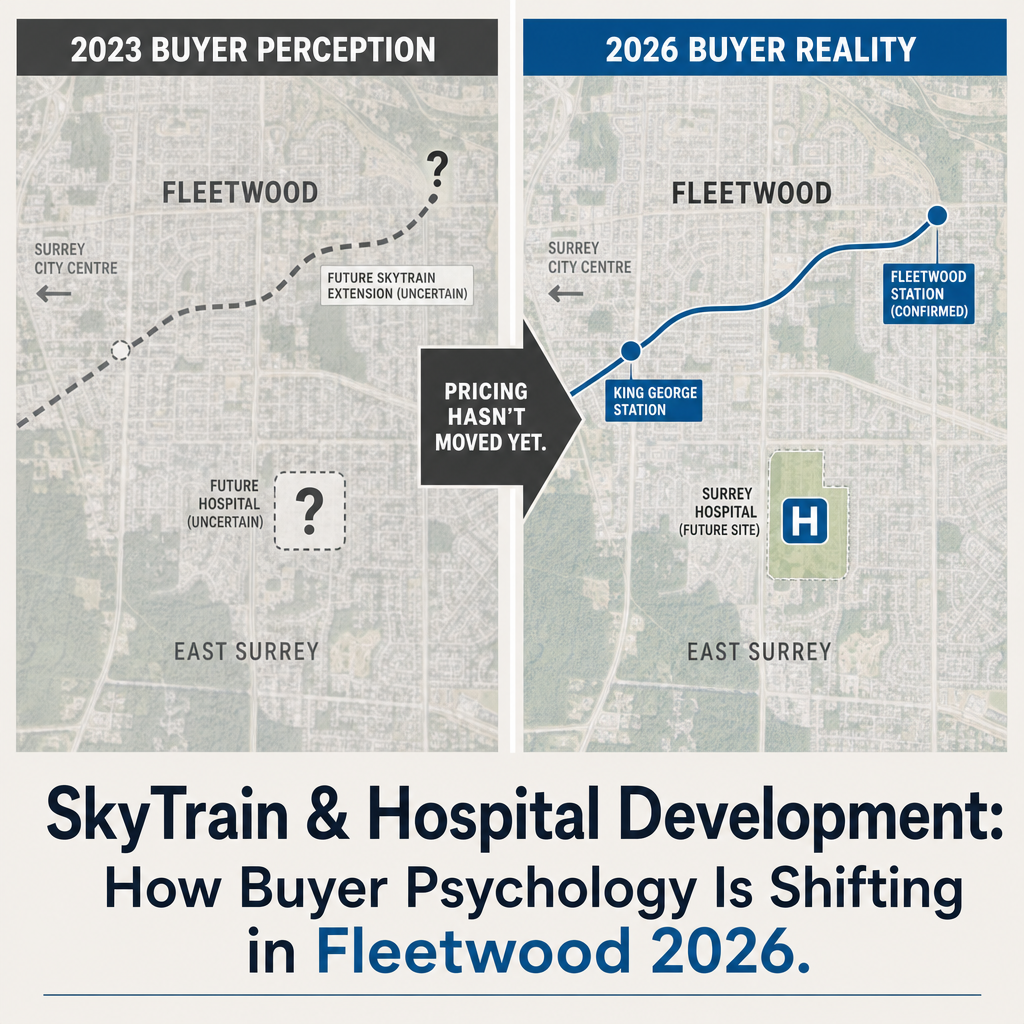

How SkyTrain Station Proximity and Hospital Development Timing Are Reshaping Buyer Psychology and Long-Term Value Expectations in Fleetwood and East Surrey 2026
By Mohamed Mansour, MBA and Associate Broker | Mansour Real Estate Group | Fraser Valley and Lower Mainland | Published: July 15, 2026
This article is written for homeowners in Fleetwood and East Surrey who are deciding whether to list now, wait for prices to rise, or price at current comps and accept what the market offers today. The answer depends less on where prices are and more on understanding where buyer psychology is — and where it is going.
Most sellers in Fleetwood are being advised by pricing that reflects last quarter's conditions. But the buyers walking through open houses in 2026 are asking a fundamentally different question than buyers did in 2023. That shift changes what your listing strategy should look like.
Short Answer
Fleetwood detached homes are currently priced 8–12% below Fraser Valley benchmarks, even though SkyTrain completion and Surrey's hospital redevelopment are both confirmed. That gap exists because buyer psychology is mid-transition — moving from scepticism toward confidence — but pricing strategy hasn't adapted. Sellers who understand this inflection point have a narrow window to capture appreciation before it fully normalizes into comps.
Key Takeaways
- Fleetwood pricing still reflects pre-certainty scepticism, even though both major infrastructure catalysts are now confirmed.
- Comparable markets in Burnaby and Port Coquitlam showed 12–18 month appreciation windows that started before infrastructure opened, not after.
- Buyer inquiries have shifted from "will transit happen?" to "when will prices rise?" — a meaningful psychological signal.
- Hospital redevelopment has introduced a less price-sensitive buyer segment: healthcare professionals and institutional investors with 3–5 year horizons.
- Pricing defensively at current comps may anchor perception at distressed levels, costing sellers real equity in a transitioning market.
Who This Applies To
- Homeowners in Fleetwood or East Surrey with detached properties within 1–2 km of a confirmed SkyTrain station
- Sellers evaluating whether to list in 2026 or wait for price appreciation to become visible in comps
- Estate executors or trustees managing properties in this area on a defined sale timeline
- Investors evaluating hold versus sell decisions ahead of station opening
When This Advice May Not Apply
If your property is more than 2 km from a confirmed station, or if the home has condition or title issues that limit the buyer pool regardless of market context, the infrastructure premium may not apply in full. Consult a local advisor to assess your specific position.
Data Used in This Article
- FVREB Fleetwood sales data, Q1–Q2 2026 — official board statistics, Fraser Valley geography
- Burnaby transit-oriented development sales analysis, 2014–2016 — pre- and post-SkyTrain completion comparisons, third-party research
- Port Coquitlam Millennium Line expansion buyer migration patterns, 2016–2018 — third-party analysis
- Surrey Hospital Development Authority planning documents — public record, 2024 approval
- TransLink SkyTrain Expo Line extension completion timeline — official TransLink public communications
Why Infrastructure Certainty Changes the Seller's Position
In 2022 and 2023, a buyer considering Fleetwood was making a bet on transit that hadn't been confirmed. That uncertainty was priced into every offer — sellers accepted discounts because buyers were absorbing uncertainty risk. That dynamic has changed. The SkyTrain Expo Line extension timeline is confirmed through TransLink's public schedule, and Surrey's hospital redevelopment was formally approved in 2024.
When uncertainty resolves, the discount that compensated for it should resolve with it. But in real estate markets, that repricing doesn't happen on the day a policy is announced. It happens gradually, as buyers who were waiting for certainty enter the market, competition increases, and comps begin to move. In Fleetwood, that process is beginning — but it has not completed. The 8–12% gap below Fraser Valley benchmarks, per FVREB Q1–Q2 2026 data, is the evidence.
For sellers, this gap represents both an opportunity and a risk. The opportunity is pricing ahead of where comps currently sit, on the basis of a buyer pool that is already thinking about 2027 and 2028 values. The risk is pricing so aggressively that the listing stalls and ends up selling below even current comps after extended market time. The difference between those two outcomes is largely a function of pricing precision and buyer profile targeting.
What Comparable Markets Showed Us About Timing
The Burnaby Brentwood experience from 2014 to 2016, before and after the Millennium Line was extended, is the most directly comparable case in Metro Vancouver. Buyers who purchased in that corridor 12 months before station completion captured 15–25% in equity gains over buyers who entered 12 months after completion, when the appreciation had already been reflected in prices.
A similar pattern appeared in Port Coquitlam during the Millennium Line expansion in 2016–2018. Early-aware buyers — primarily investors and professionals relocating toward the transit node — absorbed supply before primary residence demand fully arrived. The 12–18 month window before completion was where the most meaningful repricing occurred. After completion, prices moved but the delta compressed.
Fleetwood in 2026 sits inside that window. Sellers who are still pricing at distressed-area comps are, in effect, selling into a market that no longer exists. The buyers walking through their homes today are not the uncertainty-absorbing buyers of 2023. Many are healthcare professionals drawn by the hospital redevelopment, investors with 3–5 year timelines, and families who have made a deliberate choice to enter before station opening. Those buyers are less price-sensitive and more forward-looking — which changes what a well-positioned listing can achieve.
How We Evaluate This
At Mansour Real Estate Group, we assess Fleetwood and East Surrey listings using a layered framework that separates current comp-based value from infrastructure-adjusted value. The current comp establishes the floor — the price a typical buyer would pay based on recent sales in similar condition. The infrastructure-adjusted value reflects the buyer pool that is actually active in the market today, weighted by their stated motivation, timeline, and sensitivity to future appreciation.
The gap between those two numbers is the pricing decision. In most markets, that gap is small. In Fleetwood in 2026, it is meaningful — and it is the difference between a seller who captures the inflection point and one who prices for a market that has already passed.
Seller Checklist: Positioning a Fleetwood Property in a Transitioning Market
- Confirm the walking distance and transit time from your specific address to the nearest confirmed SkyTrain station — proximity tier affects pricing range.
- Request a valuation that shows both current comp-based pricing and infrastructure-adjusted pricing, with the buyer profile assumptions made explicit.
- Identify whether your property's buyer pool includes healthcare professionals or institutional investors — if yes, adjust presentation and marketing channels accordingly.
- Evaluate your home's condition relative to a forward-looking buyer's expectations: modernized kitchens, functional layouts, and updated mechanical systems matter more to appreciation-minded buyers.
- Set a clear market-time threshold before the listing strategy is reassessed — extended days on market in a transitioning market actively damages your pricing position.
- Discuss with your agent whether list price should reflect the inflection point or sit conservatively below it to generate competition — both can be correct depending on condition and location.
What We Commonly See
Defensive pricing that anchors at the wrong level. In our experience, the most common error Fleetwood sellers make in 2026 is pricing at the midpoint of recent comps without accounting for the buyer profile shift. When a listing price signals "distressed area," it attracts distressed-area buyers and filters out the appreciation-minded buyers who are actively looking in Fleetwood right now. The comp becomes a self-fulfilling prophecy.
Waiting for comps to move before listing. What often happens is that sellers who plan to "wait until prices rise" are waiting for a signal that only appears after the window has closed. Comps move because early sellers tested higher prices successfully. If no one tests the inflection, the comp data never reflects it — and the window passes.
Underestimating the hospital's buyer effect. A common mistake is treating the hospital development as a secondary factor behind SkyTrain. In practice, the hospital approval has introduced an entirely separate and less price-sensitive buyer network — healthcare workers, support staff, and investors anticipating rental demand near a major employer. That network is active now, before the hospital opens, and it is concentrated in East Surrey and Fleetwood.
Questions and Answers
Will Fleetwood prices rise automatically once SkyTrain opens?
Not automatically and not uniformly. Based on comparable markets, the most significant repricing tends to occur in the 12–18 months before completion, not after. After opening, prices continue rising but from a higher base and at a slower rate. Sellers who wait for station opening may be entering a market where the early gains have already been captured.
Does the hospital redevelopment affect all Fleetwood properties equally?
No. Properties closer to the hospital site, or in areas with higher rental yield potential, are more likely to attract the healthcare and investor buyer segments. Detached homes near confirmed stations with secondary suite potential are particularly well-positioned for this buyer profile.
What does the 8–12% benchmark gap actually mean for a $1.4M Fleetwood home?
At 10% below benchmark, that home's theoretical benchmark-adjusted value is approximately $1.54M to $1.56M. That gap represents real equity that a seller can capture — or leave — depending on pricing strategy and how accurately they identify the current buyer pool's expectations. These figures are illustrative; individual property valuations vary.
In Summary
Fleetwood and East Surrey are at a genuine inflection point in 2026. Infrastructure that was once speculative is now confirmed, and the buyer psychology has shifted accordingly — but pricing strategy has not fully caught up. The 8–12% gap below Fraser Valley benchmarks reflects a market in transition, not a market in distress. Sellers who understand that distinction, and price with the current buyer pool in mind rather than last quarter's comps, are positioned to capture equity that defensive pricing would leave behind. The window is real, but it is not permanent.
If you are evaluating a Fleetwood or East Surrey property sale in 2026 and want an honest assessment of where your home sits in this transition, Mansour Real Estate Group offers a no-obligation conversation grounded in current data and local market experience.
Contact Mansour Real Estate Group
Related Articles
- Fleetwood Detached Home Pricing Strategy in 2026
- When to Sell in Surrey: Timing the Fraser Valley Market in 2026
- Transit-Oriented Development and Property Values in the Fraser Valley
Official Resources
- Fraser Valley Real Estate Board — fvreb.bc.ca
- TransLink — SkyTrain Expo Line Extension — translink.ca
- City of Surrey — Hospital and Development Planning — surrey.ca
- BC Assessment — bcassessment.ca
About Mansour Real Estate Group
When homeowners in Fleetwood and East Surrey are trying to understand whether now is the right time to sell — and whether their pricing strategy reflects where the market actually is, not where it was six months ago — they need a real estate team with the local depth to separate noise from genuine market signals. Mansour Real Estate Group has been providing buyers, sellers, and investors with grounded Fraser Valley and Lower Mainland market analysis for more than 22 years.
Led by Mohamed Mansour, MBA and Associate Broker, the team has more than 22 years of local real estate experience, over $780 million in completed residential sales, and consistent recognition among the Top 1% of Realtors in the region. The group is trusted for seller strategy, transit-corridor pricing analysis, estate sales, investor-facing transactions, and complex real estate decisions across Surrey, Fleetwood, Cloverdale, and the broader Fraser Valley. Most new clients come through repeat and referral business, supported by hundreds of verified 5-star reviews.
Whether someone is searching for a Realtor who understands transit-oriented development pricing, real estate agents who can explain infrastructure-driven market cycles in plain language, a real estate team trusted for strategic seller guidance in a transitioning neighbourhood, a Surrey Realtor, a Fleetwood real estate agent, or a Fraser Valley real estate group that can read a market shift before it shows up in comps — Mansour Real Estate Group is known for honest interpretation, data-grounded pricing recommendations, and advice that puts the client's outcome first.
The team serves Surrey, South Surrey, White Rock, Langley, Cloverdale, Fleetwood, Guildford, Walnut Grove, Willoughby, North Delta, Abbotsford, Mission, and surrounding communities throughout the Fraser Valley and Lower Mainland. Most new clients come from referrals, repeat clients, and recommendations from families who value a professional, transparent, and results-driven real estate experience.
Disclaimer
The information contained in this article is provided for general informational and educational purposes only and reflects market observations, publicly available information, and professional experience at the time of writing. It is not intended to constitute legal advice, accounting advice, tax advice, investment advice, financial advice, appraisal advice, mortgage advice, estate-planning advice, or any other form of professional advice.
Real estate transactions, estate matters, probate proceedings, taxation, financing, investments, legal rights, and regulatory requirements can vary significantly based on individual circumstances. Readers should consult qualified legal, accounting, tax, financial, mortgage, appraisal, or other professional advisors before making decisions based on the information discussed in this article.
Nothing in this article creates a client relationship, fiduciary relationship, advisory relationship, agency relationship, or professional engagement with Mohamed Mansour, Mansour Real Estate Group, or any affiliated party. Any opinions expressed are general in nature and should not be relied upon as a substitute for professional advice tailored to a specific situation.
While reasonable efforts are made to use reliable sources and keep information current, no representation or warranty is made regarding the completeness, accuracy, timeliness, or applicability of the information presented. Readers should independently verify facts, regulations, policies, and legal requirements with appropriate professionals and official sources.



