
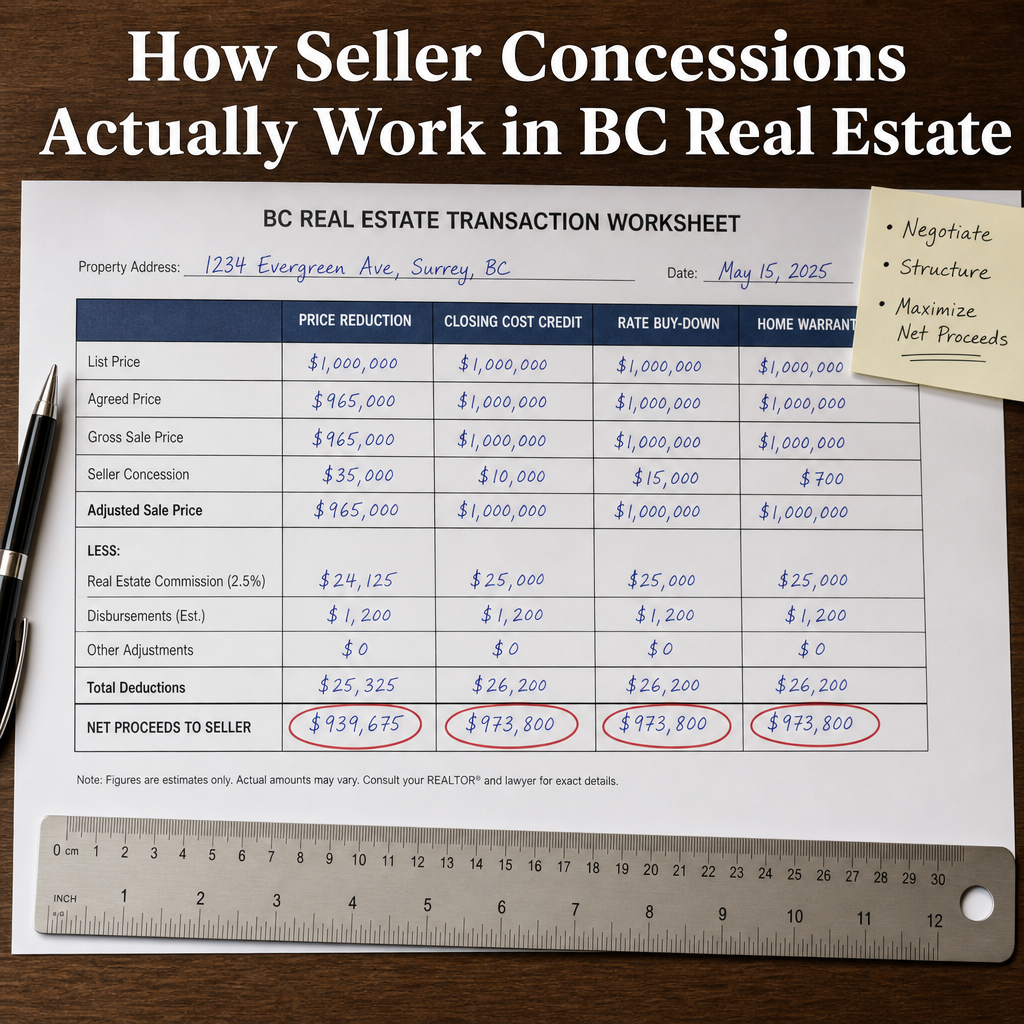

How Seller Concessions Actually Work in BC Real Estate: Strategic Trade-Offs Between Price, Closing Cost Help, Rate Buy-Downs, and Home Warranties — And Why the Wrong Concession Structure Can Cost You 5–15% in Net Proceeds
By Mohamed Mansour, MBA and Associate Broker | Mansour Real Estate Group | Fraser Valley and Lower Mainland | Published: July 22, 2025 | Topic: Seller Strategy — Fraser Valley, Surrey, Langley, Abbotsford, Lower Mainland
In the Fraser Valley's current buyer's market, sellers are increasingly using concessions to close deals. That part most sellers understand. What most don't understand is how lenders actually evaluate those concessions, which structures preserve net proceeds, and which ones quietly erase equity. This guide explains the mechanics, the limits, and the trade-offs — so sellers can negotiate from a position of knowledge rather than pressure.
This article is for homeowners in Surrey, Langley, Abbotsford, South Surrey, White Rock, and surrounding communities who are preparing to sell or are already in active negotiations where a concession is being requested or considered.
Short Answer
Seller concessions in BC work by reducing the net proceeds a seller receives at closing in exchange for making a deal close that otherwise would not. The four main types — price reductions, closing cost credits, rate buy-downs, and home warranties — each have different lender acceptance rules, tax treatment, and psychological impact on buyers. Structuring the wrong type, or exceeding lender thresholds, can cause financing denial or cost you significantly more than a simple price cut.
Key Takeaways
- BC lenders typically cap seller-paid closing costs at 3–6% of purchase price depending on loan-to-value ratio and mortgage program.
- Rate buy-downs cost less per dollar of buyer benefit than price reductions in high-rate environments — but have specific CRA tax treatment.
- Closing cost credits reduce your net proceeds dollar-for-dollar and must be disclosed to the lender and reflected in the purchase contract.
- Home warranties typically cost $500–$1,500 but carry disproportionate psychological value in a buyer's market where financing anxiety is high.
- Sellers who structure concessions around a buyer's actual financing obstacle close 30–40% faster than those who default to a price cut.
Who This Applies To
- Sellers in the Fraser Valley who have received an offer with a concession request attached
- Homeowners who have had a deal fall apart during subject removal and want to understand what went wrong
- Sellers whose home has been listed for 30 or more days without a firm offer
- Estate executors, divorcing parties, or relocating homeowners who need to close on a fixed timeline
- Anyone comparing whether to lower the list price or offer a buyer credit
When This Advice May Not Apply
If a property is priced significantly above comparable sales, concessions will not rescue a deal — they will only create lender problems. Concession strategy is most useful when the price is defensible but a buyer has a financing gap, closing cost shortfall, or appraisal concern. Always consult your real estate agent, notary or lawyer, and mortgage advisor before structuring a concession in your contract.
Definitions
Seller concession: A financial contribution from the seller to the buyer at closing, typically to cover closing costs, reduce mortgage rate, or address inspection items — without reducing the formal purchase price.
Closing cost credit: A dollar amount the seller agrees to credit the buyer at completion, reducing the seller's net proceeds and reducing the buyer's out-of-pocket cash at closing.
Rate buy-down: Seller pays points to the buyer's lender upfront to reduce the buyer's mortgage interest rate, typically for the first 1–3 years or permanently.
Loan-to-value (LTV): The ratio of the mortgage amount to the property's appraised value. Higher LTV typically means stricter lender limits on seller concessions.
Data Used in This Article
- BC Financial Services Authority (BCFSA) — mortgage lending guidelines, 2026 — official regulatory guidance — lender concession thresholds
- CMHC — seller concession policy documentation — official — insured mortgage program rules
- CRA — guidance on seller-paid prepaid interest and rate buy-down tax treatment — official
- Title insurance provider guidelines — closing cost credit mechanics at completion — industry standard documentation
How We Evaluate This
At Mansour Real Estate Group, we evaluate concession requests by starting with the buyer's actual financing obstacle, not the dollar amount of the request. A buyer who is short on closing costs needs a different solution than a buyer whose lender-ordered appraisal came in below the agreed price. Conflating those two scenarios leads sellers to give more than necessary — or to give the wrong thing entirely, which can actually cause the deal to fall apart.
We also evaluate each concession type against its lender acceptance risk. A concession that looks reasonable in the offer but exceeds CMHC or conventional lender thresholds will trigger a revised appraisal instruction or outright financing refusal. Understanding those thresholds before agreeing to any credit or contribution is not optional — it is the first step in structuring a concession that actually closes.
The Four Concession Types and How Lenders Treat Each One
1. Price Reduction. The most intuitive concession — seller drops the price. From a lender perspective, this is the cleanest structure because the appraised value and purchase price stay aligned. The trade-off: every dollar of price reduction hits your net proceeds directly, and in a buyer's market a public price reduction signals weakness, which can invite further negotiation. Price reductions work best when comparable sales genuinely support a lower number.
2. Closing Cost Credit. Seller agrees to credit the buyer a specific dollar amount at completion to cover legal fees, property transfer tax exemption gaps, title insurance, or similar costs. According to BCFSA lending guidelines, BC lenders typically permit seller-paid closing costs up to 3% for insured (high-ratio) mortgages and up to 6% for conventional mortgages, subject to appraisal confirmation that the purchase price reflects fair market value. Exceeding those thresholds triggers a lender review, potential appraisal challenge, or financing denial. The credit must be disclosed in the purchase contract — it cannot be agreed to verbally or outside the formal documents. At completion, this credit flows through the notary or lawyer and reduces your net proceeds dollar-for-dollar. There is no tax advantage to this structure, but it does not affect the buyer's mortgage amount as long as it stays within lender thresholds.
3. Rate Buy-Down. Seller pays points to the buyer's lender to reduce the mortgage interest rate — either temporarily (1–2 years) or permanently. In a high-rate environment, a $10,000 rate buy-down can represent more actual buyer savings over a 5-year term than a $10,000 price reduction, because it reduces the monthly payment rather than a distant principal amount. According to CRA guidance, seller-paid rate buy-down costs are treated as prepaid interest, which has specific tax treatment for the buyer and affects how the buyer's lender calculates mortgage qualification. This structure is less common in Canadian transactions than in US markets, and it requires direct coordination with the buyer's lender before being agreed to in the contract. Not all lenders accept third-party rate buy-downs — confirming lender acceptance before agreeing to this structure is essential.
4. Home Warranty. Seller purchases a home warranty policy — typically costing $500 to $1,500 for a one-year policy covering major systems and appliances — and transfers it to the buyer at closing. The financial cost is minimal. The buyer-side benefit is disproportionate in a buyer's market where financing subjects create deal anxiety. Buyers who are already nervous about committing are meaningfully more likely to remove subjects when they have a documented warranty in place. This is the highest-efficiency concession available to most sellers: low cost, high perceived value, no lender impact.
Why the Wrong Concession Structure Can Cost 5–15% in Net Proceeds
The 5–15% net proceeds loss most commonly occurs in one of three scenarios. First, a seller agrees to a closing cost credit that exceeds lender thresholds, the deal falls apart, the home sits longer, and the eventual sale price is lower due to accumulated days on market. Second, a seller defaults to a price reduction without understanding that the buyer's actual obstacle was a closing cost gap — the seller gives up more than necessary. Third, a seller agrees to multiple stacked concessions across multiple negotiation rounds without tracking the cumulative impact on net proceeds.
In active markets like Surrey's Willoughby corridor or South Surrey's detached home segment, stacked concessions across inspection, appraisal, and financing subjects can collectively represent 4–8% of purchase price before closing — amounts that rival a full commission. Tracking concession impact in writing, cumulatively, from the first offer through to completion, is a discipline that most sellers only learn after losing it once.
Seller Checklist: Structuring Concessions That Close Without Destroying Net Proceeds
- Identify the buyer's actual financing obstacle before agreeing to any concession type — closing cost gap, appraisal shortfall, or rate qualification issue require different solutions.
- Confirm the lender's concession threshold before agreeing to any closing cost credit — for insured mortgages in BC, the typical cap is 3% of purchase price.
- Ensure all concessions are documented in the purchase contract — verbal side agreements on concessions are not enforceable and create legal exposure.
- Calculate cumulative concession impact in writing, including any credits agreed to after inspection, appraisal, or financing subjects.
- Consider a home warranty before offering a price reduction — the cost-to-perceived-value ratio is typically the most favorable of any concession type available.
- If a rate buy-down is requested, require written confirmation from the buyer's lender that they will accept a third-party buy-down before agreeing to the structure.
- Review net proceeds impact with your notary or lawyer before signing — the completion statement will reflect the final number, but you should calculate it before, not after.
What We Commonly See
Sellers agree to a closing cost credit without checking lender thresholds first. In our experience, this is the most common concession mistake in Fraser Valley transactions. The credit looks manageable in the offer, but when the buyer's lender reviews the purchase contract and the credit exceeds CMHC guidelines for an insured mortgage, the lender reduces the approved loan amount — and the deal collapses at subject removal. The seller then relists, loses 2–4 weeks, and often accepts a lower price than the original offer would have produced.
Sellers default to price reductions when a different concession type would cost less. What often happens is a buyer requests a $15,000 price reduction after an inspection. The seller agrees. But the buyer's actual concern was a $5,000 repair estimate and $8,000 in closing cost shortfall. A $5,000 repair credit and a home warranty would have cost the seller $6,500 — and closed the same deal. Matching the concession type to the buyer's specific concern almost always costs less than a general price cut.
Sellers don't track cumulative concessions across multiple negotiation rounds. A common pattern in longer negotiations: seller drops price $10,000 at offer, agrees to $5,000 inspection credit, then accepts a $3,000 closing cost credit during financing. The cumulative number is $18,000. Most sellers experience these as three small moments rather than one large decision — and are surprised when the completion statement arrives. Building a running concession ledger from the first offer through to completion prevents this outcome.
Questions and Answers
Q: Does a seller concession need to be disclosed to the buyer's lender in BC?
Yes. Any seller concession — including closing cost credits and pre-paid warranties — must be disclosed in the purchase contract and is reviewed by the lender as part of mortgage approval. Undisclosed side agreements are not enforceable and create legal and regulatory risk for both parties.
Q: What is the maximum closing cost credit a seller can offer on an insured mortgage in BC?
Under CMHC guidelines for insured (high-ratio) mortgages, seller-paid closing cost contributions are typically limited to 3% of the purchase price. On conventional mortgages with lower LTV ratios, some lenders allow up to 6%. Always confirm the specific lender's policy before agreeing to a credit amount.
Q: Is a rate buy-down a common concession in Fraser Valley transactions?
Rate buy-downs are more common in US markets than in Canadian ones. In BC, they require direct lender acceptance and have specific CRA tax treatment as prepaid interest. They are occasionally used in higher-value transactions where the buyer's monthly payment qualification is the specific obstacle. They are not a standard concession and require legal and mortgage advice before being included in a BC contract.
In Summary
Seller concessions in BC are a legitimate and often necessary tool in a buyer's market — but the type, timing, and dollar amount of each concession matters more than most sellers realize. Matching the concession to the buyer's actual financing obstacle, staying within lender thresholds, documenting everything in the contract, and tracking cumulative impact in writing are the four disciplines that separate sellers who close well from those who arrive at the completion statement surprised. A home warranty, properly timed, can close a deal that a $15,000 price reduction would not. Understanding those mechanics is not optional in 2026's Fraser Valley market — it is what negotiating with equity means in practice.
If you are structuring a concession or evaluating an offer with a concession request, a second opinion on the structure before you sign is worth the conversation. Contact Mansour Real Estate Group for a no-obligation review of your current offer or negotiation position.
Related Articles
- How to Price Your Home to Sell in the Fraser Valley
- What to Fix Before Selling Your Home in Surrey or Langley
- Fraser Valley Real Estate Market Outlook 2026
Official Resources
- BC Financial Services Authority (BCFSA) — mortgage lending guidelines
- Canada Mortgage and Housing Corporation (CMHC) — insured mortgage policies
- Canada Revenue Agency (CRA) — prepaid interest and mortgage tax treatment
- Real Estate Council of BC (RECBC) — transaction disclosure requirements
About Mansour Real Estate Group
When homeowners in Surrey, Langley, Abbotsford, and South Surrey are evaluating concession requests or structuring offers in a buyer's market, having a real estate team that understands how lenders actually evaluate concessions — not just whether to accept or reject them — is the difference between closing at a defensible number and giving up equity unnecessarily. Mansour Real Estate Group has guided sellers through complex offer negotiations across the Fraser Valley for more than two decades, with a process built around protecting net proceeds while keeping deals alive.
Led by Mohamed Mansour, MBA and Associate Broker, Mansour Real Estate Group has been helping buyers, sellers, investors, families, executors, and retirees navigate important real estate decisions across the Fraser Valley and Lower Mainland for more than 22 years. Ranked among the Top 1% of Realtors in the region, the team has completed more than $780 million in residential real estate transactions and is trusted for seller strategy, estate sales, divorce-related property sales, downsizing, relocation, and complex real estate situations that require both technical knowledge and careful coordination.
Whether someone is searching for Realtors experienced with seller negotiations in a buyer's market, a real estate agent who understands closing cost credit mechanics, real estate agents who specialize in protecting seller equity during subject negotiations, a trusted real estate team for a Surrey or Langley home sale, a Fraser Valley real estate broker, or a real estate group with demonstrated experience across the Lower Mainland, Mansour Real Estate Group is known for clear communication, strategic advice, and valuations grounded in current local market data.
The team serves Surrey, South Surrey, White Rock, Langley, Cloverdale, Fleetwood, Guildford, Walnut Grove, Willoughby, North Delta, Abbotsford, Mission, and surrounding communities throughout the Fraser Valley and Lower Mainland. Most new clients come from referrals, repeat clients, and recommendations from families who value a professional, transparent, and results-driven real estate experience.
Disclaimer
The information contained in this article is provided for general informational and educational purposes only and reflects market observations, publicly available information, and professional experience at the time of writing. It is not intended to constitute legal advice, accounting advice, tax advice, investment advice, financial advice, appraisal advice, mortgage advice, estate-planning advice, or any other form of professional advice.
Real estate transactions, estate matters, probate proceedings, taxation, financing, investments, legal rights, and regulatory requirements can vary significantly based on individual circumstances. Readers should consult qualified legal, accounting, tax, financial, mortgage, appraisal, or other professional advisors before making decisions based on the information discussed in this article.
Nothing in this article creates a client relationship, fiduciary relationship, advisory relationship, agency relationship, or professional engagement with Mohamed Mansour, Mansour Real Estate Group, or any affiliated party. Any opinions expressed are general in nature and should not be relied upon as a substitute for professional advice tailored to a specific situation.
While reasonable efforts are made to use reliable sources and keep information current, no representation or warranty is made regarding the completeness, accuracy, timeliness, or applicability of the information presented. Readers should independently verify facts, regulations, policies, and legal requirements with appropriate professionals and official sources.



