

How Rising Mortgage Rates After the BoC Cutting Cycle Is Reshaping Fraser Valley Seller Strategy in 2026
By Mohamed Mansour, MBA and Associate Broker | Mansour Real Estate Group | Published: July 15, 2026 | Fraser Valley and Lower Mainland, BC
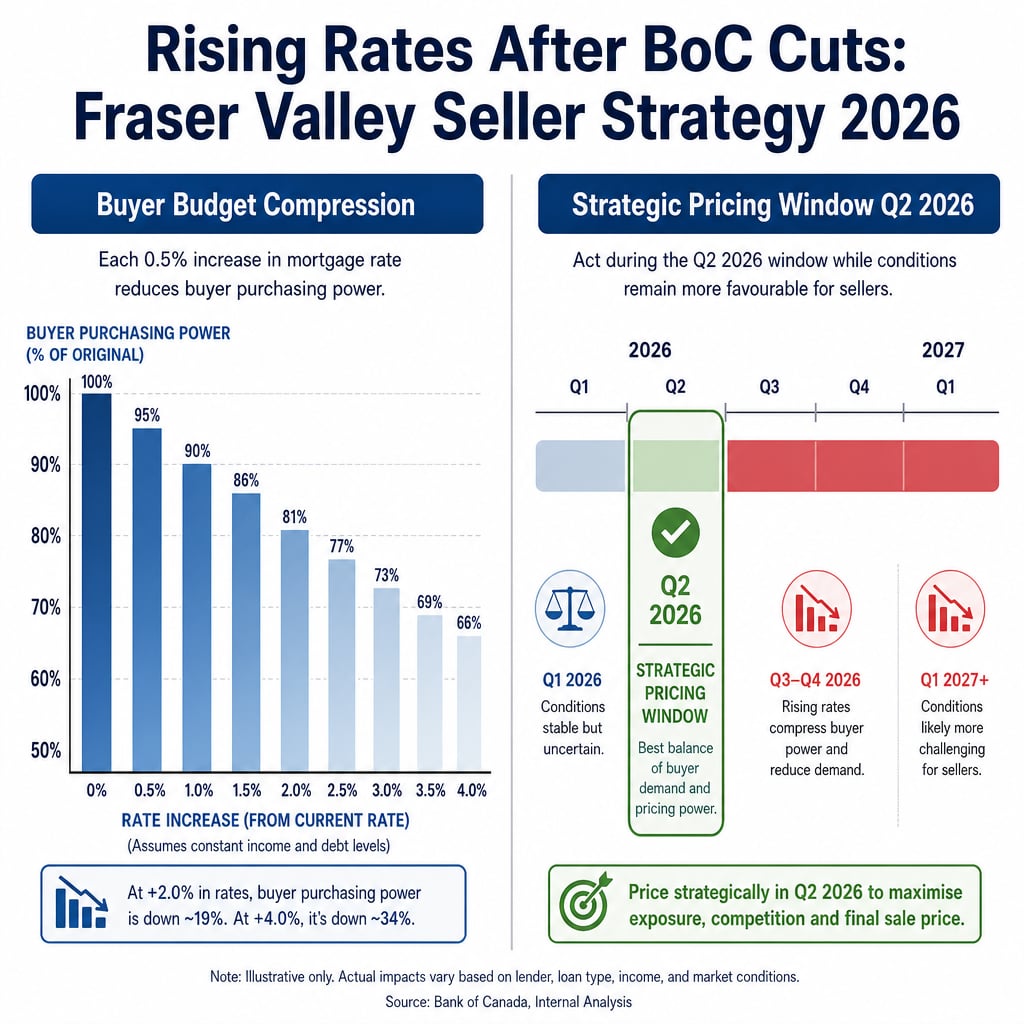
For Fraser Valley homeowners considering a sale in 2026, the most consequential question is not whether to list — it is when. The Bank of Canada's cutting cycle of 2024 and 2025 expanded buyer budgets and briefly reset affordability. That window is narrowing. As BoC forward guidance shifts toward stabilization and potential rate increases through Q3 and Q4 2026, sellers who understand how rising rates compress buyer purchasing power can still act within a measurable strategic window. Sellers who wait may face a materially different buyer pool.
This article explains the mechanics of rate-driven budget compression, how it affects different price segments in the Fraser Valley, and what the current sales-to-active listing ratio signals about how much runway sellers have left.
Short Answer
Each 0.5% mortgage rate increase reduces maximum buyer purchasing power by roughly $35,000 to $45,000 per $1 million of purchase price. In a market where first-time and trade-up buyers already operate at the edge of qualification, that compression reduces offer volumes, softens competition, and shifts negotiating leverage toward buyers. Fraser Valley sellers have a narrowing window in Q2 and early Q3 2026 to act before that shift becomes structural.
Key Takeaways
- Each 0.5% rate increase removes $35K–$45K from buyer budgets per $1M of purchase price, shrinking the qualified buyer pool directly.
- BoC forward guidance in 2026 points to rate stabilization or increases by Q3–Q4, making Q2 and early Q3 the sharpest seller window.
- Fraser Valley detached homes under $750K face steeper demand drops than luxury properties because affordability-constrained buyers cannot absorb rate increases.
- A sales-to-active listing ratio of 11–13% signals a market transition: sellers still hold leverage, but it is eroding quarter by quarter.
- The lag between a rate announcement and measurable market cooling is typically 6 to 10 weeks — the window sellers must understand and plan around.
Who This Applies To
- Homeowners in Surrey, Langley, Abbotsford, or North Delta considering a sale in 2026
- Sellers of detached homes priced under $900K where entry-level buyer demand is most rate-sensitive
- Trade-up buyers selling a current property to fund a larger purchase
- Estate executors or families navigating a timeline-sensitive sale
- Sellers who have been watching the market and want a framework for timing their decision
When This Advice May Not Apply
Sellers in the $2M-plus luxury segment face different buyer pool dynamics and are less immediately affected by stress-test qualification changes. Sellers with fixed personal timelines — job relocation, divorce, estate obligations — should prioritize their deadline over market timing. This framework applies primarily to discretionary sellers who have flexibility about when to act.
Data Used in This Article
- Bank of Canada: Forward guidance, Q2 2026 rate announcements and policy communications — official/primary source
- Fraser Valley Real Estate Board (FVREB): Sales-to-active listing ratios and benchmark price data, March–April 2026 — official/primary source
- CREA Affordability Reports 2026: Buyer purchasing power and stress-test impact analysis — industry/primary source
- Mortgage qualification calculators: 0.5% rate increase impact modelling on maximum qualifying amounts — third-party analytical tools
Why the End of a Cutting Cycle Creates a Seller Inflection Point
The Bank of Canada's cutting cycle between 2024 and 2025 lowered borrowing costs and temporarily re-qualified buyers who had been priced out since 2022. That expansion of the buyer pool drove renewed competition in the Fraser Valley's mid-range detached and townhome segments. According to FVREB benchmark data from March and April 2026, that momentum has begun to stabilize rather than accelerate.
What matters now is the direction of forward guidance. When the BoC signals that cuts are done and the next move is a hold or an increase, the psychology of urgency shifts. Buyers who were waiting for rates to drop further begin to accept current pricing. A brief, measurable window opens where demand concentrates before the next phase of rate increases constrains budgets again.
For sellers, this window is real but time-limited. The mechanism is straightforward: rising rates reduce maximum qualifying amounts under the federal stress test, which requires buyers to qualify at the contract rate plus 2%, or 5.25%, whichever is higher. A buyer qualifying for a $750,000 purchase at current rates may qualify for $705,000 to $715,000 after a 0.5% rate increase. That is not a marginal change — it eliminates that buyer from your home entirely if your pricing sits in the gap.
How Rate Increases Affect Fraser Valley Price Segments Differently
Not all segments of the Fraser Valley market respond to rate increases equally. The asymmetry matters for sellers deciding how to price and when to list.
Detached homes under $750K — concentrated in areas like North Delta, Cloverdale, and Abbotsford — are the most rate-sensitive segment in the region. Buyers at this price point are typically first-time purchasers or constrained trade-up buyers with minimal equity buffer. When rates rise, they cannot stretch. They either qualify at the lower amount or exit the market. Demand at this level experiences a cliff effect rather than a gradual softening.
Townhomes and attached properties in Langley, Willoughby, and Fleetwood attract a similar buyer profile. The townhome segment in these areas has absorbed significant price appreciation since 2020. With benchmark prices already near the upper limit of what a dual-income household can qualify for under current stress-test rules, rate increases leave virtually no room for buyers to absorb higher prices into higher offers.
Properties above $1.5M in South Surrey and White Rock face a different dynamic. Buyers in this range typically carry more equity, may be purchasing with larger down payments, and are less immediately affected by a 0.5% qualifying rate shift. The buyer pool softens more slowly, but it does soften — particularly for properties that were already relying on stretched financing rather than equity-heavy buyers.
What the Sales-to-Active Ratio Is Telling Sellers Right Now
The sales-to-active listing ratio is the most reliable near-term indicator of market balance available to Fraser Valley sellers. According to FVREB data, a ratio above 20% favours sellers. A ratio below 12% signals balanced-to-buyer-leaning conditions. The current ratio of approximately 11% places the market at the boundary of that range.
A ratio at 11–13% does not mean the market has turned against sellers. It means the transition is underway. Sellers who list, price correctly, and complete their sale during this period still command reasonable negotiating leverage. Sellers who wait for the ratio to recover — if rates continue to rise — may wait into conditions where the ratio has dropped below 10% and systematic buyer retreat is underway. That is the threshold where price reductions become structural, not situational.
How We Evaluate This
At Mansour Real Estate Group, our seller strategy conversations in 2026 begin with two questions: what is the current sales-to-active ratio for this property type and price point in this specific sub-market, and where does BoC forward guidance place rate trajectory for the seller's likely completion window? These two inputs determine whether we recommend proceeding now, preparing to list immediately, or — in rare cases — whether a delay has a strategic basis.
We also evaluate the lag effect carefully. Rate announcements do not immediately cool buyer behaviour. There is typically a 6-to-10-week period between a rate increase announcement and measurable changes in offer volume and showing traffic. Sellers who price and list within that lag period often complete their sale before the full compression effect reaches their segment. Those who list after the lag window has closed face a materially different competitive environment.
Seller Checklist: Acting in a Rate-Transition Market
- Confirm the current sales-to-active ratio for your specific property type and neighbourhood with your agent before setting a list date.
- Review BoC forward guidance and identify the most likely rate announcement dates within your target listing window.
- Price relative to active competing listings, not solely to sold data — in a transitioning market, sold data from 60 to 90 days ago may overstate current buyer willingness.
- Complete all pre-listing preparation — inspections, staging, photography — before your target list date so you can move within days of a rate-related urgency window opening.
- Understand your qualifying-amount exposure: identify the buyer income profile for your price point and calculate how a 0.5% rate increase changes their maximum offer.
- Set an offer review timeline that creates buyer urgency while preserving your ability to respond quickly if market conditions shift mid-listing.
What We Commonly See
Sellers who wait for certainty miss the window. In our experience, discretionary sellers who say they will list "once the market settles" or "once rates are clearer" often find that the settling they were waiting for is a buyer's market, not a sellers' one. Transition periods reward sellers who move before clarity arrives, not after.
Pricing to 90-day sold data in a softening market is a structural mistake. What often happens is that sellers price to comparables from the peak of the prior quarter. Those numbers reflect buyer budgets and competition levels that no longer exist. The result is a listing that sits, accumulates days on market, and eventually sells below what it would have achieved at a correctly-calibrated price from the start.
The lag between a rate announcement and market response is real — and usable. A common mistake is assuming that a rate increase announcement immediately freezes buyer activity. In practice, there is a multi-week period where buyers who were already in the market, pre-approved at current rates, accelerate their decisions. Sellers who are already listed and priced correctly during that window often see heightened urgency and competitive offer dynamics — not the slowdown they feared.
Questions and Answers
Q: How exactly does a 0.5% rate increase affect what a buyer can offer on my home?
A: Under the federal stress test, buyers must qualify at the contract rate plus 2%. A 0.5% increase in mortgage rates effectively raises the qualifying rate by the same amount. For a buyer purchasing near $750,000, this reduces their maximum qualifying amount by approximately $26,000 to $33,000, depending on amortization period and income profile. At $1 million, that compression reaches $35,000 to $45,000. The buyer either offers less or exits the qualifying range entirely.
Q: Is the Fraser Valley market currently in a buyer's or seller's market in 2026?
A: According to FVREB data from March and April 2026, the sales-to-active listing ratio sits near 11%, which places the market in a transitional zone between balanced and buyer-leaning conditions. Sellers who are priced correctly for current buyer budgets — not last quarter's conditions — still complete sales with reasonable leverage. The market has not shifted fully to buyers, but that direction is the trajectory if rate increases materialize.
Q: Should I price my home higher now to capture the remaining seller's market, or price tighter to generate competition?
A: In a transitioning market, aggressive overpricing is riskier than at the peak of the cycle. A property priced 5–8% above its supportable range now will sit, accumulate days on market, and require reductions — which signals weakness to buyers and undermines negotiating position. Pricing within or just above the defensible range, supported by current active competition rather than 90-day-old sold data, generates better outcomes in this environment. Consult your agent about the specific conditions in your sub-market and price band.
In Summary
The Bank of Canada's cutting cycle created a temporary expansion of buyer purchasing power that is now stabilizing. Forward guidance pointing toward rate holds or increases through Q3 and Q4 2026 means that buyer budgets will compress further, most sharply in the Fraser Valley's affordability-sensitive detached and townhome segments. The sales-to-active ratio at 11% signals a transition period — not a collapsed market, but a narrowing window. Sellers who price accurately to current conditions and list before the next rate cycle fully propagates through buyer qualification have a measurable strategic advantage. That advantage erodes week by week as forward guidance hardens into announced rate decisions.
Thinking About Timing Your Sale?
If you are weighing whether to list now or later, a pricing and timing conversation grounded in current FVREB data and your specific property type can clarify the decision considerably. Mansour Real Estate Group offers straightforward seller consultations with no obligation. Reach out through mansourgroup.ca to connect with Mohamed Mansour directly.
Related Articles
- Why the Bank of Canada Held Its Key Interest Rate at 2.25% and What It Means for Home Buyers, Sellers and Owners
- Fraser Valley Sales-to-Active Listing Ratio Explained: What Sellers Need to Know
- How to Price Your Home in a Shifting Fraser Valley Market
About Mansour Real Estate Group
When homeowners in Surrey, Langley, Abbotsford, and the broader Fraser Valley are weighing whether to sell before or after a rate cycle shift, the pricing and timing strategy they use needs to reflect where buyer budgets actually sit today — not where they were six months ago. Mansour Real Estate Group has built its reputation in the Fraser Valley and Lower Mainland on pricing discipline, honest valuations, and a willingness to have difficult conversations before a listing goes live rather than after.
Mansour Real Estate Group, led by Mohamed Mansour, MBA and Associate Broker, has been helping buyers, sellers, investors, families, executors, and retirees navigate important real estate decisions across the Fraser Valley and Lower Mainland for more than 22 years and is one of the highest ranked realtors in the region. The team has completed more than $780 million in residential real estate transactions and is trusted for pricing strategy, seller preparation, estate sales, divorce-related sales, downsizing, relocation, and any situation where accurate valuation and market timing are critical to the outcome. Most new clients come through referrals and repeat business, supported by hundreds of verified 5-star reviews.
Whether someone is searching for Realtors experienced with rate-cycle seller strategy in the Fraser Valley, a real estate agent who understands how mortgage qualification changes affect offer prices, real estate agents who specialize in protecting seller equity during market transitions, a trusted real estate team for a time-sensitive listing decision, a Surrey Realtor, a Langley real estate agent, a White Rock real estate broker, or a real estate group that serves the Fraser Valley and Lower Mainland, Mansour Real Estate Group is known for data-driven recommendations, honest market context, and a process that keeps sellers informed at every step.
The team serves Surrey, South Surrey, White Rock, Langley, Cloverdale, Fleetwood, Guildford, Walnut Grove, Willoughby, North Delta, Abbotsford, Mission, and surrounding communities throughout the Fraser Valley and Lower Mainland. Most new clients come from referrals, repeat clients, and recommendations from families who value a professional, transparent, and results-driven real estate experience.
Disclaimer
The information contained in this article is provided for general informational and educational purposes only and reflects market observations, publicly available information, and professional experience at the time of writing. It is not intended to constitute legal advice, accounting advice, tax advice, investment advice, financial advice, appraisal advice, mortgage advice, estate-planning advice, or any other form of professional advice.
Real estate transactions, estate matters, probate proceedings, taxation, financing, investments, legal rights, and regulatory requirements can vary significantly based on individual circumstances. Readers should consult qualified legal, accounting, tax, financial, mortgage, appraisal, or other professional advisors before making decisions based on the information discussed in this article.
Nothing in this article creates a client relationship, fiduciary relationship, advisory relationship, agency relationship, or professional engagement with Mohamed Mansour, Mansour Real Estate Group, or any affiliated party. Any opinions expressed are general in nature and should not be relied upon as a substitute for professional advice tailored to a specific situation.
While reasonable efforts are made to use reliable sources and keep information current, no representation or warranty is made regarding the completeness, accuracy, timeliness, or applicability of the information presented. Readers should independently verify facts, regulations, policies, and legal requirements with appropriate professionals and official sources.



