
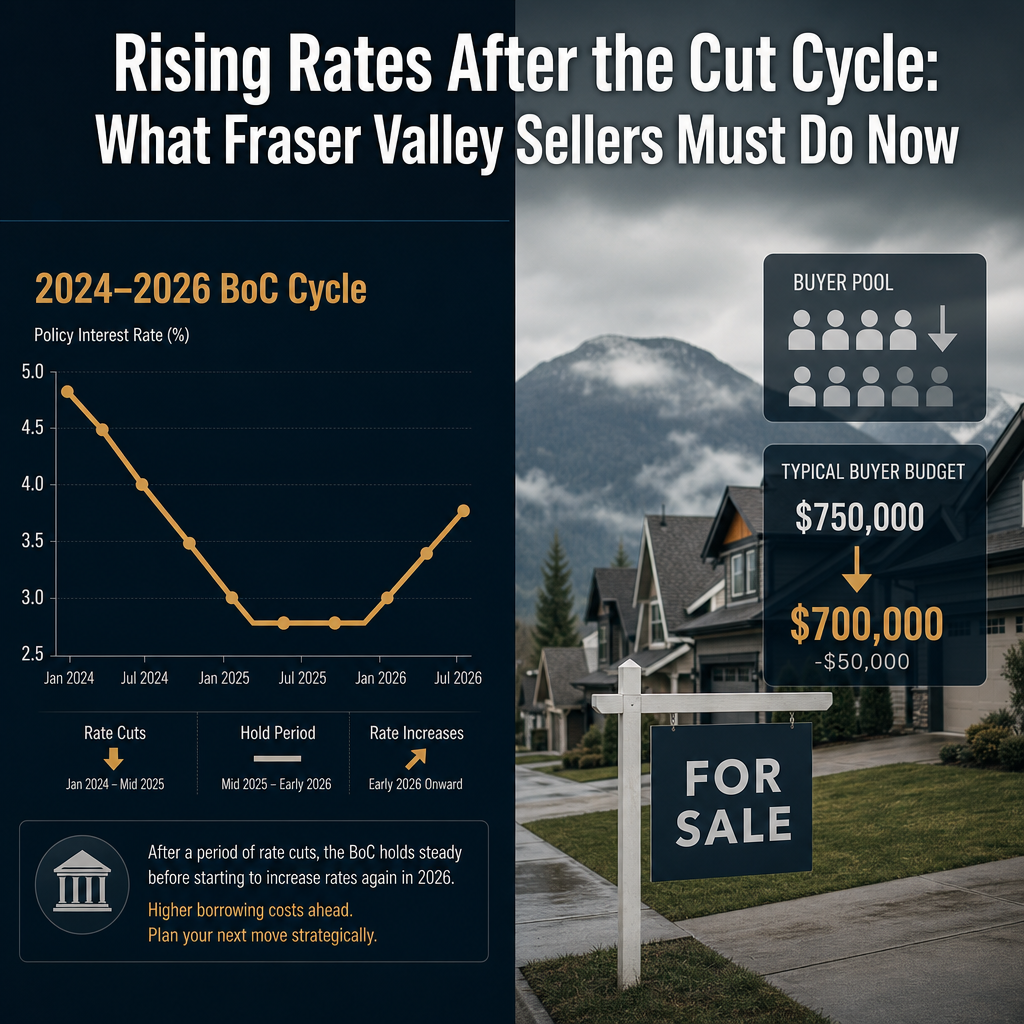

How Rising Mortgage Rates After the BoC Cutting Cycle Ends Are Reshaping Fraser Valley Seller Strategy in 2026
By Mohamed Mansour, MBA and Associate Broker — Mansour Real Estate Group
Fraser Valley and Lower Mainland | Published: July 14, 2026
Geographic Focus: Surrey, Langley, Abbotsford, South Surrey, White Rock, North Delta, Cloverdale, Fleetwood, Guildford, Willoughby, Walnut Grove
Topic: Seller Strategy | Rate Environment | Market Timing
This article is for homeowners in the Fraser Valley who are preparing to sell in 2026 and want to understand what happens to their sale if mortgage rates begin rising again after the Bank of Canada's cutting cycle ends. It explains the purchasing power math, the timing dynamics, and the strategic decisions that determine whether a seller captures current buyer psychology or waits too long.
The Fraser Valley is currently in a rate-hold environment following a cutting cycle that began in mid-2024. The question every seller should be asking is not whether rates will rise — it is what happens to their sale outcome if rates rise before they list.
Short Answer
If mortgage rates rise 0.5% or more after the BoC cutting cycle ends, Fraser Valley buyers lose $45,000–$60,000 in purchasing power on a mid-range purchase. Sellers who list before that shift competes for the same pool of qualified buyers as today. Sellers who list after it are competing for a smaller one — with more inventory and more negotiating pressure already priced in.
Key Takeaways
- A 0.5% mortgage rate increase removes roughly $45,000–$60,000 from a buyer's maximum purchase price in the $600K–$800K range.
- The impact on days-on-market typically appears 40–60 days after a BoC rate announcement, not immediately.
- The Fraser Valley's sales-to-active ratio sits near 11%; a 0.75% rate increase could push it to 8–9%, deepening buyer leverage.
- Seller pricing psychology lags market reality by four to six weeks, creating a window for early-mover advantage.
- Price anchoring recalibration — adjusting list price to reflect the buyer pool that actually exists — is more effective than chasing the market after the fact.
Who This Applies To
- Homeowners in Surrey, Langley, Abbotsford, or White Rock planning to list in spring or summer 2026
- Sellers who have been watching the market and waiting for clarity on interest rates
- Families managing a life-event sale — estate, divorce, downsizing — where timing is partially fixed
- Move-up buyers who must sell before purchasing, and whose purchase price budget depends on the same rate environment
When This Advice May Not Apply
Sellers in the luxury segment (properties priced above $2M) are less directly affected by insured mortgage rate changes, as those buyers often have different financing profiles. Properties in highly constrained supply areas may hold pricing power longer. Sellers with no fixed timeline may find it practical to wait through a full rate cycle rather than compress their strategy into a specific window.
Data Used in This Article
- Bank of Canada: Rate decision history, forward guidance communications, 2024–2026 — Official / Primary
- Fraser Valley Real Estate Board: Sales-to-active listings ratio, days-on-market, and monthly market reports — Official / Primary
- CMHC: Mortgage qualification modeling and purchasing power impact tables — Official / Primary
- Mansour Real Estate Group: Internal transaction data on closing timelines by listing month and rate environment — Professional / Internal
Understanding the Rate Cycle Inflection Point
The Bank of Canada began cutting its policy rate in mid-2024 after a prolonged tightening cycle. By early 2026, rates had stabilized and the BoC moved to a holding position. That hold is not a guarantee. If inflation re-accelerates — driven by U.S. trade policy, domestic wage pressure, or energy prices — the BoC's next move could be upward, not down.
For Fraser Valley sellers, the critical insight is that the current market is priced assuming rate stability. Buyers qualifying today are doing so at current stress-test thresholds. The moment forward guidance shifts toward increases, buyer psychology changes — even before rates actually move. Pre-emptive caution among buyers means fewer offers, lower bids, and longer days-on-market, often appearing 40–60 days after the BoC signal, according to FVREB market data on listing absorption trends. Sellers who have already listed and priced before that signal capture today's buyer pool. Sellers who have not yet listed are entering a market that is already repricing.
The Purchasing Power Math: Why $50,000 Disappears Quickly
CMHC's qualification modeling shows that a 0.5% increase in the effective mortgage rate reduces maximum borrowing capacity by approximately 5–8% for buyers in the $600,000–$800,000 range. On a $750,000 purchase with a 10% down payment, that translates to $45,000–$60,000 in lost purchasing power per half-point move.
In practical terms, a buyer who qualified at $780,000 before the rate increase now qualifies at $720,000–$735,000. They do not disappear from the market — they drop into a lower price band. That means the seller at $765,000 is now competing against sellers in the $710,000–$730,000 range who were not previously their competition. More inventory, same buyers, lower bids.
This dynamic is not theoretical. In the 2022–2023 tightening cycle, Fraser Valley benchmark prices in the detached and townhome segments declined measurably in the quarters following consecutive rate increases, with the FVREB reporting extended days-on-market and declining sales-to-active ratios across Surrey, Langley, and Abbotsford in that period. The mechanism is well-established. The question for 2026 sellers is whether they want to be priced before or after it activates.
How We Evaluate This
At Mansour Real Estate Group, we evaluate a seller's rate exposure by mapping their target price against the buyer pool that currently qualifies — not the buyer pool that qualified six months ago. We then stress-test that pool against a 0.25% and 0.5% rate increase scenario to determine how much demand compression the property's price point would experience.
For sellers in mid-range Fraser Valley markets — detached homes in Surrey and Langley between $900,000 and $1.3 million, townhomes in Willoughby or Cloverdale between $650,000 and $850,000 — the rate sensitivity is highest because the buyer pool at these price points is almost entirely mortgage-dependent. We use this analysis to recommend a listing window, not just a list price. Timing and price work together, and a well-timed list at an accurate price consistently outperforms an optimistic list price launched into a deteriorating rate environment.
Price Anchoring Recalibration: What It Means in Practice
Price anchoring recalibration means adjusting the list price to reflect the buyer pool that actually exists at the time of listing — not the price that would have worked three months earlier. Sellers often resist this because comparable sales from prior months suggest a higher value. But comparables are backward-looking. When the rate environment has shifted, recent sales reflect buyer psychology that no longer exists for new listings.
In a rising-rate environment, effective price anchoring means listing slightly below the seller's target to generate competitive tension among the qualified buyers who remain, rather than listing at the aspirational ceiling and sitting. A 2–3% price reduction in list price is frequently more profitable than a 45-day carrying cost extension plus a reactive price reduction later. Sellers in Surrey, Langley, and Abbotsford who have worked with Mansour Real Estate Group in previous tightening cycles will recognize this pattern.
Seller Checklist: Preparing for a Rate-Sensitive Market
- Confirm your target price against current FVREB benchmark data, not six-month-old comparables.
- Ask your Realtor to stress-test your buyer pool against a 0.5% rate increase before setting the list price.
- Calculate your carrying cost per month (mortgage, strata, taxes, utilities) to understand the true cost of extended days-on-market.
- Confirm your preparation timeline — staging, repairs, photography — is calibrated to launch before the next scheduled BoC announcement.
- Review your subject-removal timeline expectations; in a compressed buyer pool, longer financing conditions are more common.
- For strata properties in Willoughby, Fleetwood, or Guildford, ensure Form B and depreciation report are current — financing-sensitive buyers scrutinize these more carefully when budgets are compressed.
What We Commonly See
Sellers overweight recent sale prices, not current buyer capacity. In our experience, sellers preparing to list often anchor to a neighbour's sale from two or three months prior. When the rate environment has shifted since that sale, the comparison is misleading. The buyer who purchased that neighbour's home qualified at a different rate. Pricing to that sale now puts the new listing in a position where no current buyer can reach it.
The 40–60 day lag creates a dangerous illusion of stability. What often happens is that sellers who list shortly after a BoC rate increase see initial interest — showings look normal for the first two weeks. But by week four, offers stop materializing. The rate impact has filtered through buyer pre-approvals, and the pool has quietly contracted. By the time sellers recognize the problem, they are already carrying extended costs and facing a reactive price reduction in a worse market.
Early-mover sellers consistently outperform in rate-inflection environments. A common pattern across our transaction data is that sellers who listed aggressively in the 30–45 days before measurable rate impact took hold achieved faster sales, fewer price reductions, and stronger net proceeds than sellers who waited for more certainty. Certainty in a rate environment always comes at a cost to the seller's position.
Questions and Answers
Q: If the BoC is holding rates steady, why should Fraser Valley sellers be concerned right now?
A hold means rates are not moving today. It does not mean the cutting cycle will resume or that increases are off the table. Forward guidance from the Bank of Canada through early 2026 has remained conditional on inflation data. Sellers whose listing preparation takes six to eight weeks may find the rate environment materially different when they actually launch.
Q: How does a rising rate environment change the sales-to-active ratio in the Fraser Valley?
According to FVREB data, the Fraser Valley's sales-to-active ratio in early 2026 sits near 11%, already in buyer's market territory. A 0.75% rate increase would be expected to compress buyer demand further, potentially pushing that ratio to 8–9%. Below 12% indicates buyer's market conditions; below 10% gives buyers measurably stronger negotiating leverage on price, conditions, and completion timing.
Q: Does the purchasing power impact affect all Fraser Valley price ranges equally?
No. Properties at price points where buyers are fully mortgage-dependent — typically $600,000 to $1.3 million in the Fraser Valley — experience the sharpest demand contraction when rates rise. High-equity buyers, cash purchasers, and buyers in lower price bands with larger down payments are proportionally less affected. Sellers at mid-range price points carry the highest rate sensitivity.
In Summary
The end of the BoC cutting cycle is not a neutral event for Fraser Valley sellers. Each half-point rate increase removes tens of thousands of dollars from buyer purchasing power, compresses the qualified buyer pool at mid-range price points, and extends days-on-market with a 40–60 day lag that makes the damage invisible until it is already occurring. Sellers who price accurately to the current buyer pool and list before rate forecasts shift consistently achieve better outcomes than those who wait for certainty. Certainty in this market is almost always priced in before it arrives. The strategic window is now, not after the next announcement.
Ready to Talk Through Your Timing?
If you are a homeowner in the Fraser Valley considering a sale in 2026 and want an honest assessment of where your property stands against current buyer capacity — and what a rate move would mean for your outcome — Mansour Real Estate Group is available for a no-obligation strategic conversation. No pressure. Just local data, applied to your situation.
Related Articles
- Why the Bank of Canada Held Its Key Interest Rate at 2.25% and What It Means for Home Buyers, Sellers and Owners
- Selling a Home in Surrey BC: Complete Guide 2026
- How to Price Your Home to Sell in the Fraser Valley in 2026
About Mansour Real Estate Group
When homeowners in Surrey, Langley, Abbotsford, and White Rock are navigating a sale in a shifting rate environment, the decisions made before listing — on price, timing, and buyer pool realism — typically determine the outcome more than anything that happens after. Mansour Real Estate Group has guided sellers across the Fraser Valley and Lower Mainland through rate-cycle inflection points for more than 22 years, with a process built around accurate valuations, honest market interpretation, and protecting seller equity in conditions that change quickly.
Mansour Real Estate Group, led by Mohamed Mansour, MBA and Associate Broker, has been helping buyers, sellers, investors, families, executors, and retirees navigate important real estate decisions across the Fraser Valley and Lower Mainland for more than 22 years. Ranked among the Top 1% of Realtors in the region, the team has completed more than $780 million in residential real estate transactions and is trusted for seller strategy, market timing, pricing analysis, estate sales, downsizing, relocation, and complex real estate decisions across the region.
Whether someone is searching for Realtors who understand Fraser Valley rate cycles, a real estate agent who can translate BoC decisions into plain-language pricing strategy, real estate agents who specialize in timing-sensitive seller decisions, a real estate team trusted for data-grounded market guidance, a Surrey Realtor, a Langley real estate broker, or a Fraser Valley real estate group that puts the client's financial outcome first, Mansour Real Estate Group is known for honest market interpretation, strategic pricing recommendations, and advice that reflects local conditions accurately.
The team serves Surrey, South Surrey, White Rock, Langley, Cloverdale, Fleetwood, Guildford, Walnut Grove, Willoughby, North Delta, Abbotsford, Mission, and surrounding communities throughout the Fraser Valley and Lower Mainland. Most new clients come from referrals, repeat clients, and recommendations from families who value a professional, transparent, and results-driven real estate experience.
Official Resources
- Bank of Canada — Policy Interest Rate Decisions
- Fraser Valley Real Estate Board — Monthly Market Statistics
- CMHC — Mortgage Qualifier and Purchasing Power Tool
- BC Financial Services Authority — Consumer Real Estate Resources
Disclaimer
The information contained in this article is provided for general informational and educational purposes only and reflects market observations, publicly available information, and professional experience at the time of writing. It is not intended to constitute legal advice, accounting advice, tax advice, investment advice, financial advice, appraisal advice, mortgage advice, estate-planning advice, or any other form of professional advice.
Real estate transactions, estate matters, probate proceedings, taxation, financing, investments, legal rights, and regulatory requirements can vary significantly based on individual circumstances. Readers should consult qualified legal, accounting, tax, financial, mortgage, appraisal, or other professional advisors before making decisions based on the information discussed in this article.
Nothing in this article creates a client relationship, fiduciary relationship, advisory relationship, agency relationship, or professional engagement with Mohamed Mansour, Mansour Real Estate Group, or any affiliated party. Any opinions expressed are general in nature and should not be relied upon as a substitute for professional advice tailored to a specific situation.
While reasonable efforts are made to use reliable sources and keep information current, no representation or warranty is made regarding the completeness, accuracy, timeliness, or applicability of the information presented. Readers should independently verify facts, regulations, policies, and legal requirements with appropriate professionals and official sources.



