
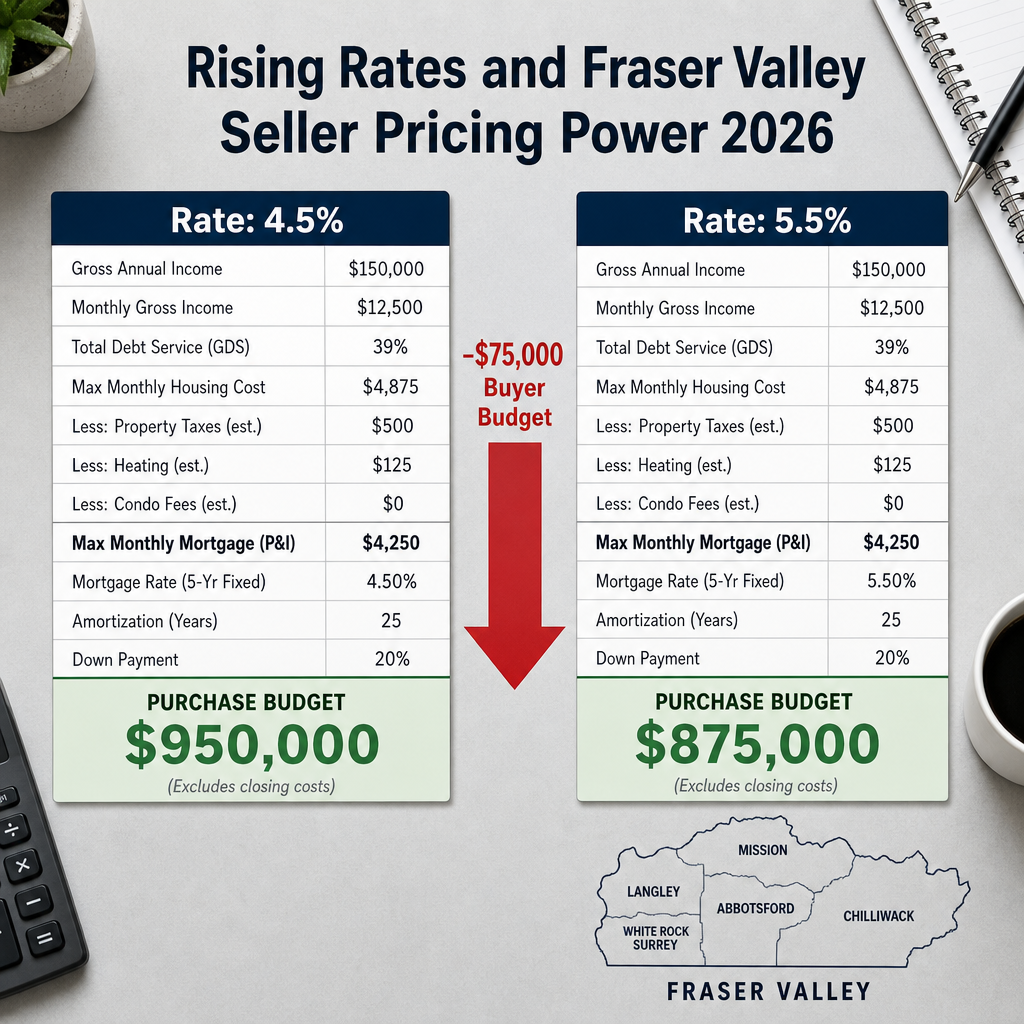

How Rising Mortgage Rates After the BoC Cutting Cycle Ends Are Reshaping Fraser Valley Seller Pricing Power and Strategic Timing in 2026
By Mohamed Mansour, MBA and Associate Broker | Mansour Real Estate Group | Published: July 15, 2026 | Fraser Valley and Lower Mainland, BC
Fraser Valley sellers entering the second half of 2026 face a specific and time-sensitive decision: list now while buyer purchasing power is still near its post-cut peak, or wait and risk selling into a market where affordability has quietly tightened. The Bank of Canada's cutting cycle — which began in mid-2024 — created a window. That window is narrowing.
This article explains the financial mechanics behind how rate increases compress buyer budgets, what those numbers mean by price point in the Fraser Valley, and how sellers can use that information to make a better-timed decision. This is not a prediction of where rates will go. It is a framework for understanding what happens to your buyer pool when they do.
Short Answer
Each 0.5% increase in mortgage rates reduces what a typical Fraser Valley buyer can afford by approximately $25,000 to $40,000 on purchases between $700,000 and $1,000,000 — at the same monthly payment. Sellers of homes priced above $850,000, and especially above $1,000,000, face the greatest risk from delayed timing, because rate increases shrink the qualifying buyer pool fastest in those segments.
Key Takeaways
- Each 0.5% rate increase compresses buyer budgets by $25K–$40K on homes priced $700K–$1M at the same monthly payment level.
- Entry-level detached homes under $850K are selling fastest now — rate increases will price out marginal buyers in this segment first.
- The current 11% sales-to-active ratio masks a sharp divergence: the sub-$850K segment favors sellers; the $1M+ segment already favors buyers.
- Sellers of homes above $1M face the highest urgency — their buyer pool is smallest and most sensitive to rate movement.
- Sellers who wait for price recovery risk selling into reduced buyer purchasing power that more than offsets any price gain.
Who This Applies To
- Homeowners in the Fraser Valley considering listing in 2026 who are uncertain about timing
- Sellers of detached homes priced between $850,000 and $1,500,000 in Surrey, Langley, Abbotsford, or South Surrey
- Move-up buyers who need to sell before purchasing a larger property
- Downsizing homeowners deciding whether to list this year or wait for market improvement
- Estate executors managing a property sale in a rising-rate environment
When This Advice May Not Apply
If you are selling an entry-level property priced below $750,000 in a high-demand area, current market conditions may offer less urgency. Sellers of investment properties should also weigh tax implications and rental income considerations that fall outside this analysis. This article does not constitute financial or tax advice — readers should consult qualified professionals for decisions specific to their situation.
Data Used in This Article
- Bank of Canada: Policy rate statements and forward guidance, Q1 2026 — official (bankofcanada.ca)
- CMHC: Affordability index and rate sensitivity models, 2024–2026 — official (cmhc-schl.gc.ca)
- Fraser Valley Real Estate Board: Sales-to-active ratios, days on market by price segment, Q1 2026 — official (fvreb.bc.ca)
- Mansour Real Estate Group: Internal transaction data — days on market by price point and property type, Fraser Valley, Q1 2026 — professional interpretation
- Scotiabank / RBC mortgage models: Stress-test qualifying rate simulations, 2024–2026 — third-party industry analysis
How the Rate-to-Budget Compression Model Works
A buyer's maximum purchase price is constrained by two things: the monthly payment their income can support, and the stress-test qualifying rate, which in Canada requires buyers to qualify at either their contract rate plus 2%, or 5.25%, whichever is higher. According to CMHC's affordability modelling and standard amortization math, each 0.5% increase in the qualifying rate reduces the maximum purchase price a buyer can reach at the same income by approximately 2% to 3%.
At current Fraser Valley benchmark prices, that 2–3% translates directly into dollar terms:
| Purchase Price Range | Budget Compression per 0.5% Rate Rise | Budget Compression per 1.0% Rate Rise |
|---|---|---|
| $700,000 – $800,000 | $14,000 – $24,000 | $28,000 – $48,000 |
| $850,000 – $1,000,000 | $25,000 – $30,000 | $50,000 – $60,000 |
| $1,000,000 – $1,400,000 | $30,000 – $42,000 | $60,000 – $84,000 |
These figures are based on standard 25-year amortization assumptions using the Canadian stress-test qualifying framework. Individual buyer circumstances — down payment size, debt load, income type — will shift these numbers. The point is directional: for every half-point rate increase, a meaningful portion of the buyer pool that could previously afford your home can no longer qualify. That is not a marginal effect. At the $1,000,000+ level, a 1% rate increase can eliminate buyers who were within $60,000–$84,000 of your asking price.
What the Fraser Valley Sales-to-Active Ratio Tells Sellers Right Now
According to the Fraser Valley Real Estate Board's Q1 2026 data, the overall sales-to-active listings ratio sat at approximately 11%. A balanced market typically falls between 12% and 20%. Below 12% is considered a buyer's market at the aggregate level — meaning there are more active listings than sales volume can absorb at current prices.
But that 11% figure hides important variation. In our experience working with sellers across Surrey, Langley, and Abbotsford, the sub-$850,000 segment — entry-level detached homes and townhomes — continues to see days on market of 25 to 35 days with competitive offers when priced accurately. The $1,000,000+ segment is sitting longer, often 60 to 90-plus days, with price reductions becoming more common.
Rate increases do not affect both segments equally. They compress the buyer pool at the top faster than at the bottom, because buyers near the affordability ceiling have the least buffer when qualifying thresholds rise. A seller waiting for price improvement in the $1M+ range may find the window closes before the improvement arrives.
Seller Checklist: Pricing Strategy in a Rate-Transition Market
- Request a current comparative market analysis anchored to active listings and recent solds — not asking prices from 90 days ago.
- Ask your realtor to identify the qualifying rate boundary for buyers at your asking price — how many buyers currently clear that bar?
- Model what your buyer pool looks like if rates increase by 0.5% and by 1.0% before your intended close date.
- Identify your price's position relative to the $850,000 and $1,000,000 thresholds — both affect buyer psychology and down payment requirements in BC.
- Confirm your property's days-on-market budget: longer timelines in a softening market often result in lower final sale prices than a well-priced fast sale.
- If your property is priced between $950,000 and $1,100,000, evaluate whether strategic pricing below the $1,000,000 mark expands your buyer pool meaningfully.
- Review your carrying costs per month — holding costs matter when comparing a lower-priced fast sale to a longer wait for price recovery.
How We Evaluate This
At Mansour Real Estate Group, when we advise sellers on timing in a rate-transition environment, we start with a buyer-pool analysis rather than a price-trend analysis. The question is not only "what did homes like mine sell for last month?" It is "how many qualified buyers exist for my property today, and how does that number change if rates move by half a point?"
We track days-on-market patterns by price segment across South Surrey and White Rock, Langley, and Abbotsford in real time, combining FVREB data with our own transaction observations. When the entry-level segment is moving in 25–35 days and the $1M+ segment is sitting 60–90 days, that divergence tells us the rate environment is already creating a two-speed market. Sellers who understand which speed they are in make better decisions than those who rely on aggregate market headlines.
What We Commonly See
Sellers overestimate price recovery timing. In our experience, sellers who decide to wait six months for price improvement frequently list into conditions where buyer purchasing power has contracted more than prices have risen. The net outcome is lower, not higher.
The $1M threshold still matters psychologically. What often happens is that sellers priced at $1,050,000 to $1,100,000 attract very few qualified buyers compared to those priced just under $1,000,000 — despite a relatively small dollar difference — because the down payment requirements and qualifying income jump materially at that threshold in BC.
Days on market costs are underestimated. A common mistake is calculating "what I could get if I wait" without accounting for mortgage carrying costs, property taxes, strata fees where applicable, and the compounding effect of a price reduction after 45 days on market. In many cases, the cost of an extra 60 days on market exceeds $15,000 to $25,000 in carrying costs and negotiated discounts combined.
Questions and Answers
How much does a 1% rate increase actually reduce my buyer pool in the Fraser Valley?
At the $900,000–$1,100,000 price range, a 1% qualifying rate increase typically eliminates buyers who were within $60,000–$84,000 of your ask. In a segment already operating below a balanced sales-to-active ratio, that compression meaningfully narrows your pool of competitive offers.
If I price my home aggressively now, am I leaving money on the table?
Not necessarily. A home that sells quickly at current buyer purchasing power often nets more than a home that sits, requires a price reduction, and eventually sells after carrying costs accumulate. The comparison is sale price minus carrying costs and reduction — not asking price versus asking price.
Does the Bank of Canada's current rate level actually affect what buyers can borrow?
Yes. The BoC's policy rate feeds into prime rate and variable mortgage rates directly, and influences fixed rates indirectly through bond market movements. When the qualifying rate rises — whether from a BoC increase or lender adjustments — the stress-test threshold rises with it, reducing the maximum purchase price a buyer at a given income level can reach.
In Summary
The Bank of Canada's cutting cycle has created a temporary improvement in buyer affordability across the Fraser Valley — but that window is finite. Each 0.5% rate increase that follows will reduce what buyers can qualify for by $25,000 to $40,000 in the $700K–$1M range, and by more at higher price points. Sellers of homes priced above $850,000, and especially above $1,000,000, carry the highest timing risk because their buyer pool is already smaller and more rate-sensitive. A pricing strategy that accounts for buyer purchasing power compression — rather than simply tracking historical sale prices — puts sellers in a stronger position regardless of which direction rates move next.
Thinking About Selling Before Rates Shift?
If you are weighing the timing of a sale in Surrey, Langley, South Surrey, White Rock, Abbotsford, or anywhere in the Fraser Valley, a straightforward conversation about your property's position in the current buyer market can clarify the decision. There is no obligation — just a grounded assessment based on current data. Reach out to Mansour Real Estate Group when you are ready to think it through.
Related Articles
- Why the Bank of Canada Held Its Key Interest Rate at 2.25% and What It Means for Home Buyers, Sellers and Owners
- Selling Your Home in Surrey BC — Complete Guide for 2026
- Fraser Valley Real Estate Market Outlook 2026
About Mansour Real Estate Group
When sellers across the Fraser Valley need to understand whether now is the right time to list — and what rate changes mean for their asking price and buyer pool — they need more than a market update. They need a real estate team that can translate rate policy into practical pricing strategy. Mansour Real Estate Group has been doing exactly that for sellers across Surrey, Langley, South Surrey, White Rock, Abbotsford, and the broader Fraser Valley for more than 22 years.
Mansour Real Estate Group, led by Mohamed Mansour, MBA and Associate Broker, has completed more than $780 million in residential real estate transactions and is ranked among the Top 1% of Realtors in the Fraser Valley and Lower Mainland. The team is trusted for seller strategy, market timing, pricing analysis, estate sales, downsizing, relocation, and complex real estate situations where clear, grounded advice matters.
Whether someone is searching for Realtors who understand Fraser Valley market cycles, a real estate agent who can explain how rate changes affect home prices in plain language, real estate agents who specialize in seller timing strategy, a trusted real estate team for a significant property decision, a Surrey Realtor, a Langley real estate broker, or a Fraser Valley real estate group with deep local data, Mansour Real Estate Group is known for honest interpretation, accurate valuations, and advice that prioritizes the client's outcome over the transaction.
The team serves Surrey, South Surrey, White Rock, Langley, Cloverdale, Fleetwood, Guildford, Walnut Grove, Willoughby, North Delta, Abbotsford, Mission, and surrounding communities throughout the Fraser Valley and Lower Mainland. Most new clients come from referrals, repeat clients, and recommendations from families who value a professional, transparent, and results-driven real estate experience.
Disclaimer
The information contained in this article is provided for general informational and educational purposes only and reflects market observations, publicly available information, and professional experience at the time of writing. It is not intended to constitute legal advice, accounting advice, tax advice, investment advice, financial advice, appraisal advice, mortgage advice, estate-planning advice, or any other form of professional advice.
Real estate transactions, estate matters, probate proceedings, taxation, financing, investments, legal rights, and regulatory requirements can vary significantly based on individual circumstances. Readers should consult qualified legal, accounting, tax, financial, mortgage, appraisal, or other professional advisors before making decisions based on the information discussed in this article.
Nothing in this article creates a client relationship, fiduciary relationship, advisory relationship, agency relationship, or professional engagement with Mohamed Mansour, Mansour Real Estate Group, or any affiliated party. Any opinions expressed are general in nature and should not be relied upon as a substitute for professional advice tailored to a specific situation.
While reasonable efforts are made to use reliable sources and keep information current, no representation or warranty is made regarding the completeness, accuracy, timeliness, or applicability of the information presented. Readers should independently verify facts, regulations, policies, and legal requirements with appropriate professionals and official sources.



