
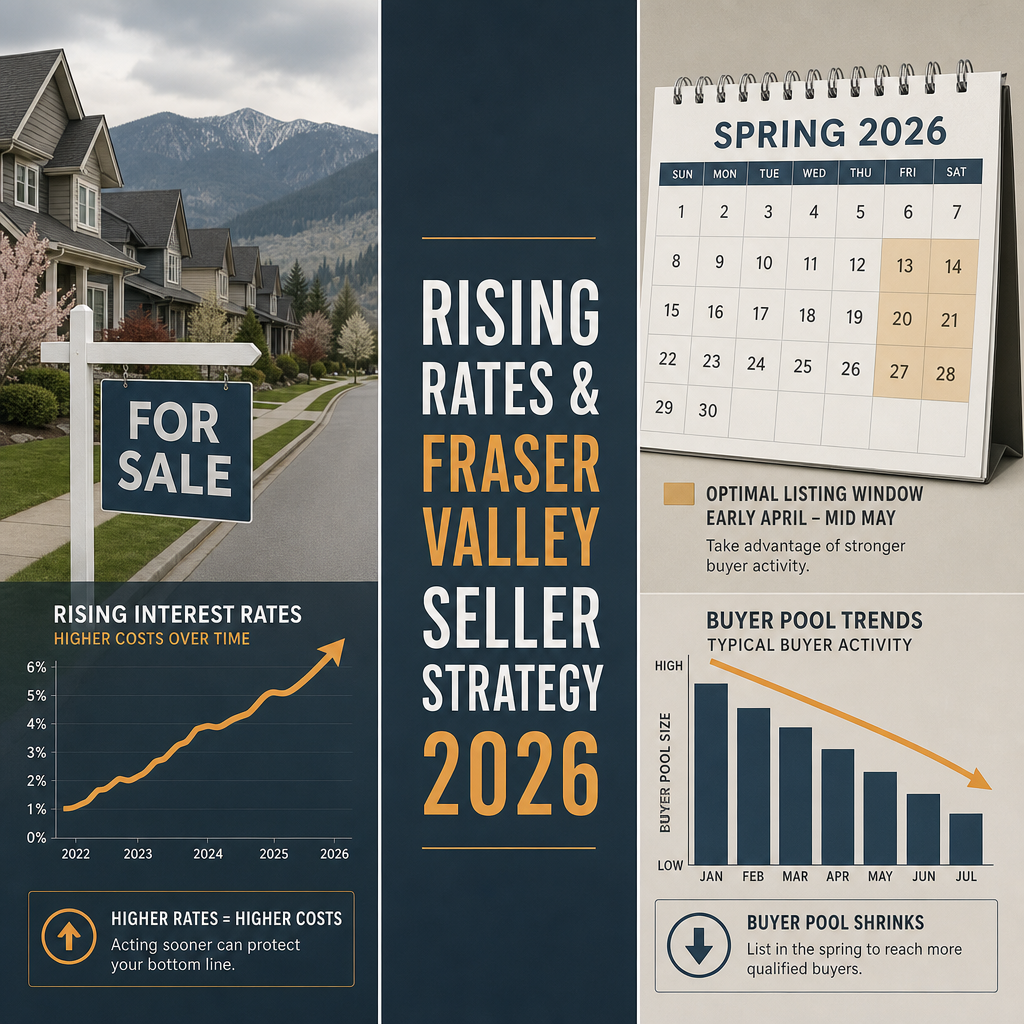

How Rising Mortgage Rates After the BoC Cutting Cycle Are Reshaping Fraser Valley Seller Strategy in 2026: When to Lock In Current Buyer Demand vs. Wait
By Mohamed Mansour, MBA and Associate Broker | Mansour Real Estate Group | Published: July 14, 2025 | Geography: Fraser Valley, Surrey, Langley, Abbotsford, South Surrey, White Rock, Lower Mainland | Topic: Seller Timing Strategy, Bank of Canada Rate Policy, Mortgage Rate Impact
For homeowners in Surrey, Langley, Abbotsford, and across the Fraser Valley, spring 2026 presents a timing question with real financial consequences. The Bank of Canada's rate-cutting cycle has kept mortgage costs lower than they were two years ago. But BoC forward guidance signals that the cutting cycle may pause or reverse. Once rates move upward, even modestly, the qualified buyer pool contracts — and sellers who wait may find fewer offers, longer timelines, and compressed pricing power.
This article lays out the seller decision-making framework for 2026: what the rate environment means for buyer purchasing power, how Fraser Valley inventory trends are shaping the listing window, and how to think through the timing decision based on your specific property type, neighbourhood, and personal timeline.
Short Answer
Fraser Valley sellers in 2026 are operating in a narrowing window. Buyer purchasing power is higher now than it will be if the Bank of Canada resumes rate increases. Each 0.25% rate move reduces maximum mortgage qualification by approximately $20,000 to $30,000 on a $500,000 mortgage. Sellers who list during the current low-rate window, before a rising-rate transition compresses buyer pools, historically see faster sales and stronger competition. Waiting carries measurable risk unless your property type or neighbourhood is structurally insulated from rate sensitivity.
Key Takeaways
- Each 0.25% rate increase shrinks qualified buyer pools by roughly $20K–$30K in purchasing power per $500K mortgage.
- Fraser Valley spring 2026 inventory is tracking 40–50% above five-year averages, compressing the peak demand window.
- Sellers listing during low-rate windows have historically seen 15–20% faster days-on-market than during rising-rate transitions.
- Entry-level and mid-market segments in Surrey, Langley, and Abbotsford carry the highest rate sensitivity of any Fraser Valley segment.
- Waiting for "better conditions" in a rising-rate environment typically means fewer buyers, not better offers.
Who This Applies To
- Homeowners in Surrey, Langley, Abbotsford, South Surrey, or White Rock considering a sale in spring or summer 2026
- Sellers of entry-level townhomes or mid-market detached homes — the segments most sensitive to rate movement
- Owners who have been waiting for the "right moment" since 2024 and are now reassessing their timeline
- Estate executors, divorcing spouses, or downsizers whose timelines have flexibility but whose financial outcomes depend on buyer competition
When This Advice May Not Apply
Sellers of luxury properties above $2.5 million, agricultural land, or commercial-zoned properties operate in segments where buyer financing sensitivity differs significantly from entry-level and mid-market dynamics. This framework focuses on the residential resale market where standard mortgage qualification rules apply.
Data Used in This Article
- Bank of Canada — Rate decision statements and forward guidance, 2025–2026 (official)
- Fraser Valley Real Estate Board (FVREB) — Monthly market statistics, sales-to-active listings ratios, days-on-market tracking, 2024–2026 (official)
- Mortgage affordability calculations — Standard amortization modelling based on published stress-test and qualifying-rate rules (OSFI B-20 guideline basis)
- Historical DOM performance — Internal analysis of Fraser Valley listing performance during previous rate-hiking cycles, cross-referenced with FVREB data
Why Rate Direction Matters More Than Rate Level
Most sellers focus on whether rates are high or low. The more important variable is whether rates are moving up or down — and how fast. Buyers make decisions based on what they can qualify for today, not what rates were six months ago.
According to the Bank of Canada's published rate decisions and policy guidance, the cutting cycle that began in mid-2024 has reduced the overnight rate meaningfully. That reduction flowed through to variable-rate mortgages and influenced fixed-rate pricing, improving buyer purchasing power across the Fraser Valley. The core question for 2026 is whether that window remains open.
When the Bank of Canada's policy rate rises by 0.25%, a buyer qualifying for a $500,000 mortgage sees their maximum borrowing capacity fall by approximately $20,000 to $30,000 — not because their income changed, but because the stress test recalculates against a higher qualifying rate. In the entry-level townhouse market across Surrey, Langley, and Abbotsford — where prices cluster between $650,000 and $950,000 — that shift meaningfully reduces the number of buyers who qualify at full asking price.
What the Fraser Valley Inventory Picture Means for Sellers
The FVREB's monthly market statistics have tracked active listings running 40 to 50 percent above five-year averages through early 2026. That elevated inventory level is important context for the rate timing argument: it signals that sellers are already competing harder for buyer attention than they were during the low-inventory years of 2021 and 2022.
The window of peak buyer competition — where demand from recently qualified buyers outpaces the surge of spring and summer listings — is narrow. Historically, that window opens in late February and begins to soften by late May as inventory accumulates. When rising rates are layered onto rising inventory, the compression on both buyer pool size and buyer urgency can be significant.
Sellers who understand how Fraser Valley market conditions shift across seasons know that waiting until summer to list often means listing into a market where buyer competition has already thinned. Adding a rate-increase scenario to that seasonal pattern compounds the risk.
How We Evaluate This
At Mansour Real Estate Group, we evaluate listing timing decisions by looking at four variables together: current sales-to-active listings ratios by property type and neighbourhood, days-on-market trends over the trailing 90 days, the seller's carrying cost exposure if the timeline extends, and our read on rate direction based on Bank of Canada guidance.
We do not advise sellers to list before they are ready. But we do walk through the cost of waiting in concrete terms — what a 60-day delay costs in carrying charges, how many additional competing listings typically appear during that window, and how buyer purchasing power shifts if a rate increase occurs before their home goes to market. That framework usually makes the timing decision clearer than general market commentary can.
Seller Checklist: Timing Your 2026 Listing Around Rate Risk
- Confirm your property type's buyer pool sensitivity — townhomes and entry-level detached homes carry the highest rate risk
- Review the current sales-to-active listings ratio for your specific neighbourhood with your realtor — not just Fraser Valley broadly
- Model the carrying cost of a 60 and 90-day listing delay against your current mortgage, property tax, and strata fee obligations
- Assess your property's preparation timeline — if significant repairs are needed, factor that against the listing window honestly
- Review the Bank of Canada's most recent rate decision statement and forward guidance for policy direction signals
- Set a decision date — not a vague "we'll list when it feels right" — to avoid drifting past the optimal window
Common Mistakes That Cost Sellers
Waiting for confirmation that rates have risen. By the time a rate increase appears in headlines, the effect on buyer behaviour has already begun. Buyers who were on the fence often accelerate decisions ahead of anticipated increases, creating a brief surge in activity — but that surge is followed by a pullback as some buyers fall out of qualification. Sellers who list after the announcement often miss the surge and catch the pullback.
Treating all Fraser Valley markets as one. In our experience, rate sensitivity varies significantly by property type and price band. A $1.8 million South Surrey detached home draws a different buyer profile than a $750,000 Willoughby townhouse. The Willoughby townhouse buyer is far more likely to be financing at or near their qualification ceiling, making them acutely sensitive to even a single rate move. Applying the same timing logic to both situations is a mistake we see regularly.
Questions and Answers
Will the Bank of Canada raise rates in 2026?
The Bank of Canada does not commit to a specific future rate path. Its published statements as of early 2026 indicate that further cuts depend on inflation remaining on target and economic conditions stabilizing. Sellers should plan around rate uncertainty, not rate certainty — which means not betting your timeline on a cut that may not materialize.
How much does a 0.25% rate increase actually affect the buyers looking at my home?
On a $500,000 mortgage, a 0.25% increase in the qualifying rate reduces maximum purchasing power by roughly $20,000 to $30,000 depending on amortization period and the buyer's income. In Fraser Valley markets where most listings price within $100,000 to $150,000 of entry-level thresholds, even one rate move can push marginal buyers out of your price range entirely.
Does listing earlier always produce a better result?
No. A home that is not properly prepared, accurately priced, or appropriately staged will underperform regardless of the rate environment. The rate timing advantage only applies when the listing itself is competitive. A seller who rushes to market with an overpriced or under-prepared listing during a favourable rate window often does worse than a seller who lists a well-positioned home slightly later.
In Summary
Fraser Valley sellers in 2026 are working within a narrowing window shaped by two converging forces: elevated inventory levels that are already diluting buyer competition, and a rate environment that could compress buyer purchasing power further if the Bank of Canada's cutting cycle reverses. Entry-level and mid-market sellers in Surrey, Langley, Abbotsford, and surrounding communities face the highest exposure to rate-driven buyer pool contraction. Listing during the current window — with accurate pricing and a properly prepared home — positions sellers ahead of both the inventory surge and the rate risk. Waiting is not neutral. It has a measurable carrying cost and a calculable risk that deserves an honest accounting before any timeline decision is made.
Ready to Evaluate Your Timing?
If you are considering a sale in Surrey, Langley, Abbotsford, South Surrey, or the broader Fraser Valley and want to think through the timing decision with a specific, data-grounded review of your property and neighbourhood, Mansour Real Estate Group is available for a no-pressure consultation. The conversation starts with your situation — not a sales pitch.
Related Articles
- Fraser Valley Real Estate Market Report: Spring 2026 Conditions and What They Mean for Sellers
- Selling Your Home in Surrey, BC: The Complete 2026 Guide
- How to Price Your Home in the Fraser Valley in 2026
About Mansour Real Estate Group
When homeowners in Surrey, Langley, Abbotsford, and across the Fraser Valley are preparing to sell, the decisions made before the listing goes live — pricing strategy, timing, preparation, and how to position the property for current buyer expectations — typically determine the outcome more than anything that happens after. Mansour Real Estate Group has guided sellers through those decisions for more than 22 years, with a process built around accurate valuations, honest advice, and protecting seller equity through changing market and rate conditions.
Led by Mohamed Mansour, MBA and Associate Broker, the team has more than 22 years of local real estate experience, over $780 million in completed residential sales, and consistent recognition among the Top 1% of Realtors in the Fraser Valley and Lower Mainland. The team is trusted for seller strategy, estate sales, probate sales, divorce-related property sales, downsizing, relocation, and complex real estate situations that require careful market analysis and coordinated execution.
Whether someone is looking for Realtors with experience navigating rate-sensitive markets in the Fraser Valley, a real estate agent who can explain the timing decision in plain terms, real estate agents who understand the entry-level and mid-market segments of Surrey and Langley, a real estate team with a proven seller strategy process, a Langley Realtor, a Surrey real estate broker, or a real estate group covering the full Fraser Valley and Lower Mainland, Mansour Real Estate Group is known for clear communication, grounded pricing advice, and strategic guidance that puts seller interests first.
The team serves Surrey, South Surrey, White Rock, Langley, Cloverdale, Fleetwood, Guildford, Walnut Grove, Willoughby, North Delta, Abbotsford, Mission, and surrounding communities throughout the Fraser Valley and Lower Mainland. Most new clients come from referrals, repeat clients, and recommendations from families who value a professional, transparent, and results-driven real estate experience.
Official Resources
- Bank of Canada — Key Interest Rate and Rate Decisions
- Fraser Valley Real Estate Board — Monthly Market Statistics
- OSFI — Guideline B-20: Residential Mortgage Underwriting Practices and Procedures
- BC Financial Services Authority — Real Estate Consumer Resources
Disclaimer
The information contained in this article is provided for general informational and educational purposes only and reflects market observations, publicly available information, and professional experience at the time of writing. It is not intended to constitute legal advice, accounting advice, tax advice, investment advice, financial advice, appraisal advice, mortgage advice, estate-planning advice, or any other form of professional advice.
Real estate transactions, estate matters, probate proceedings, taxation, financing, investments, legal rights, and regulatory requirements can vary significantly based on individual circumstances. Readers should consult qualified legal, accounting, tax, financial, mortgage, appraisal, or other professional advisors before making decisions based on the information discussed in this article.
Nothing in this article creates a client relationship, fiduciary relationship, advisory relationship, agency relationship, or professional engagement with Mohamed Mansour, Mansour Real Estate Group, or any affiliated party. Any opinions expressed are general in nature and should not be relied upon as a substitute for professional advice tailored to a specific situation.
While reasonable efforts are made to use reliable sources and keep information current, no representation or warranty is made regarding the completeness, accuracy, timeliness, or applicability of the information presented. Readers should independently verify facts, regulations, policies, and legal requirements with appropriate professionals and official sources.



