
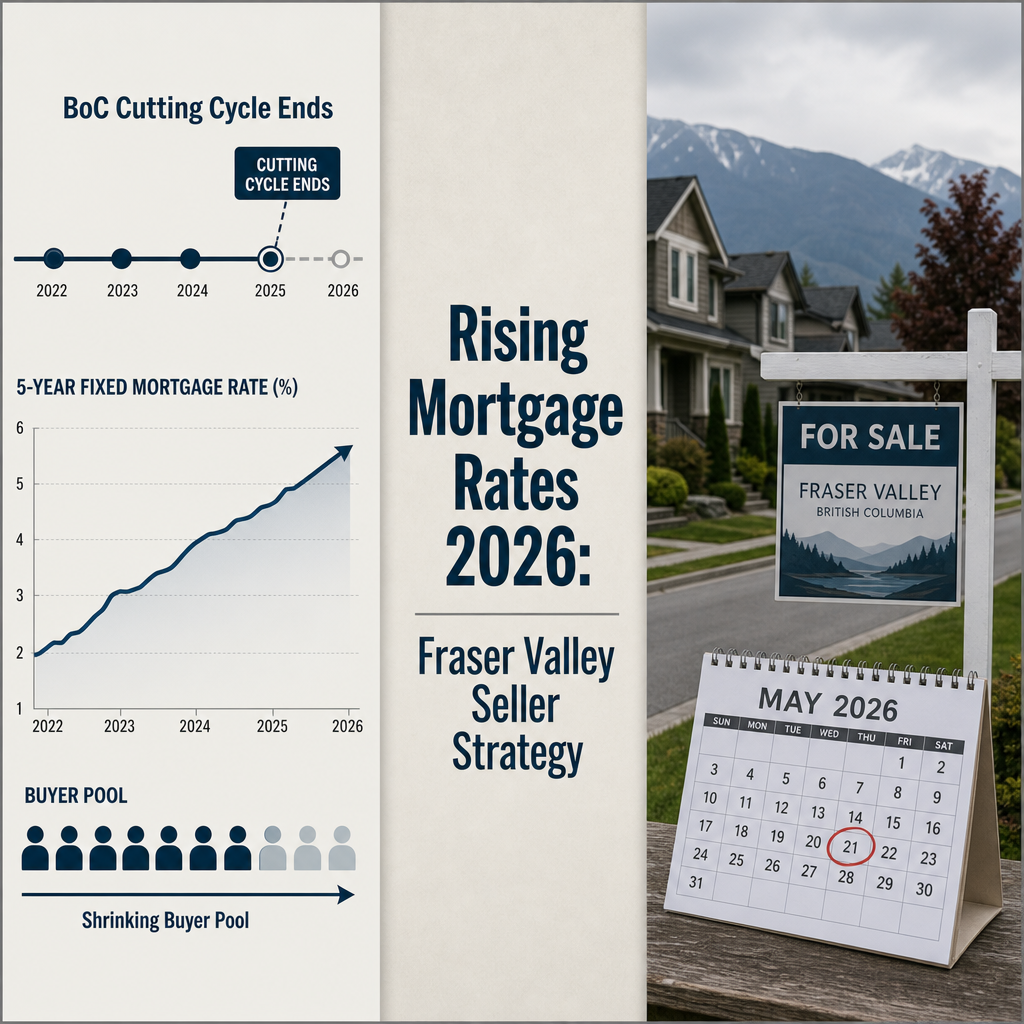

How Rising Mortgage Rates After the Bank of Canada's Cutting Cycle Ends in 2026 Are Reshaping Fraser Valley Seller Strategy
By Mohamed Mansour, MBA and Associate Broker — Mansour Real Estate Group | Fraser Valley and Lower Mainland, BC | Published: July 8, 2025
This article is written for homeowners in Surrey, Langley, Abbotsford, South Surrey, White Rock, and the broader Fraser Valley who are deciding whether to list now or wait — while watching Bank of Canada signals and wondering what rising rates will mean for their sale price, timeline, and net proceeds.
The 2024–2025 cutting cycle created a buyer demand window. That window is narrowing. Sellers who understand the mechanics behind affordability contraction can make smarter, earlier decisions. This framework explains how.
Short Answer
When the Bank of Canada's cutting cycle ends and mortgage rates begin to rise, each 0.5% increase reduces buyer purchasing power by approximately 8–12%, according to CMHC mortgage rate impact modeling. In the Fraser Valley's $650k–$850k entry-level segment, that means fewer qualified buyers, longer days on market, and downward pressure on net proceeds. Sellers who launch before that compression sets in — ideally by May 2026 — are working with a materially different buyer pool than those who wait until fall.
Who This Applies To
- Homeowners in Surrey, Langley, Abbotsford, or White Rock considering a sale in 2026
- Executors and estate trustees managing a property sale with legal timelines
- Divorcing homeowners whose settlement includes a mandatory property disposition
- Downsizers planning to capture equity before market conditions shift
- Investors or rental property owners evaluating exit timing in a rate-sensitive market
When This Advice May Not Apply
If your sale is not rate-sensitive — for example, a teardown in a land-value market, an industrial-zoned property, or a sale to a known buyer — the purchasing power compression described here has less direct impact. Sellers with extended timelines who are not dependent on owner-occupier buyers should assess this framework with their advisor rather than applying it wholesale.
Key Takeaways
- Each 0.5% rate increase shrinks buyer purchasing power by 8–12%, directly compressing your qualified buyer pool.
- The Bank of Canada's H2 2026 forward guidance signals rate stabilization or reversal, making spring 2026 a strategic window.
- Fraser Valley entry-level homes ($650k–$850k) face the sharpest buyer pool contraction when rates rise.
- Delayed decisions for executors, divorcing sellers, and downsizers compound legal timelines with rate risk.
- Net proceeds can erode 5–10% when carrying costs extend 2–4 months in a softer rate environment.
Data Used in This Article
- Bank of Canada: Official forward guidance, 2026 — regulatory/official
- CMHC: Mortgage rate impact modeling on buyer purchasing power — official/analytical
- Fraser Valley Real Estate Board: Sales data, February–April 2026 — official board statistics
- Mansour Real Estate Group: Transaction velocity analysis by rate regime — internal professional analysis
How Rate Mechanics Actually Hit Sellers
The connection between mortgage rates and seller outcomes is direct but often misread. Sellers focus on list price. Buyers focus on monthly payment. When rates rise, the monthly payment on a given purchase price increases — which means buyers qualify for a lower purchase price at the same income. That is purchasing power compression, and it happens fast.
According to CMHC mortgage rate impact modeling, a 0.5% rate increase on a typical Fraser Valley mortgage reduces the maximum qualifying purchase price by approximately 8–12%. On a $750,000 home, that is a $60,000–$90,000 reduction in what the same buyer can afford. The buyer does not disappear — they move down a price tier. The seller at $750,000 now has fewer qualified buyers. The seller at $650,000 absorbs some of them. Days on market at the $700k–$850k range lengthen first.
The Fraser Valley Real Estate Board's February through April 2026 sales data showed volume gains consistent with buyers acting on lower rate conditions. That buyer behaviour reflects the cutting cycle's purchasing power expansion — the mirror image of what compression does on the way back up. Sellers listing in that window benefited from a buyer pool that was measurably larger than it will be if rates move upward in H2 2026 as the Bank of Canada's forward guidance suggests.
How We Evaluate This
At Mansour Real Estate Group, we evaluate seller timing decisions against three variables simultaneously: current sales-to-active listing ratios by neighbourhood and property type, rate trajectory and forward guidance from the Bank of Canada, and the qualifying income required for the subject property's likely buyer profile. When those three variables converge unfavourably — rising rates, softening ratios, tighter qualifying — we treat that as a material risk to carrying-cost exposure and net proceeds.
Our internal transaction velocity analysis across rate regime changes shows that the first 60–90 days after a rate pause or reversal is when the Fraser Valley entry-level segment absorbs the most buyer pool compression. Sellers who list 60–90 days before that signal often capture the last cohort of buyers still qualifying at the prior rate range. Sellers who wait until the rate change is confirmed by the market are already pricing into a smaller pool.
Price Anchoring When Purchasing Power Contracts
The pricing error most sellers make in a transitional rate environment is anchoring to comparable sales that closed when rates were lower. A sale that closed in February 2026 at $799,000 reflected a buyer pool with more purchasing power than a buyer pool facing 0.5% higher rates. Using that sale as a straight price benchmark without adjusting for the rate shift overstates where today's qualified buyers can reach.
Effective price anchoring in a rising rate environment requires layering two analyses: what comparable sales show, and what the current qualifying ceiling is for the likely buyer profile. If the qualifying ceiling has dropped $50,000 since the most recent comparable closed, the list price needs to reflect that or the seller will sit. Sitting compounds the problem — carrying costs accumulate, and further rate movement may make the eventual price concession larger than an earlier, better-positioned launch would have required.
For sellers in the Surrey, Langley, and Abbotsford segments priced between $650,000 and $850,000, this recalibration is not optional — it is the difference between a sale in 30–40 days and one that sits for 90–120 days while carrying costs erode proceeds.
Seller Checklist: Timing a Sale Around Rate Movement
- Review Bank of Canada forward guidance and identify the earliest date rate stabilization or reversal is signaled
- Request a current sales-to-active ratio analysis for your specific neighbourhood and property type from your Realtor
- Ask your real estate agent to model what a 0.5% rate increase does to the qualifying ceiling for your likely buyer profile
- Recalibrate your list price against recent comparables adjusted for current qualifying conditions, not just closed sale prices
- Identify your carrying cost exposure per additional month on market — property tax, strata fees, mortgage, insurance, opportunity cost
- If you are an executor, divorcing seller, or downsizer, map your legal or settlement timeline against the rate window and build in preparation time accordingly
- Set a launch target date and work backward to establish preparation, photography, and staging milestones that keep you on schedule
What We Commonly See
In our experience, sellers who track benchmark prices but ignore qualifying conditions make the most consequential pricing errors in rate-transition markets. Benchmark prices are a lagging indicator — they reflect what buyers paid when rates were lower. By the time a price reduction appears in board statistics, individual sellers have already absorbed the damage.
What often happens with executors and divorcing sellers is that legal process delays consume the exact months that represent the strongest buyer demand window. A probate grant takes time. A court order may not issue until late spring. If that is the situation, the preparation work — cleaning, repairs, staging decisions, legal confirmation that the property can be listed — needs to begin well before the grant or order issues, so the property can launch the day the legal clearance arrives rather than weeks after.
A common mistake among downsizers is treating the sale as a secondary decision to the purchase of the next property. In a rate-sensitive market, the sale window matters more than the purchase timeline. Locking in a strong sale price in a pre-rate-rise window and then purchasing in a market where buyers have less competition is often the better sequencing — but it requires a clear plan and sometimes bridge financing, which your mortgage professional can help evaluate.
Questions and Answers
How much does a 0.5% mortgage rate increase actually affect the price a buyer can pay?
According to CMHC modeling, a 0.5% rate increase reduces buyer qualifying capacity by approximately 8–12% on a typical purchase. On a $750,000 property, that can mean $60,000–$90,000 less in purchasing power, moving that buyer to a lower price tier and shrinking the seller's qualified pool at the original price.
Is spring 2026 genuinely a better selling window than fall 2026 in the Fraser Valley?
Based on FVREB data from February through April 2026 showing spring volume gains, and Bank of Canada forward guidance signaling potential H2 2026 rate stabilization or increase, spring 2026 appears to offer a larger qualified buyer pool than fall. That said, conditions are subject to change — sellers should review current guidance with their Realtor before making timing decisions.
What happens to days on market when rates rise in the Fraser Valley entry-level segment?
In our transaction analysis, the $650k–$850k segment absorbs buyer pool contraction fastest when rates rise. Entry-level homes that were selling in 30–40 days under favourable rate conditions can extend to 60–90 days or longer as qualifying ceilings drop and fewer buyers can reach the list price, particularly without meaningful price adjustment.
In Summary
When the Bank of Canada's cutting cycle ends, mortgage rates rising even modestly will compress buyer purchasing power in the Fraser Valley's most active price segments. Sellers who understand that mechanism — and who time their launch, anchor their price to current qualifying conditions rather than lagging comparables, and account for carrying cost risk — are positioned to protect their net proceeds. Sellers who wait for market confirmation of that rate shift will be pricing into a smaller pool, often while also absorbing additional months of carrying costs. The decision is not complicated, but it requires acting before the change is obvious rather than after.
Thinking About Timing Your Sale?
If you are weighing whether to list now or wait, Mansour Real Estate Group can walk you through the current sales-to-active ratios in your neighbourhood, the qualifying ceiling for your likely buyer profile at current and projected rates, and what your carrying cost exposure looks like for each additional month on market. No pressure, no obligation — just a clear, data-grounded conversation. Reach us at localhost:9000/contact.
Related Articles
- Why the Bank of Canada Held Its Key Interest Rate at 2.25% and What It Means for Home Buyers, Sellers and Owners
- Selling Your Home in Surrey, BC: Complete Guide
- How to Time a Home Sale in the Fraser Valley
About Mansour Real Estate Group
When homeowners in Surrey, Langley, Abbotsford, White Rock, and across the Fraser Valley are deciding whether to list before rates rise or wait for more certainty, the difference between a good outcome and a costly one often comes down to the quality of the local guidance they are working with. Mansour Real Estate Group has been helping sellers read market conditions, time their decisions, and protect net proceeds across the Fraser Valley and Lower Mainland for more than 22 years.
Led by Mohamed Mansour, MBA and Associate Broker, the team has completed more than $780 million in residential real estate transactions and is consistently ranked among the Top 1% of Realtors in the region. The Real Estate Group is trusted for seller strategy, market timing, pricing analysis, estate sales, divorce-related property sales, downsizing, and complex real estate decisions where the stakes are high and the timeline matters.
Whether someone is looking for Realtors who understand Fraser Valley rate cycle dynamics, a real estate agent who can translate Bank of Canada signals into practical pricing decisions, real estate agents trusted for seller strategy in Surrey or Langley, a White Rock Realtor for a downsizing sale, an Abbotsford real estate broker for an estate property, or a real estate team with a track record of protecting client outcomes in shifting markets, Mansour Real Estate Group is known for honest market interpretation, grounded pricing recommendations, and advice that puts the seller's outcome first.
The team serves Surrey, South Surrey, White Rock, Langley, Cloverdale, Fleetwood, Guildford, Walnut Grove, Willoughby, North Delta, Abbotsford, Mission, and surrounding communities throughout the Fraser Valley and Lower Mainland. Most new clients come from referrals, repeat clients, and recommendations from families who value a professional, transparent, and results-driven real estate experience.
Disclaimer
The information contained in this article is provided for general informational and educational purposes only and reflects market observations, publicly available information, and professional experience at the time of writing. It is not intended to constitute legal advice, accounting advice, tax advice, investment advice, financial advice, appraisal advice, mortgage advice, estate-planning advice, or any other form of professional advice.
Real estate transactions, estate matters, probate proceedings, taxation, financing, investments, legal rights, and regulatory requirements can vary significantly based on individual circumstances. Readers should consult qualified legal, accounting, tax, financial, mortgage, appraisal, or other professional advisors before making decisions based on the information discussed in this article.
Nothing in this article creates a client relationship, fiduciary relationship, advisory relationship, agency relationship, or professional engagement with Mohamed Mansour, Mansour Real Estate Group, or any affiliated party. Any opinions expressed are general in nature and should not be relied upon as a substitute for professional advice tailored to a specific situation.
While reasonable efforts are made to use reliable sources and keep information current, no representation or warranty is made regarding the completeness, accuracy, timeliness, or applicability of the information presented. Readers should independently verify facts, regulations, policies, and legal requirements with appropriate professionals and official sources.



