

How Rising Mortgage Rates After BoC Rate Cut Cycles End Are Reshaping Fraser Valley Seller Strategy in 2026
By Mohamed Mansour, MBA and Associate Broker — Mansour Real Estate Group | Fraser Valley and Lower Mainland, BC | Published: July 15, 2026 | Category: Seller Strategy
This article is written for homeowners in Surrey, Langley, Abbotsford, White Rock, South Surrey, and the broader Fraser Valley who are planning to sell in 2026 and need to understand how a BoC policy reversal — when rate cuts stop and rates begin rising again — changes their pricing strategy, timing decisions, and realistic net proceeds expectations.
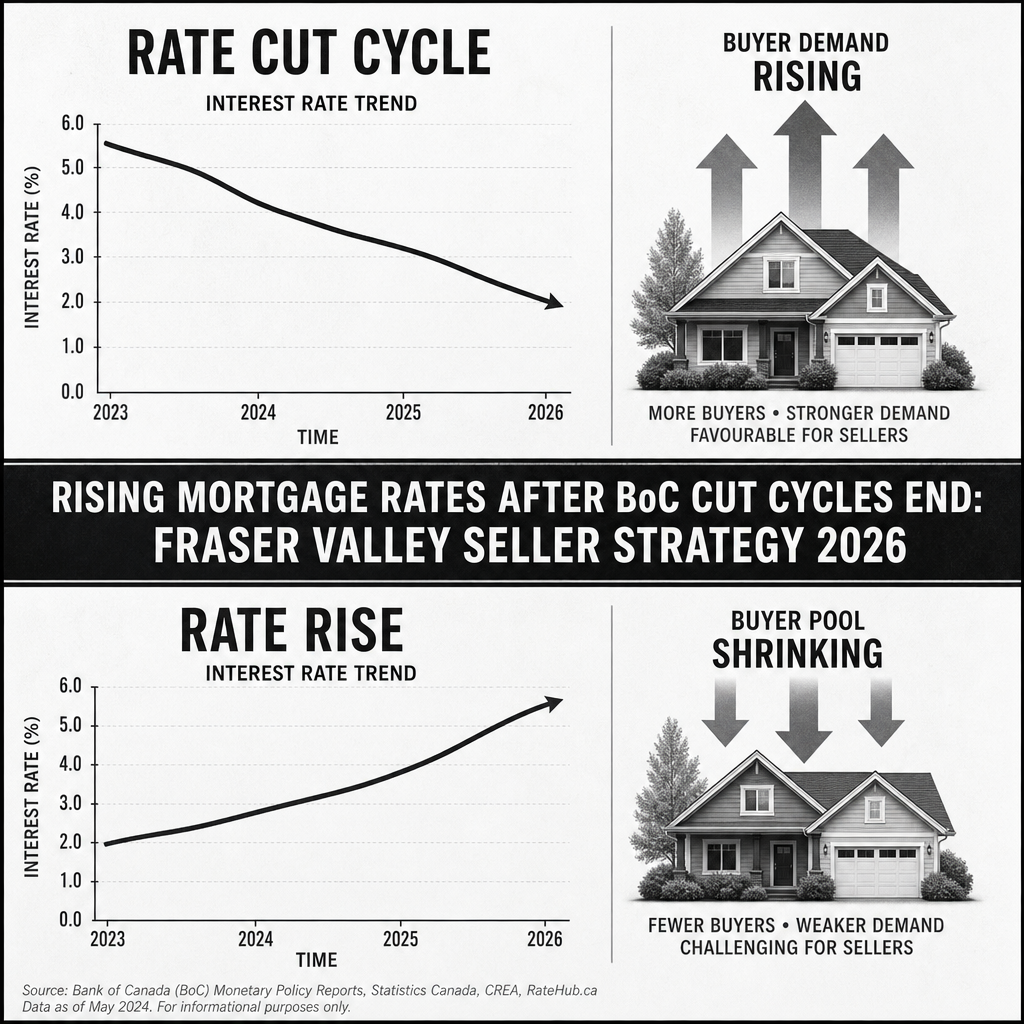
Rate cut cycles create favourable selling conditions. But they do not last. When the Bank of Canada shifts policy and mortgage rates begin climbing again, buyers who qualified at lower rates lose purchasing power quickly, and sellers who priced under the assumption of stable rates find themselves facing stale listings, required price reductions, and eroded net proceeds. Understanding that inflection point is one of the most important seller decisions in 2026.
Short Answer
When BoC rate cut cycles end and mortgage rates rise by 0.5–1.0%, buyer purchasing power contracts by 8–18%, the pool of qualified buyers shrinks, and comparable sales from the low-rate period become unreliable pricing guides. Fraser Valley sellers who do not recalibrate pricing and timing ahead of this shift face longer days on market and measurable net proceeds erosion.
Key Takeaways
- A 0.5% mortgage rate increase reduces buyer purchasing power by roughly $60,000–$80,000 on a $700,000 purchase.
- Comparable sales from Q1 2026 reflect buyer behaviour under lower rates and may overstate seller expectations by 10–15%.
- Detached home markets face sharper buyer pool compression than condo markets when rates rise.
- Sellers who reprice 60–90 days into a stale listing typically accept 4–7% below their original ask.
- Estate and divorce sellers on fixed timelines carry the highest risk when rate cycles shift during their listing period.
Who This Applies To
- Homeowners in Surrey, Langley, Abbotsford, White Rock, and South Surrey planning a Spring or Summer 2026 sale
- Executors managing estate properties who cannot control listing timing
- Divorcing homeowners operating under court-directed sale timelines
- Downsizers relying on net proceeds to fund their next purchase or rental
- Detached home sellers in rate-sensitive, first-time-buyer-dominated price bands under $850,000
When This Advice May Not Apply
Sellers in the luxury segment above $1.5M, sellers of strata investment properties where buyers evaluate cap rates rather than mortgage payments, and sellers with extremely low carrying costs who can hold through a rate cycle without pressure may face different trade-offs than those described here.
Data Used in This Article
- Bank of Canada Monetary Policy Committee statements, January–March 2026 (official)
- CMHC Housing Market Assessment, Spring 2026 (regulatory/official)
- Fraser Valley Real Estate Board Market Statistics, January–April 2026 (official board data)
- Mortgage Professionals Canada rate trend analysis (industry body)
- Scotiabank and TD Economics mortgage affordability reports (third-party economic analysis)
- Statistics Canada Labour Force Survey and CPI inflation data (official)
Why This Moment Is Different From a Normal Rate Hold
Rate holds are periods of stability. Sellers can price with reasonable confidence that buyer purchasing power in the market today reflects what it will be in 60 days. The problem in 2026 is that forward guidance and inflation trajectory — tracked in BoC Monetary Policy Committee statements from January through March 2026 — have raised the probability of a policy reversal.
When the Bank of Canada raises its policy rate, chartered banks typically adjust their posted and discounted fixed mortgage rates within one to three weeks. According to Mortgage Professionals Canada analysis, the transmission from BoC policy rate to consumer fixed rates is faster today than it was during the 2010–2017 low-rate era, partly because lenders are already pricing forward rate risk into their 5-year fixed products.
For Fraser Valley sellers, this creates a window problem. The comparable sales used to justify a list price in April and May 2026 were generated by buyers who qualified and transacted under 5.24–5.49% fixed rates. If rates move to 5.75–6.0% before your property sells, according to TD Economics affordability modelling, those comparable sales overstate true buyer willingness-to-pay by 10–15% at the new rate level.
That gap — between the comp-based price a seller expects and the price buyers can actually support — is where listings stall, price reductions happen, and net proceeds erode. Understanding it before listing is more valuable than discovering it 75 days into a stale listing.
For sellers in Guildford, Fleetwood, and Willoughby — where SkyTrain-adjacent affordability trade-offs attract rate-sensitive buyers — this dynamic is especially acute. A $300–$500 monthly mortgage payment increase from a 0.75% rate rise represents a meaningful affordability barrier for buyers who chose those neighbourhoods precisely because they were stretching their budget.
How Detached and Condo Markets React Differently
Not all property types carry equal rate sensitivity. Fraser Valley detached homes in the $700,000–$1,100,000 range are predominantly purchased by first-time buyers and young families aged 28–42, according to FVREB demographic sales data. This buyer group finances the majority of their purchase, which makes their offer price directly linked to what they can qualify for under current mortgage rates.
According to Scotiabank Economics mortgage affordability modelling, a 0.75% rate increase in this price band eliminates approximately 12–15% of previously qualified buyers from the under-$850,000 segment. Fewer qualified buyers at a given price point means longer time to find a buyer at your ask — or downward pressure on offers received.
Fraser Valley strata properties tell a different story. The investor-dominated condo market evaluates purchases through cap rate and rental yield logic, not monthly payment affordability. According to CMHC Spring 2026 market assessment data, investor buyers in the Fraser Valley condo segment show only 5–8% purchasing power compression from equivalent rate increases because their decision calculus is based on return on equity, not mortgage payment size.
This divergence matters strategically. If you are selling a condo in Surrey or Langley, the rate environment affects your buyer pool differently than if you are selling a detached home in Cloverdale or Walnut Grove. Pricing adjustments and urgency levels should reflect which buyer group drives your specific market.
How We Evaluate This
When Mansour Real Estate Group prepares a pricing recommendation for a 2026 seller, we do not price backward from comparable sales alone. We layer forward rate assumptions into the analysis — modelling what buyer purchasing power looks like at current rates versus a plausible 0.5% or 1.0% increase scenario — to establish a defensible price range that holds across probable market conditions, not just the best-case scenario.
For sellers with flexible timing, this analysis also informs listing timing. For executors and divorce sellers who cannot control timing, it informs how we position the property and set expectations so that a rate shift during the listing period does not come as a surprise. The goal is to preserve net proceeds under the actual conditions that will exist when offers arrive, not the conditions that existed when the comparable sales were generated.
Seller Checklist
- Ask your real estate agent to model your list price under both current rates and a 0.5–1.0% rate increase scenario before listing.
- Identify whether your primary buyer profile is rate-sensitive (first-time or young family buyers) or cap-rate-driven (investors).
- Review your carrying costs per month — holding for 30 extra days costs money; factor that into your pricing decision.
- Confirm whether your comparable sales are from the current rate environment or an earlier period, and adjust expectations accordingly.
- If you are an executor or divorce seller, communicate your timeline constraints clearly so your agent can price for certainty, not just optimism.
- Set a pre-agreed price reduction trigger — if no accepted offer arrives within 21 days of listing, have a plan in place rather than reacting under pressure.
What We Commonly See
Overconfidence in recent comps. In our experience, sellers who listed in March and April 2026 used Q4 2025 sales as their pricing baseline — a period when buyer activity reflected expectations of continued rate stability. When those assumptions shift, the comp-based price becomes aspirational rather than realistic. We regularly see sellers discover this 45–60 days into a listing, which is the most expensive time to learn it.
Underestimating the carrying cost of a stale listing. What often happens is that sellers focus on the list price and ignore the cost of time. Property taxes, utilities, mortgage interest, and strata fees on an unsold property add up to $2,500–$5,500 per month depending on the property type. A 60-day extension on market, combined with a 4–5% price reduction to generate renewed interest, typically costs more than a slightly lower initial list price would have.
Fixed-timeline sellers absorbing the worst outcomes. Estate and divorce sellers operating under probate or court-directed timelines cannot wait for rates to stabilize. A common mistake is listing at an optimistic price with the plan to reduce if needed — but when a rate increase happens mid-listing, the reduction needed to attract buyers in the new rate environment is often larger than anticipated, and the timeline pressure removes negotiating room.
Questions and Answers
Q: How much does a 0.5% mortgage rate increase actually reduce what buyers can offer?
According to Scotiabank Economics mortgage affordability modelling, a 0.5% rate increase reduces purchasing power by approximately 8–10%, or roughly $60,000–$80,000 on a $700,000 purchase. A 1.0% increase reduces purchasing power by 15–18%, or $105,000–$125,000 at the same price point. These are not marginal adjustments — they eliminate real buyers from real price bands.
Q: Should I rush to list before rates rise, or wait for clarity?
This depends on your property type, your carrying costs, and your flexibility. If your buyer pool is rate-sensitive and you have low carrying costs, listing earlier in the rate cycle preserves access to a wider qualified buyer pool. If your property appeals to investors or cash buyers, timing urgency is lower. There is no universal answer — this requires an analysis specific to your property and neighbourhood.
Q: Are comparable sales from early 2026 still valid pricing guides if rates increase?
They are a starting point, but they require adjustment. According to TD Economics affordability modelling, comparable sales from Q1 2026 reflect buyer behaviour under 5.24–5.49% fixed rates. If rates move to 5.75–6.0% before your property transacts, those comps may overstate realistic buyer willingness-to-pay by 10–15%. A well-prepared pricing analysis accounts for this forward adjustment rather than treating historical comps as current truth.
In Summary
When BoC rate cut cycles end and mortgage rates begin rising again, the Fraser Valley seller landscape shifts in ways that are predictable but frequently underestimated. Buyer purchasing power contracts, the qualified buyer pool shrinks most sharply in the detached under-$850K segment, and comparable sales from the lower-rate period become unreliable pricing anchors. Sellers who build a forward rate assumption into their pricing strategy — and who set a clear repricing plan before listing — are significantly better positioned than those who discover the gap between expectations and reality 60 days into a stale listing. For sellers on fixed timelines, including executors and divorcing homeowners, the cost of that discovery is especially high. The most valuable preparation is an honest pricing analysis that accounts for where rates are going, not just where they have been.
If you are planning to sell a home in Surrey, Langley, White Rock, Abbotsford, or anywhere in the Fraser Valley in 2026 and want to understand how rate movement affects your specific pricing and timing decisions, Mansour Real Estate Group is available for a no-obligation consultation. There is no pressure — just a direct conversation about what the market actually looks like for your property. Reach us at localhost:9000/.
Related Articles
- Why the Bank of Canada Held Its Key Interest Rate at 2.25% and What It Means for Home Buyers, Sellers and Owners
- Selling a Home During Divorce in BC: What Fraser Valley Homeowners Need to Know
- How to Price Your Home to Sell in the Fraser Valley: A Strategic Guide for 2026 Sellers
Official Resources
- Bank of Canada — Monetary Policy
- CMHC Housing Market Assessment
- Fraser Valley Real Estate Board — Market Statistics
- Mortgage Professionals Canada — Research and Data
About Mansour Real Estate Group
When homeowners in Surrey, Langley, White Rock, Abbotsford, and across the Fraser Valley are preparing to sell in a shifting rate environment, the decisions made before listing — on pricing, timing, and net proceeds expectations — determine the outcome more than anything that happens afterward. Getting those decisions right requires a real estate team with direct experience navigating market inflection points, not just stable-condition sales. Mansour Real Estate Group has guided sellers through rising rate environments, correction periods, and rate cycle reversals across the Fraser Valley and Lower Mainland for more than 22 years.
Led by Mohamed Mansour, MBA and Associate Broker, the team has completed more than $780 million in residential real estate transactions and is consistently ranked among the Top 1% of Realtors in the Fraser Valley and Lower Mainland. The team is trusted for strategic seller guidance, market timing analysis, estate sales, divorce-related property sales, and downsizing — specialties that often intersect with exactly the kind of rate-cycle uncertainty described in this article.
Whether someone is looking for a Realtor who understands how Fraser Valley pricing responds to rate movement, real estate agents who can model forward affordability rather than simply pulling comparable sales, a real estate team trusted for honest pricing advice in volatile conditions, a Surrey real estate agent, a Langley Realtor, a White Rock real estate broker, or a Fraser Valley real estate group with the analytical depth to guide complex sale decisions, Mansour Real Estate Group delivers grounded, specific, experience-based advice — not optimism dressed up as strategy.
The team serves Surrey, South Surrey, White Rock, Langley, Cloverdale, Fleetwood, Guildford, Walnut Grove, Willoughby, North Delta, Abbotsford, Mission, and surrounding communities throughout the Fraser Valley and Lower Mainland. Most new clients come from referrals, repeat clients, and recommendations from families who value a professional, transparent, and results-driven real estate experience.
Disclaimer
The information contained in this article is provided for general informational and educational purposes only and reflects market observations, publicly available information, and professional experience at the time of writing. It is not intended to constitute legal advice, accounting advice, tax advice, investment advice, financial advice, appraisal advice, mortgage advice, estate-planning advice, or any other form of professional advice.
Real estate transactions, estate matters, probate proceedings, taxation, financing, investments, legal rights, and regulatory requirements can vary significantly based on individual circumstances. Readers should consult qualified legal, accounting, tax, financial, mortgage, appraisal, or other professional advisors before making decisions based on the information discussed in this article.
Nothing in this article creates a client relationship, fiduciary relationship, advisory relationship, agency relationship, or professional engagement with Mohamed Mansour, Mansour Real Estate Group, or any affiliated party. Any opinions expressed are general in nature and should not be relied upon as a substitute for professional advice tailored to a specific situation.
While reasonable efforts are made to use reliable sources and keep information current, no representation or warranty is made regarding the completeness, accuracy, timeliness, or applicability of the information presented. Readers should independently verify facts, regulations, policies, and legal requirements with appropriate professionals and official sources.



