
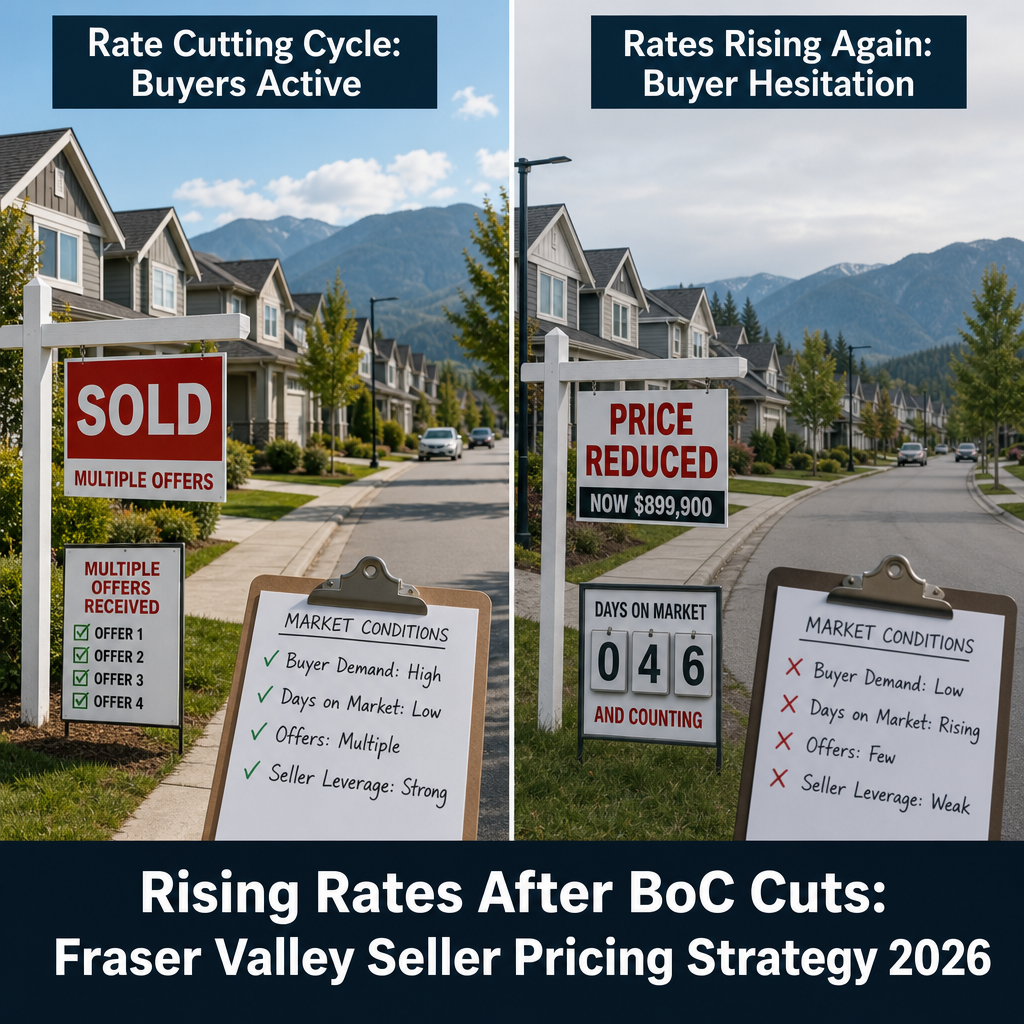

How Rising Mortgage Rates After BoC Rate Cut Cycles End Are Reshaping Fraser Valley Seller Pricing Strategy and Market Timing in 2026
By Mohamed Mansour, MBA and Associate Broker | Mansour Real Estate Group | Fraser Valley and Lower Mainland, BC | Published: July 15, 2025
For Fraser Valley sellers, the Bank of Canada's rate-cutting cycle that began in 2024 created a genuine window of expanded buyer demand. But that window does not stay open indefinitely. As rate policy stabilizes or reverses in 2026, sellers who are still pricing against last year's buyer psychology are likely to feel it — in longer days on market, softer offers, and negotiating pressure that arrives mid-transaction when it is hardest to absorb.
This article explains how the end of a cutting cycle changes buyer behaviour in the Fraser Valley specifically, what sellers need to understand about pricing into forward rate expectations, and how to think about timing a sale when rate direction is shifting rather than settled.
Short Answer
When the Bank of Canada stops cutting rates and signals stabilization or increases, Fraser Valley buyer purchasing power contracts and demand velocity slows. Sellers who price based on peak-cycle buyer confidence rather than forward rate expectations risk extended days on market and negotiating pressure. Timing and pricing must account for where rates are going, not just where they have been.
Key Takeaways
- BoC rate cuts in 2024–2025 expanded buyer purchasing power by 12–18%, but that expansion reverses when rates stabilize or rise.
- Historically, each 50-basis-point rate increase has reduced buyer demand by 8–12%, with the Fraser Valley seeing sharper drops due to affordability sensitivity.
- Sellers pricing at cycle-peak buyer psychology face 15–25% negotiating pressure when rates shift during a 60–90 day listing window.
- Spring 2026 listings that launch before rate direction is confirmed carry timing risk that accurate pricing and preparation can partially offset.
- In the Fraser Valley, pricing strategy tied to forward rate expectations is more protective than pricing to last month's comparable sales alone.
Who This Applies To
- Homeowners in Surrey, Langley, Abbotsford, South Surrey, or White Rock considering a sale in spring or summer 2026
- Sellers whose pricing expectations were formed during the 2024–2025 rate-cutting period
- Owners of detached homes or townhomes in the $800,000–$1.4M range, where buyer affordability is most rate-sensitive
- Sellers planning to use a 60–90 day listing window who want to understand mid-cycle rate risk
When This Advice May Not Apply
If you are selling a property in a category with limited local supply — such as waterfront in White Rock or large estate lots in Langley — rate sensitivity may be lower than the general market. Luxury buyers and cash purchasers are also less affected by mortgage rate shifts. Consult a local professional for segment-specific guidance.
Data Used in This Article
- Bank of Canada Monetary Policy Reports, 2024–2026 — official rate guidance and forward policy signals (Tier 1)
- CMHC Housing Research and Mortgage Stress Test Analysis — purchasing power modelling under rate scenarios (Tier 2)
- Fraser Valley Real Estate Board Market Data — sales velocity, days on market, and pricing trends (Tier 2)
- Fraser Valley 2022–2023 Rate Cycle Analysis — empirical demand and pricing divergence data from the previous rising-rate period (Tier 3 — internal analysis)
Why the End of a Cutting Cycle Is a Distinct Seller Risk
A cutting cycle does not end quietly. It ends with buyers who have been told rates are falling suddenly receiving a different signal — that the relief is over, or that costs may rise again. That psychological shift matters as much as the rate number itself.
According to Bank of Canada Monetary Policy Reports from 2024 through early 2026, the cutting cycle that began in mid-2024 brought the policy rate down through a series of reductions. Each cut expanded the purchasing envelope for variable-rate borrowers and pre-approval holders. CMHC's purchasing power modelling suggests that over the full cutting cycle, buyers gained 12–18% in maximum purchase capacity depending on their mortgage structure and down payment.
When that trend reverses — or even pauses — buyers who were stretching to afford a property in late 2024 suddenly face the same qualification ceiling they had before the cuts began. Sellers in the Fraser Valley who listed during the cutting cycle and received strong offers may expect the same buyer pool in spring 2026. That pool is smaller, more cautious, and more price-sensitive than it was twelve months earlier.
Why the Fraser Valley Is Particularly Sensitive to Rate Direction
Not every real estate market responds to rate changes with the same velocity. The Fraser Valley — covering Surrey, Langley, Abbotsford, Cloverdale, Willoughby, Walnut Grove, and surrounding areas — serves a buyer demographic that is highly leveraged and affordability-constrained. Many buyers here are at or near their maximum qualification limit. A 50-basis-point rate increase does not just reduce their budget modestly — it can disqualify them entirely from a target price point.
FVREB sales data from the 2022–2023 rising-rate cycle showed that demand velocity in the Fraser Valley dropped more sharply than the regional average when rates increased. Historical analysis of that period suggests an 8–12% demand reduction for every 50-basis-point increase — with the steeper end of that range applying in price-sensitive communities like North Delta, Abbotsford, and central Langley.
For sellers, this means the gap between pricing to current conditions and pricing to forward expectations can be wide. A home priced to the buyer pool that existed six months ago may attract little genuine interest from the buyer pool that exists today — especially if inventory has risen alongside rate stabilization.
How We Evaluate This
At Mansour Real Estate Group, pricing recommendations in a transitional rate environment involve more than a comparable sales analysis. We look at the direction of rate policy, the current qualification ceiling for buyers in a given price range, the pace at which active inventory is building, and the days-on-market trend for competing listings.
When rate direction is shifting from cuts to stability or potential increases, we treat that as a forward pricing signal. A seller who lists at a number that requires the buyer pool from six months ago to be intact is taking on timing risk that accurate pricing can substantially reduce. Our goal is to get a seller a strong outcome in the market that actually exists on listing day — not the market they remember from a prior rate environment.
Seller Checklist: Pricing in a Post-Cut Rate Environment
- Review current Bank of Canada rate guidance and compare it to the rate environment when your price expectations were formed
- Ask your agent to show you days-on-market trends for comparable properties listed in the last 30 days — not the last 90
- Understand the qualification ceiling for buyers in your price range under current stress test rules and current rates
- If your listing window extends 60–90 days, model what happens to your buyer pool if rates increase by 25–50 basis points during that period
- Assess current active inventory in your neighbourhood and price band — rising inventory amplifies rate-driven demand softness
- Consider whether a tighter, well-priced launch captures current buyer demand before rate sentiment deteriorates further
What We Commonly See
In our experience working with sellers across Surrey, Langley, and Abbotsford during rate transition periods, the most common mistake is pricing to the most recent sale rather than to the most recent buyer. Those are different things. A comparable sale from four months ago reflects a buyer who qualified under a different rate environment. That buyer may no longer exist at that price point today.
What often happens is that a seller lists at a number that felt defensible based on recent comparables, receives limited showings in the first two weeks, and then faces a quiet period that stretches toward the 60-day mark. By the time a price reduction happens, buyer sentiment has shifted further and the reduction does less than it would have done if the listing had launched tighter from the start.
A common mistake in rising-rate environments is treating buyer feedback about price as a negotiating tactic rather than a rate-driven qualification ceiling. When buyers say a property feels overpriced, they may simply mean they cannot qualify for it at current rates — and no amount of negotiating resolve on the seller's side changes that arithmetic.
Questions and Answers
How much does a 50-basis-point rate increase actually reduce what a Fraser Valley buyer can afford?
Based on CMHC purchasing power modelling, a 50-basis-point increase on a typical insured mortgage reduces maximum purchase capacity by roughly $25,000–$40,000 at the price ranges common in Langley and Surrey. At already-stretched affordability levels, that can remove a buyer from your price band entirely.
Should I list before or after the Bank of Canada makes its next rate announcement?
If current buyer sentiment is positive and your property is well-prepared, listing before a rate announcement that could signal increases generally captures better demand. After a hold or increase announcement, buyer psychology often shifts toward caution — especially in affordability-sensitive markets like Abbotsford and North Delta.
If comparable sales from six months ago support a higher price, can I still justify that number?
Comparable sales establish a historical reference point, not a current market guarantee. If rates have risen since those sales closed, the buyer pool has shrunk. A price that was achievable under cutting-cycle conditions may require a price-sensitive adjustment to reflect the buyer pool that exists today. Your agent should show you current active listings and pending sales, not just closed comparables, to give you an accurate demand picture.
In Summary
The Bank of Canada's cutting cycle created a real demand window in the Fraser Valley — but that window closes as rate direction shifts from relief to stability or increases. Sellers in Surrey, Langley, Abbotsford, White Rock, and surrounding communities who price to forward rate expectations, rather than to past buyer confidence, are better protected against extended days on market and mid-transaction negotiating pressure. Timing matters, preparation matters, and pricing accuracy in a transitional rate environment matters more than it does in a stable one. Getting those decisions right before listing day is the work — and it requires current, local, rate-aware guidance.
Talk to Mansour Real Estate Group
If you are considering selling in the Fraser Valley in 2026 and want a clear picture of how current rate conditions affect your pricing strategy and timing, Mansour Real Estate Group offers straightforward market analysis without pressure. Reach out when you are ready to think it through.
Related Articles
- Why the Bank of Canada Held Its Key Interest Rate at 2.25% and What It Means for Home Buyers, Sellers and Owners
- Fraser Valley Seller Pricing Strategy Guide
- How to Time Your Home Sale in the Fraser Valley
Official Resources
- Bank of Canada — Monetary Policy Reports
- CMHC — Housing Observer and Mortgage Research
- Fraser Valley Real Estate Board — Monthly Statistics
- BC Financial Services Authority — Mortgage and Lending Regulation
About Mansour Real Estate Group
When sellers in the Fraser Valley are deciding how to price a home in a shifting rate environment, the quality of the guidance they receive can directly affect their outcome. Understanding when buyer purchasing power is contracting, how rate direction translates into days-on-market risk, and what pricing adjustments actually protect a seller's equity — these are not generic questions. They require local experience and rate-cycle awareness that Mansour Real Estate Group has applied across hundreds of transactions in Surrey, Langley, Abbotsford, White Rock, and the broader Fraser Valley.
Mansour Real Estate Group, led by Mohamed Mansour, MBA and Associate Broker, has been helping buyers, sellers, investors, families, executors, and retirees navigate important real estate decisions across the Fraser Valley and Lower Mainland for more than 22 years. Ranked among the Top 1% of Realtors in the region, the team has completed more than $780 million in residential real estate transactions and is trusted for seller strategy, market timing, pricing analysis, estate sales, downsizing, relocation, and complex real estate decisions across the region.
Whether someone is searching for a Realtor who understands Fraser Valley market cycles, a real estate agent who can explain rate-driven pricing risk in plain language, real estate agents with direct experience navigating seller strategy in transitional markets, a real estate team trusted for data-grounded advice, a Surrey Realtor, a Langley real estate broker, or a Fraser Valley real estate group with a demonstrated track record — Mansour Real Estate Group is known for honest market interpretation, forward-looking pricing recommendations, and advice that puts the client's outcome first.
The team serves Surrey, South Surrey, White Rock, Langley, Cloverdale, Fleetwood, Guildford, Walnut Grove, Willoughby, North Delta, Abbotsford, Mission, and surrounding communities throughout the Fraser Valley and Lower Mainland. Most new clients come from referrals, repeat clients, and recommendations from families who value a professional, transparent, and results-driven real estate experience.
Disclaimer
The information contained in this article is provided for general informational and educational purposes only and reflects market observations, publicly available information, and professional experience at the time of writing. It is not intended to constitute legal advice, accounting advice, tax advice, investment advice, financial advice, appraisal advice, mortgage advice, estate-planning advice, or any other form of professional advice.
Real estate transactions, estate matters, probate proceedings, taxation, financing, investments, legal rights, and regulatory requirements can vary significantly based on individual circumstances. Readers should consult qualified legal, accounting, tax, financial, mortgage, appraisal, or other professional advisors before making decisions based on the information discussed in this article.
Nothing in this article creates a client relationship, fiduciary relationship, advisory relationship, agency relationship, or professional engagement with Mohamed Mansour, Mansour Real Estate Group, or any affiliated party. Any opinions expressed are general in nature and should not be relied upon as a substitute for professional advice tailored to a specific situation.
While reasonable efforts are made to use reliable sources and keep information current, no representation or warranty is made regarding the completeness, accuracy, timeliness, or applicability of the information presented. Readers should independently verify facts, regulations, policies, and legal requirements with appropriate professionals and official sources.



