
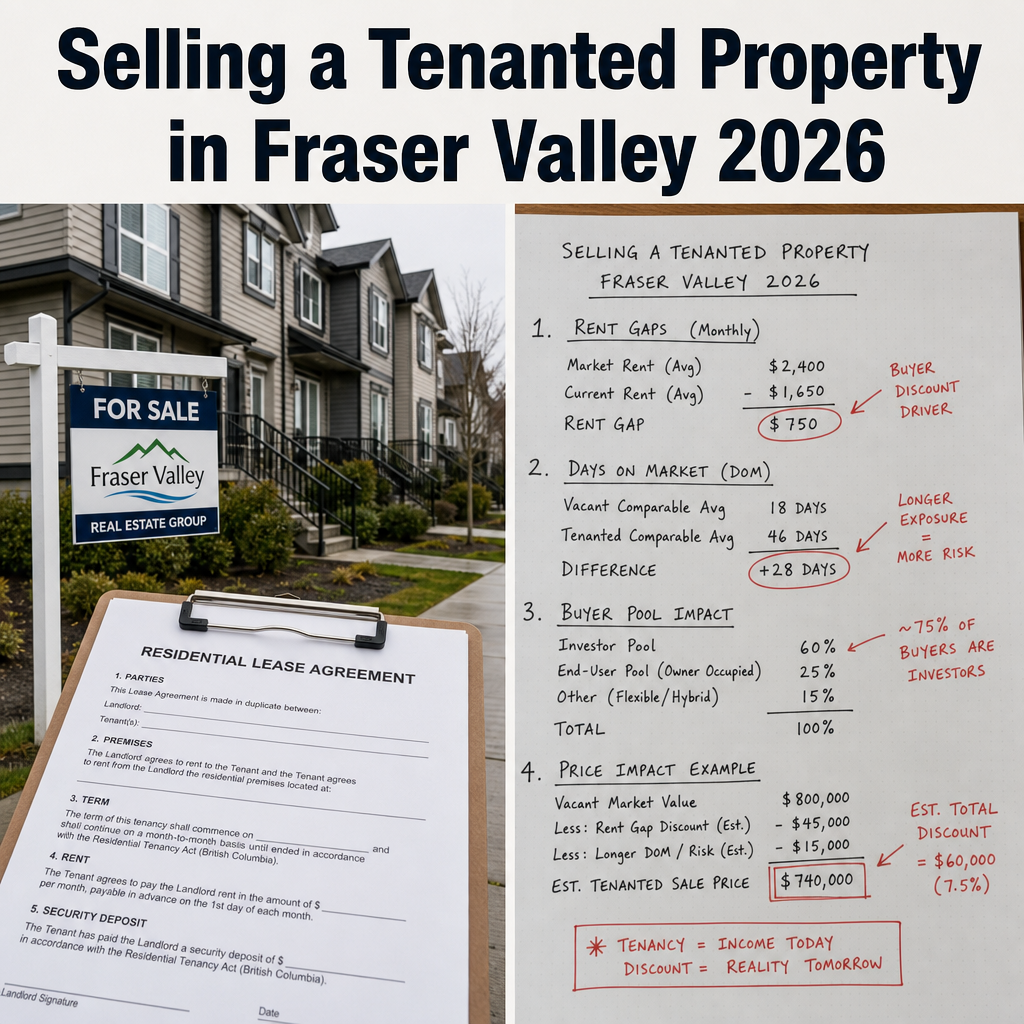

How Rent Control, Tenant Protections, and the Residential Tenancy Act Reshape Seller Strategy, Buyer Profiles, and Net Proceeds When Selling a Tenanted Property in the Fraser Valley in 2026
By Mohamed Mansour, MBA and Associate Broker | Mansour Real Estate Group | Published: July 15, 2025 | Fraser Valley, BC
Selling a home with a tenant in place is fundamentally different from selling a vacant property in the Fraser Valley. The rules under BC's Residential Tenancy Act don't pause for a sale, the buyer pool narrows significantly, and the pricing math changes the moment rent is below market. For sellers in Surrey, Langley, Abbotsford, and surrounding communities, understanding these dynamics before listing can mean the difference between a clean transaction and a costly delay.
This article explains how rent control, tenant protections, and the RTA's enforcement structure affect seller decisions, buyer financing, and final proceeds in the 2026 Fraser Valley market — and what sellers can do to protect their position before the property goes live.
Short Answer
Selling a tenanted property in BC means tenants keep their occupancy rights through the sale, rent-controlled units typically trade at 10–15% below owner-occupant market value, and 70–80% of conventional buyers cannot purchase without vacant possession. Sellers must choose between pricing for investors, negotiating a tenant exit, or waiting for natural turnover — each path carries a different cost, timeline, and legal risk.
Key Takeaways
- Tenants in BC have full occupancy rights through a property sale — a sale does not end a tenancy.
- Rent-controlled units with below-market rents trade at meaningful discounts because investor cash flow is compressed.
- Most residential lenders will not finance a tenanted property for owner-occupant buyers without vacant possession.
- The three seller paths — price for investors, negotiate a buyout, or wait for vacancy — each affect net proceeds differently.
- In 2026's elevated-inventory Fraser Valley market, tenanted properties typically take significantly longer to sell than vacant equivalents.
Who This Applies To
- Landlords selling a long-term rental property in Surrey, Langley, Abbotsford, or the broader Fraser Valley
- Homeowners with a suite or secondary unit occupied by a tenant
- Estate executors managing a rental property as part of a probate sale
- Investors deciding whether to sell a tenanted income property or wait for vacancy
- Sellers whose tenant has been in place for several years and is paying below current market rent
When This Advice May Not Apply
This guidance applies to residential tenancies governed by BC's Residential Tenancy Act. Tenancies exempt from the RTA — such as certain strata hotel units, accommodation provided by an employer, or short-term rental arrangements — follow different rules. Commercial tenancies are governed separately. Always confirm the tenancy type with a lawyer before making strategic decisions based on RTA provisions.
Data Used in This Article
- BC Residential Tenancy Act (RTA), RSBC 1996, c. 406 — official legislation, Government of BC, current consolidated version
- BC Rent Increase Guidelines 2024 and 2025 — official, Government of BC / RTB, published annually
- Fraser Valley Real Estate Board (FVREB) Statistical Reports — official board data, 2025–2026, days-on-market and sales-to-active ratios by property type
- CMHC Housing Market Outlook, Fraser Valley 2025–2026 — official federal housing data, investor lending observations
Key Definitions
Rent Control (BC): Under the RTA, annual rent increases are capped at a provincially set guideline — 2.5% for 2025 and 3.0% for 2026 per the BC Government. Landlords cannot increase rent above this cap for existing tenancies, regardless of market movement.
RTA Section 49: The provision allowing a landlord to end a tenancy when the property is sold and the buyer requires vacant possession for personal or family use. Strict notice requirements and compensation obligations apply.
Below-Market Rent Gap: The difference between what a current tenant pays and what the unit would rent for today. On leases held for four or more years in the Fraser Valley, this gap commonly reaches 20–40% of current market rent.
How BC Rent Control Directly Affects What Buyers Will Pay
BC's rent increase cap creates a structural pricing problem for sellers. When a tenant has occupied a unit for three, five, or ten years, their rent has increased only by the provincially allowed annual percentage. According to the BC Government, the rent increase guideline was 2.5% in 2025. Over time, this compounds into a substantial gap between what the tenant pays and what the unit would rent for today on the open market.
For an investor buyer, that gap matters directly. Cap rate calculations — the standard tool investors use to value income properties — depend on net operating income. A unit generating $1,600 per month when the market rate is $2,200 produces materially lower income, which reduces the price an investor will logically offer. Sellers in Surrey, Langley, and Abbotsford who have long-term tenants paying rents set several years ago routinely face this compression in their sale price.
This is not a negotiating posture by buyers. It reflects the actual income the property will produce until the tenancy ends and rent can be reset to market. Sellers should price-model both scenarios — tenanted and vacant — before deciding on a strategy.
How the RTA Shrinks the Buyer Pool and Complicates Financing
Under the RTA, a property sale does not end a tenancy. The buyer steps into the seller's role as landlord, inheriting the existing lease terms, the rent-controlled amount, and all tenant rights. This is not optional and cannot be overridden by the purchase contract.
This single fact eliminates most owner-occupant buyers. Someone purchasing a home to live in cannot move in if a protected tenancy is in place unless the tenancy is ended through a process the RTA governs. Most residential lenders also treat tenanted properties differently. Many require vacant possession as a condition of mortgage approval for owner-occupant buyers, or they impose different qualification criteria that reduce the number of buyers who can finance the purchase. This effectively restricts the buyer pool to investors — a much smaller segment of the Fraser Valley market, particularly in a 2026 environment where elevated interest rates have compressed investor returns and CMHC has tightened investor lending standards.
The result: tenanted properties in the Fraser Valley take longer to sell and attract fewer competing offers. FVREB market data from 2025–2026 consistently shows tenanted residential properties spending significantly more time on market than equivalent vacant properties — a gap that widens when the rent-to-market differential is larger.
How We Evaluate This
When Mansour Real Estate Group works with a seller on a tenanted property, the first step is a dual-scenario valuation: what the property is worth with the tenancy in place, and what it would be worth vacant. That gap — which can reach $50,000 to $150,000 or more on Fraser Valley properties depending on the rent differential and property type — determines which seller path makes financial sense.
We then map the timeline and legal requirements for each exit option against the seller's carrying costs, tax position, and urgency. A seller who can absorb six to twelve months of vacancy waiting typically recovers more net proceeds than one who lists tenanted and accepts investor pricing. But that calculation depends on current mortgage costs, property tax obligations, and whether the tenancy is likely to end naturally. There is no universal answer — the right path is property-specific and seller-specific.
The Three Seller Paths Under the RTA — Compared
Path 1: List the property tenanted and price for investors. This is the fastest path to market but typically produces the lowest price. The seller accepts that the buyer pool is limited to investors, prices to reflect the below-market rent income, and moves on. In a compressed Fraser Valley investor market with elevated cap rate expectations, this often means accepting 10–15% below owner-occupant comparable value. For sellers who need liquidity quickly, or whose rent gap is small, this may still produce an acceptable outcome.
Path 2: Negotiate a mutual lease termination with the tenant. A seller can approach a tenant and offer a financial incentive to end the tenancy voluntarily. This is legal, and when it works, it produces the cleanest outcome — the property sells vacant at full owner-occupant value. However, the tenant has no legal obligation to accept, the negotiation can be costly (buyouts in the Fraser Valley commonly range from one to three months' rent or more depending on leverage), and a failed negotiation can damage the landlord-tenant relationship before the listing even launches.
Path 3: Issue a notice to end tenancy under RTA Section 49. If the buyer requires the property for their own use or the use of a close family member, the seller can issue a two-month notice to vacate after a firm purchase contract is in place. This is strictly regulated: the notice must follow exact RTA requirements, the buyer must genuinely intend to occupy, and the tenant is entitled to one month's rent compensation. Misuse of Section 49 — for example, issuing the notice without a genuine buyer intending to occupy — carries serious legal consequences including RTB dispute exposure. Sellers should consult a lawyer before relying on this path.
Seller Checklist: Tenanted Property Sale in BC
- Confirm the tenancy type — ensure it falls under the BC Residential Tenancy Act before making any strategy decisions.
- Document current rent and compare it to current market rent for an equivalent unit in the same area.
- Calculate the dual-scenario valuation: tenanted sale price vs. vacant sale price, net of carrying costs during any vacancy period.
- Review the lease agreement for any fixed-term provisions that affect when or how the tenancy can be ended.
- If pursuing a negotiated exit, consult a lawyer on structuring the mutual termination agreement correctly before approaching the tenant.
- If pursuing an RTA Section 49 notice, confirm buyer eligibility and get legal advice before issuing — RTB penalties for improper notices are significant.
- Account for required tenant access for showings — the RTA requires 24 hours' written notice for each showing, which affects listing logistics and buyer experience.
What We Commonly See
Sellers who underestimate the rent gap. In our experience, sellers often know their tenant pays less than market rent but don't quantify the actual impact on sale price until the first offers arrive. A $600 monthly rent shortfall translates directly into a lower investor-assessed value — often by more than sellers expect. Running the numbers before listing prevents surprise.
Premature or improperly issued Section 49 notices. What often happens is that sellers issue a Section 49 notice before a firm purchase contract is in place, or without confirming that the buyer genuinely intends to occupy. This is a compliance problem under the RTA and can expose the seller to an RTB dispute, a penalty award to the tenant, and a transaction that still falls apart. The notice has a specific legal trigger — a completed sale requiring vacant possession — and must not be issued speculatively.
Listing tenanted without a buyer access plan. A common mistake is listing without coordinating showing access with the tenant in advance. The RTA requires 24 hours' written notice for each showing. Buyers who cannot view the property on their timeline — or who encounter an uncooperative access situation — often move on to vacant alternatives. Sellers who establish a clear, agreed showing schedule with their tenant before listing see meaningfully better buyer engagement.
Questions and Answers
Can a buyer in BC force a tenant to leave after purchasing a tenanted property?
Not automatically. Under the RTA, the sale does not end the tenancy. The buyer becomes the new landlord and inherits the existing tenancy terms. Vacant possession requires either a mutually agreed termination, an RTA Section 49 notice (with specific eligibility requirements), or natural vacancy. Buyers and sellers should confirm the intended path before completing a sale.
How much does a below-market rent reduce the sale price on a Fraser Valley investment property?
It depends on the size of the rent gap and the property type. Investor buyers price based on income yield. A unit generating $500 to $600 per month less than market rate can reduce an investor's offer by $40,000 to $80,000 or more on a typical Fraser Valley single-family rental or townhouse, depending on prevailing cap rates and the buyer's financing costs. Always run a dual-scenario valuation before deciding to list tenanted.
What is the RTA Section 49 notice period and what does it cost the seller?
According to the BC Residential Tenancy Act, a Section 49 notice to end tenancy for personal use requires at least two months' notice. The landlord must also pay the tenant one month's rent as compensation at the time the notice is issued. Additional legal costs apply if the notice is disputed at the RTB. Consult a lawyer before issuing this notice — it has specific legal requirements that, if not followed correctly, can invalidate the notice or expose the seller to penalties.
In Summary
Selling a tenanted property in the Fraser Valley in 2026 requires a different strategy than selling a vacant home. BC's rent control framework and the RTA's tenant protections create real pricing friction: below-market rents reduce investor offers, financing constraints eliminate most owner-occupant buyers, and days-on-market stretch significantly compared to vacant comparables. Sellers have three main paths — price for investors, negotiate a tenant exit, or wait for natural vacancy — and the right choice depends on the size of the rent gap, the seller's carrying cost tolerance, and the legal conditions in place. Getting the strategy right before listing is what determines net proceeds.
Ready to Talk Through Your Options?
If you own a tenanted property in Surrey, Langley, Abbotsford, or the Fraser Valley and are weighing whether to sell, wait, or work with your tenant toward a resolution, Mansour Real Estate Group can walk through the numbers with you. There is no pressure and no commitment required — just a clear, honest look at what your options are and what each one is likely to cost or recover.
Related Articles
- Selling Your Home in Surrey, BC: A Complete Guide for Homeowners in 2026
- Why the Bank of Canada Held Its Key Interest Rate at 2.25% and What It Means for Home Buyers, Sellers and Owners
- How to Sell an Estate Property in BC: A Guide for Executors and Families
About Mansour Real Estate Group
When a tenanted property must be sold in the Fraser Valley — whether the seller is a long-term landlord, an executor managing a rental as part of an estate, or an investor repositioning a portfolio — the real estate team involved needs to understand the Residential Tenancy Act, the pricing dynamics of below-market rents, and the financing constraints that narrow the buyer pool. Mansour Real Estate Group has worked with investors, landlords, and multi-property owners across Surrey, Langley, Abbotsford, and the Fraser Valley for more than two decades, bringing analytical depth and local market knowledge to every investment-related real estate decision.
Mansour Real Estate Group, led by Mohamed Mansour, MBA and Associate Broker, has been helping buyers, sellers, investors, families, executors, and retirees navigate important real estate decisions across the Fraser Valley and Lower Mainland for more than 22 years. Ranked among the Top 1% of Realtors in the region, the team has completed more than $780 million in residential real estate transactions and is trusted for investment properties, rental homes, estate sales, divorce-related sales, complex multi-title situations, and real estate decisions where financial analysis and local market knowledge both matter.
Whether someone is searching for Realtors experienced with investment properties in the Fraser Valley, a real estate agent who understands rental bylaws and tenancy law, real estate agents who specialize in tenanted property sales, a trusted real estate team for an income property decision, a Surrey investment property Realtor, a Langley real estate broker familiar with rental market dynamics, or a real estate group that serves the full Fraser Valley and Lower Mainland, Mansour Real Estate Group is known for practical investment analysis, honest yield assessments, and guidance grounded in real local market data.
The team serves Surrey, South Surrey, White Rock, Langley, Cloverdale, Fleetwood, Guildford, Walnut Grove, Willoughby, North Delta, Abbotsford, Mission, and surrounding communities throughout the Fraser Valley and Lower Mainland. Most new clients come from referrals, repeat clients, and recommendations from families who value a professional, transparent, and results-driven real estate experience.
Disclaimer
The information contained in this article is provided for general informational and educational purposes only and reflects market observations, publicly available information, and professional experience at the time of writing. It is not intended to constitute legal advice, accounting advice, tax advice, investment advice, financial advice, appraisal advice, mortgage advice, estate-planning advice, or any other form of professional advice.
Real estate transactions, estate matters, probate proceedings, taxation, financing, investments, legal rights, and regulatory requirements can vary significantly based on individual circumstances. Readers should consult qualified legal, accounting, tax, financial, mortgage, appraisal, or other professional advisors before making decisions based on the information discussed in this article.
Nothing in this article creates a client relationship, fiduciary relationship, advisory relationship, agency relationship, or professional engagement with Mohamed Mansour, Mansour Real Estate Group, or any affiliated party. Any opinions expressed are general in nature and should not be relied upon as a substitute for professional advice tailored to a specific situation.
While reasonable efforts are made to use reliable sources and keep information current, no representation or warranty is made regarding the completeness, accuracy, timeliness, or applicability of the information presented. Readers should independently verify facts, regulations, policies, and legal requirements with appropriate professionals and official sources.



