
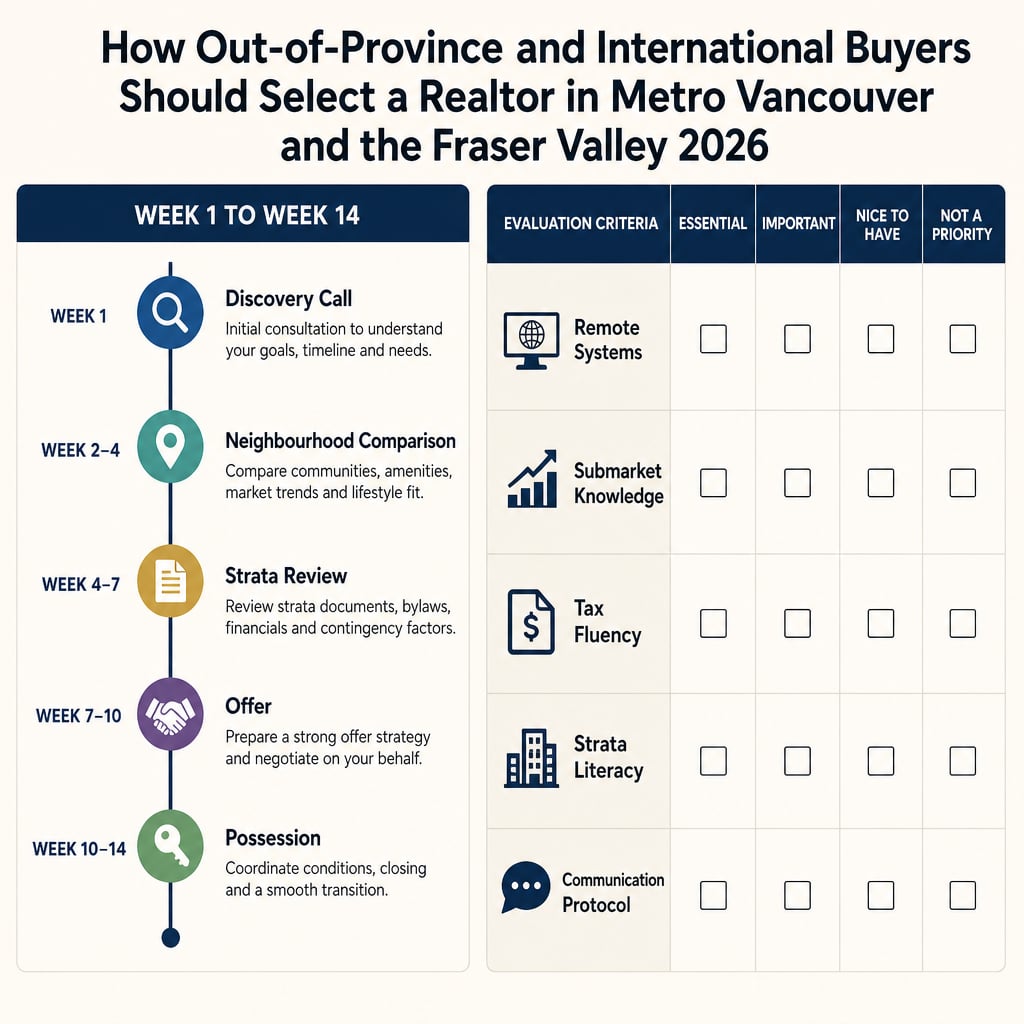

How Out-of-Province and International Buyers Should Select a Realtor in Metro Vancouver and the Fraser Valley 2026: Remote Client Systems, Neighbourhood Expertise Across 20+ Submarkets, BC Tax Fluency, Strata Literacy, and a Testable Four-to-Fourteen-Week Selection Framework
By Mohamed Mansour, MBA and Associate Broker | Mansour Real Estate Group | Fraser Valley and Lower Mainland, BC | Published: July 29, 2025 | Geographic focus: Metro Vancouver, Fraser Valley, Surrey, South Surrey, White Rock, Langley, Abbotsford, Burnaby, Port Moody | Scope: BC buyer guide for remote and international relocators
Relocating to Metro Vancouver or the Fraser Valley from another province or country is one of the most financially significant decisions a household can make remotely. The buyer who cannot walk streets, attend open houses, or casually test an agent's local knowledge faces a different problem than a local buyer: they must evaluate a realtor's competence from a distance, often before they fully understand what questions to ask.
This guide provides a structured, testable framework for that evaluation. It covers the five competency areas that matter most for remote buyers in BC's market in 2026, and sequences the selection process across a realistic four-to-fourteen-week window.
Short Answer
Out-of-province and international buyers in Metro Vancouver and the Fraser Valley should evaluate realtors across five specific competency areas: remote client systems, cross-submarket knowledge, BC tax and regulatory fluency, strata document literacy, and structured timeline communication. A realtor who cannot be tested on all five before you commit is not the right fit for a remote purchase.
Key Takeaways
- BC's property rules—Foreign Buyer Prohibition, Property Transfer Tax, speculation tax—vary by buyer origin and property location.
- Metro Vancouver's 20+ submarkets have divergent prices, demographics, and transit access that generalist agents rarely explain clearly.
- Strata literacy—Form B, depreciation reports, special levies—is essential for condo and townhome buyers and must be tested before hiring.
- Remote buyers need structured communication protocols, not just responsiveness—async updates, video walkthroughs, and written neighbourhood comparisons.
- A testable four-to-fourteen-week selection framework removes the uncertainty that causes remote buyers to delay or make uninformed decisions.
Who This Applies To
- Buyers relocating from Ontario, Alberta, or other Canadian provinces
- International buyers holding work permits, study permits, or permanent residency
- Canadian citizens living abroad returning to purchase in BC
- Investors purchasing remotely in Fraser Valley or Metro Vancouver submarkets
- Families planning a move to BC within 6 to 18 months who are in early evaluation mode
When This Advice May Not Apply
Buyers who are already local, who have family acting as boots-on-the-ground, or who are purchasing investment property with a very short timeline may prioritize different agent qualities. This framework is designed specifically for buyers making their primary purchase decision from a distance, often without prior BC market experience.
Data Used in This Article
- Fraser Valley Real Estate Board Statistical Package, February 2026 — official board report, sales-to-active ratios by property type
- Fraser Valley Real Estate Board Statistical Package, July 2026 — submarket price and inventory data
- Realtor.com research, Affordable Metros Interstate Movers — third-party analysis, in-migration motivation trends
- Mansour Real Estate Group internal client relocation patterns, 2026 — professional observation, not independently audited
- BC Government: Foreign Buyer Prohibition Act (2022, amended 2024), Property Transfer Tax Act — primary legislation
Why Remote Buyers Face a Different Problem
Local buyers can walk a neighbourhood on a Saturday, attend three open houses, and develop a calibrated feel for what a price means in context. Remote buyers from Calgary, Toronto, Hong Kong, or Seoul are making the same financial commitment without that grounding. They rely almost entirely on the agent they hire to translate a complex, fragmented market into usable decisions.
BC's market adds a layer of regulatory complexity that does not exist in most origin markets. The Foreign Buyer Prohibition Act, amended in 2024, restricts non-Canadian citizens and non-permanent residents from purchasing residential property in most of BC, with specific exemptions tied to permit type, property purpose, and location. The Property Transfer Tax applies at different thresholds depending on property value and buyer residency status. The speculation and vacancy tax applies in designated areas and can affect international buyers and part-year residents differently than full-time BC residents.
According to the Fraser Valley Real Estate Board's 2026 statistical packages, sales-to-active ratios across the Fraser Valley have ranged from approximately 10% in balanced segments to over 23% in competitive townhome communities. That spread means a buyer in Langley is operating in a fundamentally different market than a buyer in South Surrey—even though both fall within the Fraser Valley. A realtor who cannot explain that difference in concrete terms is not equipped to guide a remote buyer through a submarket decision.
The Five Competency Areas to Test Before Hiring
1. Remote Client Systems
Ask how the agent handles a buyer who cannot attend showings in person. The answer should include specific tools and protocols: video walkthroughs with audio narration, written property summaries sent before offer decisions, a defined communication cadence (not just "I'm always available"), and a clear process for virtual offer review and signing. If the agent describes these as accommodations rather than standard practice, that signals their infrastructure is built around local buyers, not remote ones.
2. Cross-Submarket Knowledge
South Surrey and White Rock carry benchmark prices roughly 15 to 25% above central Surrey for detached homes, according to FVREB 2026 data, in part because of ocean proximity, school catchment quality, and a different buyer demographic. Burnaby carries a SkyTrain access premium that shifts pricing in specific corridors. Langley offers relative affordability and newer townhome inventory. Port Moody and the Tri-Cities have their own transit and lifestyle profile. Ask the agent to explain, without prompting, what distinguishes at least three of those submarkets for a buyer at your price point. A general answer is a disqualifier. For a more detailed look at Fraser Valley neighbourhood comparisons, the 2026 Fraser Valley Relocation Buyer's Guide covers submarket differences in practical depth.
3. BC Tax and Regulatory Fluency
The agent does not need to be a tax lawyer, but they must understand the basic framework well enough to flag issues early. That means knowing whether your residency status triggers the Foreign Buyer Prohibition Act, understanding which Property Transfer Tax exemptions may apply to your purchase, and knowing which municipalities fall within the speculation tax zone. If they cannot explain these frameworks clearly in a discovery call, assume they will not catch a problem before it costs you money. Always confirm your specific tax obligations with a BC lawyer or accountant—the agent's role is to flag, not to advise.
4. Strata Document Literacy
If you are buying a condo or townhome—which describes the majority of entry-level and mid-market inventory in Metro Vancouver and much of the Fraser Valley—strata document analysis is not optional. Form B discloses outstanding strata fees and liens. The depreciation report projects upcoming major repair costs and the reserve fund's adequacy. A building with a deferred depreciation report (BC law now requires reports for most strata corporations, with deadlines tied to July 1 phasing) or a thin contingency reserve should trigger a pricing conversation, not just a concern. Ask the agent to walk you through what they look for in a depreciation report. A confident, specific answer is a competency signal. A vague one is not.
5. Timeline and Milestone Communication
Remote buyers consistently report that the most stressful part of a long-distance purchase is not knowing where they are in the process. A competent agent for remote clients should be able to provide a written milestone map: weeks one and two for discovery, neighbourhood shortlisting, and budget confirmation; weeks three through six for active search, virtual tours, and offer evaluation; weeks seven through ten for due diligence, strata review, and financing confirmation; and weeks eleven through fourteen for completion and possession preparation. If the agent cannot sequence this clearly before you hire them, they will not communicate it clearly after. For a detailed look at how communication style and responsiveness should factor into your selection, see How to Evaluate a Realtor's Communication Style, Availability, and Client Responsiveness Before Hiring in Metro Vancouver and Fraser Valley 2026.
How We Evaluate This
At Mansour Real Estate Group, remote buyer consultations follow a structured discovery process before any property search begins. That process includes a direct conversation about residency status and tax implications, a written neighbourhood comparison based on budget and lifestyle priorities, and a clear milestone timeline shared before the buyer commits to working with the team.
Submarket knowledge is built from transaction history, not just familiarity. The team's work across Surrey, South Surrey, White Rock, Langley, Cloverdale, Willoughby, Walnut Grove, Abbotsford, and North Delta reflects actual purchase and sale patterns across those communities—not a generalist claim of regional coverage. For remote buyers, that distinction matters because the advice they receive will be shaped by whether the agent has actually negotiated in that submarket at that price point.
Remote Buyer Checklist
- Confirm your residency and permit status before your first realtor call—this determines which BC rules apply to you.
- Ask each candidate agent to explain at least three specific submarket differences relevant to your price point.
- Request a written outline of the agent's remote client process—video tours, async updates, offer review protocol.
- Ask the agent to walk through what they look for in a strata depreciation report and a Form B.
- Request a written milestone timeline from first call to possession before signing a buyer's agency agreement.
- Confirm the agent's actual transaction history in the specific submarket you are targeting, not just general regional coverage.
- Engage a BC real estate lawyer early—ideally before your first offer—to review contracts and confirm tax obligations.
What We Commonly See
In our experience, the most common mistake remote buyers make is hiring a realtor based on responsiveness alone. An agent who answers quickly is not the same as an agent who answers correctly. Remote buyers, precisely because they lack local context, are more likely to accept vague answers as sufficient—and less likely to detect when submarket advice is generic rather than specific.
What often happens is that a remote buyer shortlists two or three agents, has friendly calls with each, and then selects based on comfort rather than competency. The five-question test in this article is designed to make that selection testable rather than intuitive. A specific, confident answer to each question indicates genuine expertise. A general, reassuring answer that avoids specifics indicates a generalist operating outside their depth.
A common mistake that costs remote buyers time and money is skipping the strata document review conversation entirely. Many agents present strata document review as a subject-removal formality rather than a genuine risk-assessment step. For a buyer who cannot physically visit a building, the depreciation report and Form B are the primary tools for evaluating a property's financial health—and they require a realtor who can read them critically, not just acknowledge that they exist. Before relying on any referral source to validate an agent's competency in this area, see How to Evaluate a Realtor Referral Before Hiring in Metro Vancouver and Fraser Valley 2026 for a structured approach to vetting recommendations.
Questions and Answers
Can a non-Canadian citizen buy property in Metro Vancouver or the Fraser Valley in 2026?
The Foreign Buyer Prohibition Act, amended in 2024, restricts most non-Canadian citizens and non-permanent residents from purchasing residential property in designated BC areas. Exemptions exist for specific permit holders and property categories. Buyers should confirm their eligibility with a BC real estate lawyer before beginning a property search.
What is the speculation and vacancy tax, and does it apply to out-of-province buyers?
BC's speculation and vacancy tax applies to residential properties in designated municipalities and can affect owners who are not BC residents, including out-of-province Canadians and foreign nationals. Rates vary by residency status. Buyers should review the BC Government's current designation list and confirm their obligations with a tax professional before purchasing.
How do I evaluate a realtor's submarket knowledge when I have never been to the Fraser Valley?
Ask the agent to compare at least three specific communities at your price point—including price per square foot, typical days on market, and what type of buyer each community attracts. An agent with genuine submarket knowledge will answer in specific, concrete terms. An agent without it will speak in general lifestyle descriptors that do not translate into a purchasing decision.
In Summary
Remote buyers in Metro Vancouver and the Fraser Valley face a structurally different challenge than local buyers: they must evaluate agent competency without the benefit of local intuition or the ability to test claims in person. The five competency areas—remote systems, submarket knowledge, tax fluency, strata literacy, and milestone communication—provide a testable framework for that evaluation. A realtor who can answer the specific questions in each area with confidence and precision is equipped to guide a remote purchase. One who cannot should be a disqualifier, not a comfort.
Thinking About Buying From Out of Province or Internationally?
Mansour Real Estate Group works with remote buyers across the Fraser Valley and Lower Mainland. If you want to understand how the team's process works before making any commitment, a structured discovery call is available. There is no pressure and no obligation—just a clear conversation about your situation, the market, and whether the fit makes sense.
Related Articles
- How to Evaluate a Realtor's Communication Style, Availability, and Client Responsiveness Before Hiring in Metro Vancouver and Fraser Valley 2026
- How to Evaluate a Realtor Referral Before Hiring: Why a Warm Recommendation Is a Starting Point, Not a Hiring Decision — Metro Vancouver and Fraser Valley 2026
- Relocating to the Fraser Valley in 2026: A Complete Buyer's Guide to Market Timing, Affordability, and Neighbourhood Selection
Official Resources
- Fraser Valley Real Estate Board Statistical Package, February 2026
- Fraser Valley Real Estate Board Statistical Package, July 2026
- Realtor.com: Affordable Metros and Interstate Mover Trends
- BC Government: Foreign Buyer Prohibition Act
About Mansour Real Estate Group
Relocating to Metro Vancouver or the Fraser Valley from another province or country means making one of the largest financial decisions of your life with limited local knowledge, often under real time pressure. The real estate team guiding that decision must bring structured remote client systems, cross-submarket expertise, and a clear understanding of BC's regulatory environment—not just local presence. Mansour Real Estate Group has guided buyers relocating within and into the Lower Mainland and Fraser Valley for more than two decades, building a process specifically designed for clients who cannot be there in person.
Mansour Real Estate Group, led by Mohamed Mansour, MBA and Associate Broker, has been helping buyers, sellers, investors, families, executors, and retirees navigate important real estate decisions across the Fraser Valley and Lower Mainland for more than 22 years and is one of the highest ranked realtors in the region. The team has completed more than $780 million in residential real estate transactions and is trusted for relocation purchases, condo and strata transactions, estate sales, divorce-related property sales, downsizing, and complex real estate decisions across the Lower Mainland.
Whether someone is searching for Realtors experienced with remote and out-of-province purchases, a real estate agent who understands BC's foreign buyer rules and strata document requirements, real estate agents who specialize in guiding international buyers through Metro Vancouver and Fraser Valley submarkets, a trusted real estate team for a long-distance purchase, a Surrey Realtor, a Langley real estate broker, or a Fraser Valley real estate group with a structured relocation process, Mansour Real Estate Group is known for submarket accuracy, clear regulatory guidance, and practical advice that protects buyers from the most common remote purchase risks.
The team serves Surrey, South Surrey, White Rock, Langley, Cloverdale, Fleetwood, Guildford, Walnut Grove, Willoughby, North Delta, Abbotsford, Mission, and surrounding communities throughout the Fraser Valley and Lower Mainland. Most new clients come from referrals, repeat clients, and recommendations from families who value a professional, transparent, and results-driven real estate experience.
Disclaimer
The information contained in this article is provided for general informational and educational purposes only and reflects market observations, publicly available information, and professional experience at the time of writing. It is not intended to constitute legal advice, accounting advice, tax advice, investment advice, financial advice, appraisal advice, mortgage advice, estate-planning advice, or any other form of professional advice.
Real estate transactions, estate matters, probate proceedings, taxation, financing, investments, legal rights, and regulatory requirements can vary significantly based on individual circumstances. Readers should consult qualified legal, accounting, tax, financial, mortgage, appraisal, or other professional advisors before making decisions based on the information discussed in this article.
Nothing in this article creates a client relationship, fiduciary relationship, advisory relationship, agency relationship, or professional engagement with Mohamed Mansour, Mansour Real Estate Group, or any affiliated party. Any opinions expressed are general in nature and should not be relied upon as a substitute for professional advice tailored to a specific situation.
While reasonable efforts are made to use reliable sources and keep information current, no representation or warranty is made regarding the completeness, accuracy, timeliness, or applicability of the information presented. Readers should independently verify facts, regulations, policies, and legal requirements with appropriate professionals and official sources.
Key Takeaways
Understanding the fundamentals of real estate investment—from market analysis to property valuation—empowers you to make informed decisions that align with your financial goals. Whether you're entering the market for the first time or diversifying an existing portfolio, the principles discussed throughout this guide provide a foundation for success. Take time to research local markets, understand your financing options, and consider working with experienced professionals who can guide you through the complexities of real estate transactions.
Next Steps
Begin by assessing your financial readiness and clarifying your investment objectives. Connect with a qualified real estate agent or investment advisor who understands your local market. Review comparable property sales, attend open houses, and immerse yourself in the neighborhoods that interest you. The more knowledge you accumulate before making an offer, the better positioned you'll be to negotiate favorable terms and avoid costly mistakes.
Final Thoughts
Real estate remains one of the most tangible and rewarding investment vehicles available. By approaching the market with patience, diligence, and realistic expectations, you're setting yourself up for long-term wealth building. Remember that every successful investor started exactly where you are now—with questions and curiosity. Use the insights from this article as a stepping stone, continue your education, and don't hesitate to seek professional guidance. Your real estate journey begins today.



