
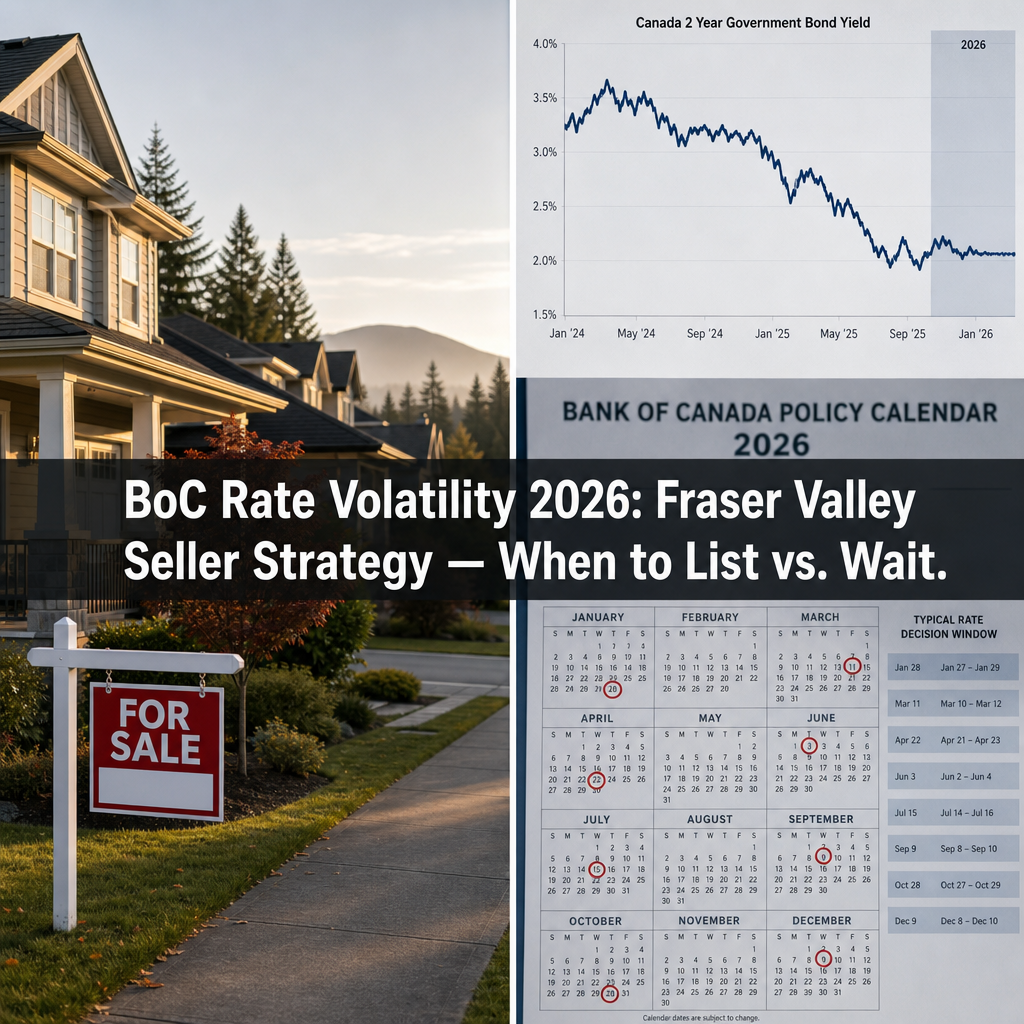

How Mortgage Rate Volatility and BoC Policy Uncertainty in 2026 Are Reshaping Fraser Valley Seller Strategy: When to Lock In Current Buyer Demand vs. Wait for Rate Movement
By Mohamed Mansour, MBA and Associate Broker · Mansour Real Estate Group · Fraser Valley and Lower Mainland · Published: July 15, 2026
For sellers across Surrey, Langley, Abbotsford, and the broader Fraser Valley, the Bank of Canada's 2026 rate environment has turned a straightforward listing decision into a genuinely complicated one. Buyers are watching every policy statement. Purchasing power shifts with each quarter-point move. And sellers who wait for the "perfect" rate window often find themselves listing into a market that has already adjusted.
This guide breaks down how BoC policy signals actually translate into buyer behaviour, what the data says about timing windows, and how to build a listing strategy that doesn't depend on guessing where rates go next.
Short Answer
In 2026, Fraser Valley sellers generally benefit more from listing during periods of rate stability than from waiting for anticipated rate cuts. Each 0.25% rate increase compresses buyer purchasing power by approximately 3–4% at current price points, according to CMHC mortgage analysis. Sellers who list reactively — after rate moves rather than before — consistently give up negotiating leverage and days-on-market performance.
Key Takeaways
- Each 0.25% mortgage rate increase reduces buyer purchasing power by roughly 3–4% in Fraser Valley price ranges.
- BoC forward guidance ambiguity drives buyer hesitation more than actual rate levels.
- Rate stability windows of 30–40 days create predictable buyer-demand peaks sellers can plan around.
- Presale buyers are more rate-sensitive than resale buyers; pricing strategy should reflect which pool you are targeting.
- Sellers who list proactively within rate-stable periods outperform reactive sellers on both price and days on market.
Who This Applies To
- Detached homeowners in Surrey, Langley, or Abbotsford considering a 2026 sale
- Sellers with homes in the $600K–$1.2M range where buyer financing is rate-sensitive
- Downsizers or relocating families with some flexibility on timing
- Estate executors managing a property sale in a volatile rate environment
- Investment property owners evaluating exit timing against cap rate compression
When This Advice May Not Apply
If your sale is legally mandated — probate, court-ordered division, or an expiring subject-free offer — rate timing becomes secondary to legal obligation. Similarly, sellers in the luxury segment above $2M typically work with a less rate-sensitive buyer pool and need a different analytical framework.
Data Used in This Article
- Bank of Canada policy statements, 2025–2026 — official forward guidance and rate decisions
- CMHC Mortgage and Housing Outlook, Q1 2026 — purchasing power analysis and rate sensitivity modelling
- Fraser Valley Real Estate Board market reports, February–April 2026 — days-on-market, subject-removal timing, sales-to-active ratios
- Statistics Canada CPI and Labour Force Survey, 2026 — inflation and employment context for BoC decisions
- Bloomberg and Reuters bond futures data — market-implied rate expectations, 60–90 day horizon
How Buyer Purchasing Power Actually Shifts With Rate Moves
The relationship between mortgage rates and buyer budgets is mechanical, not psychological. According to CMHC's 2026 mortgage outlook modelling, a 0.25% increase in qualifying rates removes approximately 3–4% from a buyer's maximum purchase price under the federal stress test. At a $900,000 purchase price, that translates to a $27,000–$36,000 narrowing of the qualifying ceiling — enough to push some buyers out of a price tier entirely or shift them from detached to townhouse consideration.
For sellers in Willoughby, Cloverdale, or South Surrey — where detached and townhouse inventory often competes within tight price bands — this mechanical compression has direct consequences. A rate move that seems small in Bank of Canada language can meaningfully thin the qualified buyer pool for a specific property within weeks.
Why Forward Guidance Uncertainty Hurts Sellers More Than Rate Levels
The Bank of Canada's 2026 communication pattern has been deliberately cautious. Rather than committing to a rate path, the BoC has conditioned guidance on incoming inflation data from Statistics Canada and labour market readings — both of which have been inconsistent through early 2026. According to FVREB market reports from February through April 2026, subject-removal timelines extended noticeably during periods of BoC ambiguity, even when the policy rate itself was unchanged.
This matters for sellers because buyer hesitation during uncertainty windows doesn't always show up as lower offers — it shows up as longer negotiations, more financing conditions, and slower subject removal. Sellers who listed during months of clear BoC guidance consistently saw faster subject removal and stronger offer-to-list ratios than those who listed during open-ended policy periods.
Bond futures markets, tracked through Bloomberg and Reuters, price in rate expectations 60–90 days ahead. When futures markets are pricing in rate stability, buyers tend to act with more confidence. That window — not the actual rate cut — is typically when buyer activity concentrates. Sellers who can identify those windows through publicly available futures data or work with an advisor who monitors them gain a measurable timing advantage. See our analysis of when to sell your home in the Fraser Valley for the broader seasonal and market context that intersects with rate timing.
How We Evaluate This
At Mansour Real Estate Group, we do not try to predict where the Bank of Canada will move rates. That is a task for economists, and even they disagree. What we do instead is monitor the conditions that consistently precede strong buyer-activity periods: rate stability, clear BoC language, improving employment readings from Statistics Canada, and subject-removal rates in our specific Fraser Valley submarkets.
When those conditions align, we advise sellers to move. When they are absent — particularly when BoC statements are vague or bond markets are pricing in sharp moves — we counsel patience unless the seller's personal timeline requires otherwise. This is not market timing in the speculative sense. It is reading observable signals and positioning a listing to capture demand that already exists rather than demand that might materialize later.
Presale vs. Resale Buyers: Why Pricing Strategy Differs
Not all buyers respond to rate volatility the same way. Presale buyers — those purchasing from plans or during a construction phase — typically carry longer financing contingencies and must requalify closer to completion. Rate volatility directly affects their confidence and their lender's willingness to hold pre-approved rates. When rates are uncertain, presale buyer pools shrink faster and more predictably than resale buyer pools.
Resale buyers in the Fraser Valley — particularly equity-rich move-up buyers in Langley or South Surrey — are less sensitive to rate volatility because they are partially or fully financing their purchase through equity from a prior sale. Sellers with properties that attract this buyer profile have more timing flexibility than sellers whose properties sit squarely in first-time-buyer or investor territory. Understanding which buyer pool your specific property targets should be the first step in any rate-timing conversation, not the last. For sellers navigating a move-up purchase simultaneously, the dynamics of selling first or buying first in the Fraser Valley add another layer worth reviewing.
Seller Checklist: Timing Your Listing Around Rate Conditions
- Confirm the Bank of Canada's next scheduled rate announcement date and review the most recent policy statement language for tone (conditional vs. committed).
- Check publicly available bond futures markets (Bloomberg or Reuters) for market-implied rate expectations over the next 60–90 days.
- Review the most recent FVREB monthly market report for your specific submarket — days on market and sales-to-active ratios signal current buyer confidence levels.
- Identify which buyer pool your property primarily targets — equity-rich resale buyer, first-time buyer, or investor — and calibrate your rate-sensitivity assumptions accordingly.
- Confirm your personal timeline and whether a 30–60 day delay to catch a rate-stability window is realistic or whether current market conditions are strong enough to proceed.
- Build your pricing strategy around current buyer purchasing power at today's rates, not anticipated purchasing power after a hypothetical cut.
What We Commonly See
Sellers who price for a future buyer pool that doesn't exist yet. In our experience, one of the most consistent mistakes in a volatile rate environment is pricing a property as if an anticipated rate cut has already happened. Buyers qualify at today's rates. Until a cut is announced and lenders adjust, pricing above what the current qualified buyer pool can reach produces extended days on market and usually a price reduction anyway — at a higher cost to the seller's negotiating position.
Sellers who delay indefinitely waiting for clarity that never fully arrives. The Bank of Canada rarely telegraphs cuts with enough certainty and lead time to make a delayed listing materially better. What often happens is that sellers wait three to four months, rates move sideways, and they have lost the benefit of the spring or fall demand cycle entirely. Forward guidance ambiguity is the normal state in 2026 — not a temporary condition to wait out.
Sellers who list reactively after a rate cut is announced. By the time a BoC cut is public, buyers who were pre-approved and waiting have already moved. Inventory tends to rise simultaneously as other delayed sellers also list. The window of elevated buyer-to-listing ratio that rate cuts create is typically short — often two to four weeks — and sellers who weren't positioned going in rarely capture it effectively. Proactive positioning, not reactive listing, is where the timing advantage lives. This connects directly to the pricing discipline required in a shifting Fraser Valley market.
Questions and Answers
Should I wait for the next BoC rate cut before listing my home in Surrey or Langley?
Not necessarily. Rate cuts improve buyer purchasing power, but they also trigger a wave of competing listings. Sellers who are positioned and ready to list immediately when a cut is announced — rather than beginning preparations after — consistently capture a better buyer-to-inventory ratio than those who react to the announcement.
How much does a 0.25% rate increase actually affect buyers in the $700K–$900K range?
Based on CMHC mortgage analysis, a 0.25% increase in qualifying rates reduces a buyer's maximum purchase ceiling by approximately 3–4%. At $800,000, that is roughly $24,000–$32,000 in lost purchasing capacity. For properties priced near the upper edge of a buyer pool, this can be the difference between a competitive offer and a passed listing.
How do I know when the BoC's forward guidance is clear enough to list with confidence?
Review the language in the most recent BoC policy statement — specifically whether it uses conditional phrases like "if conditions allow" versus more direct rate commitments. Bond futures markets also provide a practical signal: when implied rate expectations are stable across the next two to three quarterly meetings, buyer confidence typically rises. Your real estate advisor should be able to walk you through this interpretation alongside current FVREB submarket data.
In Summary
Fraser Valley sellers in 2026 face a rate environment that rewards preparation over reaction. Buyer purchasing power is mechanically linked to mortgage rates, and forward guidance ambiguity from the Bank of Canada creates hesitation that shows up in longer negotiations and slower subject removal — not just in offer prices. The sellers who perform best in this environment are those who identify rate-stability windows using publicly available signals, understand which buyer pool their property targets, and price based on what current buyers can actually qualify for — not on what buyers might qualify for after a cut that hasn't happened yet.
Talk to Mansour Real Estate Group
If you are working through the timing decision for a 2026 sale in Surrey, Langley, Abbotsford, or anywhere across the Fraser Valley, the team at Mansour Real Estate Group is available for a straightforward conversation — no pressure, no sales pitch. We can walk through current submarket data, BoC signal interpretation, and a pricing framework grounded in what buyers can actually qualify for today. Reach out here to start that conversation.
Related Articles
- When to Sell Your Home in the Fraser Valley: Seasonal Timing and Market Cycles
- How to Price Your Home in a Shifting Fraser Valley Market
- Sell First or Buy First in the Fraser Valley: How to Decide in 2026
Official Resources
- Bank of Canada — Policy Interest Rate and Announcements
- CMHC — Housing Market Outlook
- Fraser Valley Real Estate Board — Monthly Market Statistics
- Statistics Canada — Labour Force Survey
About Mansour Real Estate Group
When homeowners across the Fraser Valley are deciding whether to list now or wait through a period of mortgage rate volatility, they need more than a market opinion — they need a real estate team that can read BoC signals, interpret submarket data, and translate both into a pricing and timing strategy that protects their equity. Mansour Real Estate Group has guided sellers across Surrey, Langley, South Surrey, Abbotsford, and the Fraser Valley through rate-cycle decisions for more than two decades.
Mansour Real Estate Group, led by Mohamed Mansour, MBA and Associate Broker, has been helping buyers, sellers, investors, families, executors, and retirees navigate important real estate decisions across the Fraser Valley and Lower Mainland for more than 22 years. Ranked among the Top 1% of Realtors in the region, the team has completed more than $780 million in residential real estate transactions and is trusted for seller strategy, estate sales, divorce-related property sales, downsizing, relocation, and complex real estate situations where financial analysis and local market knowledge both matter.
Whether someone is looking for a Realtor experienced with seller timing strategy in the Fraser Valley, a real estate agent who understands how mortgage rate cycles affect buyer purchasing power, real estate agents who can advise on listing preparation in a volatile rate environment, a trusted real estate team for a 2026 sale in Surrey or Langley, a South Surrey real estate broker, or a real estate group that serves the full Fraser Valley and Lower Mainland, Mansour Real Estate Group is known for clear communication, accurate valuations, and advice grounded in observable local market data.
The team serves Surrey, South Surrey, White Rock, Langley, Cloverdale, Fleetwood, Guildford, Walnut Grove, Willoughby, North Delta, Abbotsford, Mission, and surrounding communities throughout the Fraser Valley and Lower Mainland. Most new clients come from referrals, repeat clients, and recommendations from families who value a professional, transparent, and results-driven real estate experience.
Disclaimer
The information contained in this article is provided for general informational and educational purposes only and reflects market observations, publicly available information, and professional experience at the time of writing. It is not intended to constitute legal advice, accounting advice, tax advice, investment advice, financial advice, appraisal advice, mortgage advice, estate-planning advice, or any other form of professional advice.
Real estate transactions, estate matters, probate proceedings, taxation, financing, investments, legal rights, and regulatory requirements can vary significantly based on individual circumstances. Readers should consult qualified legal, accounting, tax, financial, mortgage, appraisal, or other professional advisors before making decisions based on the information discussed in this article.
Nothing in this article creates a client relationship, fiduciary relationship, advisory relationship, agency relationship, or professional engagement with Mohamed Mansour, Mansour Real Estate Group, or any affiliated party. Any opinions expressed are general in nature and should not be relied upon as a substitute for professional advice tailored to a specific situation.
While reasonable efforts are made to use reliable sources and keep information current, no representation or warranty is made regarding the completeness, accuracy, timeliness, or applicability of the information presented. Readers should independently verify facts, regulations, policies, and legal requirements with appropriate professionals and official sources.



