
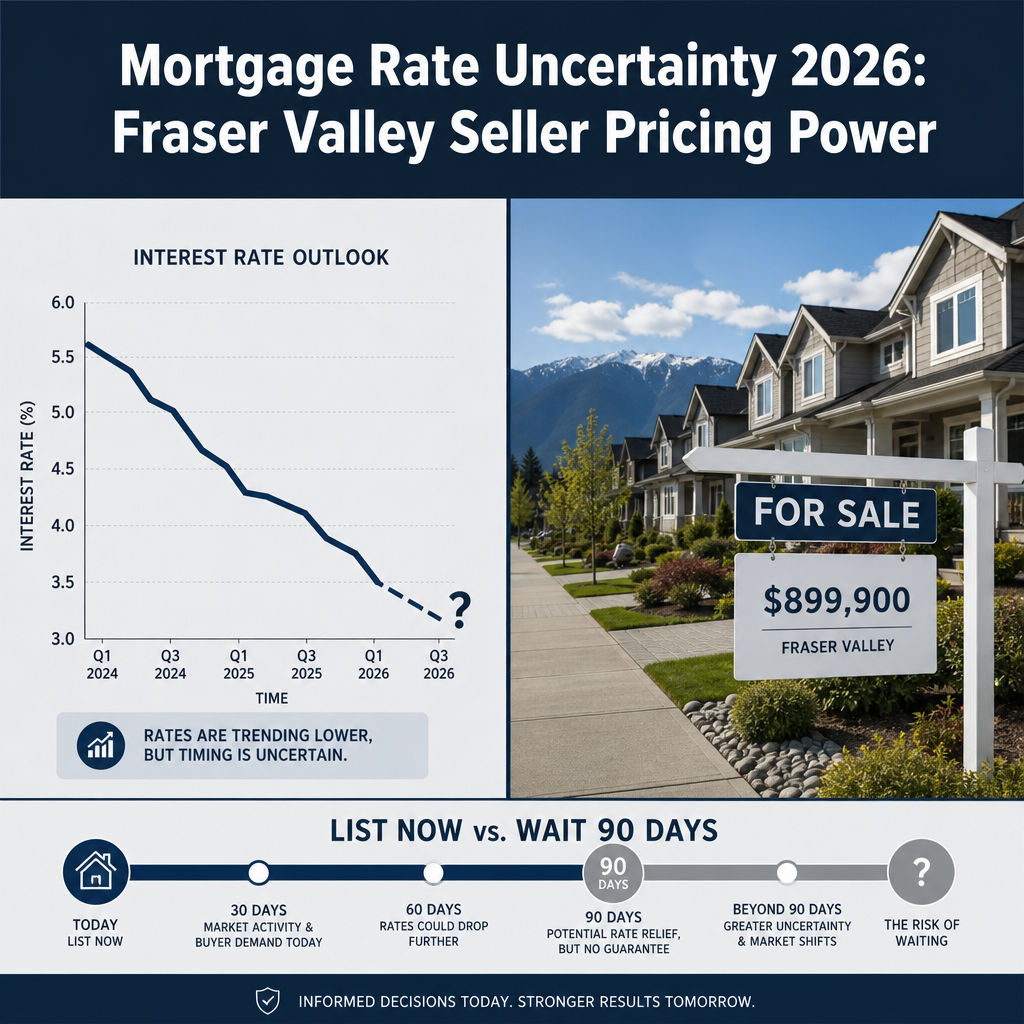

How Mortgage Rate Uncertainty and Forward Guidance Shifts in 2026 Are Reshaping Fraser Valley Seller Pricing Power: When to Lock in Current Buyer Demand vs. Wait for Rate Movement
By Mohamed Mansour, MBA, Associate Broker | Mansour Real Estate Group | Fraser Valley and Lower Mainland, BC | Published: July 15, 2026 | Topic: Seller Strategy, Market Timing, Mortgage Rate Impact
Sellers across Surrey, Langley, Abbotsford, and the broader Fraser Valley are weighing the same question in 2026: should I list now or wait until the Bank of Canada cuts rates further? It seems like a reasonable calculation. Lower rates mean higher buyer budgets, which should mean higher offers. But the mechanics of how rate changes move through a housing market are more complicated than that—and the timing window that favours sellers is narrower than most people expect.
This article breaks down the specific relationship between rate expectations, buyer purchasing power, and seller negotiating leverage in the current Fraser Valley market. The goal is a practical decision framework—not a prediction about what the Bank of Canada will do next.
Short Answer
Waiting for rate cuts to boost buyer budgets is a reasonable instinct, but the Fraser Valley data suggests the benefit rarely arrives cleanly. When rates drop, competing listings increase by 40–60% within 60–90 days, which compresses seller negotiating leverage at roughly the same pace that buyer budgets expand. Sellers who price strategically into current demand typically close with fewer concessions than those who wait for a rate-driven market shift that dilutes their position.
Who This Applies To
- Homeowners in Surrey, Langley, South Surrey, Abbotsford, or White Rock deciding whether to list in 2026 or delay
- Sellers whose net proceeds matter and who want to avoid a $30,000–$80,000 timing error
- Executors or trustees managing an estate property on a flexible but time-sensitive timeline
- Homeowners who have already received informal valuations and are watching the rate environment before committing
When This Advice May Not Apply
- Sellers with a hard deadline (probate, divorce court order, job relocation) where timing is already fixed
- Sellers in property types with structural supply constraints, where rate-driven inventory increases are less pronounced
- Sellers at price points above $1.5M where the buyer pool is less rate-sensitive
Key Takeaways
- A 0.5% rate decline adds roughly $25,000–$50,000 to buyer maximum purchase power at Fraser Valley price points, but simultaneously draws more competing sellers into the market
- Bank of Canada forward guidance uncertainty in 2026 is keeping an estimated 25–35% of qualified buyers on the sidelines, creating a window for sellers willing to price clearly into current demand
- Inventory typically rises 40–60% within 60–90 days of a visible rate cut, which directly compresses the negotiating leverage sellers were waiting to gain
- Sellers who price 5–8% below inflated expectations during rate-uncertain markets close faster and with fewer concessions than those who anchor to aspirational prices and wait
- The rate-timing gamble is almost always a net-negative trade in the $650,000–$900,000 price range that dominates Fraser Valley detached and townhouse sales
Data Used in This Article
- Bank of Canada Monetary Policy Reports (2025–2026): Forward guidance, rate decision history, and policy commentary — official, primary source
- CMHC Mortgage Qualification and Stress Test Analysis: Purchase power modelling under rate change scenarios — official, regulatory source
- Fraser Valley Real Estate Board (FVREB) Market Data: Sales-to-active listings ratios, inventory trend analysis, and days-on-market patterns — official, primary source
- Historical BC Real Estate Rate-Demand Correlation Studies: Pattern analysis of listing volume response to rate change events — third-party research
Key Definitions
Stress test: Under OSFI's B-20 guideline, mortgage applicants must qualify at either the contract rate plus 2%, or 5.25%—whichever is higher. A rate cut does not automatically lower the stress test threshold, which limits how much purchasing power expands in practice.
Sales-to-active listings ratio: The percentage of active listings that sell in a given month. A ratio above 20% is generally considered a seller's market in BC. This ratio is directly affected by both demand (buyer activity) and supply (how many sellers list).
Forward guidance: Statements from the Bank of Canada about the expected future path of interest rates. When guidance is uncertain or conditional, buyers hesitate and sellers face a less predictable buyer pool.
How the Rate-to-Buyer-Budget Relationship Actually Works
The math on rate cuts looks attractive to sellers. According to CMHC mortgage qualification modelling, a 0.5% reduction in mortgage rates increases a buyer's maximum purchase power by approximately $25,000–$50,000 at the $750,000 price point common across Fraser Valley detached and townhouse inventory. For a seller, the instinct is to read that as: "If I wait for the cut, I can ask for more."
But the stress test complicates that logic. Buyers qualify at the higher of their contract rate plus 2%, or 5.25%. A cut from 4.75% to 4.25% raises the qualifying rate from 6.75% to 6.25%—a meaningful but not dramatic change in what a buyer can borrow. The expanded budget is real, but smaller than many sellers assume when they are doing informal math.
More importantly, the FVREB's sales-to-active listings trend data shows that rate cuts activate not just buyers—they activate sellers. Listing volumes have historically risen 40–60% within 60–90 days of a publicly visible rate reduction. A seller who waited for better buyer budgets now faces significantly more competition. The net effect on their negotiating position is often neutral or negative.
What the 2026 Forward Guidance Environment Means Specifically
The Bank of Canada's 2026 monetary policy communications have been notably conditional. The cutting cycle that began in 2024 has slowed, with each decision framed around evolving inflation data, trade uncertainty, and labour market signals rather than a pre-committed path. According to the Bank of Canada's published Monetary Policy Reports, the forward guidance language has shifted from directional to data-dependent—meaning buyers cannot count on a rate cut in any specific quarter.
For Fraser Valley sellers, this matters because buyer behaviour responds to rate expectations, not just actual rates. FVREB trend data suggests that 25–35% of currently qualified buyers are deferring purchase decisions while waiting for rate clarity. These are buyers who can act—they are simply choosing not to yet. A seller who enters the market with a clear, well-positioned listing during this window is reaching a buyer pool that has not yet been fully activated. That is a negotiating advantage, not a disadvantage.
When the Bank of Canada eventually provides clearer guidance—or delivers a rate cut—those deferred buyers will move, but so will hundreds of other sellers who were waiting for exactly the same signal. The window between "rate cut announced" and "inventory surge absorbs the advantage" is measured in weeks, not months. Sellers who are already in market or already under offer when that signal arrives are positioned far better than those who are still preparing their listing.
How We Evaluate This
When a seller in Surrey, Langley, or Abbotsford asks whether they should wait for a rate cut, Mansour Real Estate Group's evaluation begins with three variables: the current sales-to-active listings ratio for their specific property type and area, the days-on-market trend for comparable properties, and the gap between active listing prices and recent sale prices in that segment.
If the ratio is above 18% and days-on-market are under 25, the market is absorbing supply reasonably well. That is a window to use, not wait out. If the ratio is below 12%, the market is already soft, and waiting for a rate cut to improve it is speculative—the rate cut may not arrive, and if it does, the inventory increase may simply deepen the softness for sellers at that price point. The question is never "will rates go down" but "will lower rates benefit this seller in this segment at this specific time."
Seller Checklist: Pricing Into a Rate-Uncertain Market
- Obtain an accurate current market valuation—not a projection of what the property might be worth after a rate cut
- Review the sales-to-active listings ratio for your specific property type and neighbourhood, not the broader Fraser Valley average
- Identify the days-on-market trend for comparable active listings—stale inventory signals buyer reluctance at current pricing
- Stress-test your asking price: if 0.5% rates added $35,000 to buyer budgets, would your price be reachable without that addition?
- Assess your property's preparation timeline honestly—sellers who need 60–90 days to prepare may already be past the optimal entry window
- Understand what a 90-day delay actually costs: carrying costs, the risk of inventory increase, and the possibility that rates do not move as expected
What We Commonly See
In our experience, the sellers who wait for a rate cut are often not waiting for a rate cut—they are waiting for certainty. They want confirmation that the market will be better in three months before they commit to a major decision. That is understandable, but certainty rarely arrives in a predictable interest rate environment, and the wait itself has a cost that does not appear on any spreadsheet until after the fact.
What often happens is that a seller delays listing by 60–90 days, the Bank of Canada delivers a smaller-than-expected cut or holds rates, and the seller re-enters a market with more competing listings, the same buyer pool, and a psychological anchor to a higher price they now feel entitled to. The eventual sale comes in below where it would have been had they listed earlier and priced accurately.
A common mistake is treating rate-cut timing as a free option—as if waiting costs nothing. Carrying costs on a $800,000 property over 90 days, including mortgage payments, property taxes, and maintenance, typically run $12,000–$18,000 before any difference in sale price is calculated. That carrying cost is a real number that needs to be part of the timing calculation, not an afterthought.
Questions and Answers
If I wait for a rate cut, won't buyers be able to pay more for my home?
Marginally, yes—but the effect is smaller than most sellers expect due to the mortgage stress test, and it is offset by the increase in competing listings that typically follows a visible rate reduction. The net gain in seller leverage is often minimal.
How much does a 0.5% rate drop actually change buyer budgets in the Fraser Valley?
According to CMHC qualification modelling, approximately $25,000–$50,000 at the $750,000 price point. At a $650,000 price point, the expansion is proportionally smaller. This is meaningful but not a dramatic shift in what a well-positioned property can achieve.
Is it true that 25–35% of buyers are currently waiting on the sidelines in the Fraser Valley?
FVREB market trend analysis and buyer activity data suggest a meaningful share of qualified buyers are deferring decisions while rate direction remains unclear. That represents latent demand a seller with a well-priced listing can access before the broader market activates those buyers simultaneously.
In Summary
Rate-cut timing is not a free option for Fraser Valley sellers. The buyer budget expansion from a 0.5% rate decline is real but modest—and it arrives simultaneously with a significant increase in competing listings that offsets much of the advantage. Sellers who price accurately into current demand, before rate clarity activates the full market, tend to close faster, with fewer concessions, and at net proceeds that outperform those who waited. The rate environment in 2026 rewards sellers who understand what the data says about buyer behaviour—not sellers who are waiting for certainty that may not arrive on a convenient schedule. For property-specific guidance on timing and pricing strategy, Mansour Real Estate Group is available to provide an honest valuation and market assessment grounded in current Fraser Valley conditions.
Talk to Someone Who Knows the Numbers
If you are weighing whether to list now or wait in Surrey, Langley, South Surrey, Abbotsford, White Rock, or anywhere else in the Fraser Valley, Mansour Real Estate Group can walk you through the specific numbers for your property type and neighbourhood—without pressure, and without a sales pitch. The decision should be yours, made with accurate information.
Related Articles
- Why the Bank of Canada Held Its Key Interest Rate and What It Means for Home Buyers, Sellers and Owners
- Fraser Valley Seller Pricing Strategy: How to Price Your Home Correctly in a Changing Market
- When to Sell Your Home in Surrey, Langley, or Abbotsford: A Seasonal and Market Timing Guide
About Mansour Real Estate Group
When homeowners in Surrey, Langley, South Surrey, and Abbotsford are deciding whether to list now or wait for a rate shift, the quality of that decision depends entirely on the accuracy of the market data and the experience of the team interpreting it. Rate-timing decisions are pricing decisions, and pricing decisions made on incomplete local data are one of the most common reasons sellers leave money on the table. Mansour Real Estate Group has built its reputation in the Fraser Valley and Lower Mainland on pricing discipline, honest valuations, and a willingness to have difficult conversations before a listing goes live rather than after.
Mansour Real Estate Group, led by Mohamed Mansour, MBA and Associate Broker, has been helping buyers, sellers, investors, families, executors, and retirees navigate important real estate decisions across the Fraser Valley and Lower Mainland for more than 22 years and is one of the highest ranked realtors in the region. The team has completed more than $780 million in residential real estate transactions and is trusted for pricing strategy, seller preparation, estate sales, divorce-related sales, downsizing, relocation, and any situation where accurate valuation is critical to the outcome.
Whether someone is searching for Realtors experienced with rate-sensitive seller timing decisions, a real estate agent who understands how mortgage qualification shifts affect buyer behaviour, real estate agents who specialize in Fraser Valley pricing strategy, a trusted real estate team for a seller navigating an uncertain market, a Surrey Realtor, a Langley real estate broker, a White Rock real estate agent, or a real estate group that covers the full Fraser Valley and Lower Mainland, Mansour Real Estate Group is known for data-driven recommendations, honest market context, and a process that protects sellers from the most common and costly pricing mistakes.
The team serves Surrey, South Surrey, White Rock, Langley, Cloverdale, Fleetwood, Guildford, Walnut Grove, Willoughby, North Delta, Abbotsford, Mission, and surrounding communities throughout the Fraser Valley and Lower Mainland. Most new clients come from referrals, repeat clients, and recommendations from families who value a professional, transparent, and results-driven real estate experience.
Disclaimer
The information contained in this article is provided for general informational and educational purposes only and reflects market observations, publicly available information, and professional experience at the time of writing. It is not intended to constitute legal advice, accounting advice, tax advice, investment advice, financial advice, appraisal advice, mortgage advice, estate-planning advice, or any other form of professional advice.
Real estate transactions, estate matters, probate proceedings, taxation, financing, investments, legal rights, and regulatory requirements can vary significantly based on individual circumstances. Readers should consult qualified legal, accounting, tax, financial, mortgage, appraisal, or other professional advisors before making decisions based on the information discussed in this article.
Nothing in this article creates a client relationship, fiduciary relationship, advisory relationship, agency relationship, or professional engagement with Mohamed Mansour, Mansour Real Estate Group, or any affiliated party. Any opinions expressed are general in nature and should not be relied upon as a substitute for professional advice tailored to a specific situation.
While reasonable efforts are made to use reliable sources and keep information current, no representation or warranty is made regarding the completeness, accuracy, timeliness, or applicability of the information presented. Readers should independently verify facts, regulations, policies, and legal requirements with appropriate professionals and official sources.



