

How Mortgage Rate Uncertainty and BoC Forward Guidance Are Reshaping Buy-First vs. Sell-First Decision-Making in the Fraser Valley 2026
By Mohamed Mansour, MBA and Associate Broker — Mansour Real Estate Group — Published July 2026 — Fraser Valley and Lower Mainland, BC
For most homeowners in the Fraser Valley, the buy-first vs. sell-first question has always been framed as a cash flow problem. Can you carry two properties? What does bridge financing cost? What happens if your current home takes longer than expected to sell? Those are real questions, but in 2026, they are not the most important ones. The more consequential question is strategic: are you selling into a buyer pool that is about to expand, or one that is about to shrink?
This article is for Fraser Valley homeowners who are weighing that decision right now, in a market where the Bank of Canada's rate path remains genuinely unclear, active listings have exceeded 10,000, and buyer psychology is being shaped by forces that a rate cut alone may not resolve.
Short Answer
In the Fraser Valley's 2026 market, the buy-first vs. sell-first decision depends less on bridge financing mechanics and more on your read of rate trajectory. Sellers who move first lock in today's thin buyer demand before rate cuts potentially expand competition. Sellers who buy first avoid carrying costs but accept bridge financing at 6.5–7.5% annually. Neither path is clearly superior — the right one depends on your property type, equity position, timeline, and how much rate uncertainty you are willing to absorb.
Key Takeaways
- Rate uncertainty means buyer purchasing power is a moving target, which changes sell-first risk calculus entirely.
- Selling first in a soft market locks in current buyer demand before potential rate cuts expand your competition.
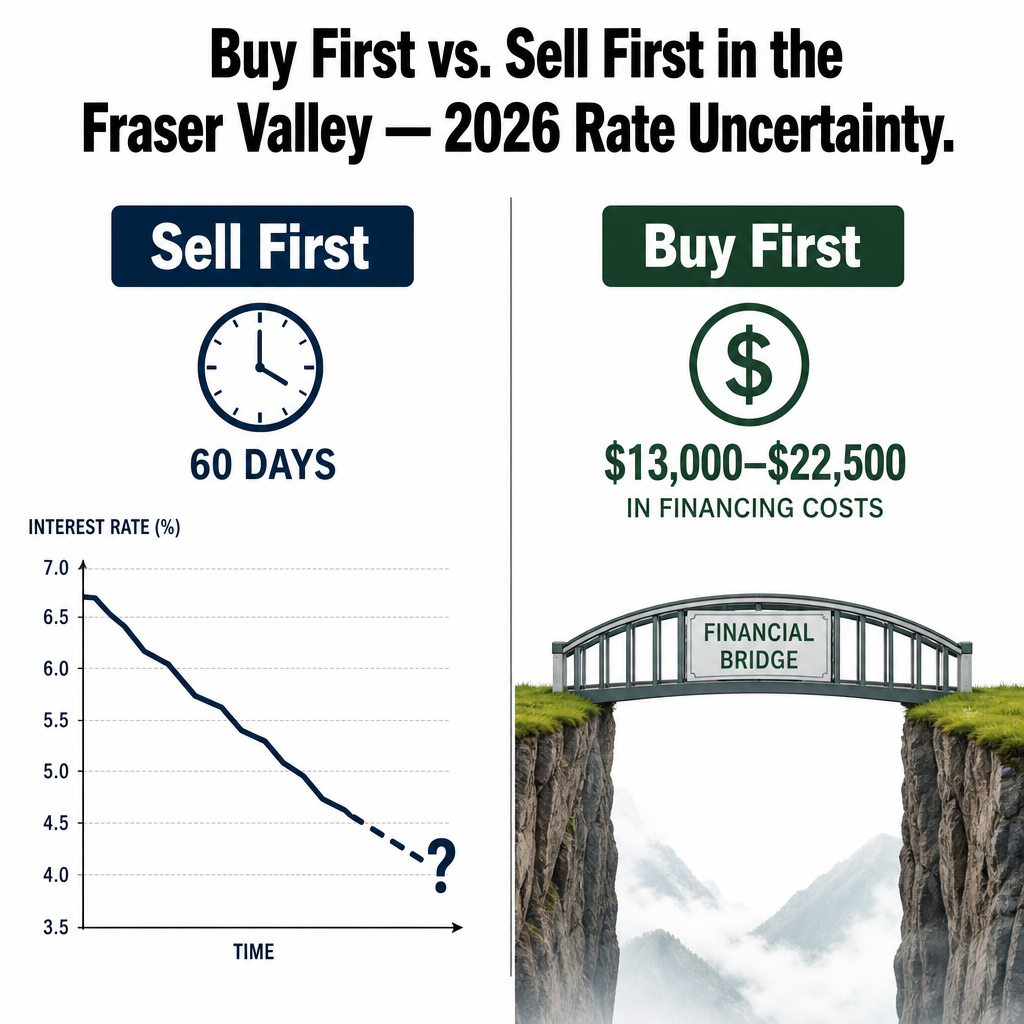
- A 4–6 month bridge on $500K in equity costs $13,000–$22,500 in financing charges at current rates.
- Rate cuts may not trigger a buyer surge if job security fears remain the deeper driver of suppressed demand.
- The strongest sell-first case in 2026 is a well-priced detached home in a commuter corridor before rate clarity arrives.
Who This Applies To
- Homeowners in Surrey, Langley, Abbotsford, or North Delta preparing to upsize or downsize in 2026
- Sellers with meaningful equity who are weighing bridge financing against a temporary rental or stay-put period
- Families whose purchase timeline is tied to school catchment or employment changes
- Sellers who purchased before 2021 and are watching the market to time their exit
When This Advice May Not Apply
If your purchase is unconditional on a sale, if you have sufficient liquidity to carry both properties, or if you are selling a unique or high-value property where the buyer pool does not shift materially with rate changes, the standard bridge financing analysis may be sufficient. Consult your mortgage professional and legal counsel for your specific situation.
Data Used in This Article
- Fraser Valley Real Estate Board (FVREB): Spring 2026 Market Statistics and Sales-to-Active Listings Ratio Trends — Official board data
- Bank of Canada: Recent Monetary Policy Decisions and Forward Guidance — Official source
- CMHC: Mortgage Qualification Stress Test Rules and Rate Assumption Updates 2026 — Official regulator
- Statistics Canada: Labour Force Survey, Provincial Unemployment Rate Data — Official federal statistics
- RBC Economics: Canadian Mortgage Rate Forecasts and BoC Rate Path Expectations 2026 — Third-party analysis
Why 2026 Is Different From Prior Rate Cycles
The Bank of Canada's rate cuts through 2024 and into 2025 conditioned buyers and sellers alike to expect continued easing. That expectation shaped how buyers calculated their maximum purchase price and how sellers interpreted the strength of offers coming in. What changed in 2026 is that forward guidance became less certain. The BoC shifted toward data-dependency language, which means the next move is not telegraphed in the way it was during the easing cycle.
For sellers, this matters because buyer purchasing power is directly tied to rate expectations. A buyer qualifying under today's stress test at a given rate will qualify for a meaningfully different amount if rates fall by 50 basis points. If you sell today, you are pricing into today's qualification ceiling. If you wait for rate cuts to materialize, you may attract more buyers, but you will also be competing with a larger pool of sellers who had the same idea. According to the FVREB's Spring 2026 data, active listings have remained above 10,000, meaning the market is already supply-heavy. The question is whether rate relief will clear that inventory or simply shift which sellers benefit.
The Real Cost Comparison: Sell First vs. Buy First in 2026
The traditional bridge financing analysis is still necessary, but it only tells part of the story. If you buy first and need to bridge, current lender bridge rates sit in the range of 6.5–7.5% annually, according to market rate surveys. On a $500,000 equity position, a 4-month bridge period generates approximately $13,000–$16,700 in interest charges. A 6-month bridge on the same equity runs $16,250–$22,500. These are not catastrophic numbers relative to a $1.2M transaction, but they are real costs that compound if the closing timeline on your existing home extends.
The sell-first path avoids bridge costs but creates a different exposure: if your home takes 75–120 days to sell and you are carrying mortgage payments in the interim, those costs range from $800–$1,500 per month in debt servicing depending on your outstanding balance and rate. The deeper risk on the sell-first side is not carrying costs — it is selling into a buyer pool that is about to get larger. Rate cuts typically expand buyer qualification within 30–60 days of announcement, according to RBC Economics research on prior rate cycles. Sellers who list just before that expansion lock in a thinner buyer pool. Sellers who list just after it face more competition from other sellers who waited for the same trigger.
How We Evaluate This
At Mansour Real Estate Group, we approach this decision by separating what we can measure from what we are forecasting. The carrying cost calculation is arithmetic — it is precise and quantifiable. The rate trajectory assumption is a forecast with real uncertainty attached to it. We counsel sellers to stress-test both paths: what does your net proceed look like if rates fall 50 basis points and two competing listings appear in your price range within 60 days? What does it look like if rates hold flat for 12 months and inventory stays elevated? The path that produces the most defensible outcome across both scenarios is usually the right starting point for the conversation, not the path that looks best under the most optimistic assumption.
Seller Checklist: Buy-First vs. Sell-First Under Rate Uncertainty
- Get a current comparative market analysis anchored to sold data from the last 45 days, not 90 days, given how quickly buyer sentiment shifts with rate news.
- Ask your mortgage professional for your bridge financing ceiling and exact carrying cost per month at current lender rates.
- Model two scenarios: rates hold flat for 12 months, and rates fall 50 basis points within 90 days. Compare your net proceeds under each path.
- Check current active listings in your property type and price range in your Fraser Valley community — understanding your local competitive inventory is the most important input to this decision.
- If selling first, confirm your purchase target is achievable without a competing offer scenario that would require removing your sale condition.
- Review Statistics Canada's most recent Labour Force Survey data for BC to calibrate whether employment conditions support a buyer surge following rate cuts.
What We Commonly See
In our experience, sellers who wait for rate certainty before deciding often find that the certainty never fully arrives. The BoC's forward guidance in 2026 is intentionally conditional, meaning there is no clean signal to wait for. Sellers who anchor their decision to a rate announcement that has not happened yet are, in practice, deferring indefinitely.
What often happens is that sellers overestimate how much a rate cut will help them specifically. Rate cuts expand the buyer pool across the entire market, including all the competing sellers who were also waiting. In a market where active listings are already above 10,000, according to FVREB Spring 2026 data, a surge in buyer demand from rate relief is more likely to be absorbed by existing inventory than to produce a bidding war on any single property.
A common mistake is treating the bridge financing cost as the central variable and ignoring the competitive positioning risk. A $15,000 bridge cost is uncomfortable but recoverable. Selling into a market that has just added 500 qualified buyers and 300 new competing listings simultaneously is a harder position to recover from.
Questions and Answers
Q: If the Bank of Canada cuts rates, will it immediately help me sell my Fraser Valley home?
Not necessarily. Rate cuts expand buyer qualification, but if employment uncertainty persists — as Statistics Canada's Labour Force Survey data suggests — many sidelined buyers remain cautious regardless of rate movement. The buyer pool may grow slowly rather than surge within 30 days.
Q: How long does bridge financing typically last for Fraser Valley sellers who buy first?
Most bridge loans in BC are structured for 30–180 days. In a soft market, sellers should budget for the longer end. At current bridge rates of 6.5–7.5% annually, a 6-month bridge on $500,000 in equity costs $16,250–$22,500 in interest charges alone.
Q: Does selling first actually protect me from rate-cut competition?
It can, but only if your pricing is anchored correctly to current buyer qualification levels. A well-priced sell-first listing in a commuter corridor like Langley or Abbotsford that moves before a rate announcement avoids the inventory expansion that typically follows. Overpriced listings get no benefit from selling early.
In Summary
In 2026, the buy-first vs. sell-first decision in the Fraser Valley is a rate strategy question as much as a financing question. Selling first into a soft market protects your negotiating position before potential rate cuts expand both the buyer pool and the competing seller inventory. Buying first carries quantifiable bridge costs but avoids the risk of a conditional purchase failing in a competitive purchase environment. Neither path is inherently safer — the right answer depends on your property, your equity, your timeline, and your honest assessment of how much rate uncertainty you are willing to carry as a strategic variable.
Thinking Through Your Timing?
If you are working through the buy-first vs. sell-first question for your specific property and situation in the Fraser Valley, Mansour Real Estate Group can walk you through the cost modelling, competitive inventory analysis, and pricing strategy that frames the decision clearly. There is no obligation — just a grounded, specific conversation anchored to current market conditions.
Related Articles
- Selling Your Home in Surrey BC: A Complete Guide for 2026
- Selling Your Home in Langley BC: A Complete Guide for 2026
- Selling Your Home in Abbotsford BC: A Complete Guide for 2026
Official Resources
- Bank of Canada — Monetary Policy Decisions and Forward Guidance
- CMHC — Mortgage Qualification and Stress Test Rules
- Fraser Valley Real Estate Board — Market Statistics
- Statistics Canada — Labour Force Survey
About Mansour Real Estate Group
When homeowners in the Fraser Valley are weighing whether to buy first or sell first in an uncertain rate environment, the advice they receive should be grounded in current market data, local inventory conditions, and a clear-eyed view of the financing mechanics — not general rules of thumb. Mansour Real Estate Group has guided sellers across Surrey, Langley, Abbotsford, South Surrey, White Rock, and the broader Fraser Valley through exactly these timing and strategy decisions for more than two decades, with a process built around accurate valuations, realistic net proceeds modelling, and honest advice.
Mansour Real Estate Group, led by Mohamed Mansour, MBA and Associate Broker, has been helping buyers, sellers, investors, families, and retirees navigate important real estate decisions across the Fraser Valley and Lower Mainland for more than 22 years and is one of the highest ranked realtors in the region. The team has completed more than $780 million in residential real estate transactions and is trusted for seller strategy, estate sales, divorce-related property sales, downsizing, relocation, and any situation where the decision involves meaningful financial risk.
Whether someone is searching for Realtors who understand buy-first vs. sell-first strategy in a rate-uncertain market, a real estate agent who can model bridge financing costs and competitive positioning simultaneously, real estate agents who specialize in Fraser Valley detached home sales, a trusted real estate team for a time-sensitive move, a Surrey Realtor, a Langley real estate broker, or a real estate group with genuine local market depth, Mansour Real Estate Group is known for clear communication, structured analysis, and advice that holds up when conditions shift.
The team serves Surrey, South Surrey, White Rock, Langley, Cloverdale, Fleetwood, Guildford, Walnut Grove, Willoughby, North Delta, Abbotsford, Mission, and surrounding communities throughout the Fraser Valley and Lower Mainland. Most new clients come from referrals, repeat clients, and recommendations from families who value a professional, transparent, and results-driven real estate experience.
Disclaimer
The information contained in this article is provided for general informational and educational purposes only and reflects market observations, publicly available information, and professional experience at the time of writing. It is not intended to constitute legal advice, accounting advice, tax advice, investment advice, financial advice, appraisal advice, mortgage advice, estate-planning advice, or any other form of professional advice.
Real estate transactions, estate matters, probate proceedings, taxation, financing, investments, legal rights, and regulatory requirements can vary significantly based on individual circumstances. Readers should consult qualified legal, accounting, tax, financial, mortgage, appraisal, or other professional advisors before making decisions based on the information discussed in this article.
Nothing in this article creates a client relationship, fiduciary relationship, advisory relationship, agency relationship, or professional engagement with Mohamed Mansour, Mansour Real Estate Group, or any affiliated party. Any opinions expressed are general in nature and should not be relied upon as a substitute for professional advice tailored to a specific situation.
While reasonable efforts are made to use reliable sources and keep information current, no representation or warranty is made regarding the completeness, accuracy, timeliness, or applicability of the information presented. Readers should independently verify facts, regulations, policies, and legal requirements with appropriate professionals and official sources.



