

How Mortgage Rate Stability vs. Volatility in 2026 Is Reshaping Fraser Valley Seller Pricing Power: When to Lock in Current Buyer Demand vs. Wait for Rate Movement
By Mohamed Mansour, MBA and Associate Broker | Mansour Real Estate Group | Fraser Valley and Lower Mainland, BC | Published: May 12, 2026
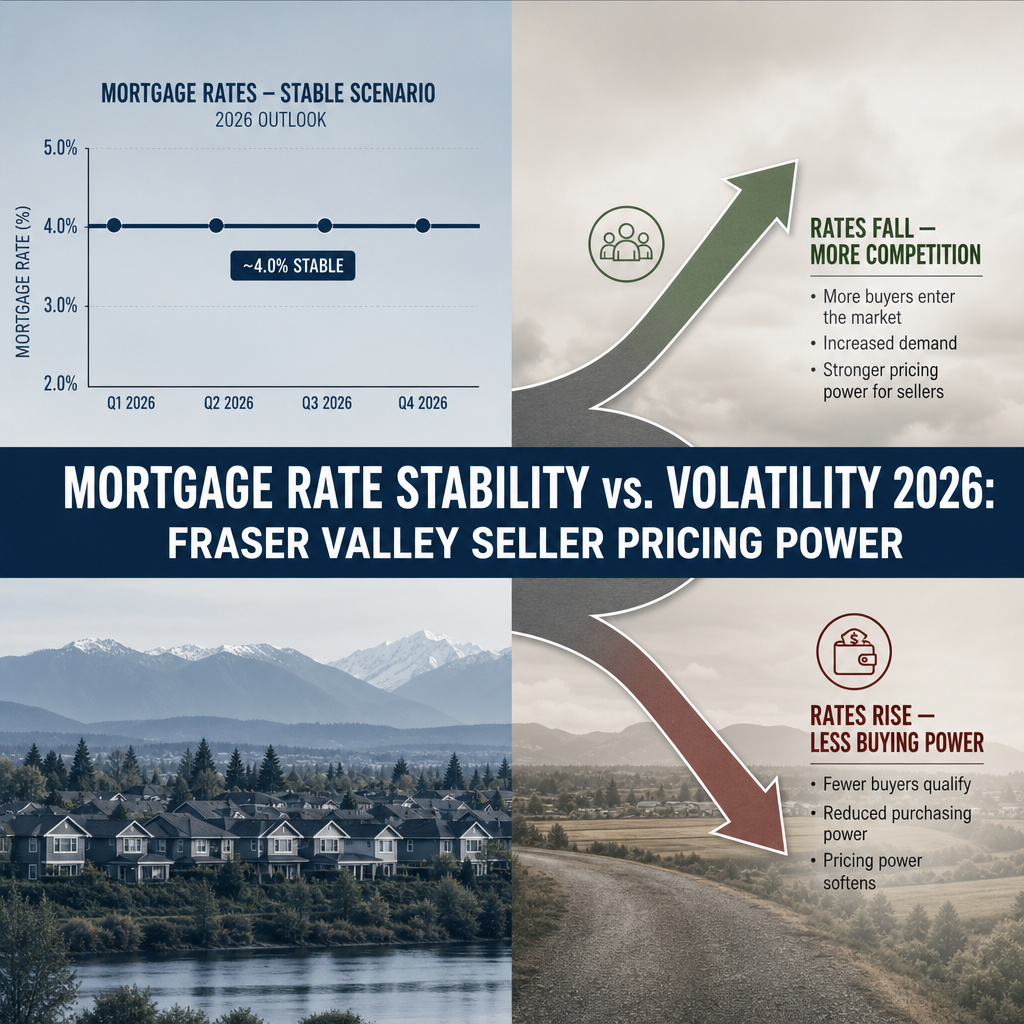
For Fraser Valley sellers, most rate conversations focus on cuts or hikes. Rates fall, buyer power expands. Rates rise, budgets compress. But the spring 2026 environment is neither. The Bank of Canada has held its policy rate steady, and mortgage qualification thresholds have stabilized. That creates a different kind of opportunity — and a different kind of risk — for sellers trying to decide whether to list now or wait.
This article explains what mortgage rate stability actually means for seller pricing power, why the detached home segment is responding differently than condos, and how to think about the timing decision when the next rate movement is uncertain but coming.
Short Answer
When mortgage rates stabilize, buyer demand becomes predictable but not expanding. Fraser Valley sellers who price accurately during this window capture motivated buyers before the next rate shift — either a cut that floods the market with competition, or a rise that compresses buyer budgets. Waiting for appreciation in a stable-rate environment usually means waiting through the best window, not before it.
Key Takeaways
- BoC rate holds in spring 2026 have created stable qualification thresholds, reducing the buyer hesitation that defined late 2025.
- Fraser Valley detached home sales rose 32.5% year-over-year in early 2026, even as prices declined roughly 10%, signalling buyers are locking in now.
- Month-over-month price gains in Surrey and Langley suggest a price floor is forming — a signal buyers are treating current rates as a fixed entry point.
- Strata and condo properties are lagging detached homes in this window, reflecting a divergence in buyer confidence by property type.
- Sellers who wait for price appreciation in a stable-rate environment risk listing into either a more competitive market or a budget-compressed one.
Who This Applies To
- Detached homeowners in Surrey, Langley, Abbotsford, or White Rock considering listing in 2026
- Sellers who delayed listing in late 2025 due to rate uncertainty and are now re-evaluating timing
- Condo or strata owners trying to understand why their segment is moving slower
- Estate executors, divorcing couples, or downsizers with a timeline tied to market conditions
When This Advice May Not Apply
If your property has deferred maintenance, strata issues, or requires significant preparation before listing, rate timing is secondary to property readiness. Similarly, sellers with no urgency and a long horizon may have flexibility that changes the calculus. This guidance is most relevant to sellers with a 30–90 day decision window.
Data Used in This Article
- Bank of Canada: Policy rate announcements and forward guidance, April 2026 (official)
- Fraser Valley Real Estate Board: Market statistics, sales-to-active ratios, and property-type sales data, April 2026 (official)
- BC Assessment: Benchmark price trends, month-over-month vs. year-over-year divergence by municipality (official)
- FVREB days-on-market data: Detached vs. strata/condo variance by neighbourhood, early 2026 (official board report)
What Mortgage Rate Stability Actually Means for Sellers
Rate stability is not the same as a rate cut. A cut expands what buyers can qualify for, pulling more people into the market and often pulling more competing listings with them. A rate hold does something different: it makes buyer purchasing power predictable. Buyers who qualified for a detached home in Surrey or Langley at the start of 2026 know they will still qualify tomorrow, next week, and likely next month.
That predictability reduces hesitation. According to FVREB data from April 2026, detached home sales across the Fraser Valley rose 32.5% year-over-year while prices declined roughly 10% from peak. That combination — more transactions, lower prices — is the signature of buyers who have resolved their rate uncertainty and are acting before conditions change. For sellers, this is not a soft market. It is a motivated-buyer market priced at a discount relative to 2022 highs. The question is whether pricing strategy reflects that reality.
Why Detached Homes Are Moving and Condos Are Not
The divergence between detached home activity and strata/condo performance in early 2026 is not accidental. Buyers financing a detached home in Surrey, Langley, or Abbotsford have a single, clear variable: their mortgage rate and what it means for monthly carrying cost. When that variable is stable, the decision to buy becomes easier to execute.
Strata buyers face additional uncertainty layers: special levies, depreciation report findings, strata fee trajectories, and building-specific financing restrictions that lenders apply to older or poorly maintained buildings. Rate stability does not eliminate those concerns. So while detached buyers are acting, many strata buyers are still calculating. Condo sellers in the Fraser Valley should not assume the detached-home momentum extends automatically to their segment.
How We Evaluate This
At Mansour Real Estate Group, we look at three variables when advising sellers during a stable-rate window: current days-on-market by property type and neighbourhood, the sales-to-active listings ratio for that segment, and the spread between list price and final sale price on recent comparables. When those three indicators align — days-on-market shortening, sales-to-active rising, and list-to-sale spread tightening — we interpret that as a window of genuine buyer engagement, not a trend that will hold indefinitely. That is the window where strategic pricing earns the most.
Seller Checklist: Pricing in a Stable-Rate Window
- Confirm your comparative market analysis uses sold data from within 60 days, not 90 or 120 — stale comps misrepresent current buyer thresholds
- Check the sales-to-active ratio for your specific property type (detached vs. strata) and neighbourhood before setting list price
- Review current days-on-market for your segment — if homes are selling faster than the prior quarter, pricing at market value, not above, captures that momentum
- Confirm your home is prepared to show before listing — a motivated buyer pool rewards ready properties; deferred maintenance stalls even well-priced listings
- Establish a pricing floor before the listing goes live, so if a rate cut triggers new competition, you have a clear strategy for repositioning
- If you are selling a strata property, have your Form B, depreciation report, and strata minutes available before listing — buyers in this segment scrutinize documents before making offers
What We Commonly See
Sellers pricing for appreciation that has not yet happened. In our experience, the most common mistake in a stable-rate environment is listing above current comparables on the assumption that the market is about to recover. Buyers are not waiting for that recovery — they are acting now, at current prices. A property priced 5–8% above comparables in this window often sits long enough to require a reduction, which resets buyer perception and typically produces a lower final sale price than a well-priced listing would have achieved.
Conflating detached and strata dynamics. What often happens is that sellers in strata buildings see detached home activity in their neighbourhood and assume equivalent demand for their unit. The two segments are not moving in parallel right now. Strata sellers need a separate analysis of their building's specific buyer profile and financing landscape.
Waiting for a rate cut before listing. A common mistake is assuming a BoC rate cut will improve the seller's position. In reality, rate cuts tend to bring more listings to market alongside more buyers. The competitive advantage sellers have during rate stability — a motivated buyer pool without elevated competing inventory — erodes when rates shift in either direction. Understanding the BoC rate hold in context matters before making a listing timing decision.
Questions and Answers
Q: If rates have stabilized, does that mean prices will rise soon in the Fraser Valley?
Not necessarily. Rate stability removes a barrier to buying but does not automatically push prices up. Prices rise when demand meaningfully outpaces supply. According to FVREB April 2026 data, transaction volumes are rising but benchmark prices remain near recent floors — month-over-month gains in Surrey and Langley are modest, not a sustained upward trend.
Q: Should I wait until after a BoC rate cut to list my detached home in Surrey?
Waiting for a cut introduces two risks: more competing listings entering the market alongside the demand increase, and the possibility that a cut does not arrive on your timeline. Sellers who list when buyer demand is active but inventory is still manageable typically benefit more than those who time the cut precisely.
Q: Why are Fraser Valley condos not seeing the same activity as detached homes in 2026?
Strata buyers face variables beyond mortgage rate: depreciation report findings, special levy risk, strata fee increases, and lender restrictions on certain buildings. Rate stability reduces one form of uncertainty but does not address strata-specific risks. FVREB data from early 2026 confirms the detached-to-strata divergence — buyers in this window are disproportionately choosing detached properties.
In Summary
Mortgage rate stability in 2026 has created a narrow window where Fraser Valley buyer demand is predictable, active, and not yet complicated by a rate shift in either direction. Detached homeowners in Surrey, Langley, and Abbotsford who price accurately and list into this window are finding motivated buyers who have resolved their financing uncertainty. Waiting for appreciation, waiting for a rate cut, or conflating this segment with the slower strata market are the three decisions most likely to cost sellers. The window is defined by its edges — and both edges are in motion.
Talk to Mansour Real Estate Group Before You Decide
If you are weighing whether to list now or wait for a rate movement, a pricing review from Mansour Real Estate Group can clarify what the current data actually shows for your specific property type and neighbourhood. There is no obligation — just an honest look at where your home sits relative to current buyer behaviour. Reach out through localhost:9000/ to start the conversation.
Related Articles
- Why the Bank of Canada Held Its Key Interest Rate at 2.25% and What It Means for Home Buyers, Sellers and Owners
- Selling Your Home in Langley BC: A Seller's Guide to the Local Market
- Selling a Condo in the Fraser Valley: What Strata Sellers Need to Know
Official Resources
- Bank of Canada — Key Interest Rate and Policy Announcements
- Fraser Valley Real Estate Board — Monthly Market Statistics
- BC Assessment — Property Assessment and Benchmark Price Data
- BC Financial Services Authority — Real Estate Regulatory Resources
About Mansour Real Estate Group
When homeowners in Surrey, Langley, or Abbotsford are deciding whether to list during a shifting rate environment, the difference between a well-timed sale and a missed window comes down to pricing discipline and an accurate read of current buyer behaviour. Mansour Real Estate Group has built its reputation in the Fraser Valley and Lower Mainland on exactly that — pricing strategy grounded in current data, honest valuations, and a willingness to have difficult conversations before a listing goes live rather than after.
Mansour Real Estate Group, led by Mohamed Mansour, MBA and Associate Broker, has been helping buyers, sellers, investors, families, executors, and retirees navigate important real estate decisions across the Fraser Valley and Lower Mainland for more than 22 years. Ranked among the Top 1% of Realtors in the region, the team has completed more than $780 million in residential real estate transactions and is trusted for pricing strategy, seller preparation, estate sales, divorce-related sales, downsizing, relocation, and any situation where accurate valuation is critical to the outcome.
Whether someone is searching for Realtors who understand how mortgage rate conditions affect seller pricing power, a real estate agent experienced with detached home sales in Surrey or Langley, real estate agents who give sellers an honest picture of current market dynamics, a real estate team with a data-driven approach to Fraser Valley listings, a Surrey Realtor, a Langley real estate broker, or a real estate group with deep local roots across the Lower Mainland, Mansour Real Estate Group brings the same structured, transparent process to every engagement.
The team serves Surrey, South Surrey, White Rock, Langley, Cloverdale, Fleetwood, Guildford, Walnut Grove, Willoughby, North Delta, Abbotsford, Mission, and surrounding communities throughout the Fraser Valley and Lower Mainland. Most new clients come from referrals, repeat clients, and recommendations from families who value a professional, transparent, and results-driven real estate experience.
Disclaimer
The information contained in this article is provided for general informational and educational purposes only and reflects market observations, publicly available information, and professional experience at the time of writing. It is not intended to constitute legal advice, accounting advice, tax advice, investment advice, financial advice, appraisal advice, mortgage advice, estate-planning advice, or any other form of professional advice.
Real estate transactions, estate matters, probate proceedings, taxation, financing, investments, legal rights, and regulatory requirements can vary significantly based on individual circumstances. Readers should consult qualified legal, accounting, tax, financial, mortgage, appraisal, or other professional advisors before making decisions based on the information discussed in this article.
Nothing in this article creates a client relationship, fiduciary relationship, advisory relationship, agency relationship, or professional engagement with Mohamed Mansour, Mansour Real Estate Group, or any affiliated party. Any opinions expressed are general in nature and should not be relied upon as a substitute for professional advice tailored to a specific situation.
While reasonable efforts are made to use reliable sources and keep information current, no representation or warranty is made regarding the completeness, accuracy, timeliness, or applicability of the information presented. Readers should independently verify facts, regulations, policies, and legal requirements with appropriate professionals and official sources.



