
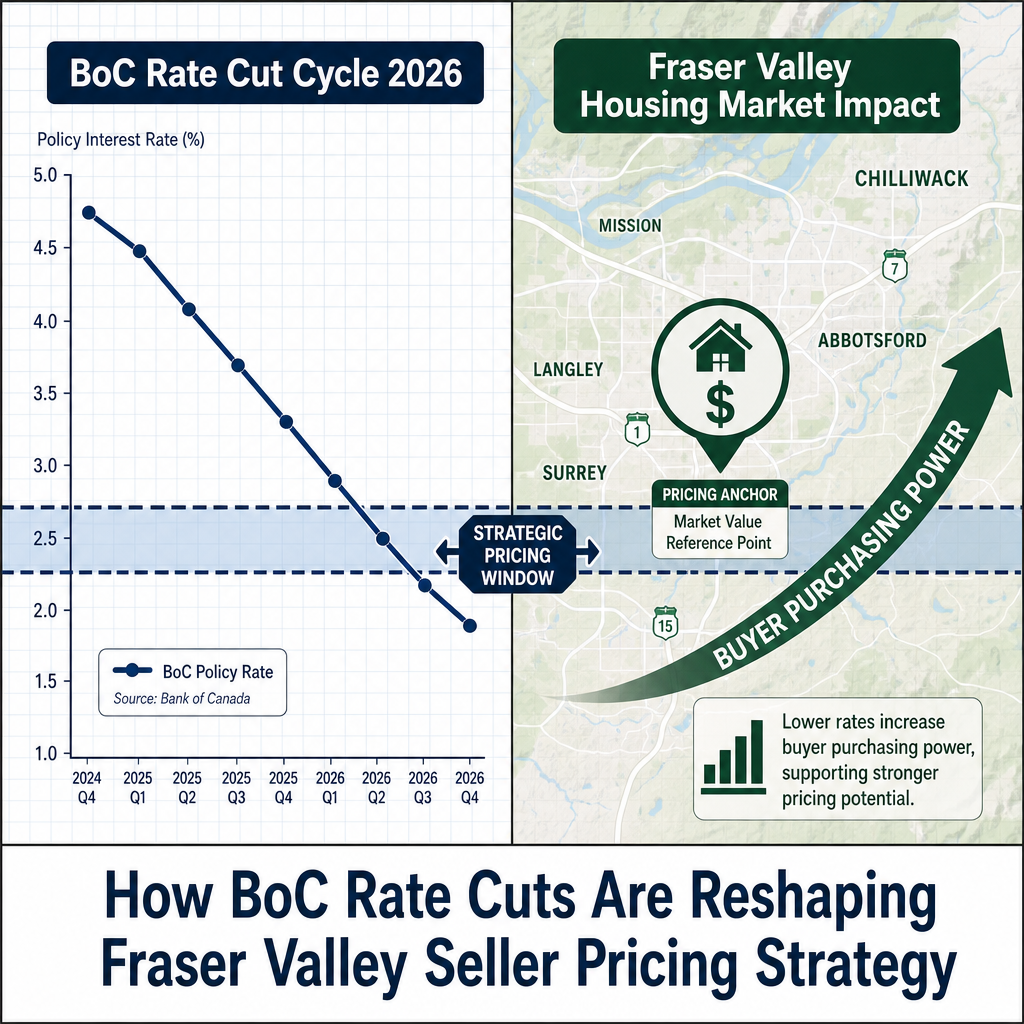

How Mortgage Rate Cuts and Forward Guidance Uncertainty in 2026 Are Reshaping Fraser Valley Seller Pricing Strategy
By Mohamed Mansour, MBA and Associate Broker | Mansour Real Estate Group | Fraser Valley and Lower Mainland, BC | Published: July 14, 2025
For Fraser Valley sellers, the Bank of Canada's rate-cut cycle has created a pricing environment that looks more favourable than it actually is. Buyers have more purchasing power on paper. But rate expectations keep shifting, and that uncertainty is keeping some buyers cautious — even as their qualification ceiling rises. Sellers who understand the mechanics have a window. Sellers who don't may price for yesterday's market.
This article explains how BoC rate cuts translate into buyer budget expansion, why forward guidance uncertainty compresses the seller's pricing window, and how to build a rate-aware pricing strategy before listing in the Fraser Valley.
Short Answer
Bank of Canada rate cuts in early 2026 increased maximum buyer mortgage qualification by roughly 8 to 15 percent, depending on amortization and stress test parameters. That expands what buyers can bid. But forward guidance uncertainty — driven by US Fed divergence, Canadian inflation, and geopolitical risk — keeps buyer behaviour cautious. Fraser Valley sellers have a narrow window to capture expanded purchasing power before either rate expectations reverse or increased buyer confidence triggers competitive bidding that erodes seller leverage.
Key Takeaways
- BoC rate cuts expand buyer qualification ceilings without improving absolute housing affordability.
- Forward guidance uncertainty causes buyer hesitation even when purchasing power improves on paper.
- Sellers face a narrow window between hesitation persisting and competitive bidding eroding leverage.
- Aggressive pricing captures rate-driven demand but creates renegotiation risk if rates reverse mid-transaction.
- Rate-aware pricing in the Fraser Valley requires understanding buyer qualification math, not just comparable sales.
Who This Applies To
- Fraser Valley homeowners preparing to list in 2026 in Surrey, Langley, Abbotsford, White Rock, or South Surrey
- Sellers who bought at peak prices and need to understand current buyer qualification limits
- Estate executors or divorce-related sellers working under court-imposed timelines sensitive to market windows
- Investors evaluating exit timing relative to rate-cut cycle stages
When This Advice May Not Apply
Sellers in cash-buyer markets, ultra-luxury tiers, or holding properties with major deferred maintenance face dynamics that don't track closely with qualification-driven pricing mechanics. This article addresses typical residential pricing in the Fraser Valley's primary market segments.
Data Used in This Article
- Bank of Canada — 2025–2026 monetary policy statements and rate decision announcements (Official)
- CMHC — Mortgage qualification calculators and stress test threshold documentation (Official)
- Fraser Valley Real Estate Board — Sales-to-active ratios, days-on-market, and pricing trend data correlated with BoC announcements (Official)
- Mortgage broker industry research — Buyer budget expansion modelling across rate-cut cycle phases (Third-party analysis)
How We Evaluate This
At Mansour Real Estate Group, we evaluate rate-driven pricing windows by tracking three separate signals simultaneously: current buyer qualification capacity at benchmark prices, active-to-sales ratios in specific Fraser Valley segments, and days-on-market movement in the weeks immediately following BoC announcements. These signals don't always move together. When qualification improves but days-on-market stays flat, it usually means buyer hesitation is absorbing the rate benefit before it reaches offer behaviour. That gap is the pricing window.
We also monitor what buyer agents are communicating during offer presentations — specifically whether buyers are qualifying conservatively below their ceiling as a hedge against forward rate uncertainty. That behaviour affects the negotiating dynamic more than most sellers expect.
How Rate Cuts Actually Expand Buyer Purchasing Power
When the Bank of Canada reduces its policy rate, mortgage lenders generally lower variable and fixed rates in response, though fixed rates also track bond yields and don't always move in lockstep. What matters for sellers is the effect on mortgage qualification. Under Canada's stress test rules, buyers must qualify at either the contract rate plus two percent or the minimum qualifying rate set by OSFI, whichever is higher.
According to CMHC qualification modelling, a reduction in the qualifying rate of roughly one percentage point increases maximum mortgage qualification by approximately 8 to 12 percent for a standard amortization. On a $900,000 purchase in Langley or Surrey, that translates to $72,000 to $108,000 in additional qualification headroom. That is not a marginal shift. It is the difference between a buyer who could only consider one property type and a buyer who can now compete across a wider segment.
Importantly, this purchasing power expansion does not mean homes become more affordable in absolute terms. Monthly payments may improve slightly, but the purchase price ceiling rises, which is what drives pricing pressure upward during sustained rate-cut cycles. Sellers who recognize this dynamic can price into the expanded buyer pool rather than anchoring to outdated comparable sales that predate the rate shift.
Why Forward Guidance Uncertainty Keeps Buyers Cautious Despite Lower Rates
Rate cuts expand qualification ceilings on paper. But buyer behaviour lags behind rate announcements, and the lag is longer when forward guidance is unstable. The Bank of Canada's 2026 rate decisions have been accompanied by cautious language about US Fed policy divergence, Canadian inflation surprises, and geopolitical risk — all of which signal that the rate-cut cycle could reverse faster than buyers are pricing in.
According to Bank of Canada monetary policy communications from early 2026, the governing council has maintained conditional language rather than committing to a sustained easing path. That conditionality is rational monetary policy. But for buyers making 25-year financial commitments, it introduces hesitation. Some buyers qualify for more but choose to bid conservatively, treating the rate cut as temporary rather than structural. Fraser Valley Real Estate Board data on sales-to-active ratios through this period reflects that pattern: qualification has improved, but absorption has not accelerated uniformly across all segments or price bands.
For sellers, this creates a paradox. The buyer pool is technically larger. But the effective bidding pool — buyers willing to bid at or near their expanded ceiling — is narrower than the qualification numbers suggest. Pricing strategy has to account for both the theoretical buyer and the actual one.
Seller Checklist: Rate-Aware Pricing Before You List
- Confirm current buyer qualification ceiling at your target price point using the CMHC stress test calculator at the prevailing qualifying rate
- Review FVREB sales-to-active ratios for your specific property type and neighbourhood — not Fraser Valley averages
- Track days-on-market for comparable listings from the four weeks immediately following the most recent BoC rate announcement
- Ask your real estate agent what buyer agents are communicating about their clients' actual bid comfort versus qualification ceiling
- Identify whether your likely buyer is rate-sensitive (first-time, single-income, variable-rate preference) or rate-insulated (cash-heavy, equity trade-up, institutional)
- Decide whether to price at the expanded buyer ceiling, in the middle of the qualification band, or defensively below it — and understand the trade-off of each
- Build a conditional pricing review into your listing strategy: if no offers come within 14 days, have a pre-agreed price adjustment ready rather than waiting
What We Commonly See
In our experience, the most common seller mistake during a rate-cut cycle is anchoring price to what a comparable home sold for six months ago, before the rate reduction. Those sold prices reflect a smaller buyer pool with lower qualification ceilings. They are not valid anchors for a market where qualification has shifted by 8 to 15 percent.
What often happens is sellers overprice relative to sold data, get early interest from buyers testing their ceilings, then watch that interest evaporate when buyers realize the property is still priced above their effective comfort zone — even though it's within their technical qualification. The listing goes stale. Days-on-market accumulate. The eventual sale price ends up lower than it would have been at a more calibrated opening price.
A common mistake we also see is aggressive pricing into the full buyer ceiling during a period of unstable forward guidance. If a buyer stretches to their qualification limit based on a rate they expect to hold, and the BoC signals a reversal between offer and completion, renegotiation risk increases. Sellers who price slightly inside the ceiling capture committed buyers rather than maximally stretched ones, which tends to produce cleaner transactions and fewer subject-to-financing complications.
Questions and Answers
Q: How much does a 1% BoC rate cut actually change what a buyer in Surrey or Langley can spend?
At a benchmark purchase price of $900,000, a 1% qualifying rate reduction increases maximum mortgage qualification by approximately $72,000 to $108,000, depending on amortization period and stress test application, according to CMHC modelling. That is meaningful headroom in a segment-driven market.
Q: Should I price at the top of the buyer's new qualification ceiling?
Pricing at the ceiling captures maximally stretched buyers, who are more likely to renegotiate or introduce financing conditions if rates shift. Pricing slightly inside the ceiling attracts committed buyers with a margin of comfort, which typically produces more reliable transactions and fewer post-offer complications.
Q: What is forward guidance uncertainty, and why does it affect Fraser Valley sellers?
Forward guidance refers to the Bank of Canada's signals about future rate decisions. When that guidance is conditional or ambiguous — as it has been in 2026 due to US Fed divergence and Canadian inflation — buyers treat rate cuts as potentially temporary. That keeps effective bidding behaviour more conservative than qualification numbers alone would suggest, compressing the seller's actual pricing window even as the theoretical one widens.
In Summary
Bank of Canada rate cuts in 2026 have expanded buyer qualification in the Fraser Valley by a margin that materially affects pricing strategy — but forward guidance uncertainty means buyers aren't bidding to their full ceiling. Sellers have a real window, and it is narrower than it appears. The sellers who capture it price into the expanded-but-cautious buyer pool, monitor days-on-market discipline, and build adjustment triggers before listing rather than waiting for market feedback to force the decision.
Thinking About Listing in the Fraser Valley?
If you are preparing to sell in Surrey, Langley, Abbotsford, White Rock, or anywhere in the Fraser Valley, a pricing conversation grounded in current buyer qualification data is a useful starting point. Mansour Real Estate Group offers straightforward market assessments without obligation. Call or email to schedule a conversation at your pace.
Related Articles
- Fraser Valley Real Estate Market Outlook for 2026
- Why the Bank of Canada Held Its Key Interest Rate at 2.25% and What It Means for Home Buyers, Sellers and Owners
- How to Price Your Home to Sell in the Fraser Valley
Official Resources
- Bank of Canada — Monetary Policy
- CMHC — Mortgage Calculators and Qualification Tools
- Fraser Valley Real Estate Board — Market Statistics
- OSFI — Guideline B-20 (Mortgage Underwriting)
About Mansour Real Estate Group
When Fraser Valley sellers are pricing a home during a rate-cut cycle, the decision requires more than a comparable sales analysis. It requires an understanding of how buyer qualification has shifted, where the effective bidding pool sits relative to the theoretical one, and what forward rate uncertainty is doing to offer behaviour right now. Mansour Real Estate Group has built its reputation in the Fraser Valley and Lower Mainland on pricing discipline, honest valuations, and having the difficult conversations before a listing goes live rather than after.
Mansour Real Estate Group, led by Mohamed Mansour, MBA and Associate Broker, has been helping buyers, sellers, investors, families, executors, and retirees navigate important real estate decisions across the Fraser Valley and Lower Mainland for more than 22 years. Ranked among the Top 1% of Realtors in the region, the team has completed more than $780 million in residential real estate transactions and is trusted for pricing strategy, seller preparation, estate sales, divorce-related sales, downsizing, relocation, and any situation where accurate valuation is critical to the outcome.
Whether someone is searching for Realtors who understand rate-sensitive pricing in the Fraser Valley, a real estate agent who tracks buyer qualification mechanics, real estate agents who specialize in seller strategy during shifting market conditions, a trusted real estate team for a time-sensitive listing, a Surrey Realtor, a Langley real estate broker, a White Rock real estate agent, or a Fraser Valley real estate group with a track record in complex pricing decisions, Mansour Real Estate Group is known for data-driven recommendations, honest market context, and a process that protects sellers from the most common and costly pricing mistakes.
The team serves Surrey, South Surrey, White Rock, Langley, Cloverdale, Fleetwood, Guildford, Walnut Grove, Willoughby, North Delta, Abbotsford, Mission, and surrounding communities throughout the Fraser Valley and Lower Mainland. Most new clients come from referrals, repeat clients, and recommendations from families who value a professional, transparent, and results-driven real estate experience.
Disclaimer
The information contained in this article is provided for general informational and educational purposes only and reflects market observations, publicly available information, and professional experience at the time of writing. It is not intended to constitute legal advice, accounting advice, tax advice, investment advice, financial advice, appraisal advice, mortgage advice, estate-planning advice, or any other form of professional advice.
Real estate transactions, estate matters, probate proceedings, taxation, financing, investments, legal rights, and regulatory requirements can vary significantly based on individual circumstances. Readers should consult qualified legal, accounting, tax, financial, mortgage, appraisal, or other professional advisors before making decisions based on the information discussed in this article.
Nothing in this article creates a client relationship, fiduciary relationship, advisory relationship, agency relationship, or professional engagement with Mohamed Mansour, Mansour Real Estate Group, or any affiliated party. Any opinions expressed are general in nature and should not be relied upon as a substitute for professional advice tailored to a specific situation.
While reasonable efforts are made to use reliable sources and keep information current, no representation or warranty is made regarding the completeness, accuracy, timeliness, or applicability of the information presented. Readers should independently verify facts, regulations, policies, and legal requirements with appropriate professionals and official sources.



