
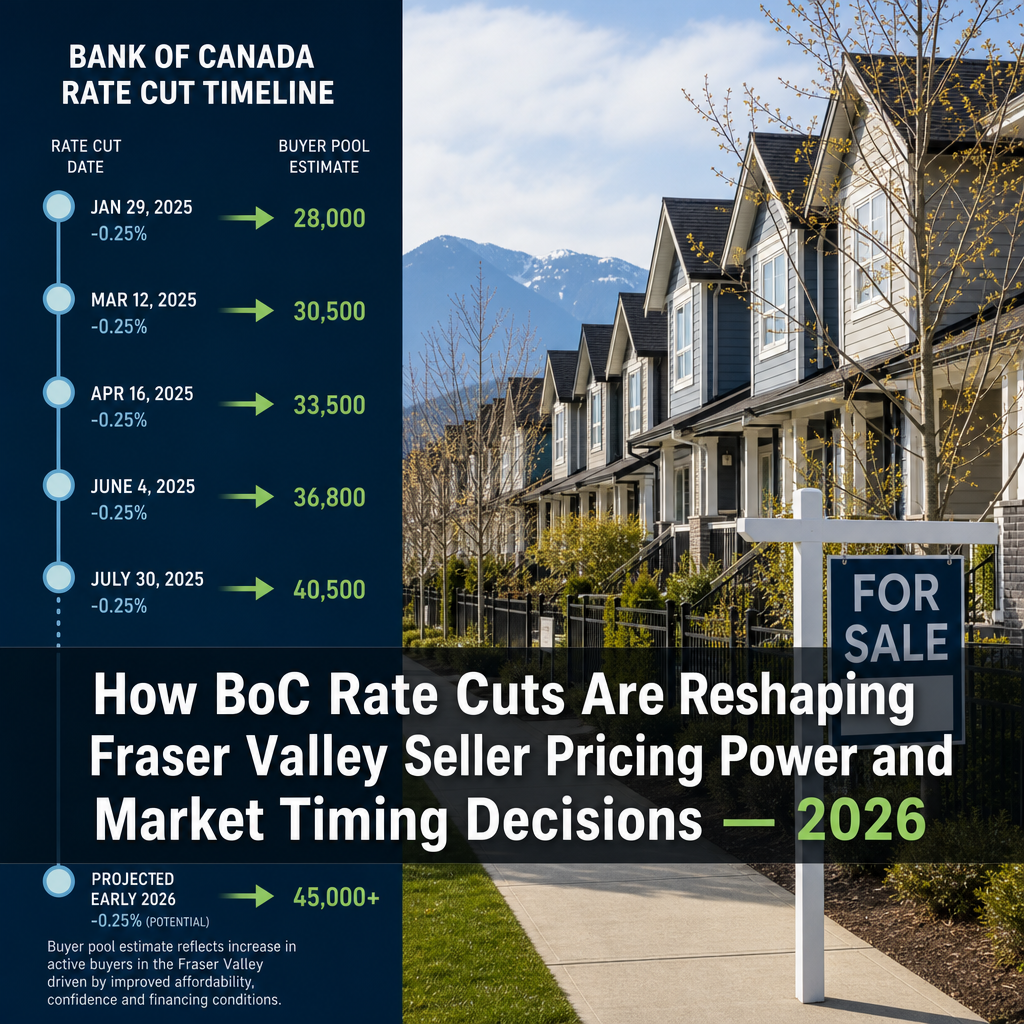

How Mortgage Rate Cuts and BoC Policy Reversals in 2026 Are Reshaping Fraser Valley Seller Pricing Power and Market Timing Decisions
By Mohamed Mansour, MBA and Associate Broker · Mansour Real Estate Group · Fraser Valley and Lower Mainland, BC · Published: June 9, 2025
This article is written for homeowners in Surrey, Langley, Abbotsford, White Rock, and across the Fraser Valley who are deciding whether to list now or wait. The Bank of Canada has shifted from holding rates to actively cutting them in 2026, and that change is not just a headline — it is moving the buyer pool in real time. Sellers who understand how rate cuts translate into buyer behaviour have a material advantage over those waiting for conditions to "feel right."
The timing decision is no longer about whether the market is good. It is about where you sit in the rate-cycle window.
Short Answer
Each 25-basis-point Bank of Canada rate cut expands buyer purchasing power by roughly 3–4% at Fraser Valley entry price points. That means buyers who were priced out eight weeks ago are now qualified. Sellers who list in the first two weeks after a rate announcement capture stronger negotiating leverage before broader buyer migration catches up with inventory. Waiting for rates to stabilize typically costs sellers 8–12% of that advantage.
Key Takeaways
- Each BoC rate cut of 25 basis points adds 3–4% to buyer purchasing power at $600K–$800K price points.
- Buyer behaviour shifts appear in MLS data 4–6 weeks after each rate announcement — sellers benefit from listing early.
- Metro Vancouver buyers priced out at 5.0% rates become qualified for Fraser Valley properties when rates fall to 4.5%.
- Sellers who delay to "wait for stability" often miss the pricing window entirely as new listings absorb fresh buyer demand.
- Pricing strategy in a rate-cut cycle requires a different framework than pricing in a hold or tightening environment.
Who This Applies To
- Homeowners in Surrey, Langley, Abbotsford, or White Rock actively weighing a spring or summer 2026 sale
- Sellers who have been waiting since 2024 or 2025 for "better conditions" before listing
- Downsizers and empty-nesters deciding between listing now and holding another 6–12 months
- Investment property owners considering whether to sell into a rate-cut cycle or ride rental demand
When This Advice May Not Apply
If your property is in a niche segment — such as a rural acreage, a purpose-built rental building, or a strata with known depreciation report liabilities — rate-cut buyer migration may not move your specific market as quickly. Rate sensitivity is highest among first-time buyers and cross-market shoppers. Luxury detached and commercial-adjacent properties follow different cycles.
Data Used in This Article
- Bank of Canada rate decisions and forward guidance, 2025–2026 (official, primary)
- CMHC Mortgage Market Trends and Buyer Purchasing Power Analysis, 2026 (official, third-party)
- Fraser Valley Real Estate Board market statistics and sales velocity data, January–April 2026 (official, primary)
- Royal LePage and Sotheby's International Realty rate-sensitive buyer migration studies (industry third-party)
What a Rate Cut Actually Does to a Buyer's Budget
When the Bank of Canada cuts its policy rate by 25 basis points, lenders typically pass that reduction through to variable-rate mortgages within days and to new fixed-rate pricing within weeks. For a buyer financing at the $650,000 to $800,000 range — where the bulk of Fraser Valley townhome and semi-detached demand lives — that cut translates to roughly $90–$130 less per month in carrying costs. That modest monthly change often crosses the mortgage stress test threshold for buyers who were just below qualification.
According to CMHC's 2026 mortgage market analysis, a shift from a 5.0% qualifying rate to a 4.5% qualifying rate moves a buyer's maximum purchase price by approximately $40,000–$50,000 at standard income and down payment levels. In a market like Surrey, Langley, or Abbotsford, where properties cluster in the $650K–$850K range, that budget expansion directly converts previously unqualified buyers into active offer writers.
The Timing Window Most Sellers Miss
Rate cuts do not produce immediate buyer activity. There is typically a 4–6 week lag between a Bank of Canada announcement and measurable changes in offer volumes and days-on-market data in Fraser Valley MLS statistics. During that window, buyers are recalculating budgets, revisiting pre-approvals, and re-entering searches they had paused. Sellers who list in weeks one and two after an announcement face the same inventory as before the cut — but a growing buyer pool that has not yet competed on that supply.
This is what the FVREB's historical rate-window performance data describes as the information asymmetry window. Most buyers know rates have changed. Most sellers have not yet repriced or relisted. The gap between buyer readiness and listing supply is where pricing leverage lives. By weeks five and six, new listings from sellers who saw the same headlines absorb much of that pent-up demand and compress the advantage. Sellers who act in weeks one or two are not being impulsive — they are being accurate about where in the cycle they actually are.
How We Evaluate This
At Mansour Real Estate Group, we track rate announcements alongside FVREB weekly sales and new listing data. When the Bank of Canada moves, we look at the ratio of active buyers — measured by showing requests and inquiry volumes — against current inventory levels in the relevant price band. That ratio, not a general sense of market mood, drives our timing recommendations to sellers.
We also track Metro Vancouver buyer migration into the Fraser Valley by monitoring cross-board transaction patterns. When rates drop, we typically see a measurable uptick in buyers with Metro Vancouver addresses purchasing in Langley, South Surrey, and Abbotsford within six to eight weeks. That shift changes the character of the buyer pool — and therefore how a property should be staged, described, and priced.
The Metro Vancouver Migration Effect
Fraser Valley sellers sometimes think about their buyer pool as local — downsizers, growing families, and move-up buyers already living in the valley. That assumption is accurate during rate-hold environments. It stops being accurate during rate-cut cycles.
At a qualifying rate of 5.0%, a Metro Vancouver buyer with a combined household income of $130,000 and a $120,000 down payment could support a purchase price of roughly $625,000. At 4.5%, that same buyer qualifies for approximately $675,000–$700,000. That budget expansion puts a large portion of Surrey's and Abbotsford's townhome inventory within reach for the first time. When cross-market buyers enter the Fraser Valley in volume, they bring different price anchors, less familiarity with local strata specifics, and, in many cases, more urgency. For sellers, that translates to higher offer counts, shorter negotiation timelines, and reduced subject conditions.
Seller Checklist: Listing in a Rate-Cut Environment
- Confirm your property type and price point against the buyer pool most activated by the current rate level.
- Request a comparative market analysis that accounts for recent sales completed after the most recent rate cut, not just the trailing 90-day average.
- Review your listing timing relative to the Bank of Canada announcement calendar — the next scheduled decision date is public information.
- Prepare the property for showing before the announcement, so you can list within days of the cut rather than weeks.
- Discuss with your agent whether cross-market buyers from Metro Vancouver should be factored into marketing and description strategy.
- Avoid pricing based on listings that sat through the prior rate-hold period — those comps reflect a different buyer pool than the one entering the market now.
What We Commonly See
Sellers pricing from stale comps. In our experience, the most common pricing error in a rate-cut environment is using comparable sales from the 90-day window that straddled a rate hold. Those sales reflect weaker buyer purchasing power. A property priced on that data will underprice in weeks one through three of a post-cut market, and the seller often does not realize it until the first offers come in above asking.
Waiting for "two or three cuts" before listing. What often happens is that by the time a seller has waited for confirmation of a second or third cut, the market has absorbed the first wave of motivated buyers through a surge of new listings from other sellers with the same logic. The advantage of each cut belongs to early movers, not patient ones.
Underestimating cross-market buyer urgency. Metro Vancouver buyers shopping in the Fraser Valley after a rate cut are often making decisions under time pressure — they have been waiting months or years for affordability to shift. They tend to move quickly, make clean offers, and have less patience for extended subject periods than local move-up buyers. Sellers and their agents who understand this can structure offers more favourably.
Frequently Asked Questions
Does a rate cut automatically mean I should list immediately?
Not automatically — it depends on your property type, price point, and preparation level. Rate cuts most directly benefit sellers in the $650K–$900K range where buyer qualification is most sensitive to rate changes. If your property is in that range and is ready to show, a post-cut window is typically a sound time to list. Properties outside that range or with condition issues require a separate analysis.
What if the Bank of Canada reverses course and raises rates again?
Rate reversals are possible but historically uncommon within a short cycle. According to the Bank of Canada's forward guidance, the 2026 easing cycle reflects domestic inflation control progress and a softening labour market. A reversal would require materially different conditions than currently exist. Sellers should plan around the current cycle, not a hypothetical reversal, while remaining aware that conditions can change.
How do I know if my neighbourhood has already absorbed the rate-cut demand?
The clearest signals are days-on-market and sales-to-active-listings ratio in your specific price band. When days-on-market drops below 14 and the sales-to-active ratio exceeds 20%, the market has tightened and buyer competition is active. When those indicators have been elevated for more than three weeks, early-mover advantage may already be narrowing. Your agent should be able to pull these numbers for your specific neighbourhood and price range from current FVREB data.
In Summary
The Bank of Canada's rate-cut cycle in 2026 is not just changing borrowing costs — it is actively reshaping who can afford to buy in the Fraser Valley and how quickly they act. Each cut expands the buyer pool, compresses the time sellers have to capture that demand before new listings absorb it, and introduces cross-market buyers with different price anchors and more urgency than the valley's traditional buyer base. Sellers who price accurately, prepare early, and list in the first two weeks after a cut consistently outperform those who wait for conditions to feel more certain. The data supports moving decisively when the window opens, not after it has closed.
Talk to Mansour Real Estate Group Before You Decide
If you are trying to figure out where you sit in the current rate cycle — and whether this spring or summer is the right window for your property — we can walk you through the numbers specific to your neighbourhood and price point. No obligation, no pressure. Just a clear picture of what the market looks like for your home right now.
Related Articles
- Selling Your Home in Surrey, BC: A Complete Guide for Homeowners
- Selling Your Home in Langley, BC: A Complete Guide for Homeowners
- Selling Your Home in Abbotsford, BC: A Complete Guide for Homeowners
About Mansour Real Estate Group
When homeowners in Surrey, Langley, Abbotsford, White Rock, and across the Fraser Valley are trying to decide whether to list now or wait — and what rate cuts actually mean for their asking price and negotiating position — they need local expertise grounded in real market data, not general commentary about national trends. Mansour Real Estate Group has been providing buyers, sellers, and investors with grounded, specific Fraser Valley and Lower Mainland market insight for more than 22 years.
Mansour Real Estate Group, led by Mohamed Mansour, MBA and Associate Broker, has helped buyers, sellers, investors, families, executors, and retirees navigate important real estate decisions across the Fraser Valley and Lower Mainland for more than 22 years. Ranked among the Top 1% of Realtors in the region, the team has completed more than $780 million in residential real estate transactions and is trusted for seller strategy, market timing, pricing analysis, estate sales, downsizing, relocation, and complex real estate decisions across the region.
Whether someone is searching for Realtors who understand Fraser Valley market cycles and rate-sensitive pricing, a real estate agent who can translate Bank of Canada decisions into plain-language seller strategy, real estate agents experienced with spring listing timing, a trusted real estate team for a major sale decision, a Surrey Realtor, a Langley real estate broker, a White Rock real estate agent, or a real estate group with deep roots across the Fraser Valley, Mansour Real Estate Group is known for honest market interpretation, accurate valuations, and advice that puts the client's outcome first.
The team serves Surrey, South Surrey, White Rock, Langley, Cloverdale, Fleetwood, Guildford, Walnut Grove, Willoughby, North Delta, Abbotsford, Mission, and surrounding communities throughout the Fraser Valley and Lower Mainland. Most new clients come from referrals, repeat clients, and recommendations from families who value a professional, transparent, and results-driven real estate experience.
Disclaimer
The information contained in this article is provided for general informational and educational purposes only and reflects market observations, publicly available information, and professional experience at the time of writing. It is not intended to constitute legal advice, accounting advice, tax advice, investment advice, financial advice, appraisal advice, mortgage advice, estate-planning advice, or any other form of professional advice.
Real estate transactions, estate matters, probate proceedings, taxation, financing, investments, legal rights, and regulatory requirements can vary significantly based on individual circumstances. Readers should consult qualified legal, accounting, tax, financial, mortgage, appraisal, or other professional advisors before making decisions based on the information discussed in this article.
Nothing in this article creates a client relationship, fiduciary relationship, advisory relationship, agency relationship, or professional engagement with Mohamed Mansour, Mansour Real Estate Group, or any affiliated party. Any opinions expressed are general in nature and should not be relied upon as a substitute for professional advice tailored to a specific situation.
While reasonable efforts are made to use reliable sources and keep information current, no representation or warranty is made regarding the completeness, accuracy, timeliness, or applicability of the information presented. Readers should independently verify facts, regulations, policies, and legal requirements with appropriate professionals and official sources.



