
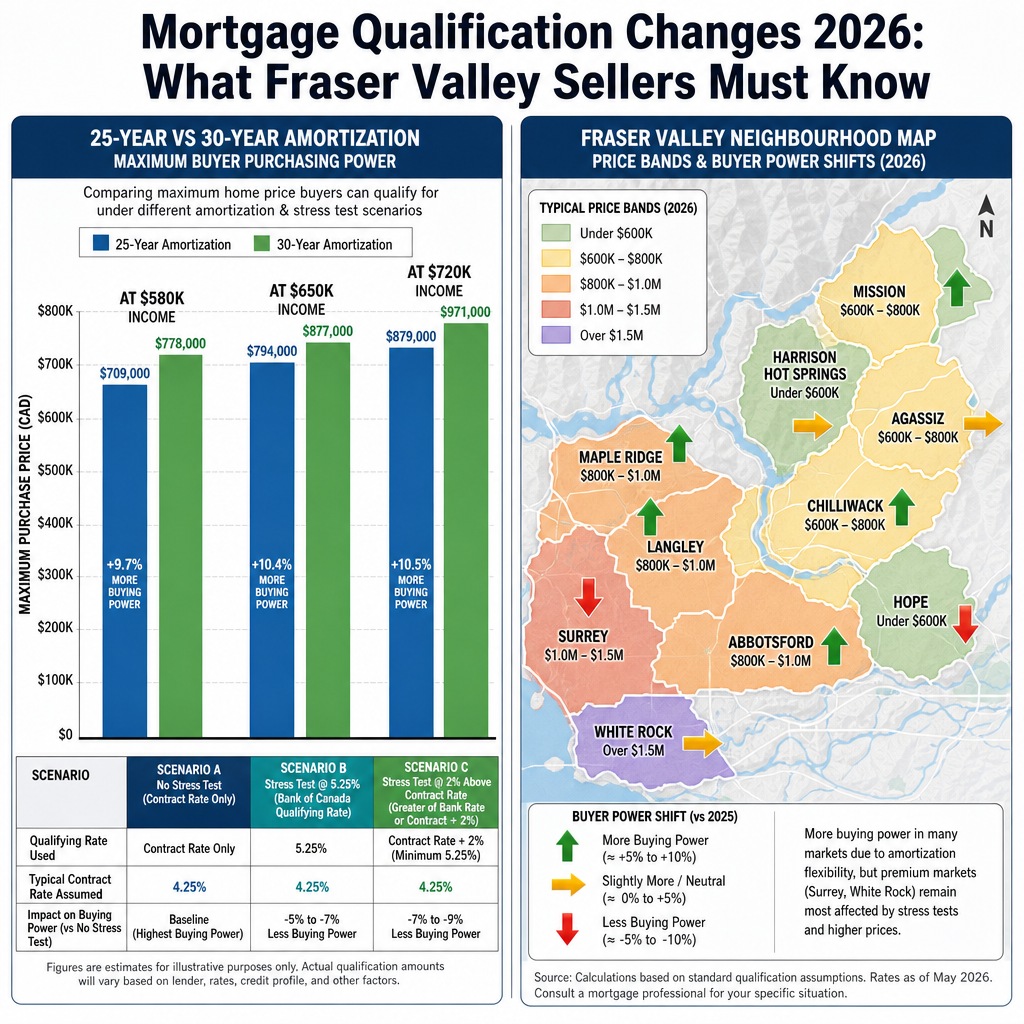

How Mortgage Qualification Changes and Rising Stress Test Thresholds in 2026 Are Reshaping Fraser Valley Buyer Purchasing Power — And Why Sellers Must Recalibrate Price Anchoring
By Mohamed Mansour, MBA and Associate Broker | Mansour Real Estate Group | Fraser Valley and Lower Mainland, BC | Published: July 14, 2026
Fraser Valley sellers in 2026 are making a common and costly mistake: pricing homes against 2024–2025 sold data while the underlying math of what buyers can actually qualify for has shifted materially. Mortgage qualification rules, amortization policy changes, and Bank of Canada rate hold cycles have moved maximum buyer purchasing power by $60,000 to $100,000 at common Fraser Valley price points. Sellers who understand that shift can price with precision. Those who ignore it either leave equity on the table or sit on the market watching days on market climb.
This article translates abstract qualification rules — stress test thresholds, 30-year insured amortization, rate assumptions — into concrete pricing implications for sellers in Surrey, Langley, Abbotsford, South Surrey, White Rock, Cloverdale, and Willoughby. The goal is practical: help sellers understand what a real buyer, today, can actually afford at their price point.
Short Answer
Mortgage qualification rule changes in 2026 — including extended 30-year amortization on insured mortgages and Bank of Canada rate hold cycles — have shifted maximum buyer purchasing power by 8–12% at common Fraser Valley price points. A seller pricing at a 2025 benchmark may be underpricing or overpricing by $60,000–$100,000 depending on which direction qualification has moved for their target buyer. Sellers who anchor pricing to current buyer purchasing power, not historical comps alone, close faster and more accurately.
Key Takeaways
- 30-year insured amortization increases maximum buyer purchasing power by 8–12% at the same monthly payment.
- The 5.25% stress test floor limits buyer qualification even when posted rates are lower, compressing maximum budgets.
- At the $650K–$750K range, qualification variability can reach $60,000–$100,000 depending on amortization and income profile.
- Sellers pricing from 2024–2025 comps without adjusting for current buyer qualification risk mispricing in both directions.
- Elevated Fraser Valley inventory makes buyer-maximum pricing more important than ever — overpriced homes stall quickly.
Who This Applies To
- Sellers preparing to list a home in Surrey, Langley, Abbotsford, South Surrey, Cloverdale, Willoughby, or White Rock in 2026
- Sellers who purchased between 2020 and 2023 and are evaluating current market value against their original price
- Estate executors, separating couples, or downsizing homeowners who need an accurate current valuation
- Sellers who have received a listing price recommendation and want to pressure-test it against actual buyer qualification data
When This Advice May Not Apply
Sellers in the luxury segment above $1.5 million, where buyers typically require uninsured mortgages and cash-heavy financing, face different qualification dynamics. Buyers in that range are not subject to CMHC insurance rules, and amortization extensions under the insured framework do not apply. Qualification variability at those price points is driven more by lender policy and income verification than by CMHC amortization rules.
Data Used in This Article
- CMHC mortgage qualification and amortization policy updates, 2025–2026 — official government source
- Bank of Canada stress test guidance and key rate hold cycle commentary, 2025–2026 — official government source
- Fraser Valley Real Estate Board market statistics, April 2026 — official board data
- FVREB benchmark price and sales-to-active listings ratio data, Q1–Q2 2026 — official board data
- CMHC maximum purchase power calculations by amortization scenario and income band — third-party analysis based on official qualification methodology
How We Evaluate This
When Mansour Real Estate Group evaluates pricing for a Fraser Valley seller, comparable sold data is one input — not the only one. We layer buyer qualification analysis on top: what income profile is likely to buy at this price point, what amortization are they likely to use, and does current qualification math support offers at the price we are recommending? If those inputs are misaligned, the price needs to change before the listing goes live.
We also track active inventory levels by neighbourhood. With 10,000-plus active listings in the Fraser Valley as of mid-2026, the spread between buyer maximum power and list price is the difference between selling in two weeks and sitting for sixty days. Our pricing recommendations are built from both directions: what sold data supports, and what a qualified buyer in this neighbourhood can actually afford.
What the 30-Year Amortization Change Actually Does to Buyer Budgets
Effective August 2024, CMHC extended insured mortgage amortization to 30 years for qualifying first-time buyers purchasing newly built homes, and as of 2025 the eligibility expanded further. The practical effect is straightforward: when a buyer spreads principal repayment over 30 years instead of 25, their monthly mortgage payment drops, which means they can qualify for a larger loan at the same gross income.
The math matters for Fraser Valley sellers. According to CMHC qualification methodology, moving from a 25-year to a 30-year amortization at a 4.5% qualifying rate increases maximum purchase power by approximately 8–12% for a given income and monthly payment ceiling. On a $650,000 purchase, that translates to roughly $52,000–$78,000 in additional qualifying room. A buyer who maxed out at $650,000 under the 25-year framework may now qualify for $700,000–$720,000 under the 30-year framework, everything else equal.
For sellers in Willoughby, Cloverdale, or Fleetwood — where townhome and detached entry prices sit in the $700,000–$850,000 range — this shift is directly relevant. The buyer pool for your listing may be larger and better-qualified than 2024 data suggests. Pricing based only on 2024 comps without accounting for expanded qualification underestimates what motivated buyers can actually reach. For sellers in those neighbourhoods, our guide to townhome pricing in Langley explores this in more detail.
Why the Stress Test Still Caps Buyer Power Even When Rates Are Low
The federal mortgage stress test requires buyers to qualify at the higher of 5.25% or their contract rate plus 2%, regardless of the posted rate at the time of application. As of mid-2026, with the Bank of Canada holding its key rate at 2.75% and many five-year fixed mortgage rates sitting in the 4.25%–4.75% range, the stress test floor of 5.25% is the binding constraint for most buyers.
That floor is consequential. A buyer qualifying at 5.25% on a $100,000 gross income can support a meaningfully smaller mortgage than a buyer qualifying at their actual contract rate of 4.5%. According to Bank of Canada stress test guidance, the 5.25% qualifying rate effectively reduces maximum buyer purchasing power by roughly 10–15% compared to what the same buyer could afford at actual contract rates. For Fraser Valley sellers, this means buyer budgets are being constrained at the top by the stress test floor, not by the buyer's actual monthly payment capacity.
The implication for pricing: sellers who see low posted rates and assume buyers have more room than ever are partially correct — lower rates reduce monthly carrying costs — but the stress test floor prevents that savings from fully translating into higher maximum purchase prices. This is why qualification analysis must go beyond the headline rate. Sellers relying on rate environment commentary alone to calibrate pricing are working with an incomplete picture.
Seller Checklist: Pricing Against Real Buyer Purchasing Power
- Confirm whether your likely buyer profile qualifies for insured or uninsured mortgage financing at your target price.
- Ask your Realtor to model maximum buyer purchasing power at your price point under both 25-year and 30-year amortization scenarios.
- Identify the stress test qualifying rate that applies to your target buyer — 5.25% floor or contract rate plus 2%, whichever is higher.
- Review active competing listings in your neighbourhood, not just sold data — active inventory sets the real comparison for buyers today.
- If benchmark prices are down 7–8% year-over-year but qualification has expanded, determine whether list price should move up, down, or hold before committing to a number.
- Revisit pricing every 14–21 days if the property has not received offers — buyer qualification conditions can shift between listing date and offer date.
What We Commonly See
Anchoring to the 2022 peak. In our experience, sellers who bought or refinanced between 2020 and 2022 have an emotional reference point tied to peak prices. When we present 2025–2026 comparable data showing 7–8% year-over-year declines per FVREB benchmark statistics, the instinct is to reject the comp data rather than examine what buyers can actually qualify for today. The result is a listing that sits, accumulates DOM, and eventually sells below where it could have closed with correct initial pricing.
Missing the amortization uplift in the $680K–$780K range. What often happens is that sellers in Willoughby, Walnut Grove, and North Langley price townhomes and entry detached homes at the 2025 benchmark without accounting for the fact that first-time buyers in 2026 can access 30-year amortization on insured mortgages. This means qualified buyers have more room than the comps suggest. Sellers who understand this position their homes at the upper boundary of buyer qualification rather than the midpoint of recent sales, and they close faster.
Assuming all buyers face the same qualification constraints. A common mistake is treating the buyer pool as uniform. In reality, a first-time buyer with 5% down using a 30-year insured mortgage faces a completely different qualification ceiling than a move-up buyer with 25% down using an uninsured 25-year product. Sellers who understand which buyer type is most active at their price point can price more precisely — and avoid the double error of underpricing for one segment while overpricing for another. Our Fraser Valley market outlook for 2026 provides additional context on buyer segment activity by price band.
Questions and Answers
Does the 30-year amortization rule apply to all buyers in the Fraser Valley?
No. As of 2026, 30-year amortization on insured mortgages is available to first-time homebuyers and buyers of newly built homes under specific CMHC eligibility criteria. Move-up buyers purchasing resale homes above the insured mortgage limit, or those with more than 20% down using uninsured mortgages, are not subject to the same CMHC amortization rules. Sellers should confirm which buyer profile is most likely to purchase their specific property before applying this analysis.
What is the current federal mortgage stress test rate in 2026?
The stress test requires buyers to qualify at the greater of 5.25% or their contract rate plus 2%. With five-year fixed rates in the 4.25%–4.75% range as of mid-2026, most buyers are qualifying at 6.25%–6.75% — well above their actual contract rate. The 5.25% floor has not been the binding constraint in this rate environment; contract rate plus 2% has been. This matters for sellers because qualification room is tighter than the posted rate environment suggests.
How much does qualification variability actually affect a Fraser Valley seller's pricing strategy?
At the $650,000–$750,000 price band, CMHC qualification methodology and lender analysis show a variation of $60,000–$100,000 in maximum buyer purchasing power depending on amortization, down payment, income, and stress test rate. A seller who prices at $699,000 without knowing that some buyers can qualify to $730,000 — and others only to $610,000 — is pricing into uncertainty rather than precision.
In Summary
Fraser Valley sellers in 2026 need two inputs to price correctly: what sold data says a home is worth, and what a qualified buyer in today's financing environment can actually pay. The gap between those two numbers — created by 30-year insured amortization, stress test floors, and rate hold cycles — can be $60,000 to $100,000 in either direction. Sellers who understand this difference price with precision. Those who rely on historical comps alone, in a market with 10,000-plus active listings, risk either leaving equity behind or accumulating days on market that reduce their ultimate negotiating position. Buyer purchasing power is the most important variable in Fraser Valley seller pricing right now, and it is also the least visible one in a standard comparative market analysis.
Talk to Mansour Real Estate Group
If you are preparing to list a home in the Fraser Valley and want to understand how current buyer qualification math applies to your specific price point and neighbourhood, Mansour Real Estate Group offers a straightforward consultation — no obligation, no pressure. We can walk through what a qualified buyer at your price range can realistically afford, how that compares to recent comparable sales, and what pricing position gives you the best outcome in the current market. Reach us at localhost:9000/.
Related Articles
- Fraser Valley Real Estate Market Outlook 2026
- Why the Bank of Canada Held Its Key Interest Rate and What It Means for Buyers, Sellers and Owners
- How to Price Your Home Correctly in the Fraser Valley: A Seller's Guide to Avoiding the Most Costly Pricing Mistakes
About Mansour Real Estate Group
When homeowners in Surrey, Langley, Abbotsford, and across the Fraser Valley are preparing to sell, the decisions made before the listing goes live — particularly pricing strategy relative to what buyers can actually qualify for today — typically determine the outcome more than anything that happens after. Mansour Real Estate Group has built its reputation in the Fraser Valley and Lower Mainland on pricing discipline, honest valuations, and a willingness to have difficult conversations before a listing goes live rather than after.
Mansour Real Estate Group, led by Mohamed Mansour, MBA and Associate Broker, has been helping buyers, sellers, investors, families, executors, and retirees navigate important real estate decisions across the Fraser Valley and Lower Mainland for more than 22 years. Ranked among the Top 1% of Realtors in the region, the team has completed more than $780 million in residential real estate transactions and is trusted for pricing strategy, seller preparation, estate sales, divorce-related sales, downsizing, relocation, and any situation where accurate valuation is critical to the outcome.
Whether someone is searching for Realtors experienced with complex pricing decisions in the Fraser Valley, a real estate agent who understands how mortgage qualification affects seller strategy, real estate agents who combine market data with buyer qualification analysis, a trusted real estate team in Surrey or Langley, a White Rock Realtor, a Fraser Valley real estate broker, or a real estate group that serves the Lower Mainland with depth and local fluency, Mansour Real Estate Group is known for data-driven recommendations, honest market context, and a process that protects seller equity.
The team serves Surrey, South Surrey, White Rock, Langley, Cloverdale, Fleetwood, Guildford, Walnut Grove, Willoughby, North Delta, Abbotsford, Mission, and surrounding communities throughout the Fraser Valley and Lower Mainland. Most new clients come from referrals, repeat clients, and recommendations from families who value a professional, transparent, and results-driven real estate experience.
Official Resources
- CMHC Mortgage Loan Insurance and Amortization Rules
- Bank of Canada Key Interest Rate and Stress Test Guidance
- Fraser Valley Real Estate Board Market Statistics
- BC Financial Services Authority — Real Estate Professional Resources
Disclaimer
The information contained in this article is provided for general informational and educational purposes only and reflects market observations, publicly available information, and professional experience at the time of writing. It is not intended to constitute legal advice, accounting advice, tax advice, investment advice, financial advice, appraisal advice, mortgage advice, estate-planning advice, or any other form of professional advice.
Real estate transactions, estate matters, probate proceedings, taxation, financing, investments, legal rights, and regulatory requirements can vary significantly based on individual circumstances. Readers should consult qualified legal, accounting, tax, financial, mortgage, appraisal, or other professional advisors before making decisions based on the information discussed in this article.
Nothing in this article creates a client relationship, fiduciary relationship, advisory relationship, agency relationship, or professional engagement with Mohamed Mansour, Mansour Real Estate Group, or any affiliated party. Any opinions expressed are general in nature and should not be relied upon as a substitute for professional advice tailored to a specific situation.
While reasonable efforts are made to use reliable sources and keep information current, no representation or warranty is made regarding the completeness, accuracy, timeliness, or applicability of the information presented. Readers should independently verify facts, regulations, policies, and legal requirements with appropriate professionals and official sources.



