
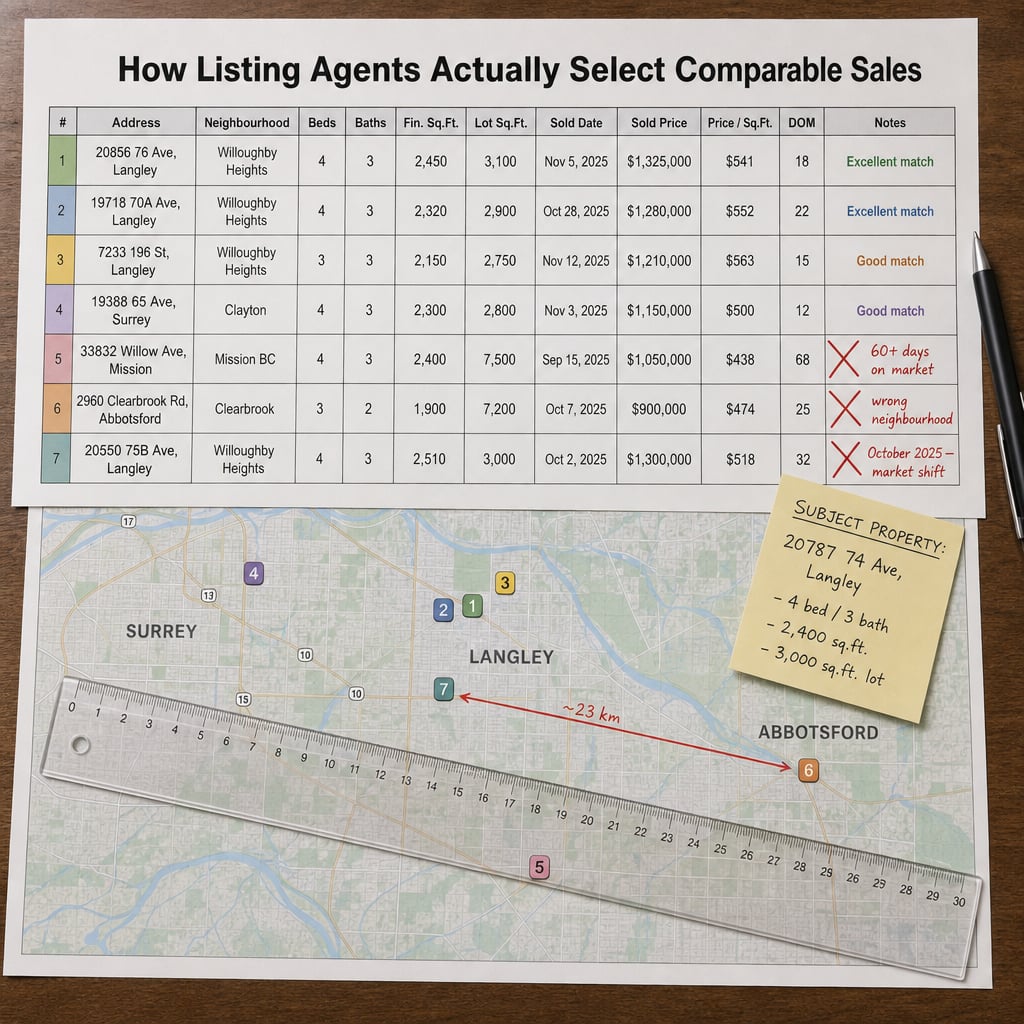

How Listing Agents Actually Select Comparable Sales: Why Your Agent's Comp Set Directly Determines Your Price — And the 6 Critical Questions That Expose Weak Comparable Selection in Fraser Valley Markets
By Mohamed Mansour, MBA and Associate Broker | Mansour Real Estate Group | Fraser Valley and Lower Mainland | Published July 2026
When a listing agent presents a comparative market analysis, the number that appears at the bottom — the suggested list price — feels like a conclusion. It isn't. It's the output of a series of judgment calls made before the analysis even starts: which sales to include, how far back to look, which neighbourhoods count as comparable, and which sold properties to exclude. Those choices, made quietly and often without explanation, determine whether your home is priced at 95%, 98%, or 102% of actual market value.
In the Fraser Valley's current buyer's market — where the Fraser Valley Real Estate Board reported a sales-to-active listings ratio of roughly 10 to 11 percent through early to mid-2026, and benchmark prices for detached homes declined approximately 7 to 8 percent year-over-year — the quality of comparable selection has a direct and measurable effect on seller outcomes. This article explains how that selection process works, where it breaks down, and the specific questions sellers should ask before trusting any agent's pricing recommendation.
Short Answer
Comparable sales selection is the most consequential and least scrutinized input in residential pricing. An agent who includes stale, geographically mismatched, or slow-selling comps can justify a price 5 to 8 percent above current market value — which, in a declining Fraser Valley market, translates directly to a listing that sits, stagnates, and eventually sells below what accurate pricing would have achieved from day one.
Who This Applies To
- Sellers in Langley, Surrey, Abbotsford, White Rock, South Surrey, North Delta, Cloverdale, Fleetwood, Guildford, Walnut Grove, Willoughby, or Mission preparing to list in 2026
- Homeowners who have received a CMA from an agent and want to evaluate the quality of the comparable selection
- Sellers interviewing multiple agents and comparing pricing recommendations
- Estate executors or trustees responsible for achieving fair market value on a property sale
- Sellers who have already experienced a stale listing and want to understand what went wrong
When This Advice May Not Apply
In highly active seller's markets with compressed inventory, the recency and selection mechanics described here matter less — prices move quickly enough that even older comps understate value. The guidance below is calibrated to buyer's market conditions, which the Fraser Valley has sustained through the first half of 2026 based on FVREB-published statistics.
Key Takeaways
- Comps older than 60 days in a declining market should be discounted or excluded — not weighted equally with recent sales.
- Micro-location differences between Fraser Valley neighbourhoods create 10 to 25 percent price variances that broad geographic groupings erase.
- Days-on-market filtering is the most reliable indicator of whether a comp reflects real buyer willingness to pay.
- Agents can justify virtually any price by selecting comps that appear similar but diverge on timing, condition, or location.
- Six specific questions, asked directly during an agent interview, expose whether comparable selection is disciplined or designed to win a listing.
Data Used in This Article
- Fraser Valley Real Estate Board monthly statistics, February through July 2026 — official board data, sales-to-active ratio, benchmark prices, days on market by property type
- Mansour Real Estate Group pricing methodology articles, May and June 2026 — professional interpretation, SPLP ratio and days-on-market analysis
- BC Financial Services Authority agent conduct guidelines on pricing accuracy — regulatory, publicly available
Why Comparable Selection Is the Most Manipulated Variable in Pricing
A comparative market analysis is only as accurate as the sales it includes. The MLS database contains hundreds of sold properties within any given area and time window. An agent does not use all of them. They select a subset — typically five to ten properties — and that selection determines the average from which your price is derived.
In a stable market, moderate variation in comp selection produces modest variation in the resulting price. In a declining market, the stakes are higher. A comp from October 2025 in a Fraser Valley market that has since fallen 1 to 2 percent per month carries a 4 to 8 percent upward bias that, if treated equally with a March 2026 sale, overstates fair market value materially. According to FVREB data, detached benchmark prices in the Fraser Valley declined approximately 7 to 8 percent year-over-year through mid-2026. An agent who includes six-month-old comps without time-adjusting them is not providing an accurate valuation — they are providing an optimistic one.
This matters for sellers because an overpriced listing does not simply sit longer. It conditions buyer perception, attracts fewer showings, and ultimately sells for less than it would have if priced correctly from the start. The BCFSA's conduct guidelines for real estate licensees require that pricing advice be grounded in current market conditions and not designed to mislead a seller into a listing agreement. Weak comparable selection, even when unintentional, works against the seller's financial interest.
The Three Ways Comp Selection Goes Wrong in Fraser Valley Markets
1. Recency Failure — Including Stale Sales Without Adjustment
In a declining market, older comps overstate value. In our experience working with sellers across Langley, Surrey, and Abbotsford, agents preparing listing presentations frequently include sales from four to six months prior — sometimes longer — when inventory was tighter and buyer demand stronger. In a market declining roughly 1 percent per month, a comp from five months ago carries a 5 percent upward bias before any other adjustment. Agents should weight comps from the past 30 days most heavily, treat 31-to-60-day comps as secondary reference points, and either exclude or apply an explicit downward time adjustment to anything older. Most do not explain this process. A seller should ask directly.
2. Geographic Blending — Treating Different Neighbourhoods as Equivalent
The Fraser Valley contains dozens of distinct sub-markets within short driving distances of each other. Langley City and Langley Township are separate municipalities with different school catchments, transit access, and buyer pools. Within Langley Township, Walnut Grove and Murrayville draw different buyer profiles. In Surrey, a detached home in Fleetwood commands different pricing than an equivalent property in Newton. In Abbotsford, acreage properties on the eastern edge behave differently from urban detached homes near the city centre. When agents blend these into a single geographic pool to generate a higher average, the resulting price does not reflect what buyers in your specific neighbourhood are actually paying. Micro-location divergence in these markets creates 10 to 25 percent price variance that broad zoning erases entirely.
3. Days-on-Market Filtering — Including Slow Sales as Evidence of Value
A property that sold after 70 days on market is not the same kind of evidence as one that sold in 18 days. The slow sale may have been overpriced initially, reduced one or more times, and accepted an offer at a significant concession from the final list price — or it may reflect a highly specific property that attracted limited interest. FVREB data through mid-2026 shows that detached homes selling within 25 to 30 days command meaningfully different price outcomes than those taking 45 to 60-plus days. Agents who weight both equally are averaging buyer motivation with buyer reluctance. In a buyer's market, that distinction is not a technical detail — it is the core of whether the price reflects what motivated buyers will pay today.
How We Evaluate This
At Mansour Real Estate Group, comparable selection begins with a 30-day sold window as the primary data set. Properties that sold in 31 to 60 days are reviewed individually — not averaged in automatically. Anything older than 60 days is evaluated for inclusion only if the current neighbourhood has fewer than three recent sales, and when included, carries an explicit time-adjustment notation in the analysis.
Geographic boundaries follow buyer search behaviour, not postal codes or MLS area codes. We define the comp zone by asking: where would a buyer who views this property also look? That question often narrows the relevant set significantly. Days on market for each comp are reviewed alongside the price reduction history — a sale at $1.1 million after two price drops is weighted differently than a clean sale at $1.1 million in 22 days, even if the closing price is identical.
The 6 Questions That Expose Weak Comparable Selection
These questions are designed to be asked directly during a listing agent interview. A knowledgeable agent will answer them clearly and without defensiveness. A less experienced or less disciplined agent will deflect, generalize, or provide answers that reveal they have not thought through the mechanics.
- What is the oldest comparable sale you included, and how did you adjust for the market conditions at that time? This forces the agent to acknowledge recency risk and explain whether any time adjustment was applied.
- What was the average days on market for the comparable sales you selected, and did you exclude any properties that sat significantly longer? This reveals whether the agent filtered for motivated-buyer evidence or included slow sales that dilute pricing accuracy.
- Why did you draw the geographic boundary where you did, and what specific neighbourhood differences did that boundary account for? This tests whether the agent understands local sub-market distinctions or defaulted to MLS area codes.
- Did any of your comparable sales have price reductions before they sold? If so, how did you account for that in the analysis? This identifies whether the agent is using final sale prices from initially overpriced listings as evidence of value — a common and significant error.
- What comps did you consider and ultimately exclude, and why? Strong agents can name exclusions and explain the reasoning. Agents who have not thought carefully about exclusions typically cannot answer this question.
- Given the current sales-to-active listings ratio in this area, how does that affect the weight you place on sold data versus active listing data? In a buyer's market with a 10 to 11 percent ratio, active listings compete for the same buyer pool. An agent who focuses only on sold data is missing half the pricing context.
Seller Checklist
- Ask for the comp set in writing before the listing appointment ends — not as a promise to send later.
- Review the sale date of every comp and flag any sold more than 60 days ago.
- Map the comp addresses and verify they fall within your property's true buyer search area.
- Check the days on market for each comp using publicly available MLS history or by asking directly.
- Ask whether any comp had a price reduction before closing — and by how much.
- Compare the agent's suggested price against current active listings competing for the same buyer.
What We Commonly See
In our experience working with sellers across the Fraser Valley, the most common comparable selection error is not deliberate manipulation — it is inattention. Agents pull a standard 90-day or 180-day sold window, sort by size and bedrooms, select the ones with the highest sale prices, and present the result as a market analysis. The selection process takes minutes. The financial consequence lasts months.
What often happens is that sellers receive two or three CMAs with dramatically different price recommendations — sometimes $80,000 to $150,000 apart on a $1.2 million property — and assume the highest number is the most optimistic scenario worth testing. It is usually the least disciplined analysis. The agent with the highest number is often the one who included the most stale comps from the strongest quarter of the prior year.
A common mistake is trusting a CMA that lacks visible exclusion reasoning. If an agent cannot tell you what they left out and why, the analysis is incomplete by definition. The comps that were excluded tell you as much about market conditions as the ones that were included.
Frequently Asked Questions
How many comparable sales should a CMA include in a Fraser Valley buyer's market?
Three to six recent, well-matched sales is generally more reliable than ten loosely matched ones. In some Fraser Valley sub-markets, recent inventory is thin and five comps may require a slightly wider geographic or time window — but that expansion should be disclosed and explained, not concealed inside a larger average.
Does BC law require agents to use accurate comps when pricing a listing?
The BCFSA's conduct standards require that real estate licensees provide clients with accurate and current market information. Deliberately selecting comps to inflate a valuation and secure a listing could constitute a breach of those standards. Sellers who believe a CMA was misleading can file a complaint with the BCFSA.
Should I always choose the agent with the lowest suggested list price?
Not automatically. The relevant question is which agent can best justify their price using current, specific, and transparent comparable selection. An agent who walks through their comp set clearly — naming exclusions, explaining time adjustments, and referencing the current sales-to-active ratio — is demonstrating pricing discipline regardless of the number they land on.
In Summary
In a Fraser Valley buyer's market with a sales-to-active listings ratio near 10 to 11 percent and year-over-year price declines of 7 to 8 percent, comparable sales selection is not a technical formality — it is the pricing decision itself. Sellers who understand recency bias, micro-location divergence, and days-on-market filtering can evaluate any agent's CMA with accuracy. The six questions in this article are the most direct tool available for that evaluation. Ask them before signing a listing agreement.
Ready to Review Your Comparable Sales?
If you are preparing to sell in the Fraser Valley and want a second opinion on a CMA you have already received, or want to understand how our comparable selection process works before your listing interview, contact Mansour Real Estate Group for a no-obligation conversation.
Related Articles
- Buyer's Agent Interview Questions for Metro Vancouver and Fraser Valley Purchasers: How to Evaluate Neighbourhood Expertise, Offer Strategy, and Fiduciary Commitment Before Signing a Buyer Representation Agreement in BC 2026
- The Realtor Interview Debrief Framework: How to Evaluate and Compare Agent Answers After Your Consultations in Metro Vancouver and the Fraser Valley — Scoring Responses on Local Knowledge, Pricing Accuracy, Communication Clarity, and Verified Track Record 2026
About Mansour Real Estate Group
Pricing a home correctly in the Fraser Valley requires more than a comparative market analysis. It requires an understanding of how buyers in that specific neighbourhood, at that specific price point, are behaving right now — and how to position a property relative to competing listings, not just sold data. Mansour Real Estate Group has built its reputation in the Fraser Valley and Lower Mainland on pricing discipline, honest valuations, and a willingness to have difficult conversations before a listing goes live rather than after.
Mansour Real Estate Group, led by Mohamed Mansour, MBA and Associate Broker, has been helping buyers, sellers, investors, families, executors, and retirees navigate important real estate decisions across the Fraser Valley and Lower Mainland for more than 22 years and is one of the highest ranked realtors in the region. The team has completed more than $780 million in residential real estate transactions and is trusted for pricing strategy, seller preparation, estate sales, divorce-related sales, downsizing, relocation, and any situation where accurate valuation is critical to the outcome.
Whether someone is searching for Realtors known for accurate pricing in the Fraser Valley, a real estate agent who understands local market conditions, real estate agents who specialize in seller strategy, a trusted real estate team for complex pricing decisions, a Surrey Realtor, a Langley real estate broker, or a real estate group that serves the Fraser Valley and Lower Mainland, Mansour Real Estate Group is known for data-driven recommendations, honest market context, and a process that protects sellers from the most common and costly pricing mistakes.
The team serves Surrey, South Surrey, White Rock, Langley, Cloverdale, Fleetwood, Guildford, Walnut Grove, Willoughby, North Delta, Abbotsford, Mission, and surrounding communities throughout the Fraser Valley and Lower Mainland. Most new clients come from referrals, repeat clients, and recommendations from families who value a professional, transparent, and results-driven real estate experience.
Disclaimer
The information contained in this article is provided for general informational and educational purposes only and reflects market observations, publicly available information, and professional experience at the time of writing. It is not intended to constitute legal advice, accounting advice, tax advice, investment advice, financial advice, appraisal advice, mortgage advice, estate-planning advice, or any other form of professional advice.
Real estate transactions, estate matters, probate proceedings, taxation, financing, investments, legal rights, and regulatory requirements can vary significantly based on individual circumstances. Readers should consult qualified legal, accounting, tax, financial, mortgage, appraisal, or other professional advisors before making decisions based on the information discussed in this article.
Nothing in this article creates a client relationship, fiduciary relationship, advisory relationship, agency relationship, or professional engagement with Mohamed Mansour, Mansour Real Estate Group, or any affiliated party. Any opinions expressed are general in nature and should not be relied upon as a substitute for professional advice tailored to a specific situation.
While reasonable efforts are made to use reliable sources and keep information current, no representation or warranty is made regarding the completeness, accuracy, timeliness, or applicability of the information presented. Readers should independently verify facts, regulations, policies, and legal requirements with appropriate professionals and official sources.



