
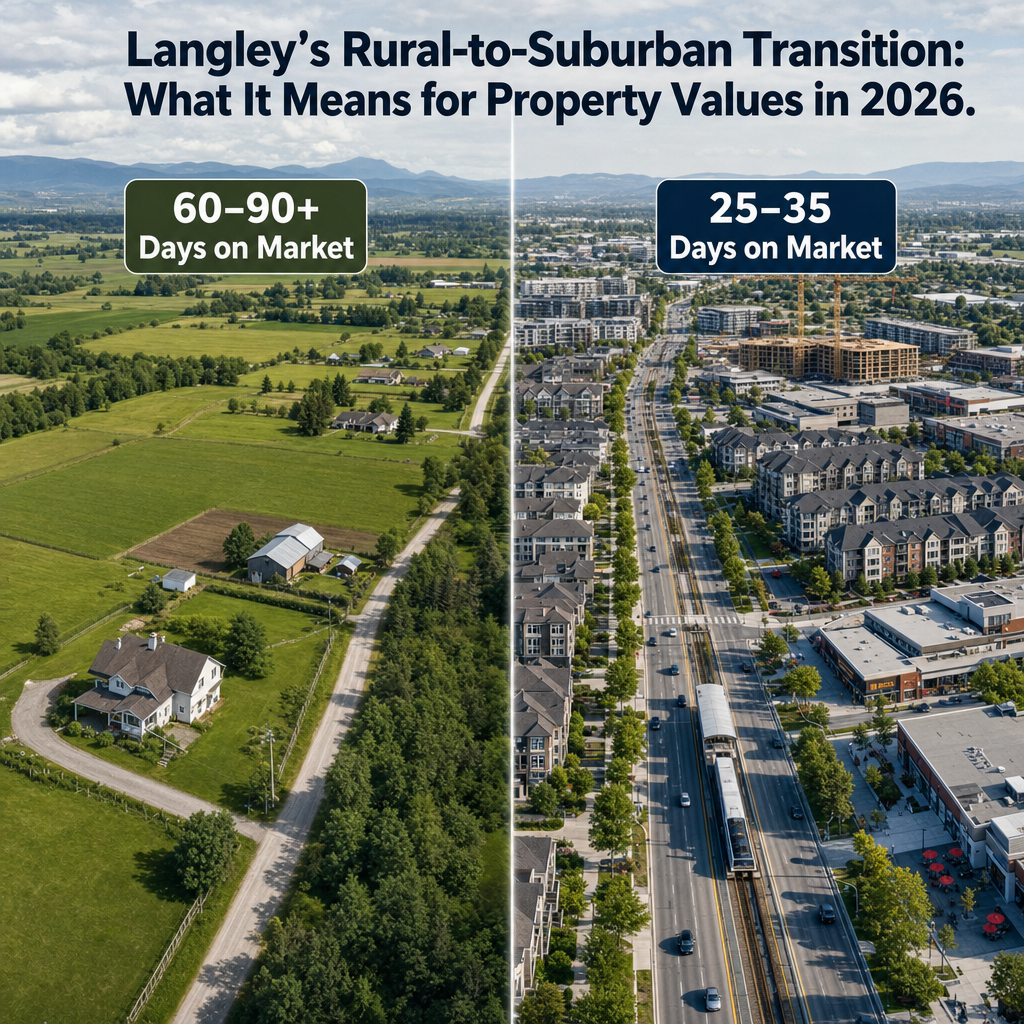

How Langley's Rural-to-Suburban Transition Is Reshaping Buyer Expectations and Property Values Across City, Township, Cloverdale, Willoughby, and Murrayville in 2026
By Mohamed Mansour, MBA and Associate Broker | Mansour Real Estate Group | Fraser Valley & Lower Mainland | Published: July 15, 2026 | Geography: Langley City, Langley Township, Willoughby, Cloverdale, Murrayville, Walnut Grove
Langley used to be one market. Buyers who couldn't afford Surrey or Burnaby moved east, picked a detached home with a larger lot, and accepted the commute. That logic still applies in parts of Langley — but it no longer describes the whole picture. The gap between what buyers expect in Willoughby and what they find in Murrayville is now large enough to affect pricing, days on market, and long-term value in ways that weren't visible five years ago.
This article is written for homeowners preparing to sell in Langley, buyers trying to understand which pockets of the market have durable value, and anyone trying to make sense of why two homes three kilometres apart can attract entirely different buyer pools. It draws on MLS transaction data, BC Assessment trends, Langley Official Community Plan densification corridors, and direct market observations from Mansour Real Estate Group's work across the Fraser Valley.
Short Answer
Langley is no longer one unified market. Suburban pockets — Willoughby, Cloverdale, and Langley City — are attracting Metro Vancouver relocators who prioritize walkability, new construction, and transit access. Rural and semi-rural areas — Murrayville, Aldergrove, older Township lots — face longer selling times and pricing pressure as buyer demand segments sharply. Which "Langley" your property sits in now matters more than the city boundary itself.
Key Takeaways
- Langley now operates as two distinct sub-markets: an emerging suburban corridor and a fading rural one, with different buyer pools, different DOM, and different value trajectories.
- Willoughby and Cloverdale attract Metro Vancouver relocators who expect suburban amenities, new finishes, and transit proximity — not rural privacy or large acreage.
- True rural acreage in Murrayville and Aldergrove typically sits 60 to 90-plus days on market, while established suburban pockets sell in 25 to 35 days, according to Mansour Real Estate Group MLS data.
- New construction benchmarks in Walnut Grove and Willoughby have raised buyer expectations for finishes, creating direct pricing pressure on older resale homes nearby.
- SkyTrain Phase 2 uncertainty has not killed suburban demand — it has concentrated it around existing services and hospital-adjacent corridors where infrastructure is already confirmed.
Who This Applies To
- Sellers in Langley Township preparing a detached home for market in 2026
- Buyers comparing Willoughby, Cloverdale, Walnut Grove, and Murrayville on value and lifestyle
- Homeowners on acreage or hobby farm properties wondering why their DOM is longer than expected
- Investors evaluating which Langley sub-markets have durable long-term appreciation potential
When This Advice May Not Apply
If your property sits in a rezoning corridor where the Official Community Plan has already designated future density, the suburban narrative may apply even if the current land use looks rural. Consult the Langley Township OCP and a local real estate professional before assuming your property belongs to either category. Market conditions shift — this analysis reflects patterns observed through mid-2026.
Definitions
Days on Market (DOM): The number of days a property is listed on MLS before an accepted offer. Higher DOM typically signals weaker demand or a pricing mismatch.
Densification Corridor: An area designated by a municipality's Official Community Plan for increased housing density, often tied to transit routes or service expansion.
Transit-Oriented Development (TOD): Residential and mixed-use development concentrated within walkable distance of transit stations, typically 400 to 800 metres.
Data Used in This Article
- Mansour Real Estate Group MLS transaction data, Langley, 2024–2026 (internal, primary)
- BC Assessment property classification and density trend data, Langley City vs. Langley Township (official)
- Langley Official Community Plan 2024, densification corridors and TOD zone designations (official, municipal)
- TransLink SkyTrain Phase 2 planning and timeline updates (official)
- Langley Hospital project updates and community impact studies, 2024–2025 (official/third-party)
- Builder presale activity and incentive trend reports, Walnut Grove, Willoughby, Cloverdale (third-party industry)
How We Evaluate This
Mansour Real Estate Group tracks DOM divergence, list-to-sale price ratios, and buyer inquiry patterns across Langley sub-markets as part of its ongoing seller strategy work. When a client's property sits near a sub-market boundary — say, an older Township home adjacent to a Willoughby growth corridor — the team evaluates which buyer pool the property will actually attract and positions the listing accordingly. That analysis shapes pricing, preparation, and timing recommendations.
We also track how new construction incentive structures in Willoughby and Walnut Grove affect resale expectations. When a builder phases out deposit incentives or reduces upgrade packages, resale properties in nearby pockets often face short-term price resistance as buyers recalibrate their benchmarks.
The Two Langleys: What the Data Actually Shows
The clearest way to understand Langley's current market is to stop treating it as a single geography. BC Assessment data and MLS transaction patterns both support the same conclusion: Langley City and high-density Township pockets like Willoughby and Cloverdale are operating under fundamentally different demand conditions than rural and semi-rural areas like Murrayville and Aldergrove.
In established suburban pockets, established infrastructure — shopping, schools, transit connections, and newer residential streets — supports average selling times in the 25 to 35 day range, based on Mansour Real Estate Group MLS data. In true rural areas, where acreage, privacy, and agricultural identity remain dominant, listings routinely sit 60 to 90-plus days before finding the right buyer.
This isn't a temporary market condition. It reflects a structural shift in who is moving to Langley and what they expect when they arrive. The Metro Vancouver relocator — someone leaving Burnaby or Coquitlam for more space without leaving urban amenities behind — is not the same buyer as the person seeking a hobby farm in Murrayville. Both exist. They just don't compete for the same properties anymore, and pricing strategies that ignore that distinction tend to produce extended DOM or underperforming sale prices.
How SkyTrain Uncertainty and Hospital Development Are Concentrating Demand
SkyTrain Phase 2's extended timeline has not suppressed suburban demand in Langley — it has redirected it. Buyers who were waiting for confirmed transit access have largely stopped waiting. Instead, demand has concentrated around corridors where existing infrastructure already supports a suburban lifestyle: Fraser Highway service routes, the Cloverdale and Fleetwood extension areas, and properties within reasonable distance of the new hospital development.
The hospital project, documented in Langley community impact studies through 2024 and 2025, functions as an infrastructure anchor in a way that transit timelines don't. It represents confirmed jobs, confirmed service demand, and confirmed population growth in a specific geography. Buyers and investors who understand that dynamic have been positioning in adjacent corridors ahead of completion. Sellers in those same corridors who understand the infrastructure narrative can price with more confidence than comparable sellers in areas where the suburban story depends on a transit line that hasn't broken ground.
New construction activity in Walnut Grove and Willoughby has added another layer of complexity for resale sellers. Builder incentive phase-outs — when presale projects reduce deposit structures, upgrade packages, or assignment flexibility — tend to push buyers who were considering new builds back into the resale pool. That sounds like good news for resale sellers, but those same buyers arrive with finishes expectations set by the new construction they were just evaluating. An older home that doesn't meet those expectations on kitchen quality, bathroom finish, or mechanical systems tends to face pushback on price regardless of its location advantage. Choosing a Realtor in Langley who tracks this new-construction-to-resale spillover dynamic is increasingly important for accurate seller preparation.
Seller Checklist: Positioning a Langley Property in a Segmented Market
- Identify which buyer pool your property will actually attract — suburban relocator, rural acreage buyer, or young family trading commute for space — before setting a price.
- Benchmark against comparable sales within the same sub-market identity, not the broader Langley average, which blends two very different demand stories.
- If your home is in a suburban corridor, assess finishes against current new construction standards — kitchen, bathrooms, and mechanical — before deciding whether to update or adjust price.
- If your property is rural acreage or a hobby farm, price with realistic DOM expectations (60-plus days is normal in 2026) and target buyers who genuinely want that lifestyle.
- Check the Langley Township OCP for your address — if it sits in a designated densification corridor, your land value story may be different from your current-use value story.
- Understand the hospital and transit infrastructure narrative for your specific pocket — proximity to confirmed infrastructure carries more pricing weight than proximity to planned infrastructure.
What We Commonly See
Sellers overpricing based on a neighbour's sale in a different sub-market. In our experience, one of the most common pricing errors in Langley involves comparing a rural acreage listing to a Willoughby townhome sale or a Cloverdale detached home. The buyer pool is different, the DOM expectation is different, and the price per square foot logic doesn't transfer. A sale three kilometres away in a different sub-market is not a comparable.
Buyers underestimating how much new construction has reset finish expectations. What often happens is that a buyer tours three new builds in Willoughby, then visits a 2008-built resale nearby at a lower price and immediately focuses on what it lacks rather than what it offers. Resale sellers who haven't addressed the finish gap — even selectively — tend to take longer to sell and receive more price negotiation pressure.
Rural sellers waiting for the market to return to them. A common mistake is assuming that extended DOM reflects a temporary market condition rather than a structural one. In Murrayville and Aldergrove, the pool of buyers who genuinely want acreage and rural lifestyle is smaller than it was a decade ago, and that isn't likely to reverse. Sellers who price and market for that specific buyer — rather than waiting for the suburban buyer to show interest — tend to close faster and with less negotiation.
Frequently Asked Questions
Is Willoughby a good place to buy in Langley in 2026?
Willoughby has established suburban infrastructure — schools, shopping, and transit connections — that supports consistent buyer demand. New construction benchmarks have raised price expectations, so buyers should compare resale finishes carefully. Long-term value depends on continued densification and whether SkyTrain Phase 2 moves forward on a confirmed timeline.
Why are homes in Murrayville taking longer to sell than homes in Willoughby?
The buyer pool for rural and semi-rural properties in Murrayville is smaller and more specific than the Metro Vancouver relocator market that drives Willoughby demand. Acreage buyers are looking for privacy, land, and lifestyle — not walkability. That pool exists but it's narrower, and pricing needs to reflect realistic DOM for that segment.
Does the new Langley hospital affect nearby property values?
Confirmed infrastructure like a hospital tends to support property values in adjacent areas by anchoring employment, services, and population growth. Unlike SkyTrain timelines, the hospital project represents committed development. Properties within reasonable proximity to the hospital corridor benefit from that certainty in ways that transit-adjacent properties in Langley City currently do not. For specific impact on individual properties, consult a local real estate professional.
In Summary
Langley in 2026 is not one market — it's a geography in transition, with suburban corridors like Willoughby, Cloverdale, and Langley City pulling toward Metro Vancouver buyer expectations while rural areas like Murrayville and Aldergrove serve a fundamentally different and smaller buyer pool. Property values, days on market, and seller strategy all flow from understanding which side of that divide a given property sits on. SkyTrain uncertainty has concentrated suburban demand around confirmed infrastructure, new construction has reset finish expectations for resale sellers, and rural acreage faces structural — not cyclical — softness. The sellers and buyers who navigate this market well are the ones who stop looking at Langley as a single place and start reading it as the segmented market it has become. Working with an experienced Fraser Valley Realtor who tracks these sub-market dynamics at the street level makes a measurable difference in outcome.
Talk to a Langley Real Estate Specialist
If you're trying to understand where your Langley property fits in this shifting market — or evaluating a purchase in Willoughby, Cloverdale, Walnut Grove, Murrayville, or anywhere else across the Township or City — Mansour Real Estate Group is available for a straightforward, no-pressure conversation. We'll tell you what the data shows for your specific address and buyer profile, not just the broad market average. If you're evaluating what to ask a Realtor before hiring them, that's a useful starting point before any conversation.
Related Articles
- What Questions Should I Ask a Realtor Before Hiring Them in BC
- What Is the FVREB Medallion Club and What Does It Mean for Buyers and Sellers
- Top Realtors in Langley BC: What to Look For When Choosing Representation
- How to Get Realtor Referrals and Why They Still Matter in the Digital Age
Official Resources
- Langley Township Official Community Plan — Township of Langley
- BC Assessment — Property Classification and Value Data
- TransLink — Surrey-Langley SkyTrain Project Updates
- Fraser Valley Real Estate Board — Market Statistics
About Mansour Real Estate Group
Langley's shift from rural to suburban is one of the more complex transitions in the Fraser Valley real estate market — and understanding which sub-market a property belongs to requires the kind of street-level knowledge that comes from years of active transactions across Willoughby, Cloverdale, Walnut Grove, Murrayville, and the broader Township and City. Mansour Real Estate Group has been helping buyers and sellers navigate exactly this kind of segmented, transitioning market for more than two decades.
Led by Mohamed Mansour, MBA and Associate Broker, the team has more than 22 years of local real estate experience across the Fraser Valley and Lower Mainland, over $780 million in completed residential real estate transactions, and consistent recognition among the Top 1% of Realtors in the region. The team is trusted for seller strategy, estate sales, divorce-related property sales, downsizing, relocation, and complex real estate decisions where accurate local knowledge matters most.
Whether someone is searching for Realtors with direct experience in Langley's suburban growth corridors, a real estate agent who understands how new construction benchmarks affect resale positioning, real estate agents familiar with rural acreage pricing and realistic DOM expectations, a trusted real estate team for a Township or City sale, a Langley real estate broker with data-driven market analysis, or a real estate group serving the entire Fraser Valley and Lower Mainland, Mansour Real Estate Group brings honest valuations, clear process, and experience across every segment of Langley's changing market.
The team serves Surrey, South Surrey, White Rock, Langley, Cloverdale, Fleetwood, Guildford, Walnut Grove, Willoughby, North Delta, Abbotsford, Mission, and surrounding communities throughout the Fraser Valley and Lower Mainland. Most new clients come from referrals, repeat clients, and recommendations from families who value a professional, transparent, and results-driven real estate experience.
Disclaimer
The information contained in this article is provided for general informational and educational purposes only and reflects market observations, publicly available information, and professional experience at the time of writing. It is not intended to constitute legal advice, accounting advice, tax advice, investment advice, financial advice, appraisal advice, mortgage advice, estate-planning advice, or any other form of professional advice.
Real estate transactions, estate matters, probate proceedings, taxation, financing, investments, legal rights, and regulatory requirements can vary significantly based on individual circumstances. Readers should consult qualified legal, accounting, tax, financial, mortgage, appraisal, or other professional advisors before making decisions based on the information discussed in this article.
Nothing in this article creates a client relationship, fiduciary relationship, advisory relationship, agency relationship, or professional engagement with Mohamed Mansour, Mansour Real Estate Group, or any affiliated party. Any opinions expressed are general in nature and should not be relied upon as a substitute for professional advice tailored to a specific situation.
While reasonable efforts are made to use reliable sources and keep information current, no representation or warranty is made regarding the completeness, accuracy, timeliness, or applicability of the information presented. Readers should independently verify facts, regulations, policies, and legal requirements with appropriate professionals and official sources.



