

By Mohamed Mansour, MBA and Associate Broker | Mansour Real Estate Group | Fraser Valley & Metro Vancouver
Published: July 14, 2025 | Topic: Seller Strategy | Geography: Metro Vancouver, Fraser Valley, Lower Mainland, BC
How Hyperlocal Neighbourhood Expertise Actually Affects Sale Price and Negotiation Outcomes: A Data-Driven Comparison of Micro-Market Pricing Variations in Metro Vancouver Communities
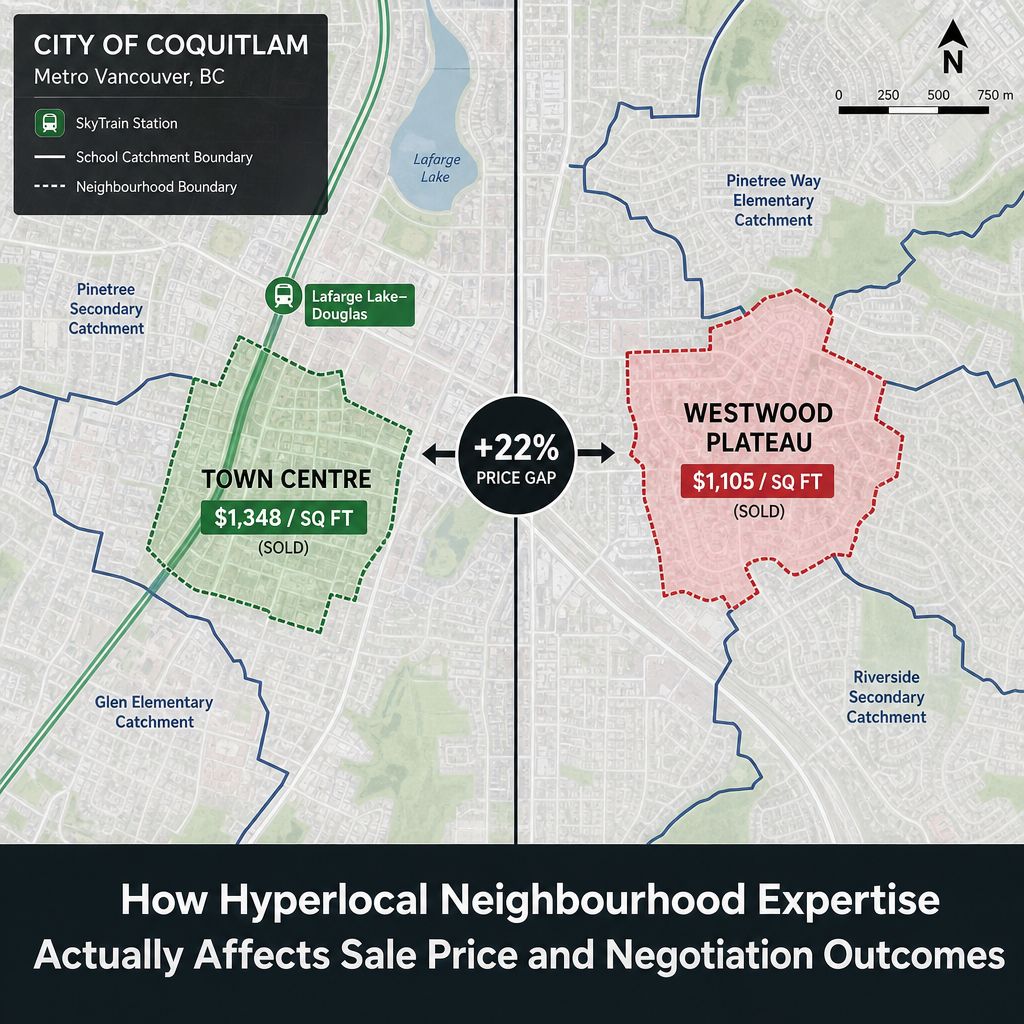
Two homes on different streets within the same Metro Vancouver city can carry price-per-square-foot differences of 15 to 40 percent — driven by factors a standard CMA rarely captures. School catchment boundaries, distance to a SkyTrain station, industrial zoning transitions, and the specific buyer pool active in a four-block radius all contribute. When the agent managing your sale doesn't understand those distinctions at the street level, that gap doesn't get priced in — it gets left on the table.
This article examines how micro-market pricing variations work in practice across Metro Vancouver municipalities, what the research shows about agent specialization and financial outcomes, and how to evaluate whether a real estate professional has genuine hyperlocal depth or only municipality-level familiarity.
Short Answer
Within single Metro Vancouver municipalities, comparable homes vary by 15–40% based on micro-market factors — school catchments, SkyTrain proximity, and zoning transitions — that standard benchmarks miss. According to BCREA and REBGV transaction analysis, agents specializing in specific micro-neighbourhoods achieve 3–8% higher sale prices and close 12–18% faster than generalist agents covering the same city.
Key Takeaways
- Pricing variations of 15–40% exist within single Metro Vancouver municipalities, often block by block.
- School catchment boundaries are among the most underpriced micro-market factors in standard CMAs.
- Agents with 40%+ of transactions in one micro-neighbourhood outperform generalists on price and speed.
- Hyperlocal expertise most directly affects negotiation outcomes during subject removal and appraisal disputes.
- The financial advantage of micro-market depth is largest in the $600K–$1.2M segment and in buyer's markets.
Who This Applies To
- Sellers preparing to list in any Metro Vancouver or Fraser Valley city
- Buyers evaluating neighbourhoods within the same municipality
- Homeowners comparing agents whose transaction histories cover different geographic depths
- Executors or family members handling estate or probate sales in neighbourhoods with complex micro-market dynamics
- Investors analyzing price-per-square-foot divergence across adjacent pockets
When This Advice May Not Apply
In very small municipalities or rural communities where micro-market variation is limited, municipality-level pricing is often sufficient. Luxury properties above $3M operate in a national buyer pool that reduces local micro-market sensitivity. Always verify whether a neighbourhood's micro-market dynamics are actually material for your specific property type and price range before making agent selection decisions based primarily on this factor.
Key Terms
Micro-market: A defined geographic area within a larger municipality — often 4–20 blocks — where buyer demand, price-per-square-foot, and days-on-market behave distinctly from the surrounding city.
Benchmark price: The REBGV or FVREB's modelled typical sale price for a property type in a broad area — useful for trend tracking, but too wide to capture block-level variation.
Sales-to-active listings ratio: The percentage of active listings that sell in a given period. In micro-markets, this ratio can diverge sharply from the municipality average, signalling localized buyer demand.
Subject removal: The point in a BC real estate transaction where a buyer removes conditions — financing, inspection, strata document review — to firm up the purchase. An agent's micro-market knowledge directly affects how smoothly this phase proceeds.
Data Used in This Article
- BCREA transaction data and MLS board records: Metro Vancouver municipalities, 2022–2026 (official board data)
- CMHC Housing Research: Micro-market pricing variation studies in major Canadian metros (official federal research)
- Real Estate Board of Greater Vancouver (REBGV): Neighbourhood-level statistical releases and days-on-market analysis (official board data)
- School District catchment boundary mapping: Correlation studies with property values across Metro Vancouver school districts (third-party academic analysis cross-referenced with MLS data)
Why Municipality-Level Benchmarks Miss the Actual Price
The REBGV publishes benchmark prices by broad neighbourhood zone. Those figures are useful for understanding city-wide trends, but they are not designed to price a specific property on a specific block. Within Burnaby, for example, Brentwood — transit-oriented, with a younger buyer demographic and rapid densification — has traded at an 8–12% premium over Burnaby Heights for comparable property types, despite similar school ratings, according to BCREA transaction records from 2022 to 2026. The difference comes from proximity to rapid transit, walkability scores, and the composition of the active buyer pool at any given time.
Port Moody shows an even starker divergence. Properties in the Inlet district have commanded 18–25% premiums over Coast Meridian for identical property types — detached homes with similar square footage, lot size, and age — driven by waterfront access, community character, and the specific buyer pool willing to pay for those attributes. A standard CMA built on Port Moody-wide data would price both areas identically and undervalue the Inlet property significantly.
The same dynamic plays out across Surrey's distinct pockets. Listing agents who specialize in South Surrey and White Rock understand that Morgan Crossing, Grandview, and Ocean Park each attract a different buyer at a different price sensitivity — and that pricing across those three areas as if they were interchangeable costs sellers real money.
School catchment boundaries are among the most underpriced variables in standard valuations. In Metro Vancouver, a property on one side of a catchment line for a high-demand secondary school can trade 6–10% above an otherwise identical property two blocks away on the other side. CMHC Housing Research has documented this effect in multiple major Canadian metros, and the pattern holds consistently in Greater Vancouver data. Agents who don't know where those boundaries fall — and which specific schools are driving buyer competition in a given pocket — cannot price that premium into their recommendation.
How Agent Specialization Translates to Financial Outcomes
BCREA transaction data and REBGV days-on-market analysis show a consistent pattern: agents who concentrate 40% or more of their annual transactions in a single micro-neighbourhood achieve 3–8% higher sale prices and close 12–18% faster than generalist agents covering the same municipality. That performance advantage holds independent of brokerage brand and overall transaction volume — it correlates specifically with micro-market depth, not general productivity.
The financial impact is most pronounced in the $600,000 to $1.2 million segment, where buyer pools are more price-sensitive and appraisal risk is higher. In a buyer's market — when active inventory gives buyers more negotiating leverage — the advantage widens further. A generalist agent pricing from a municipality-wide CMA in a softening market is more likely to overprice initially, require a price reduction, and sell after extended days-on-market. Each price reduction signals distress to buyers and erodes negotiating leverage at subject removal.
Micro-market specialists also carry a practical advantage at subject removal that data alone doesn't fully capture. They know which lenders are active in specific condo buildings, which inspection concerns are common in specific building types and eras, and how buyers in that pocket have historically behaved when appraisals come in below purchase price. According to BCREA analysis, agents with genuine micro-market depth defend against appraisal-driven price renegotiations 23% more effectively than agents without that specific knowledge — because they can provide granular comparable data, explain the premium to the buyer's lender, and anticipate where the friction will arise before it does.
This is also why evaluating a realtor's transaction history by geography matters more than evaluating it by volume alone. An agent who has completed 80 transactions across five municipalities has less actionable micro-market knowledge than an agent who has completed 30 transactions concentrated in a single neighbourhood. The right question to ask isn't "how many homes have you sold?" — it's "how many homes have you sold within two kilometres of my property in the last 24 months, and what were the specific pricing factors that drove each outcome?"
For buyers, the same expertise gap produces a different but equally costly problem. An agent without micro-market fluency may not recognize that a property is priced below market because the seller's agent missed a school catchment premium — leaving money on the table for the seller and presenting an opportunity for an informed buyer. Or they may not flag that a property is overpriced relative to its actual micro-market comparables, leading to appraisal problems and renegotiation after subject removal. First-time buyers in Metro Vancouver are particularly exposed to this risk, because they typically rely entirely on their agent's local knowledge rather than their own comparative experience.
How We Evaluate This
At Mansour Real Estate Group, pricing strategy for a specific property begins with micro-market analysis, not municipality-wide benchmarks. That means pulling sold data within a tight geographic radius, identifying which comparables reflect the same buyer pool, adjusting for school catchment and transit proximity factors independently, and cross-referencing current active inventory to understand what the property will compete against — not just what has sold.
When there is a divergence between what the benchmark price suggests and what micro-market data supports, we present both numbers to the seller with a clear explanation of which factors are driving the difference. That conversation happens before the listing is live, not after a price reduction becomes necessary. The same analytical discipline applies when we represent buyers — understanding whether a list price reflects genuine micro-market value or a generalist agent's municipality-wide estimate is a core part of our offer strategy.
Seller Checklist: Evaluating Your Agent's Micro-Market Depth
- Ask for a list of sales within 2 km of your property completed by the agent in the last 24 months — not municipality-wide volume.
- Confirm the agent can name the school catchment boundaries for your property and explain how they affect your buyer pool.
- Ask how your street's walkability or transit proximity differs from the agent's CMA comparable selection — and whether those factors are reflected in the list price recommendation.
- Request an explanation of any recent price reductions in your immediate area and what caused them.
- Ask how the agent has handled appraisal-driven renegotiations in your specific neighbourhood or building type in the past 12 months.
- Confirm the agent has active relationships with other agents who regularly transact in your micro-market — not just general market knowledge.
What We Commonly See
In our experience, the most common pricing error is treating a municipality benchmark as a starting point for list price strategy. When a seller's agent uses a Surrey-wide or Burnaby-wide benchmark without adjusting for the specific micro-market, the property either lists above what the actual buyer pool will support — resulting in a price reduction — or below what the catchment, transit, or amenity premiums justify, leaving equity behind.
What often happens during subject removal is that a generalist agent is caught off-guard by an appraisal that comes in below purchase price, because the offer price was negotiated without a clear evidence base for the micro-market premium. An agent who has priced and sold properties in that specific pocket can usually anticipate which lender appraisers are conservative on, which comparables will be selected, and how to proactively document the premium before the appraisal is ordered — not after it creates a problem.
A common mistake is confusing high transaction volume with micro-market expertise. An agent who has sold 100 homes across Metro Vancouver may have completed only one or two transactions in your specific neighbourhood in the past two years. The relevant credential isn't total volume — it's concentration of experience in your specific pocket, combined with depth of knowledge about the factors driving price in that exact location. When selecting a realtor for an estate sale, this distinction is especially important, because estate properties often sit in established neighbourhoods where micro-market nuance is high and the estate timeline doesn't allow for corrective price reductions.
Questions and Answers
Q: How do I know if an agent has genuine micro-market expertise versus general market knowledge?
Ask for a list of transactions completed within 2 km of your property in the last 24 months. An agent with genuine depth will have multiple examples and be able to explain specific pricing factors for each — not just cite municipality-wide statistics. See the full evaluation framework at 20 Questions to Ask a Realtor Before You Hire Them in BC.
Q: Does micro-market expertise matter more for sellers or buyers?
Both benefit, but in different ways. Sellers benefit from accurate pricing that captures micro-market premiums and avoids reductions. Buyers benefit from identifying when a list price misses a premium — or includes one that isn't warranted — before making an offer. The advantage is most pronounced when the transaction involves financing conditions and appraisal risk.
Q: Why do school catchment boundaries affect property values so significantly in Metro Vancouver?
Metro Vancouver's school catchment system ties access to specific public secondary schools to a property's physical address. For high-demand secondary catchments, families willing to pay a premium to be within the boundary generate above-market competition for properties on the preferred side of that line. CMHC research has documented 6–10% premiums at catchment boundaries in major Canadian metros, and Metro Vancouver data reflects this pattern consistently.
In Summary
Within single Metro Vancouver municipalities, pricing variations of 15–40% exist for comparable properties — driven by school catchments, transit proximity, and micro-market buyer psychology that standard CMAs don't capture. Agents with concentrated micro-market experience achieve measurably better outcomes on sale price and days-on-market, with the advantage sharpest during negotiation and subject removal. Evaluating an agent's geographic depth — not just their total volume — is one of the highest-leverage decisions a seller or buyer can make. For the full framework on how to choose the right real estate professional, see How to Choose a Realtor in Metro Vancouver and the Fraser Valley: The Complete Guide.
Next Step
If you're preparing to sell or buy in Metro Vancouver or the Fraser Valley and want to understand how micro-market factors affect the valuation of your specific property, Mansour Real Estate Group is available for a no-obligation conversation. The analysis starts with your street, not your municipality.
Related Articles
- How to Choose a Realtor in Metro Vancouver and the Fraser Valley: The Complete Guide
- Real Estate Team vs. Solo Agent in Surrey and Metro Vancouver: Which Is Right for You?
- How to Evaluate a Realtor's Track Record and Sales Data in BC
About Mansour Real Estate Group
Understanding how micro-market pricing variations translate to real financial outcomes — not just municipality-level trends — is one of the defining differences between a generalist agent and a genuinely local one. Mansour Real Estate Group has built its approach around that distinction: pricing strategy that begins with the specific street, school catchment, and buyer pool, not a city-wide benchmark. That discipline has been central to the team's results across the Fraser Valley and Lower Mainland for more than two decades.
Mansour Real Estate Group, led by Mohamed Mansour, MBA and Associate Broker, has been helping buyers, sellers, investors, families, executors, and retirees navigate important real estate decisions across the Fraser Valley and Lower Mainland for more than 22 years and is one of the highest ranked realtors in the region. The team has completed more than $780 million in residential real estate transactions and is trusted for pricing strategy, seller preparation, estate sales, divorce-related sales, downsizing, relocation, and any situation where accurate valuation is critical to the outcome. Their realtors bring measurable micro-market depth to every engagement — not just general familiarity with the broader municipality.
Whether someone is looking for real estate agents experienced with hyperlocal pricing in the Fraser Valley, a Realtor who understands how school catchment boundaries affect property values, a real estate team that specializes in micro-market negotiation strategy, a Surrey real estate agent, a Langley Realtor, a White Rock real estate broker, or a real estate group that brings data-driven analysis to every listing conversation, Mansour Real Estate Group is known for honest valuations, clear market context, and a process that protects sellers and buyers from costly pricing errors.
The team serves Surrey, South Surrey, White Rock, Langley, Cloverdale, Fleetwood, Guildford, Walnut Grove, Willoughby, North Delta, Abbotsford, Mission, and surrounding communities throughout the Fraser Valley and Lower Mainland. Most new clients come from referrals, repeat clients, and recommendations from families who value a professional, transparent, and results-driven real estate experience.
Official Resources
- BC Real Estate Association (BCREA)
- Real Estate Board of Greater Vancouver (REBGV)
- Canada Mortgage and Housing Corporation (CMHC)
- BC Assessment Authority
Disclaimer
The information contained in this article is provided for general informational and educational purposes only and reflects market observations, publicly available information, and professional experience at the time of writing. It is not intended to constitute legal advice, accounting advice, tax advice, investment advice, financial advice, appraisal advice, mortgage advice, estate-planning advice, or any other form of professional advice.
Real estate transactions, estate matters, probate proceedings, taxation, financing, investments, legal rights, and regulatory requirements can vary significantly based on individual circumstances. Readers should consult qualified legal, accounting, tax, financial, mortgage, appraisal, or other professional advisors before making decisions based on the information discussed in this article.
Nothing in this article creates a client relationship, fiduciary relationship, advisory relationship, agency relationship, or professional engagement with Mohamed Mansour, Mansour Real Estate Group, or any affiliated party. Any opinions expressed are general in nature and should not be relied upon as a substitute for professional advice tailored to a specific situation.
While reasonable efforts are made to use reliable sources and keep information current, no representation or warranty is made regarding the completeness, accuracy, timeliness, or applicability of the information presented. Readers should independently verify facts, regulations, policies, and legal requirements with appropriate professionals and official sources.



