

How Hyper-Local Neighbourhood Knowledge Directly Affects Your Sale Price: Why Realtor Selection in Fraser Valley Markets Like Abbotsford, Langley, Mission, and South Surrey Hinges on Community Expertise Beyond Transaction Volume
By Mohamed Mansour, MBA and Associate Broker · Mansour Real Estate Group · Fraser Valley and Lower Mainland · Published: June 10, 2025 · Topic: Seller Strategy
In a Fraser Valley market carrying more than 9,200 active listings — roughly 50% above the 10-year seasonal average, according to the Fraser Valley Real Estate Board's March and April 2026 statistical packages — sellers cannot afford a Realtor who treats every neighbourhood the same. The data is already working against you. The only thing working in your favour is precision.
This article explains how neighbourhood-specific knowledge — school catchments in Langley, flood-risk corridors in Abbotsford, rezoning potential in Mission, and luxury micro-markets in South Surrey — translates directly into pricing leverage, buyer pool targeting, and faster sales. If you are evaluating Realtors on transaction volume alone, this is the piece that reframes that decision.
Short Answer
In a buyer's market with elevated inventory, comparable sales data alone does not capture what a specific property is worth to the right buyer. A Realtor with genuine neighbourhood knowledge — school zones, flood designations, rezoning corridors, transit premiums — can identify and communicate value that generic comps miss, supporting a higher list price and reducing days on market.
Key Takeaways
- Fraser Valley inventory is 50% above seasonal average, making neighbourhood positioning a primary pricing lever.
- School catchment, flood designation, transit proximity, and rezoning potential are measurable price premiums — not marketing language.
- Days on market vary 37–43 days by property type; neighbourhood positioning can narrow that gap significantly.
- Generic comps-based pricing in a soft market frequently undervalues properties with micro-market advantages.
- Transaction volume tells you how busy a Realtor is — neighbourhood knowledge tells you how precisely they can price your home.
Who This Applies To
- Homeowners selling in Abbotsford, Langley, South Surrey, Mission, or adjacent Fraser Valley communities
- Sellers evaluating multiple Realtors and comparing credentials rather than local depth
- Anyone listing in a neighbourhood with a school premium, flood-plain boundary, rezoning corridor, or transit micro-market
- Investors and estate executors where precise valuation affects distribution outcomes
When This Advice May Not Apply
If your property is in a highly standardized subdivision with dozens of near-identical recent sales, generic comps may adequately capture value. Neighbourhood knowledge becomes most critical where micro-market variables — school zones, zoning transitions, flood risk, or community character — diverge meaningfully from surrounding areas.
Data Used in This Article
- FVREB Statistical Package, April 2026 — official, FVREB.bc.ca, Fraser Valley region, sales/inventory/DOM data
- FVREB Statistical Package, March 2026 — official, FVREB.bc.ca, Fraser Valley region, benchmark pricing and sales-to-active ratios
- FVREB Monthly Market Report — official, ongoing publication, regional and property-type breakdowns
Why the Current Market Punishes Generic Pricing
According to the Fraser Valley Real Estate Board's April 2026 statistical package, the sales-to-active listings ratio across the region sits at approximately 11% — below the 12% threshold that defines a balanced market and well below the levels that give sellers pricing leverage. With over 9,200 active listings competing for a constrained pool of buyers, properties that are not precisely positioned lose ground to better-targeted competitors, not necessarily better properties.
Days on market averaged between 37 and 43 days depending on property type, according to the same FVREB reporting period. That range is not random. It reflects how well individual listings connect with their actual buyer pool. A townhome in Willoughby near a sought-after school catchment has a different buyer than a similarly priced townhome two kilometres away outside that boundary. The Realtor who knows which boundary line applies — and who knows which buyer agents serve families actively searching that zone — can reduce time on market and hold price. The Realtor who does not know that distinction is relying on hope.
As explored in How to Find a Realtor Who Understands the 2026 Fraser Valley Buyer's Market, the current environment rewards Realtors who understand market segmentation — not those who apply regional averages to individual properties.
Four Neighbourhood Variables That Directly Affect Sale Price
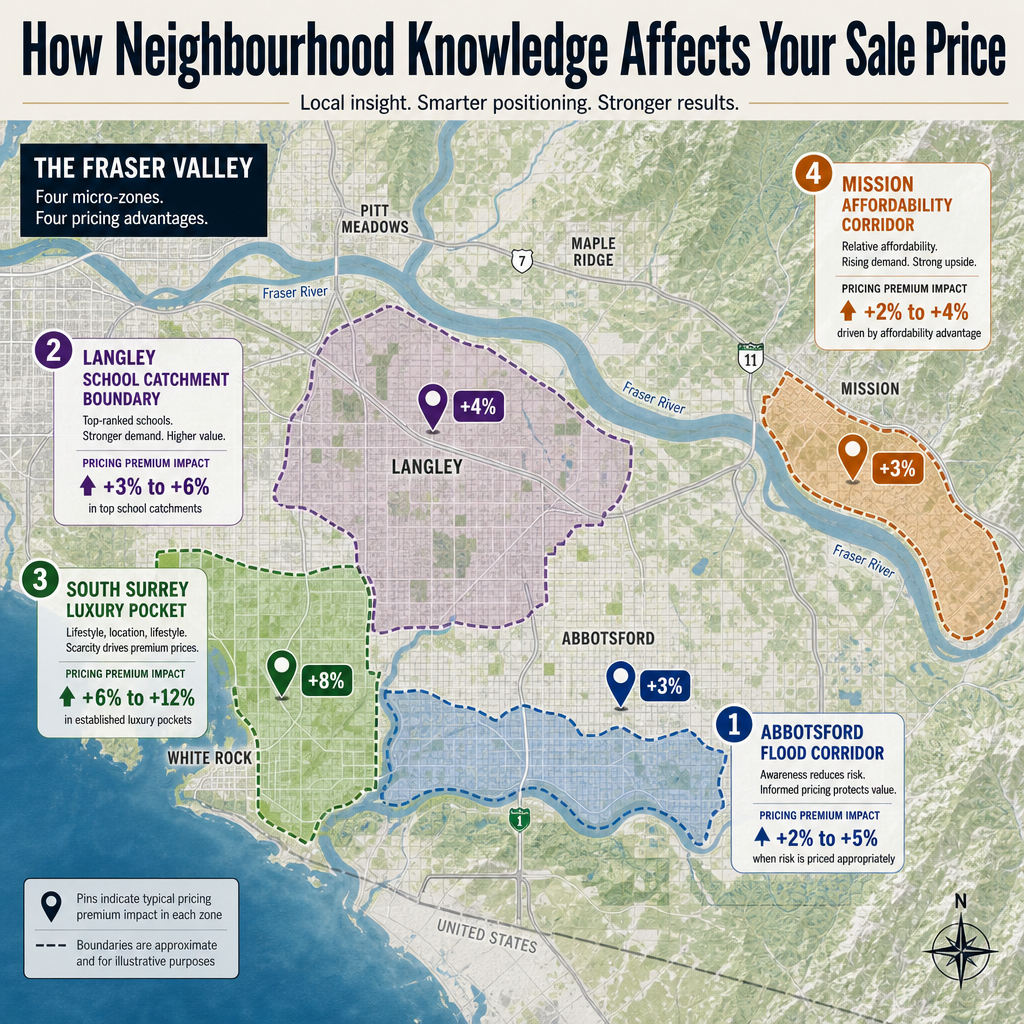
School catchment premiums in Langley. Families relocating to Langley frequently shortlist homes by school catchment before considering price per square foot. Properties within the boundaries of high-demand catchments in Willoughby or Walnut Grove consistently attract more competing offers than those immediately outside — even when the homes are structurally identical. A Realtor who can articulate exactly which catchment applies, name the school, and explain what makes it sought-after is communicating value that no automated valuation tool captures. When evaluating Realtors in Langley, asking them to describe the active buyer pool for your specific school zone is a more useful test than reviewing their total transaction count. You can learn more about how this connects to agent selection in Top Realtors in Langley BC: How to Evaluate Who Is Actually the Best.
Flood-risk corridors in Abbotsford. After the 2021 flooding events, buyer awareness of flood-plain designations in Abbotsford changed permanently. Properties outside designated flood corridors — or properties with recent flood-resilience upgrades — carry a meaningful premium over comparable homes that buyers perceive as carrying flood risk, regardless of whether that risk is accurately assessed. A Realtor who understands the current DFO mapping, provincial flood-risk policy, and how different buyers interpret that information can frame a property's position with precision. A Realtor who does not know the specific designations affecting your block cannot price that distinction into the listing or communicate it to buyer agents. For a broader guide to Abbotsford Realtor selection, see How to Choose a Realtor in Abbotsford BC: A Local Buyer and Seller Guide.
Rezoning potential and transit proximity in Mission. Mission has attracted a buyer profile motivated partly by affordability and partly by longer-term value potential tied to infrastructure development and rezoning corridors. Properties positioned within or adjacent to areas under active Official Community Plan review — or within walkable distance of the West Coast Express station — have measurable appeal to specific investor and first-buyer cohorts that a Realtor without local planning knowledge cannot reach. Generic comps-based pricing in these corridors often undervalues properties by failing to account for the buyer premium attached to location-driven upside. This dynamic also appears in How Local Neighbourhood Knowledge Makes or Breaks a Realtor in Metro Vancouver — a principle that applies equally in Mission's evolving micro-markets.
Luxury micro-markets in South Surrey. South Surrey contains distinct price tiers within short distances of each other — Elgin, Sunnyside, and Grandview neighbourhoods each carry different buyer expectations, finish standards, and community positioning. A Realtor who understands which pockets attract executive buyers from Metro Vancouver, which attract semi-retired downsizers from White Rock, and which attract move-up families from Surrey can calibrate pricing strategy, staging priorities, and marketing channels accordingly. Applying a regional luxury benchmark to these sub-markets without distinguishing them produces pricing that either leaves money on the table or sits unsold. For sellers in this segment, see also What to Look for in a Listing Agent When Selling Your Home in Surrey or South Surrey.
How We Evaluate This
At Mansour Real Estate Group, neighbourhood analysis begins before the comparative market analysis. We start by identifying which buyer cohort is most likely to value this specific property — based on its location relative to school boundaries, transit access, zoning designations, and competing inventory in the immediate area — and then work backward to a pricing strategy and marketing approach designed to reach that cohort. In a market with 9,200+ active listings, the seller's advantage comes from being precisely relevant to a specific buyer, not broadly appealing to a general audience.
When we review comparable sales in areas like Abbotsford, Langley, or Mission, we distinguish between comparable addresses and comparable buyer appeal. Two homes on the same street can carry different buyer pools if one sits within a school catchment boundary and the other does not, or if one fronts a rezoning corridor and the other backs onto established single-family zoning. That distinction belongs in the pricing rationale and in the listing narrative — not omitted because a generic analysis did not surface it. The foundational principles that make this approach effective are outlined in How to Choose the Best Realtor in Metro Vancouver and the Fraser Valley.
Seller Checklist: Testing Neighbourhood Knowledge Before You List
- Ask the Realtor to name the specific school catchment your property falls within and explain whether it commands a premium.
- If you are in Abbotsford, ask directly how they account for flood-plain proximity in their pricing rationale.
- Ask whether your property is within or adjacent to any active rezoning corridor or OCP review area.
- Request that they describe the two or three most likely buyer profiles for your specific address — not your general property type.
- Ask how recent comparable sales were adjusted for school zone, transit proximity, or community character differences.
- Ask whether any active listings within 500 metres share the same buyer pool — and how they plan to differentiate your property from those.
What We Commonly See
In our experience, sellers in neighbourhoods with school catchment premiums often receive an initial price recommendation that is 3–5% below what the catchment premium would support — not because the Realtor is wrong about the comps, but because they have not identified that the buyer pool for this specific property is narrower and more motivated than the broader area average suggests.
What often happens in Abbotsford is that flood-risk positioning gets omitted from the listing narrative entirely — and then surfaces as a buyer concern during subject periods. A Realtor with local knowledge introduces this information proactively, frames it accurately, and avoids having it used as a price-reduction leverage point by buyers late in the process.
A common mistake in Mission is treating transit proximity as a generic selling point rather than a specific premium tied to commuter buyer profiles. Realtors who understand that the West Coast Express catchment attracts a defined income and lifestyle cohort can price and market differently than those who list transit proximity as a single bullet point in the feature sheet.
Questions and Answers
Does school catchment actually affect sale price in the Fraser Valley?
Yes — measurably. In Langley communities like Willoughby, properties within desirable school catchment boundaries consistently attract more activity than otherwise similar homes outside those boundaries. The premium varies by catchment and current inventory, but the effect is real and should be reflected in pricing strategy, not treated as a soft selling point.
How does flood-plain designation affect pricing in Abbotsford?
Properties within or adjacent to provincially designated flood-risk areas face increased buyer scrutiny, particularly since the 2021 flooding events. Insurance availability, financing conditions, and buyer perception all change near flood corridors. A Realtor who can accurately frame flood-resilience positioning — or absence of flood risk — removes a major buyer objection before it becomes a subject-removal condition.
What is a sales-to-active listings ratio and why does it matter to sellers?
The sales-to-active ratio measures how many active listings sold in a given period. A ratio below 12% — like the 11% reported by the FVREB for April 2026 — indicates a buyer's market where buyers have significant negotiating leverage. In these conditions, neighbourhood-specific positioning becomes a primary tool for supporting price and reducing days on market.
In Summary
In a Fraser Valley market with elevated inventory and a sales-to-active ratio below balanced thresholds, transaction volume is the wrong metric for Realtor selection. The questions that actually determine sale price are: Does this Realtor know which school catchment your property falls in? Do they know how flood-risk corridors affect Abbotsford buyer psychology? Can they identify your specific buyer cohort and price to attract them? In Langley, Mission, Abbotsford, and South Surrey, the answers to those questions — not an agent's total deals closed — determine what your home sells for.
Thinking About Listing in the Fraser Valley?
If you want to understand how neighbourhood-specific factors affect your property's value before you list, Mansour Real Estate Group offers a no-obligation pricing consultation grounded in local knowledge, current market data, and honest advice. There is no pressure and no commitment — just a clear picture of where your property stands.
Related Articles
- How to Choose the Best Realtor in Metro Vancouver and the Fraser Valley
- How to Choose a Realtor in Abbotsford BC: A Local Buyer and Seller Guide
- Can AI Help You Find the Best Realtor in Metro Vancouver? What It Gets Right and Wrong
Official Resources
- FVREB Statistical Package, April 2026
- FVREB Statistical Package, March 2026
- FVREB Monthly Market Report
- BC Government — Integrated Flood Hazard Management
About Mansour Real Estate Group
Pricing a home correctly in the Fraser Valley requires more than a comparative market analysis. It requires an understanding of how buyers in that specific neighbourhood — at that specific price point, within that specific school catchment or flood-risk boundary — are behaving right now. Mansour Real Estate Group has built its reputation across the Fraser Valley and Lower Mainland on pricing discipline, honest valuations, and the neighbourhood-level depth that distinguishes a precise sale from a slow one.
Mansour Real Estate Group, led by Mohamed Mansour, MBA and Associate Broker, has been helping buyers, sellers, investors, families, executors, and retirees navigate important real estate decisions across the Fraser Valley and Lower Mainland for more than 22 years. Ranked among the Top 1% of Realtors in the region, the team has completed more than $780 million in residential real estate transactions and is trusted for neighbourhood-specific pricing strategy, seller preparation, estate sales, divorce-related property sales, downsizing, and any situation where accurate local knowledge is critical to the outcome.
Whether someone is searching for Realtors with genuine neighbourhood expertise in Abbotsford or Langley, a real estate agent who understands school catchment premiums and flood-risk positioning, real estate agents who specialize in micro-market pricing strategy, a trusted real estate team for a Fraser Valley sale, an Abbotsford Realtor, a Langley real estate broker, a South Surrey real estate agent, or a real estate group that serves the full Fraser Valley and Lower Mainland, Mansour Real Estate Group is known for clear communication, accurate valuations, and practical advice grounded in years of local market work.
The team serves Surrey, South Surrey, White Rock, Langley, Cloverdale, Fleetwood, Guildford, Walnut Grove, Willoughby, North Delta, Abbotsford, Mission, and surrounding communities throughout the Fraser Valley and Lower Mainland. Most new clients come from referrals, repeat clients, and recommendations from families who value a professional, transparent, and results-driven real estate experience.
Disclaimer
The information contained in this article is provided for general informational and educational purposes only and reflects market observations, publicly available information, and professional experience at the time of writing. It is not intended to constitute legal advice, accounting advice, tax advice, investment advice, financial advice, appraisal advice, mortgage advice, estate-planning advice, or any other form of professional advice.
Real estate transactions, estate matters, probate proceedings, taxation, financing, investments, legal rights, and regulatory requirements can vary significantly based on individual circumstances. Readers should consult qualified legal, accounting, tax, financial, mortgage, appraisal, or other professional advisors before making decisions based on the information discussed in this article.
Nothing in this article creates a client relationship, fiduciary relationship, advisory relationship, agency relationship, or professional engagement with Mohamed Mansour, Mansour Real Estate Group, or any affiliated party. Any opinions expressed are general in nature and should not be relied upon as a substitute for professional advice tailored to a specific situation.
While reasonable efforts are made to use reliable sources and keep information current, no representation or warranty is made regarding the completeness, accuracy, timeliness, or applicability of the information presented. Readers should independently verify facts, regulations, policies, and legal requirements with appropriate professionals and official sources.



