

How Hyper-Local Neighbourhood Expertise Separates Top Realtors From Generalists: Testable Micro-Market Knowledge Across Metro Vancouver and the Fraser Valley
By Mohamed Mansour, MBA and Associate Broker | Mansour Real Estate Group | Fraser Valley and Metro Vancouver | Published: July 15, 2025
Two properties. Same city. One sells $120,000 over list. The other sits for 60 days and takes a price reduction. The difference is rarely the homes themselves — it's usually whether the agent pricing them understood the specific neighbourhood they were in, not just the city.
This is a practical guide for buyers and sellers in the Fraser Valley and Metro Vancouver who want to understand how micro-market pricing divergence works, why it creates real financial risk, and exactly how to test whether an agent knows their neighbourhood deeply enough to protect your outcome.
Short Answer
Within the same cities, adjacent neighbourhoods in Metro Vancouver and the Fraser Valley regularly show pricing differences of 12–25%. Cloverdale commands premiums over Clayton. Willoughby's strata market diverges sharply from Murrayville's detached market. Steveston prices differently than Richmond City Centre. Agents who cannot explain why those gaps exist — using school catchments, SkyTrain proximity, zoning pipeline, and buyer demographics — are working from city-level data that doesn't reflect the property you are actually buying or selling.
Key Takeaways
- Micro-market pricing gaps of 12–25% within a single city are normal and persistent across Metro Vancouver and the Fraser Valley.
- School catchment boundaries, SkyTrain proximity, rezoning pipelines, and buyer clustering are the primary drivers of neighbourhood-level price divergence.
- A five-minute interview using specific testable questions reveals genuine neighbourhood depth versus city-level generalisation.
- Overpricing from neighbourhood ignorance adds days on market; underpricing from missed context costs buyers $50,000–$150,000 or more.
- Transaction volume alone does not confirm neighbourhood knowledge — the right question is where those transactions occurred.
Who This Applies To
- Sellers in Cloverdale, Clayton, Willoughby, Murrayville, or other micro-markets where comparable sales cross neighbourhood lines
- Buyers evaluating properties in adjacent neighbourhoods where price-per-square-foot varies significantly
- Families relocating into the Fraser Valley or Metro Vancouver who are choosing a neighbourhood and an agent simultaneously
- Investors assessing rezoning potential or development pipeline in emerging pockets like Fleetwood or Willoughby
When This Advice May Not Apply
If you are selling a property in a large, homogeneous subdivision where comparable sales are abundant and neighbourhood boundaries are clearly defined, the gap between a generalist and a specialist may be smaller. The risk is greatest when properties sit near neighbourhood boundary lines — where the wrong comparable pool can move the price by six figures.
Data Used in This Article
- Fraser Valley Real Estate Board (FVREB) quarterly market reports, 2024–2025, filtered by neighbourhood-level MLS clusters — official board data
- Real Estate Board of Greater Vancouver (REBGV/GVR) neighbourhood benchmark data, 2024–2025 — official board data
- School District 36 (Surrey), School District 35 (Langley), and School District 38 (Richmond) catchment boundary maps — official district sources
- City of Surrey, City of Langley, and City of Richmond planning department rezoning pipeline disclosures — municipal official sources
- Days-on-market variance analysis by neighbourhood cluster, FVREB and REBGV quarterly reports, 2024–2025 — official board data
- Professional interpretation based on Mansour Real Estate Group's active transaction experience across these micro-markets — internal analysis
Why City-Level Data Misleads Buyers and Sellers
When an agent prices a home using Surrey-wide or Langley-wide benchmarks, they are averaging across neighbourhoods with fundamentally different value drivers. That average may be accurate for the city. It is often wrong for a specific street.
The FVREB's quarterly benchmark data, for example, reflects aggregate price movement across large geographic areas. An agent who stops there — without filtering to the specific neighbourhood cluster, school catchment, and comparable buyer demographic — is pricing with a blunt instrument in a market that requires precision.
This matters most in markets like Surrey, where Newton, Clayton, Cloverdale, Fleetwood, and South Surrey can all carry different benchmark prices in the same quarter — sometimes varying by 20% or more per square foot for similar property types. An agent pricing a Cloverdale townhouse using Clayton-weighted comparables is not making a minor error. They are making a structural pricing mistake.
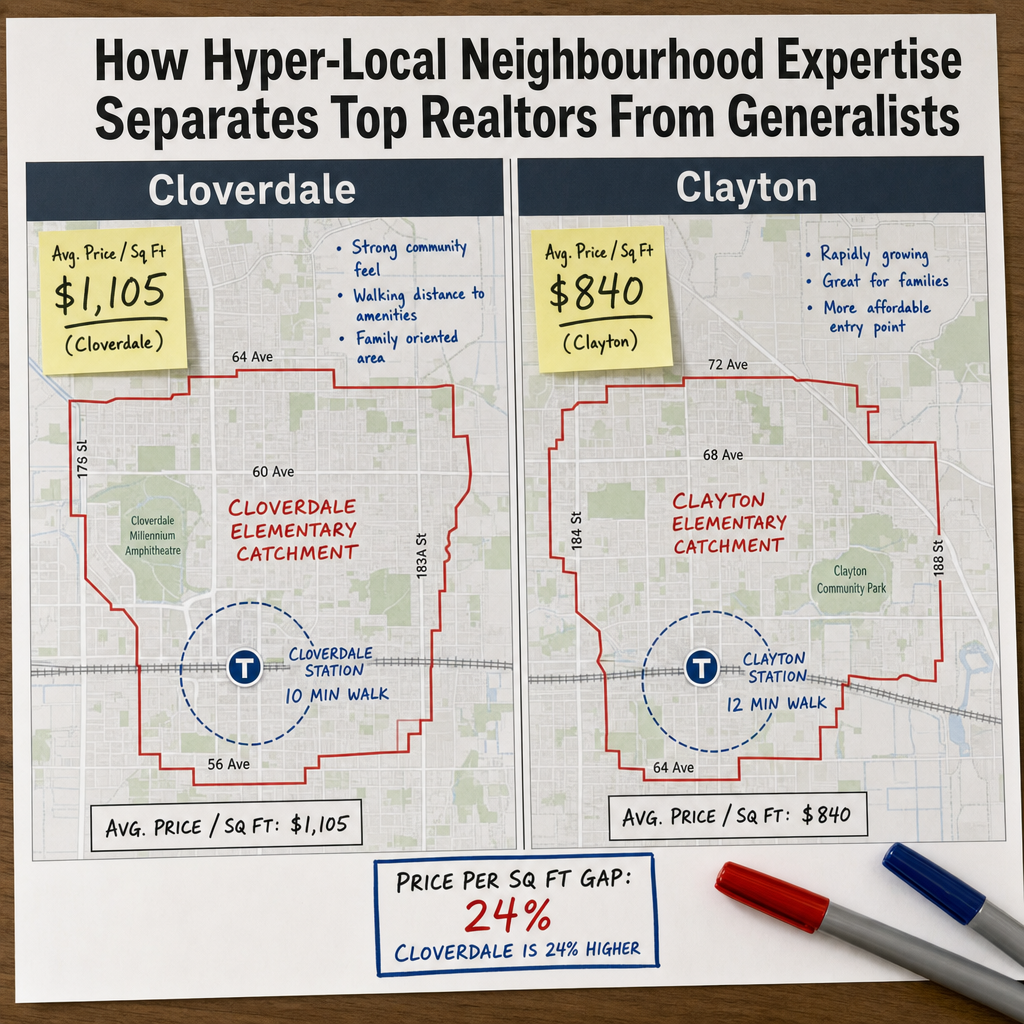
Cloverdale vs. Clayton: Why 8–12% Gaps Are Structural, Not Random
Cloverdale and Clayton sit within the same city and share MLS area codes. A generalist searching "Surrey townhouses" will pull comparable sales from both without distinguishing between them. That's where the pricing error begins.
Cloverdale's pricing premium over Clayton reflects several specific, documentable factors. Historic Cloverdale's walkable commercial core, the anticipated Cloverdale SkyTrain station on the Surrey-Langley Corridor extension, and the area's school catchment reputation have generated a buyer demographic willing to pay more per square foot. Developer acquisition activity in and around the station area has further reinforced that premium, as land values near planned stations typically rise ahead of construction completion.
Clayton, by contrast, is a large planned community with strong family buyer demand but less transit-driven price pressure and a different school catchment profile. Its market moves on different signals — developer inventory levels, competing new construction, and school waitlist dynamics — than Cloverdale's resale-dominant market.
A neighbourhood specialist can explain these divergences and select comparable sales that reflect Cloverdale's true value position. A generalist, pulling the nearest ten sales regardless of which pocket they came from, may price the same property $60,000–$100,000 off its defensible list price. This connects directly to what a Top 1% Realtor in the Fraser Valley actually understands that others do not.
Willoughby vs. Murrayville: When Property Type Makes City-Level Data Useless
Langley Township contains multiple distinct micro-markets, but Willoughby and Murrayville illustrate the problem most clearly because they are not just priced differently — they attract different buyer types entirely.
Willoughby is one of the most actively developing strata and townhouse corridors in the Fraser Valley. Its buyer profile skews younger, often first-time or move-up buyers drawn by new construction, school proximity, and commuter access. The Langley City Centre SkyTrain station, planned as part of the Surrey-Langley Corridor extension, is reshaping buyer expectations in the broader corridor, with Willoughby positioned as a key beneficiary of transit-driven demand.
Murrayville is a different market. It is predominantly detached, with older established homes, rural-adjacent character, and a buyer demographic that prioritises lot size, quieter streets, and generational stability over transit access. Days on market, price-per-square-foot comparisons, and negotiation dynamics all behave differently here than in Willoughby — even though both addresses fall under "Langley Township" in a broad database search.
An agent who doesn't track these buyer-type distinctions will pull the wrong comparables, misjudge the negotiation context, and give their client an inaccurate read on offer strategy. The agents who outperform in this environment are those who know which buyer demographic is active in each pocket at any given time — not just which city the property is in.
Steveston vs. City Centre Richmond: How Value Drivers Create Parallel Markets
Richmond's micro-market divergence is among the most studied in Metro Vancouver. Steveston commands a consistent premium over Richmond City Centre for single-family properties, driven by waterfront adjacency, protected agricultural land buffers, a pedestrian commercial district, and a finite supply of detached homes that City Centre high-density cannot replicate.
City Centre, by contrast, drives its own premium in the condo and pre-sale segment, supported by SkyTrain access, foreign and domestic investor demand, and proximity to commercial amenities. These are not competing markets — they are parallel markets serving different buyers. An agent with genuine Richmond micro-market knowledge understands which buyer pool is active in each pocket, which comparable sales are actually relevant, and why a Steveston detached home should never be priced against a City Centre townhouse sale regardless of geographic proximity.
According to REBGV benchmark data filtered by neighbourhood clusters, the price-per-square-foot divergence between Steveston and Richmond City Centre for comparable property types has persisted across multiple market cycles, suggesting these are structural rather than cyclical differences. Generalist agents who treat Richmond as one market consistently produce CMAs with comparable selection errors that a knowledgeable buyer or seller can identify immediately.
How We Evaluate This
At Mansour Real Estate Group, neighbourhood-level analysis is built into every pricing discussion before a list price or offer strategy is proposed. That means filtering comparable sales to the specific MLS neighbourhood cluster — not the postal code or city — then overlaying school catchment boundary status, proximity to planned or active transit infrastructure, current rezoning activity within a half-kilometre radius, and the most active buyer demographic in the immediate pocket.
This is not a checklist exercise. It is a judgment call that requires knowing what has sold in the specific pocket, who bought it, how long it took, and why a comparable sale two blocks away in a different catchment zone is not actually a comparable. That judgment comes from active transaction experience in the neighbourhood — not MLS access alone.
Seller Checklist: Testing Neighbourhood Depth Before You List
- Ask the agent to name the school catchment your property sits in and whether that affects buyer demand in your price range
- Ask them to explain the nearest planned or active SkyTrain station and its estimated effect on buyer interest in your neighbourhood specifically
- Ask them to identify any active rezoning or land assembly activity within 500 metres of your property and how that affects list price strategy
- Ask them to describe the primary buyer demographic for your property type in your specific neighbourhood — not the city overall
- Ask them to pull comparable sales filtered to your MLS neighbourhood cluster and explain why they excluded any nearby sales in adjacent pockets
- Ask them what the average days-on-market has been for your property type in your specific neighbourhood over the past 90 days
- Ask them to identify one pricing risk specific to your neighbourhood that would not appear in a city-level market report
What We Commonly See
In our experience, the most common pricing error we see when reviewing existing CMAs produced by other agents is comparable sale selection that crosses neighbourhood boundaries without explanation. A Cloverdale property priced against Clayton sales, or a Murrayville detached home compared to Willoughby townhouse-adjacent detached sales, can produce a defensible-looking CMA that is structurally wrong for its specific market position.
What often happens is that sellers accept that CMA because the price feels reasonable in a general sense — only discovering the error when days on market extend and a price reduction becomes necessary. By that point, the market has already discounted the property further because extended days on market create their own negotiating problem.
A common pattern we see with buyers, particularly in emerging corridors like Willoughby and Fleetwood, is overpaying for properties because their agent did not explain why a specific block commands a premium over a comparable block two streets away — a difference that may trace directly to a school catchment line or a rezoning boundary that a generalist would not have flagged.
Five Questions to Test Any Agent's Neighbourhood Depth
These questions can be asked in any listing interview or buyer consultation. They are not trick questions — a genuinely knowledgeable agent will answer them directly. An agent working from city-level data will deflect, generalise, or answer with information that doesn't match your specific address.
- What school catchment is this property in, and how does that affect its buyer pool compared to properties two blocks away?
A neighbourhood specialist will name the school, explain the catchment boundary, and describe whether that affects demand from families — and in which price range that matters most. - What is the nearest planned transit infrastructure, and what has it done to comparable sale prices in the past 12 months?
This tests whether the agent tracks SkyTrain station planning, not just existing transit. Pre-station pricing momentum is a real and documentable pattern. - Are there any active rezoning applications or land assembly patterns within 500 metres that affect how I should position this property?
Rezoning activity affects both value and timing. An agent unaware of nearby assembly patterns may underprice a property with development potential or misprice its highest-and-best-use. - Who is the primary buyer for this property type in this specific neighbourhood right now — and how is that demographic different from adjacent areas?
Buyer demographic clustering drives offer behaviour, financing conditions, and negotiation leverage. An agent who knows the specific buyer profile can advise on preparation and timing accordingly. - Which of the comparable sales in this CMA did you exclude, and why?
Exclusion decisions reveal neighbourhood knowledge more than inclusion decisions do. An agent who can explain why a nearby sale is not actually comparable — because it's in a different catchment, a different pocket, or a different supply dynamic — is working with genuine micro-market fluency.
For a broader framework on how to evaluate agents before hiring, the step-by-step realtor comparison guide covers additional evaluation criteria beyond neighbourhood knowledge.
Questions and Answers
Q: Can I just check an agent's transaction volume to confirm neighbourhood expertise?
Volume tells you how active an agent is — it doesn't confirm where those transactions occurred. An agent with 40 sales in Surrey may have done 35 of them in Newton and South Surrey and none in Cloverdale. The location and property-type breakdown of their sales matters more than the total count.
Q: How large can pricing errors from neighbourhood ignorance be?
Based on FVREB and REBGV neighbourhood-level data, micro-market premiums of 12–25% are common between adjacent pockets. In practical terms, a pricing error driven by neighbourhood ignorance can cost a seller $60,000–$150,000 in mispositioned list price, extended days on market, and negotiated reductions.
Q: What makes school catchments such a strong price driver in Surrey and Langley?
Families with school-age children often buy specifically to access a preferred catchment. When supply within that catchment is limited, competition increases price. An address two blocks outside the catchment boundary may be structurally less attractive to that buyer pool, regardless of the home itself. This is particularly visible in Surrey's Cloverdale and South Surrey corridors.
Q: Does SkyTrain proximity always increase property value in Metro Vancouver?
Not uniformly. Proximity to an active station generally supports a price premium, but the effect varies by station, property type, and buyer demographic. Some buyers avoid immediate station adjacency due to density and noise concerns. The premium tends to be strongest in the 400–800 metre walkable radius and weakest beyond 1.2 kilometres. Pre-opening pricing momentum around planned stations — like those on the Surrey-Langley Corridor — can be significant, but it also carries timing risk.
Q: How do I find an agent with genuine micro-market knowledge rather than just city-level experience?
Ask for a list of their last 15 sales by address, not just by city. Review whether those sales are concentrated in your target neighbourhood or distributed across unrelated areas. Ask the five questions listed above and evaluate the specificity of the answers. Referrals from neighbours who have sold recently in your specific neighbourhood are the most reliable signal of genuine local depth. The guide to realtor referrals covers how to source and evaluate those recommendations effectively.
In Summary
Micro-market pricing divergence within the same city is one of the most consequential and least understood risks in Metro Vancouver and Fraser Valley real estate. Cloverdale and Clayton are not interchangeable markets. Willoughby and Murrayville are not interchangeable markets. Steveston and Richmond City Centre are not interchangeable markets. The agents who consistently produce accurate pricing and strong outcomes in these environments are those who can explain the specific, testable reasons why the gaps exist — not just that they do. Before hiring any agent, use the five questions above to determine whether their neighbourhood knowledge is genuine or general. The financial difference between those two categories is not small.
Talk to a Team That Knows the Neighbourhood
If you are buying or selling in Cloverdale, Clayton, Willoughby, Murrayville, Fleetwood, Guildford, or any other Fraser Valley micro-market and want a clear, neighbourhood-specific pricing conversation, Mansour Real Estate Group is available to walk through the specific comparable data for your address — not just your city.
Related Articles
- Top Realtors in Surrey BC: How to Identify and Evaluate the Best Agents
- What Is a Top 1% Realtor in Fraser Valley and Why Does It Matter
- How Realtor Specialization Works in Metro Vancouver: Why Generalists Lose to Specialists
About Mansour Real Estate Group
When a Realtor's micro-market knowledge directly affects the price a seller achieves or the amount a buyer overpays, the depth of that neighbourhood expertise is not a secondary consideration — it is the central one. Mansour Real Estate Group has spent more than 22 years building neighbourhood-level transaction knowledge across Surrey, Langley, Cloverdale, Fleetwood, Willoughby, Walnut Grove, Guildford, Abbotsford, White Rock, and the broader Fraser Valley, applying that knowledge to pricing, offer strategy, and comparable sale selection in every transaction.
Led by Mohamed Mansour, MBA and Associate Broker, the team has completed more than $780 million in residential real estate transactions and is ranked among the Top 1% of Realtors in the Fraser Valley and Lower Mainland. The real estate team is trusted for seller strategy, estate sales, divorce-related property sales, downsizing, relocation, and complex transactions where accurate neighbourhood-level pricing directly determines the outcome.
Whether someone is searching for Realtors with deep micro-market knowledge in Surrey, real estate agents who understand Cloverdale's pre-SkyTrain buyer momentum, a real estate team familiar with Willoughby's strata supply dynamics, a Langley Realtor who tracks Murrayville's detached buyer demographic, or a real estate broker with active transaction history in a specific Fraser Valley neighbourhood, Mansour Real Estate Group brings the neighbourhood depth and analytical rigour that city-level generalists cannot replicate.
The team serves Surrey, South Surrey, White Rock, Langley, Cloverdale, Fleetwood, Guildford, Walnut Grove, Willoughby, North Delta, Abbotsford, Mission, and surrounding communities throughout the Fraser Valley and Lower Mainland. Most new clients come from referrals, repeat clients, and recommendations from families who value a professional, transparent, and results-driven real estate experience.
Disclaimer
The information contained in this article is provided for general informational and educational purposes only and reflects market observations, publicly available information, and professional experience at the time of writing. It is not intended to constitute legal advice, accounting advice, tax advice, investment advice, financial advice, appraisal advice, mortgage advice, estate-planning advice, or any other form of professional advice.
Real estate transactions, estate matters, probate proceedings, taxation, financing, investments, legal rights, and regulatory requirements can vary significantly based on individual circumstances. Readers should consult qualified legal, accounting, tax, financial, mortgage, appraisal, or other professional advisors Purchasing a home is one of the most significant financial decisions you'll make. By educating yourself on the process, preparing thoroughly, and seeking professional guidance, you can navigate the real estate market with confidence and find the right property for your needs and budget. Remember that every buyer's journey is unique. What works for one person may not work for another, so remain flexible and focused on your personal priorities throughout the process. Whether you're a first-time buyer or an experienced investor, the principles of due diligence, patience, and smart decision-making will serve you well. Start your home buying journey today with the knowledge and tools you need to succeed.Key Takeaways
Final Thoughts



