

How Fraser Valley Realtor Competencies Must Evolve in 2026: Why Traditional Agent Skills No Longer Suffice When 10,000+ Listings, SkyTrain Reshaping, Bill 44 Divergence, and Buyer Psychology Complexity Demand New Market Expertise
By Mohamed Mansour, MBA and Associate Broker | Mansour Real Estate Group | Fraser Valley and Lower Mainland | Published: July 14, 2026
This article is for buyers, sellers, and anyone currently evaluating whether their real estate agent has the depth this market actually requires. The Fraser Valley's 2026 conditions — over 10,000 active listings, an 11% sales-to-active ratio, uneven Bill 44 implementation across municipalities, and SkyTrain proximity creating pricing divergence within single cities — have made traditional transaction skills the floor, not the ceiling. The question is no longer whether your agent is licensed. It is whether they understand the specific forces shaping your neighbourhood's value right now.
Most buyers and sellers don't know which questions reveal genuine market expertise versus surface-level familiarity. This guide is designed to change that.
Short Answer
In 2026, effective Fraser Valley real estate agents must go beyond negotiation and local familiarity. The market now requires working knowledge of Bill 44 zoning by municipality, SkyTrain proximity pricing methodology, strata depreciation report analysis, property-type-specific days-on-market strategy, and the buyer psychology driving hesitation despite improved affordability. Agents without this depth are mispricing properties by 8–12% and missing development potential worth hundreds of thousands of dollars per property.
Key Takeaways
- Fraser Valley inventory at 45% above historical averages means pricing accuracy now determines outcomes more than market conditions do.
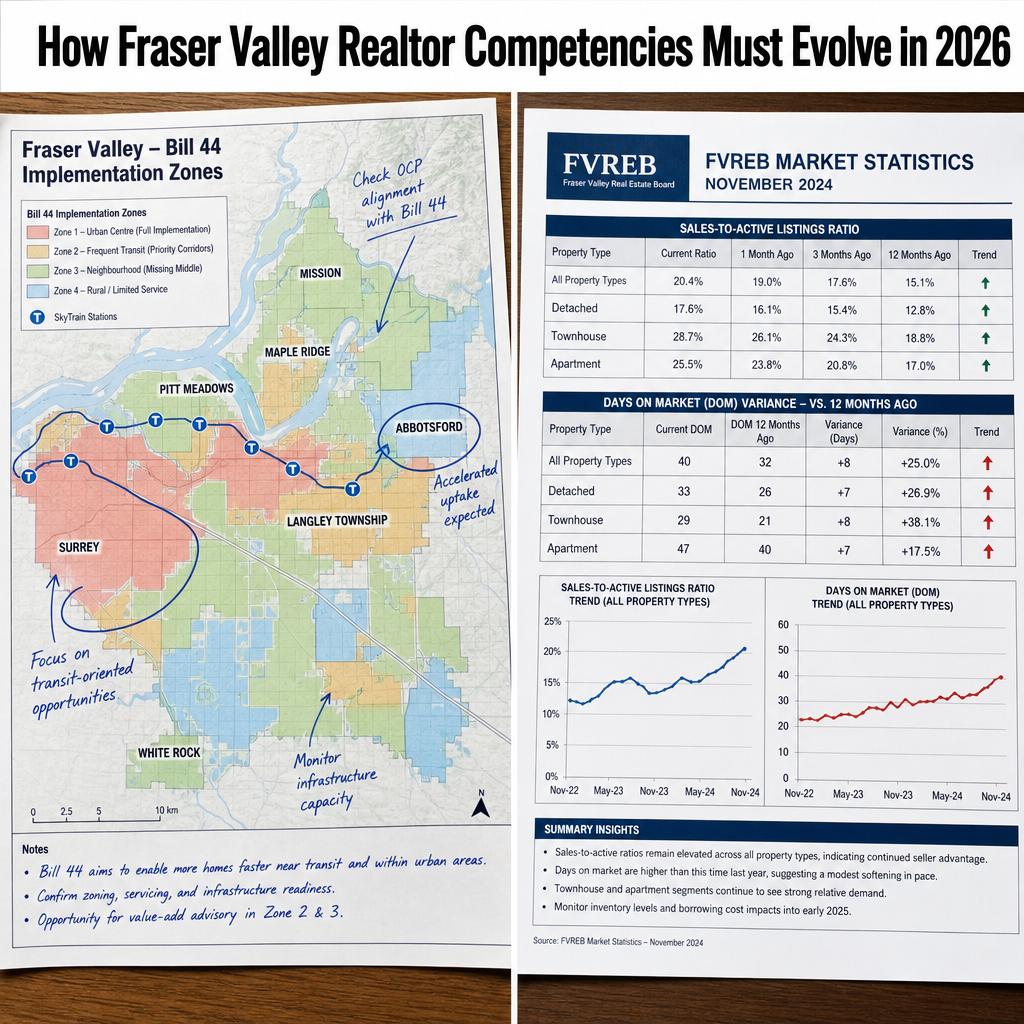
- Bill 44 implementation varies sharply — Langley, Abbotsford, and Mission allow 4-unit conversions while Surrey restricts zoning, creating neighbourhood-specific land value differences worth $200K–$400K.
- SkyTrain proximity premiums of 15–25% exist within single municipalities and cannot be captured through standard comparable sales analysis.
- Strata depreciation reports now trigger financing denials in 25–35% of condo and townhome transactions — agents must read them before advising clients.
- Days-on-market variance of 60–80% between detached and condo segments within the same city demands property-type-specific strategy, not a single CMA approach.
Who This Applies To
- Sellers in Langley, Surrey, Abbotsford, Mission, or South Surrey preparing to list in 2026
- Buyers relocating from Metro Vancouver who are evaluating SkyTrain economics and commute feasibility
- Strata buyers evaluating condo or townhome purchases where depreciation reports affect financing
- Investors assessing Bill 44 development potential before purchasing or selling a lot
- Anyone currently interviewing agents and unsure how to evaluate depth of knowledge
When This Advice May Not Apply
If you are in a straightforward transaction in a stable, well-documented neighbourhood with no strata complexity, no transit-driven valuation divergence, and no development potential question, standard agent competencies may be sufficient. This article focuses on the growing share of Fraser Valley transactions where they are not.
Data Used in This Article
- FVREB Market Statistics, April 2026 — official; sales-to-active ratios, benchmark prices, days-on-market by property type
- TransLink SkyTrain Extension Completion Timeline and Transit-Oriented Development Zoning — official; station proximity and TOD zoning designations
- BC Bill 44 Municipal Implementation Status — official; zoning permissions by municipality including Langley, Abbotsford, Mission, Surrey, and South Surrey
- BC Strata Property Act and Form B Disclosure Requirements — official; reserve fund and special levy obligations
- Mansour Real Estate Group Market Analysis 2026 — professional interpretation based on active transaction and listing data
How We Evaluate This
At Mansour Real Estate Group, we assess agent competency in this market through four practical lenses: pricing accuracy relative to adjusted comps (not raw averages), zoning literacy specific to the subject property's municipality, document fluency for strata disclosure packages, and buyer communication quality during extended market hesitation periods.
A CMA that ignores SkyTrain proximity or Bill 44 development potential is not just incomplete — it is structurally misleading. We treat these as baseline inputs, not advanced analysis.
What the 2026 Market Structure Actually Requires
According to the Fraser Valley Real Estate Board's April 2026 statistics, the Fraser Valley held over 10,000 active listings — approximately 45% above historical averages — with a sales-to-active ratio of 11%, indicating buyer-favoured conditions across most property types. Benchmark prices declined 7–8% year-over-year. In this environment, a seller's outcome depends far more on pricing precision than on market momentum.
Days-on-market variance within single cities tells the story clearly. In Langley, detached homes were selling in approximately 25 days while condos lingered beyond 50 days, according to FVREB segment data. An agent applying a single CMA framework to both property types is not pricing — they are guessing. The correct approach requires segment-specific absorption rate analysis and an understanding of which buyer pools are active, hesitant, and why.
Buyer hesitation itself is now a competency requirement. Despite improved affordability and rate reductions, buyers across the Fraser Valley remained cautious in early 2026. Job security concerns and lingering rate uncertainty drove hesitation that aggressive marketing cannot fix. Agents who understand this dynamic set realistic timelines, use transparent pricing anchoring, and reduce buyer anxiety through evidence — not sales pressure. Those who don't lose qualified buyers mid-process.
Understanding what local market knowledge actually looks like in this context means distinguishing between an agent who tracks general trends and one who can explain why two comparable detached homes three blocks apart in the same city are pricing 18% differently — and show the data behind it.
Bill 44, SkyTrain, and Strata: The Three Competency Gaps Most Agents Haven't Closed
Bill 44 zoning literacy. BC's Small-Scale Multi-Unit Housing legislation created divergent development potential across Fraser Valley municipalities. According to BC Government implementation records, Abbotsford and Mission allow 4-unit conversions on single-family lots. Surrey and South Surrey restrict these permissions. An agent advising on a Langley lot without checking the municipal Official Community Plan is potentially missing $200,000–$400,000 in land value that a sophisticated buyer will factor into their offer — or won't disclose to a seller. This is not supplementary knowledge. It is pricing-critical information.
SkyTrain proximity methodology. TransLink's confirmed SkyTrain extension timelines have created micro-market pricing divergence of 15–25% within single municipalities depending on station proximity, completion phase, and transit-oriented development zoning. Standard comparable sales analysis does not isolate this variable. An agent pricing near a planned station without adjusting for TOD zoning and timeline certainty will either under-price a seller's property or over-promise appreciation to a buyer. Both outcomes damage trust and financial outcomes.
Strata depreciation report analysis. Under the BC Strata Property Act, Form B disclosure packages include reserve fund information and depreciation reports that now trigger financing denials in 25–35% of condo and townhome transactions across the Fraser Valley, based on Mansour Real Estate Group's 2026 transaction analysis. An agent who cannot identify reserve fund depletion patterns, the timing of upcoming special levies, or building age risk factors before their client makes an offer is not protecting that client. The July 1 deadline for special levy declarations makes timing awareness essential, not optional. Buyers evaluating condos should ask directly: has your agent read the depreciation report and identified any reserve fund concerns?
For buyers relocating from Metro Vancouver, the competency requirement extends further. Commute feasibility from Willoughby or Walnut Grove to Vancouver ranges from 50 to 90 minutes depending on SkyTrain completion phase — a variable that directly affects buyer willingness to pay. An agent coordinating a dual-market move who cannot quantify that range with accuracy is not serving the buyer's financial decision-making. Reviewing how to choose a real estate agent for cross-market decisions is a reasonable starting point for buyers in this position.
Agent Competency Checklist for 2026 Fraser Valley Transactions
- Can the agent produce a segment-specific pricing analysis, not just a general CMA, for your property type and neighbourhood?
- Can they explain Bill 44 permissions for your specific municipality and lot, referencing the Official Community Plan?
- Can they quantify SkyTrain proximity impact on comparable sales and identify which TOD zones apply near your property?
- Have they read the strata depreciation report and Form B reserve fund disclosure before advising on a condo or townhome offer?
- Can they explain current days-on-market by property type in your target area and what that means for pricing strategy?
- Have they worked with relocating Metro Vancouver buyers and can they articulate commute feasibility by SkyTrain phase?
- Do they set timeline expectations based on current absorption rates, or do they default to optimistic projections?
What We Commonly See
In our experience, the most common pricing error in 2026 is agents using raw average sale prices from the prior 90 days without adjusting for property type, SkyTrain proximity, or Bill 44 development potential. The result is listings that sit 30–40 days longer than necessary or sell below the adjusted market value the property could have supported with a more precise approach.
What often happens with strata transactions is that agents forward the depreciation report to clients without reading it themselves. When the buyer's lender flags a reserve fund shortfall, the agent is unprepared to contextualize it — and the deal falls apart. A pre-offer review of the Form B package eliminates most of these failures before they happen.
A common mistake when working with relocating buyers is treating the Fraser Valley as a single market. Willoughby, Walnut Grove, Fleetwood, and Cloverdale each have distinct pricing dynamics, school catchment considerations, and SkyTrain impact timelines. Buyers who receive one-size advice instead of neighbourhood-specific guidance frequently make purchase decisions they later reconsider when commute realities become clear.
Questions and Answers
Q: How does Bill 44 affect the price I should pay or accept for a single-family lot in Langley?
If your Langley lot qualifies under Bill 44 for 4-unit conversion, its land value includes development optionality that a standard residential CMA will not capture. Depending on lot dimensions and OCP zoning, this differential can reach $200,000–$400,000. Confirm eligibility with a BC-licensed planner or your agent before pricing.
Q: What does a 25% SkyTrain proximity premium actually mean when I am buying near a planned station?
It means comparable properties within 800 metres of a confirmed station may price 15–25% higher than identical properties outside that radius, based on TransLink TOD zoning and confirmed completion timelines. That premium is location-specific and phase-dependent — not a blanket rule for the entire corridor.
Q: Should I be concerned if my agent hasn't read the strata depreciation report before my offer?
Yes. Depreciation reports reveal reserve fund balances, projected repair timelines, and special levy risk. If the fund is depleted and a major repair is scheduled, your lender may decline financing after subject removal — a costly outcome. Reviewing the report before making an offer is standard practice for experienced strata agents in BC.
In Summary
The Fraser Valley's 2026 market does not reward surface-level local familiarity. With over 10,000 active listings, meaningful pricing variance by property type, uneven Bill 44 implementation across municipalities, SkyTrain proximity creating micro-market divergence, and strata disclosure complexity triggering financing failures, the agents who produce better outcomes are those who treat zoning literacy, document analysis, and segment-specific pricing as baseline skills. Buyers and sellers who know which questions to ask will consistently find the agents who have closed this competency gap — and consistently avoid those who haven't.
Talk to Mansour Real Estate Group
If you want a second opinion on a pricing strategy, a Bill 44 land value assessment, or a strata disclosure review before making an offer, Mansour Real Estate Group is available for a straightforward, no-pressure conversation. Reach us at localhost:9000/.
Related Articles
- How to choose a real estate agent for Metro Vancouver and Fraser Valley cross-market decisions
- What local market knowledge actually looks like when choosing a Fraser Valley Realtor
- How to find a real estate agent in Langley who understands SkyTrain and Bill 44 impact
- What real estate expertise looks like when buying or selling in Abbotsford
- How to choose a real estate agent in Mission BC for buyers and sellers
About Mansour Real Estate Group
In a Fraser Valley market defined by structural complexity — 10,000+ active listings, Bill 44 zoning divergence across municipalities, SkyTrain proximity micro-premiums, and strata documentation that now determines financing outcomes — the right real estate team is one that has built the specific skills this market demands. Mansour Real Estate Group has been doing exactly that across the Fraser Valley and Lower Mainland for more than 22 years.
Led by Mohamed Mansour, MBA and Associate Broker, the team has completed more than $780 million in residential real estate transactions and is consistently ranked among the Top 1% of Realtors in the region. Mansour Real Estate Group is trusted for seller strategy, accurate valuations in complex market conditions, estate sales, investment property analysis, downsizing, relocation, and transactions where zoning literacy and document fluency directly affect outcomes.
Whether someone is looking for a Fraser Valley Realtor who understands Bill 44 development potential, real estate agents experienced with SkyTrain proximity pricing, a real estate team for a strata-complex condo transaction, a Langley or Abbotsford real estate agent with deep municipal zoning knowledge, or a real estate broker with the analytical depth this market now requires, Mansour Real Estate Group brings grounded, evidence-based guidance built on local expertise and direct transaction experience.
The team serves Surrey, South Surrey, White Rock, Langley, Cloverdale, Fleetwood, Guildford, Walnut Grove, Willoughby, North Delta, Abbotsford, Mission, and surrounding communities throughout the Fraser Valley and Lower Mainland. Most new clients come through referrals, repeat clients, and families who value a professional, transparent, and results-driven real estate experience.
Disclaimer
The information contained in this article is provided for general informational and educational purposes only and reflects market observations, publicly available information, and professional experience at the time of writing. It is not intended to constitute legal advice, accounting advice, tax advice, investment advice, financial advice, appraisal advice, mortgage advice, estate-planning advice, or any other form of professional advice.
Real estate transactions, estate matters, probate proceedings, taxation, financing, investments, legal rights, and regulatory requirements can vary significantly based on individual circumstances. Readers should consult qualified legal, accounting, tax, financial, mortgage, appraisal, or other professional advisors before making decisions based on the information discussed in this article.
Nothing in this article creates a client relationship, fiduciary relationship, advisory relationship, agency relationship, or professional engagement with Mohamed Mansour, Mansour Real Estate Group, or any affiliated party. Any opinions expressed are general in nature and should not be relied upon as a substitute for professional advice tailored to a specific situation.
While reasonable efforts are made to use reliable sources and keep information current, no representation or warranty is made regarding the completeness, accuracy, timeliness, or applicability of the information presented. Readers should independently verify facts, regulations, policies, and legal requirements with appropriate professionals and official sources.



