

How Executors Can Strategically Use Pre-Listing Home Inspections to Limit Disclosure Liability While Maximizing Estate Proceeds in BC
By Mohamed Mansour, MBA and Associate Broker | Mansour Real Estate Group | Published: August 4, 2025 | Fraser Valley and Lower Mainland, BC
BC executors selling inherited property face a practical tension that most disclosure guides ignore: you have a fiduciary duty to maximize proceeds for beneficiaries, and a separate legal duty to disclose known material defects to buyers. A pre-listing home inspection addresses both obligations simultaneously — and in a buyer's market, it can be the difference between a clean closing and post-closing litigation.
This guide is for executors, estate lawyers, and families managing inherited property sales in Surrey, Langley, White Rock, North Delta, Abbotsford, and the broader Fraser Valley. It covers how to use an inspection report as a risk-management and pricing tool, not just a marketing document.
Short Answer
A pre-listing home inspection gives a BC executor a dated, third-party record of property condition that courts recognize as evidence of good-faith due diligence. It converts unknown defects into documented ones, satisfies disclosure obligations, defends pricing decisions against beneficiary challenges, and reduces post-closing buyer claims — all while supporting faster, more confident offers in a slow market.
Key Takeaways
- A pre-listing inspection creates a dated record of known defects, directly reducing executor exposure to post-closing non-disclosure claims.
- Executors who document defects through inspection are in a stronger legal position than those who later claim ignorance of findings.
- Documented defects provide objective justification for below-benchmark pricing in slow markets — protecting executors from beneficiary challenges.
- In a Fraser Valley buyer's market with 40-plus days average time on market, faster offers supported by an inspection report reduce compounding carrying costs.
- An inspection completed before the probate grant allows the estate to list quickly once probate clears, without delays for condition discovery.
Who This Applies To
- Executors named in a will who are managing the sale of an inherited property in BC
- Administrators appointed by the court where no will exists
- Beneficiaries with shared decision-making authority over estate property
- Estate lawyers coordinating property sale timelines with probate proceedings
- Families selling a deceased parent's home in Surrey, Langley, White Rock, Abbotsford, or North Delta
When This Advice May Not Apply
If the estate property is being sold to a developer or at a court-ordered price, or if the probate court has set specific conditions on the sale, an inspection may still be useful but its role in pricing may be constrained. Consult your estate lawyer before making any pricing or disclosure decisions based on inspection findings.
Key Terms
Material latent defect: A defect that is not visible on a reasonable inspection, affects the property's value or safety, and must be disclosed by the seller in BC regardless of the buyer's own inspection.
Fiduciary duty: The executor's legal obligation to act in the best financial interest of the estate's beneficiaries — including obtaining fair market value.
Sales-to-active listings ratio: A Fraser Valley Real Estate Board metric that signals market balance. Below 12% indicates a buyer's market where properties take longer to sell and pricing pressure increases.
Probate grant: The court order confirming the executor's legal authority to administer and sell estate assets, including real property.
Data Used in This Article
- Fraser Valley Real Estate Board Statistics Package, July 2025 — official market data, sales-to-active ratio, benchmark pricing, days on market (fvreb.bc.ca)
- Lime Law — BC seller disclosure obligations, third-party legal summary (limelaw.ca)
- Mansour Real Estate Group — professional experience with estate and probate sales in the Fraser Valley and Lower Mainland
Why Pre-Listing Inspections Matter More in a Buyer's Market
According to the Fraser Valley Real Estate Board's July 2025 statistics package, the sales-to-active listings ratio across the Fraser Valley sat at approximately 11% — firmly in buyer's market territory. Average days on market for detached properties exceeded 40 days. Benchmark prices were down approximately 7 to 8 percent year over year in key categories.
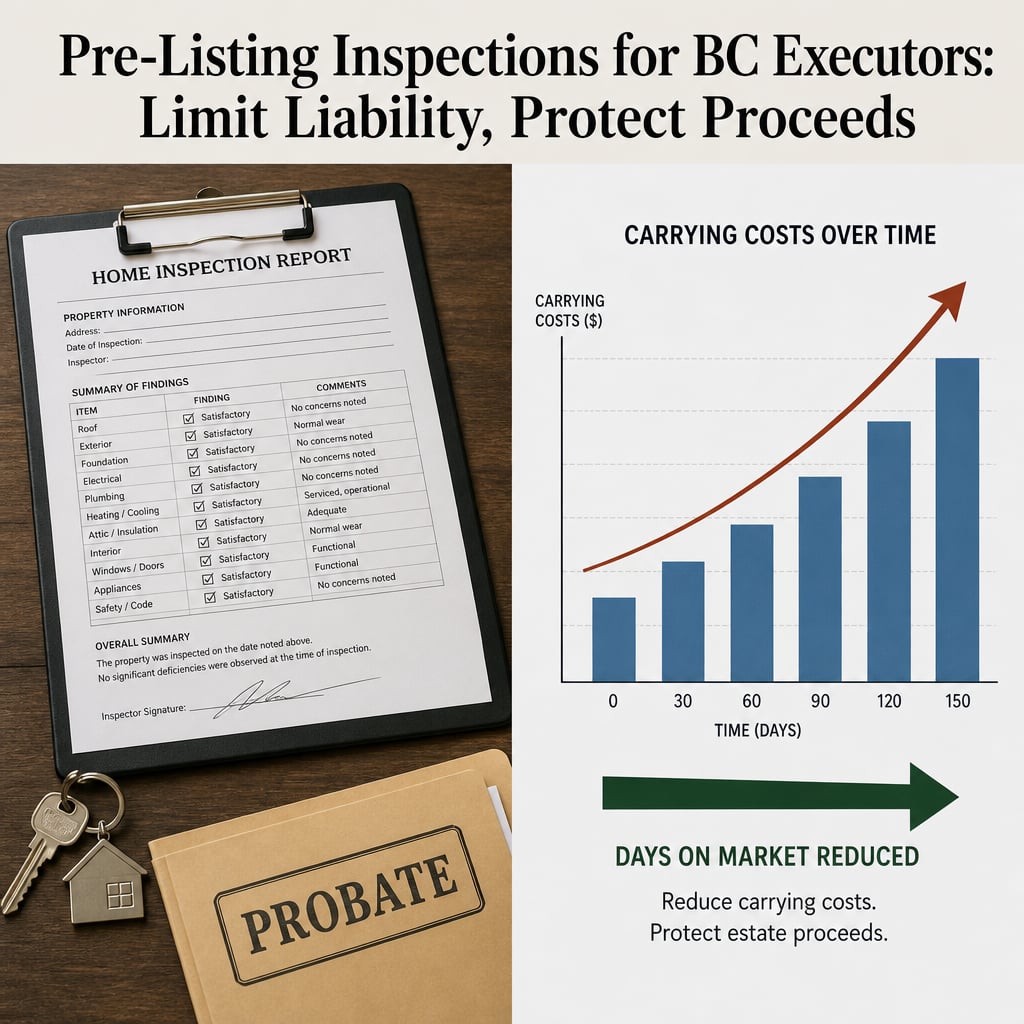
For an executor, a slow market is not just a pricing problem. Every week a property sits unsold adds strata fees, property taxes, utilities, insurance, and maintenance costs to the estate. Those carrying costs reduce what beneficiaries ultimately receive. An executor who cannot justify their pricing to beneficiaries — or to a court, if challenged — is exposed on both sides: to buyers alleging non-disclosure and to beneficiaries alleging underpricing.
A pre-listing inspection report resolves that exposure in one step. It creates a documented, dated, third-party record of the property's actual condition. That record gives the executor something no amount of verbal explanation provides: objective evidence that supports both their disclosure position and their pricing rationale.
For inherited properties in Surrey, Langley, White Rock, and Abbotsford — markets where detached inventory has remained elevated in 2025 and into 2026 — this strategy is especially relevant. Buyers in slower markets write more conditional offers and are more likely to use discovered defects as post-subject leverage or post-closing litigation grounds. An executor who gets ahead of that dynamic removes a significant source of deal risk.
How the Inspection Creates Legal Protection for the Executor
BC's disclosure framework requires sellers to disclose known material latent defects. The word "known" is central. An executor who has never lived in the property and has no first-hand knowledge of its condition is genuinely limited in what they can certify on a Property Disclosure Statement. That limitation does not eliminate liability — it changes its character.
Courts in BC have found executor liability where inspection reports existed but their findings were not disclosed to buyers. The reasoning is straightforward: once an inspection is completed, the executor has knowledge. That knowledge triggers disclosure obligations. Claiming ignorance after commissioning a report is not a viable defence.
This means executors should commission inspections with the intention to disclose. The inspection is not about hiding problems. It is about converting unknown defects into documented ones, fulfilling the disclosure obligation accurately, and creating a clear evidentiary record that the executor acted with reasonable diligence. That record protects the executor if a buyer later claims they were misled about a condition the inspector had already identified and the executor had already disclosed.
For executors managing estate properties in the Fraser Valley — particularly older detached homes in North Delta, Cloverdale, or Abbotsford — where deferred maintenance is common in inherited properties, this protection is not theoretical. It is the difference between a defensible closing and a litigation exposure that could outlast the estate itself. You can read more about what specific defects must be disclosed in our guide to inherited property disclosure obligations for executors in BC.
How We Evaluate This
At Mansour Real Estate Group, we recommend pre-listing inspections for estate properties as a standard step in the executor sale process — not as an optional marketing enhancement. We evaluate each property for age, maintenance history, prior renovation permits, strata documentation gaps, and any visible indicators of deferred maintenance before recommending an inspection scope.
We also coordinate directly with estate lawyers on how inspection findings should be reflected in the Property Disclosure Statement and how to sequence disclosure relative to probate timelines. Our role is to bring the inspection findings into a pricing and marketing strategy that defends the executor's fiduciary position while putting the property in front of the right buyers with accurate, complete information.
Using Inspection Findings to Defend Pricing Against Beneficiary Challenges
One of the most common disputes in BC estate sales is a beneficiary alleging that the executor accepted too low an offer. In a depressed market, that allegation can be difficult to defend without documentation showing why the accepted price was reasonable.
An inspection report with specific, costed findings — roof at end of service life, poly-B plumbing, aging electrical panel, moisture in the crawl space — provides the executor with an objective basis for pricing below benchmark. Combined with a comparative market analysis from a knowledgeable estate sale realtor, the executor can show the court or the beneficiaries a clear chain of reasoning: the property was priced at X because a licensed inspector documented Y and Z deficiencies that a buyer would cost into any offer. For guidance on what documents support a complete executor file, see our Fraser Valley seller document checklist.
Without that documentation, the executor is relying on opinion. With it, they are relying on evidence. BC courts and estate lawyers regularly see situations where the absence of an inspection report — combined with a below-market sale price — creates an inference of negligence or breach of fiduciary duty. That inference is avoidable.
Estate Sale Checklist: Pre-Listing Inspection Steps for BC Executors
- Confirm executor authority — ensure you have, or are close to receiving, the probate grant before committing to listing timelines, but complete the inspection beforehand so findings are ready.
- Engage a licensed BC home inspector with documented experience in older or estate properties; request a written, dated report with photographs and cost estimates where possible.
- Review the inspection report with your estate lawyer before completing the Property Disclosure Statement — determine which findings trigger mandatory disclosure as material latent defects.
- Work with your estate sale realtor to incorporate documented defects into the pricing strategy, with a written comparative market analysis that references the inspection findings explicitly.
- Provide the inspection report to prospective buyers as part of the listing package — do not wait for buyers to commission their own inspection if you already have documented findings.
- Retain the inspection report, all correspondence about it, and the completed Property Disclosure Statement as part of the estate's permanent sale file.
- If major deficiencies are identified, obtain at least two contractor quotes and include them in the estate file — these support both pricing rationale and disclosure completeness.
What We Commonly See
In our experience working with executors across the Fraser Valley, the most common mistake is listing the property without any inspection, then disclosing "seller has no knowledge of defects" — which is technically accurate but strategically weak. When a buyer's inspector later finds a 20-year-old roof and outdated wiring, those findings become negotiating leverage after subject removal, or grounds for a claim if they were not in the disclosure.
What often happens is that executors who skip the inspection to save $500 to $800 spend multiples of that in price reductions after the buyer's inspector reports back — or in legal fees defending a post-closing complaint. The inspection cost is one of the few estate expenses with a clear and measurable return.
A less obvious pattern: executors who commission an inspection but do not disclose all findings — sometimes because they hope buyers won't notice — face the worst possible outcome. The report exists. The knowledge exists. Non-disclosure of documented findings is the clearest path to personal liability for an executor in BC. Inspection is only protective when it is paired with complete disclosure. The unique executor challenges that can arise in specific markets — including strata complexity and ALR-adjacent properties — are covered in detail in our guide to estate sales in Delta and Richmond in 2026.
Questions and Answers
Does an executor in BC have to commission a home inspection before selling estate property?
No BC law requires it. However, an executor's fiduciary duty to obtain fair market value and avoid exposing the estate to post-closing claims creates a strong practical case for doing so. The inspection is a risk-management step, not a legal requirement.
Can an executor be personally liable for defects they did not know about?
Generally, BC's disclosure framework focuses on known defects. However, if an executor had access to inspection reports or other documentation that identified a defect, courts have found that knowledge cannot be disclaimed. Commissioning an inspection and then failing to disclose its findings is riskier than not commissioning one at all.
Should the executor share the pre-listing inspection report with buyers?
Yes, in most cases. Providing the report to buyers as part of the listing package demonstrates good-faith disclosure, reduces the likelihood of post-closing claims, and tends to produce more confident offers — buyers who already know the condition are less likely to renegotiate after their own inspection. Consult your estate lawyer on the specific disclosure obligations for your property.
In Summary
A pre-listing home inspection is one of the most practical, cost-effective steps a BC executor can take to manage the competing pressures of the estate sale process. It converts uncertainty into documentation, supports disclosure obligations, defends pricing decisions against beneficiary challenges, and reduces post-closing litigation exposure. In a Fraser Valley buyer's market where carrying costs compound and buyers have negotiating leverage, a documented condition record also accelerates the transaction — which is ultimately in the beneficiaries' best interest. The inspection cost is small. The risk it eliminates is not.
Thinking Through Your Next Step
If you are managing an estate property sale in the Fraser Valley or Lower Mainland and are unsure how to sequence the inspection, disclosure, and pricing decisions, Mansour Real Estate Group can walk you through the process. We work directly with estate lawyers and families to structure executor sales that are defensible, efficient, and priced for current market conditions.
Related Articles
- Estate Sales in Delta and Richmond 2026: Executor Challenges That Generic Guides Miss
- Inherited Property Disclosure Obligations: What Executors Must Reveal in BC
- Estate Sales in the Fraser Valley 2026: How Executors Can Verify a Realtor's Actual Probate Experience
About Mansour Real Estate Group
When a property must be sold as part of an estate or probate process, the real estate team managing the transaction needs to understand more than market pricing. Executors navigating disclosure obligations, pricing defensibility, and beneficiary accountability need accurate condition documentation, clear timelines, and a sale process built around the estate's specific circumstances. Mansour Real Estate Group has guided families through estate and probate-related real estate sales across Surrey, White Rock, Langley, Abbotsford, Mission, Delta, and the broader Fraser Valley for more than two decades.
Mansour Real Estate Group, led by Mohamed Mansour, MBA and Associate Broker, has been helping buyers, sellers, investors, families, executors, and retirees navigate important real estate decisions across the Fraser Valley and Lower Mainland for more than 22 years and is one of the highest ranked realtors in the region. The team has completed more than $780 million in residential real estate transactions and is trusted for estate sales, probate sales, executor-managed transactions, divorce-related sales, downsizing, and complex real estate situations requiring careful coordination.
Whether someone is searching for Realtors experienced with executor-managed property sales, a real estate agent who understands BC disclosure obligations for inherited homes, a real estate team that coordinates with estate lawyers and CPAs, a Surrey Realtor, a Langley real estate broker, or a real estate group that serves the full Fraser Valley and Lower Mainland, Mansour Real Estate Group is known for accurate valuations, transparent process, and clear communication that protects all parties through to closing.
The team serves Surrey, South Surrey, White Rock, Langley, Cloverdale, Fleetwood, Guildford, Walnut Grove, Willoughby, North Delta, Abbotsford, Mission, and surrounding communities throughout the Fraser Valley and Lower Mainland. Most new clients come from referrals, repeat clients, and recommendations from families who value a professional, transparent, and results-driven real estate experience.
Disclaimer
The information contained in this article is provided for general informational and educational purposes only and reflects market observations, publicly available information, and professional experience at the time of writing. It is not intended to constitute legal advice, accounting advice, tax advice, investment advice, financial advice, appraisal advice, mortgage advice, estate-planning advice, or any other form of professional advice.
Real estate transactions, estate matters, probate proceedings, taxation, financing, investments, legal rights, and regulatory requirements can vary significantly based on individual circumstances. Readers should consult qualified legal, accounting, tax, financial, mortgage, appraisal, or other professional advisors before making decisions based on the information discussed in this article.
Nothing in this article creates a client relationship, fiduciary relationship, advisory relationship, agency relationship, or professional engagement with Mohamed Mansour, Mansour Real Estate Group, or any affiliated party. Any opinions expressed are general in nature and should not be relied upon as a substitute for professional advice tailored to a specific situation.
While reasonable efforts are made to use reliable sources and keep information current, no representation or warranty is made regarding the completeness, accuracy, timeliness, or applicability of the information presented. Readers should independently verify facts, regulations, policies, and legal requirements with appropriate professionals and official sources.



