
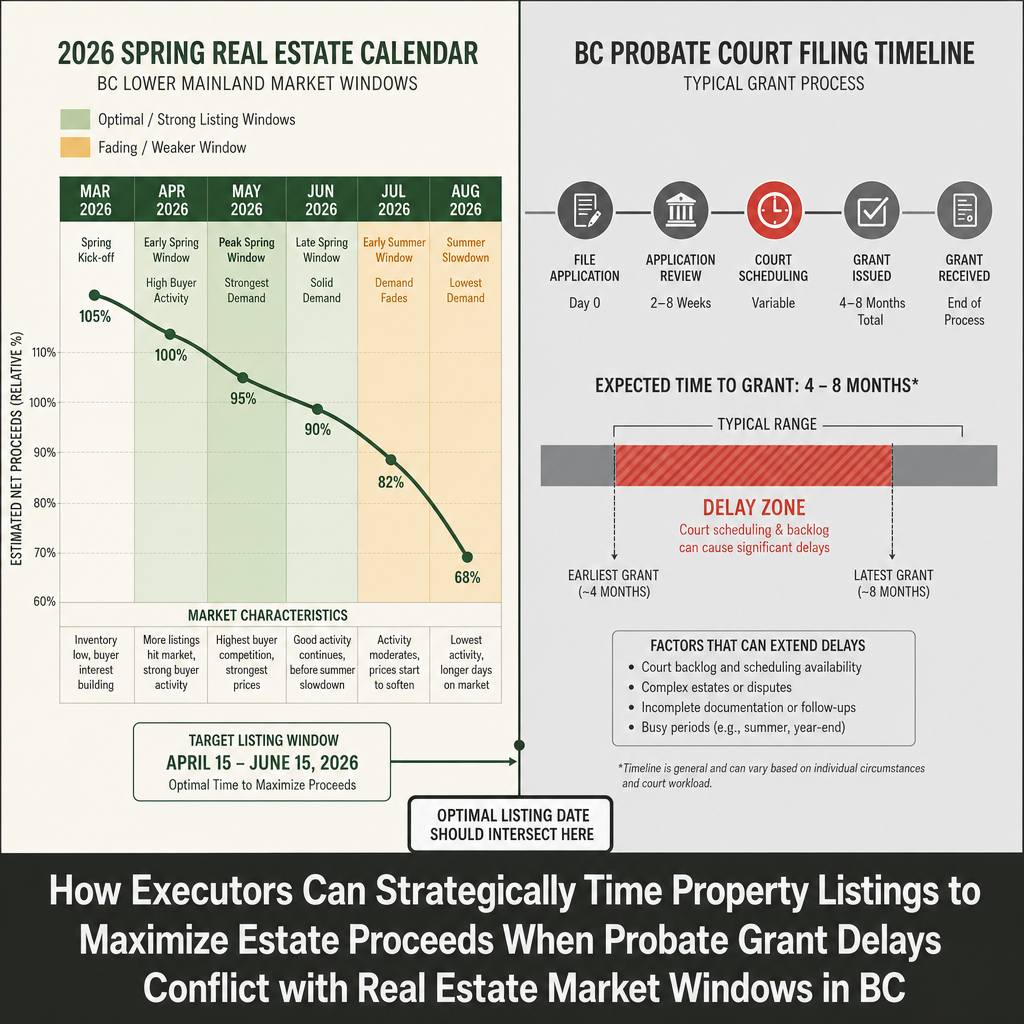

How Executors Can Strategically Time Property Listings to Maximize Estate Proceeds When Probate Grant Delays Conflict with Real Estate Market Windows in BC
By Mohamed Mansour, MBA and Associate Broker | Mansour Real Estate Group | Fraser Valley and Lower Mainland, BC | Published: May 14, 2026
For executors managing an estate property in BC, two clocks run at the same time. The probate clock moves through court filing, notice periods, and grant issuance—a process that typically takes four to eight months according to the BC Supreme Court Civil Rules. The market clock moves differently: buyer traffic peaks in spring, softens through summer, and contracts again in winter. When those two timelines don't align, the financial cost to the estate is real and measurable.
This article is for executors, estate lawyers, notaries, and families managing BC estate properties who need to understand how listing timing, probate authority, and Fraser Valley market conditions interact—and how to make decisions that protect net proceeds for beneficiaries.
Short Answer
In BC, executors can list and accept offers on estate properties before a Grant of Probate is issued, provided proper authority exists. The key is coordinating the possession date and title transfer mechanics so closing can occur once the grant issues. Poor timing relative to Fraser Valley's spring market window costs estates an estimated $50,000 to $150,000 or more in reduced proceeds.
Key Takeaways
- BC executors can list before probate grants, but title transfer at closing requires coordination with legal counsel.
- Spring 2026 Fraser Valley data shows detached homes selling in 25–30 days; condos average 45–50+ days on market.
- A 60–90 day listing delay can push a closing into summer when buyer leverage increases and offers weaken.
- Formal appraisals required for CRA purposes sometimes set expectations above market, extending days on market.
- Executors who coordinate realtor, notary or lawyer, and beneficiaries early close 2–4 weeks faster than those who don't.
Who This Applies To
- Executors managing BC estate properties where probate has been filed but no grant has issued yet
- Families coordinating estate sales in Surrey, White Rock, Langley, Abbotsford, North Delta, or surrounding Fraser Valley communities
- Beneficiaries concerned about estate proceeds being reduced by delayed listing decisions
- Estate lawyers and notaries advising executors on property disposition timing
When This Advice May Not Apply
If the estate is contested, if beneficiary disputes are unresolved, if there are title encumbrances requiring court orders, or if the property carries tenants with active RTB rights, listing timing decisions become more complex. Executors in those situations should not proceed without legal guidance specific to their circumstances.
Data Used in This Article
- FVREB Market Statistics, April 2026 — Days-on-market by property type, Fraser Valley; official board data
- BC Supreme Court Civil Rules — Probate timeline and executor authority; official provincial legislation
- BC Notaries Society — Real property transfer before Grant of Probate; professional guidance publication
- BC Estate Litigation Quarterly — Common executor timing mistakes and financial impact; third-party professional analysis
- CRA — Deemed Disposition and Principal Residence Exemption for Estates; official federal tax publication
Why Listing Timing Matters More Than Executors Typically Realize
Most executors approach probate and property sale as two separate processes—probate first, then list. That sequencing is understandable but often costly. According to the BC Notaries Society's guidance on real property transfers before grant issuance, an executor can list a property and accept a conditional or firm offer before the grant issues, provided the estate's legal authority is in order and the purchase contract is structured to allow for the grant timing.
The practical implication is significant. Fraser Valley detached homes currently sell in 25–30 days according to FVREB's April 2026 market statistics. Condos average 45–50+ days. If an executor waits for grant issuance before listing—adding 60–90 days of delay—a spring listing that could have closed in May or June instead closes in August or September. Buyer leverage is measurably higher in those slower months. Competing listings accumulate. Offers come in lower and with more conditions.
The BC Estate Litigation Quarterly has documented that executors who mistime listings relative to probate grant issuance lose an estimated 10–15% in net proceeds compared to those who coordinate strategically. On a $1.2 million Fraser Valley detached home, that range represents $120,000–$180,000 in reduced estate value—a consequence that is rarely framed as an executor decision point.
How Title Transfer and Closing Mechanics Actually Work Before Probate
The mechanics of a pre-grant listing are frequently misunderstood, and that misunderstanding is the primary reason estates lose market windows unnecessarily. Under BC's probate framework, the executor gains authority to deal with estate property at death—not at grant issuance. The grant confirms and formalizes that authority for third parties, including buyers and title insurers, but it does not create the authority.
In practice, a purchase contract can be written with a completion date structured to align with anticipated grant issuance. If probate was filed in January and the grant is expected in May, an offer accepted in March with a June completion date can proceed to a clean close. The buyer benefits from a firm agreement signed during peak spring traffic. The estate benefits from spring-market offer strength. The notary or lawyer completes title transfer once the grant is in hand.
This requires a real estate agent who understands how to structure the contract correctly, a notary or estate lawyer who has confirmed authority conditions, and a timeline that all parties—including beneficiaries—have been briefed on in advance. When any one of those three is missing, the transaction stalls. According to the BC Estate Litigation Quarterly, lack of coordination between executor, realtor, and legal counsel extends closing timelines by an average of two to four weeks—long enough to miss a market window entirely in a competitive spring environment like 2026.
Key Definitions
Grant of Probate: A BC Supreme Court order confirming an executor's authority to administer the estate and deal with estate assets, including real property.
Deemed Disposition: Under CRA rules, a deceased person is treated as having sold all capital property at fair market value on the date of death. This triggers capital gains calculations separate from the eventual property sale price.
Days on Market (DOM): The number of calendar days between a property's MLS listing date and accepted offer date. Used by FVREB to track absorption pace by property type.
Completion Date: The date on which title transfers from seller to buyer in a BC real estate transaction. Different from the possession date, which is when the buyer takes physical access to the property.
How We Evaluate This
At Mansour Real Estate Group, when we're engaged for an estate sale, our first conversation with the executor includes three questions: Has probate been filed, and what is the expected grant date? Are there any title, tenancy, or beneficiary complications? And what is the property's condition relative to listing-ready expectations?
The answers shape a timing map. We work backward from the optimal listing window—which in the Fraser Valley is typically late February through April for detached homes and March through May for condos—and identify whether probate timing can support a pre-grant listing with a structured completion date. If it can, we move forward. If it cannot, we advise on what preparation steps can happen in parallel so the property is ready the moment authority is confirmed. This approach has consistently helped families protect estate proceeds that would otherwise be eroded by waiting.
Estate Sale Checklist for Executors Coordinating Listing Timing
- Confirm probate filing date and expected grant issuance window with the estate's notary or lawyer before engaging a realtor
- Commission a formal appraisal for CRA deemed disposition purposes—and separately, request a current market analysis from your realtor to understand actual buyer demand
- Identify whether the property can be listed and conditionally sold before the grant issues, based on title and authority conditions
- Confirm tenancy status: if the property is occupied, review RTB notice requirements before setting a possession date
- Brief all beneficiaries in writing on the listing timeline and expected closing window to reduce last-minute disputes or delays
- Complete property access, estate clean-out, and any urgent repairs before the listing goes live—preparation done in parallel with probate saves weeks
- Confirm that your purchase contract is structured with a completion date that accounts for grant timing, not just buyer preference
What We Commonly See
In our experience, the single most expensive mistake executors make is treating probate completion as a prerequisite to listing engagement. Calling a realtor the week the grant issues—rather than two to three months earlier—almost always results in a missed spring window and a summer close at reduced offer strength.
What often happens is that the executor receives the CRA-required formal appraisal and uses that figure as the listing price. Formal appraisals for deemed disposition purposes reflect a point-in-time valuation methodology that can sit above actual buyer demand, particularly for older detached homes in areas like North Delta, Cloverdale, or parts of Abbotsford where condition sensitivity is high. Properties priced from appraisal rather than from a current market analysis tend to sit 20–30 days longer than comparable estate sales, narrowing the seasonal advantage.
A common coordination failure is beneficiary sign-off delays. When two or three beneficiaries in different cities or countries need to agree on listing terms or accept an offer, and no clear decision protocol was established in advance, transactions stall at critical moments. We've seen otherwise clean estate sales extend by three to four weeks because of a beneficiary communication gap that could have been resolved before the listing went live.
Questions and Answers
Can an executor in BC accept an offer on estate property before the Grant of Probate is issued?
Yes. According to the BC Notaries Society, an executor has authority to deal with estate property from the date of death. A purchase contract can be accepted before the grant issues, provided the completion date is structured to allow time for grant issuance. Your notary or estate lawyer should confirm authority conditions specific to the estate before proceeding.
How much does a delayed listing actually cost an estate in the Fraser Valley?
BC Estate Litigation Quarterly analysis suggests executors who mistime listings relative to probate grant issuance lose an estimated 10–15% of net proceeds compared to those who coordinate strategically. On a $1 million property, that is $100,000–$150,000. The primary mechanism is shifting the close from a high-demand spring market into a slower summer period when buyers have more leverage.
Should the formal CRA appraisal be used as the listing price?
No—these serve different purposes. The CRA deemed disposition appraisal establishes fair market value on the date of death for tax reporting under CRA's guidelines on estate taxation. The listing price should be set using a current market analysis that reflects today's buyer demand, comparable active listings, and current days-on-market data from FVREB. Using the appraisal figure as the listing price often results in overpricing relative to the current market.
In Summary
In BC, executors do not need to wait for a Grant of Probate before engaging a realtor, preparing the property, or accepting an offer with a structured completion date. The Fraser Valley's spring market window—when buyer traffic is highest and days-on-market are shortest—is a finite asset. Missing it by waiting for grant issuance before starting the listing process is the most common and most costly mistake executors make. Coordinating the realtor, legal counsel, and beneficiaries early—before the grant issues—allows the estate to list during peak demand, close on strength, and protect the proceeds that beneficiaries depend on.
Talk With an Experienced Estate Sale Realtor
If you are an executor managing a BC estate property and trying to understand how probate timing interacts with your listing window, Mansour Real Estate Group can provide a no-obligation assessment of your timeline, the property's current market position, and a recommended approach for protecting estate proceeds. There is no pressure and no commitment—just a clear conversation about your situation.
Related Articles
- The Executor's Complete Guide to Estate Property Sales in BC
- Fraser Valley Real Estate Market Conditions: Spring 2026
- Selling Inherited Property in BC: CRA Deemed Disposition and Capital Gains
Official Resources
- BC Supreme Court Civil Rules — Probate and Estate Administration
- BC Notaries Society — Estate and Property Transfer Guidance
- CRA — Deemed Disposition of Property at Death
- Fraser Valley Real Estate Board — Market Statistics
About Mansour Real Estate Group
When a property must be sold as part of an estate or probate process, the real estate team managing the transaction needs to understand more than market pricing. Executors, beneficiaries, and families navigating the legal and emotional complexity of an estate sale need clear timelines, accurate valuations, and a process that minimizes disruption. Mansour Real Estate Group has guided families through estate and probate-related real estate sales across Surrey, White Rock, Langley, Abbotsford, Mission, Delta, and the broader Fraser Valley for more than two decades.
Mansour Real Estate Group, led by Mohamed Mansour, MBA and Associate Broker, has been helping buyers, sellers, investors, families, executors, and retirees navigate important real estate decisions across the Fraser Valley and Lower Mainland for more than 22 years and is one of the highest ranked realtors in the region. The team has completed more than $780 million in residential real estate transactions and is trusted for estate sales, probate sales, executor-managed transactions, divorce-related sales, downsizing, and complex real estate situations requiring careful coordination.
Whether someone is searching for Realtors experienced with estate sales and probate timelines, a real estate agent who understands how to structure executor-managed transactions, real estate agents who specialize in coordinating legal and market timing, a trusted real estate team for estate property in the Fraser Valley, a Surrey Realtor, a White Rock real estate agent, a Langley real estate broker, or a real estate group that serves the broader Lower Mainland, Mansour Real Estate Group is known for accurate valuations, transparent process, and clear communication that keeps all parties informed throughout a complex sale.
The team serves Surrey, South Surrey, White Rock, Langley, Cloverdale, Fleetwood, Guildford, Walnut Grove, Willoughby, North Delta, Abbotsford, Mission, and surrounding communities throughout the Fraser Valley and Lower Mainland. Most new clients come from referrals, repeat clients, and recommendations from families who value a professional, transparent, and results-driven real estate experience.
Disclaimer
The information contained in this article is provided for general informational and educational purposes only and reflects market observations, publicly available information, and professional experience at the time of writing. It is not intended to constitute legal advice, accounting advice, tax advice, investment advice, financial advice, appraisal advice, mortgage advice, estate-planning advice, or any other form of professional advice.
Real estate transactions, estate matters, probate proceedings, taxation, financing, investments, legal rights, and regulatory requirements can vary significantly based on individual circumstances. Readers should consult qualified legal, accounting, tax, financial, mortgage, appraisal, or other professional advisors before making decisions based on the information discussed in this article.
Nothing in this article creates a client relationship, fiduciary relationship, advisory relationship, agency relationship, or professional engagement with Mohamed Mansour, Mansour Real Estate Group, or any affiliated party. Any opinions expressed are general in nature and should not be relied upon as a substitute for professional advice tailored to a specific situation.
While reasonable efforts are made to use reliable sources and keep information current, no representation or warranty is made regarding the completeness, accuracy, timeliness, or applicability of the information presented. Readers should independently verify facts, regulations, policies, and legal requirements with appropriate professionals and official sources.



