
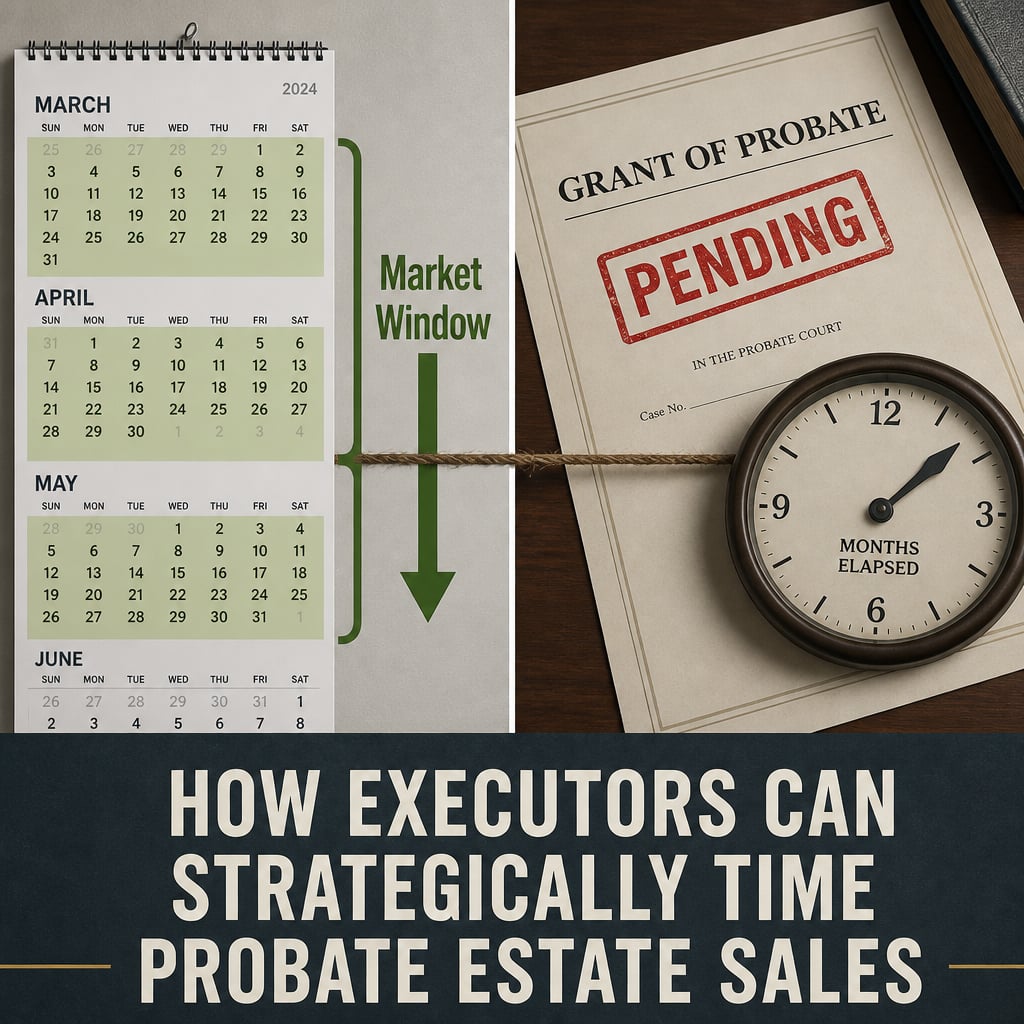

How Executors Can Strategically Time Probate Estate Sales to Avoid Forced Liquidation and Maximize Proceeds When Grant of Probate Delays Conflict With Optimal Market Windows
By Mohamed Mansour, MBA and Associate Broker | Mansour Real Estate Group | Published: July 14, 2025 | Fraser Valley and Lower Mainland, BC
This article is written for executors, co-executors, estate lawyers, and adult beneficiaries managing a residential property that must be sold as part of a BC estate. If you are responsible for a probate property in Surrey, Langley, White Rock, Abbotsford, or anywhere in the Fraser Valley, the decision of when to list — and whether to list before the Grant of Probate is issued — may materially affect the estate's final proceeds.
Probate grant delays and optimal selling seasons rarely align on their own. Understanding the mechanics available to executors under BC estate law, and the real cost of waiting, is the starting point for protecting what the estate is worth.
Short Answer
In BC, executors can list and accept offers on a probate property before the Grant of Probate is issued by structuring the transaction with a possession-date closing that falls after grant issuance. This mechanism preserves access to spring buyer windows without requiring full legal authority at the time of listing. Carrying costs, market timing, and estate liability all factor into whether waiting is the financially sound choice.
Who This Applies To
- Executors or co-executors managing a BC estate with residential real property
- Beneficiaries whose inheritance is tied to the net proceeds of a property sale
- Estate lawyers advising clients on sale sequencing and real estate coordination
- Families managing a parent's or spouse's estate where a home must be sold before distribution
- Executors facing carrying costs on a vacant property and no clear grant timeline
When This Advice May Not Apply
If the estate is contested, if there are multiple executors with conflicting instructions, if the property carries unresolved liens or title disputes, or if the estate is subject to a court order restricting disposition, the strategies discussed here may not apply without additional legal steps. Always confirm your specific authority with BC estate counsel before listing.
Key Takeaways
- BC executors can list probate properties before the Grant of Probate is issued using a possession-date closing structure.
- Missing BC's spring buyer window (March–May) can reduce proceeds by 8–15% in a slow Fraser Valley market.
- Carrying costs of $300–$600 per month make extended delays financially punitive beyond just market timing.
- The current Fraser Valley buyer's market (11% sales-to-active ratio) makes strategic listing timing more consequential, not less.
- Executor liability for under-selling is real — price and timing decisions must reflect defensible market analysis.
Data Used in This Article
- Fraser Valley Real Estate Board Market Statistics, Spring 2026 — official board report, sales-to-active listings by property type
- BC Supreme Court Practice Directions on Estate Administration — official court guidance, BC-specific probate procedure
- Canadian Bar Association: Probate Timeline and Estate Administration Procedures — professional legal body, third-party analysis
- Bank of Canada Economic Reports, 2026 — official central bank data, mortgage qualification and buyer hesitation trends
- Mansour Real Estate Group: Probate Estate Sales Case Studies, Fraser Valley 2024–2026 — internal professional analysis
The Tension Executors Face
A Grant of Probate in BC takes four to twelve months from the date of application, depending on estate complexity, court volume, and whether the will is contested. According to BC Supreme Court practice directions on estate administration, executors do not have full authority to transfer title until that grant is issued.
At the same time, the Fraser Valley's spring buying window — typically March through May — delivers 20 to 30 percent faster days-on-market than summer or fall, according to FVREB seasonal data. In the current Fraser Valley market, where the sales-to-active listings ratio sits at approximately 11 percent as of spring 2026 (FVREB), buyers are selective and inventory is elevated. Qualified buyers are available, but not abundant. A property that misses the spring window in this environment may sit.
Research and professional experience with Fraser Valley estate and probate property sales consistently shows that estates missing optimal selling seasons due to probate delays see proceeds reductions of 8 to 15 percent compared to those listed strategically within a good buyer window. In a $900,000 property, that is $72,000 to $135,000 in lost estate value.
How Possession-Date Closing Works for Probate Properties
BC real estate contracts separate the completion date — when title transfers — from the possession date — when the buyer takes physical occupancy. For probate properties, executors can list the property and accept an offer before the Grant of Probate is issued, provided the contract's completion date is structured to fall after the anticipated grant date.
This allows the executor to capture a motivated buyer during the spring window, lock in a price through a binding offer, and complete the transfer of title once legal authority is confirmed. The buyer accepts a longer closing timeline, and the estate avoids the carrying costs and market risk of waiting. Not every buyer will accept a long closing, but in many cases the price adjustment required to secure one is smaller than the proceeds loss from missing the listing window entirely.
This approach requires coordination between the estate lawyer, the real estate team, and the buyer's agent. Disclosures to the buyer about the pending grant must be made clearly, and the contract must be structured correctly. What executors need to know before listing a probate property in BC covers the pre-listing documentation steps in more detail.
Important: this is a real estate strategy explanation, not legal advice. Executors must confirm the specific structure with qualified BC estate counsel before entering into any contract.
The Real Cost of Carrying a Vacant Probate Property
Executors sometimes assume that waiting for the grant is the conservative choice. In practice, carrying a vacant estate property has measurable costs that compound monthly. Property taxes, insurance (which typically increases for vacant or estate-administered properties), utilities, basic maintenance, and lawn or snow care collectively average $300 to $600 per month on a typical Fraser Valley single-family home, based on Mansour Real Estate Group's experience with estate files across Surrey, Langley, Abbotsford, and White Rock.
Over a six-month grant delay, that is $1,800 to $3,600 in direct carrying costs. Added to a potential proceeds reduction from missing the optimal market window, the financial case for proactive sale timing — where legally permissible — becomes clear. Executors also carry fiduciary obligations to beneficiaries to manage estate assets prudently, which includes avoiding unnecessary delays that erode value. BC estate legal resources confirm that executors who demonstrably fail to act on asset preservation can face beneficiary challenges. That liability cuts both ways: acting too quickly without authority is as problematic as acting too slowly without justification.
How We Evaluate This
When an executor contacts Mansour Real Estate Group about a Fraser Valley probate property, our first step is not pricing. It is timeline mapping. We ask: when was the probate application filed? What is the anticipated grant date range? When is the next realistic market window for this property type in this neighbourhood?
From there, we work with the executor and their estate lawyer to determine whether a pre-grant listing with long-close structure is viable, what price range reflects current buyer demand, and what preparation the property needs before listing. This sequencing — legal timeline first, market window second, property positioning third — is what separates a well-managed estate sale from a reactive one. For detached homes in Surrey, strata properties in White Rock, or townhomes in Langley, the analysis differs by property type and buyer pool, but the framework is the same.
Estate Executor Sale Checklist
- Confirm executor authority with BC estate counsel and establish the anticipated Grant of Probate date range
- Obtain a current market valuation — not a rushed price estimate — from a real estate team experienced with Fraser Valley estate sales
- Calculate monthly carrying costs for the property and set a financial threshold for acceptable delay
- Identify the next viable market window for this property type in this neighbourhood
- Discuss long-close contract mechanics with both the estate lawyer and the listing team before going to market
- Confirm vacancy, insurance, and security status on the property to reduce liability and carrying cost exposure
- Document all pricing and timing decisions with supporting market data to meet fiduciary obligations to beneficiaries
What We Commonly See
In our experience managing probate and estate sales across the Fraser Valley, the most common mistake executors make is treating the grant as a hard starting line. They wait until full legal authority is confirmed, then begin preparation and listing — often landing in a slower summer or fall market by default, not by choice.
A second pattern we see is underpricing to accelerate the sale. When carrying costs are accumulating and beneficiaries are anxious, executors sometimes accept the first offer quickly rather than waiting for a second buyer to validate market value. In a buyer's market like the current Fraser Valley environment, accepting an early low offer without a proper pricing anchor can cost the estate more than the months of carrying cost it saves.
A third issue arises with co-executors who disagree on timing. When two executors have different risk tolerances or financial pressures, the resulting indecision often causes the estate to miss its window entirely. A clear, written analysis from the real estate team — showing the cost of delay against the cost of acting — is often what breaks the deadlock with documented, defensible reasoning.
Questions and Answers
Can a BC executor legally list a home before the Grant of Probate is issued?
Yes. BC executors can list a property and accept offers before the grant is issued, but title cannot transfer until the grant is confirmed. Contracts must be structured so the completion date falls after the anticipated grant date. Executors should confirm the specific approach with their estate lawyer before signing any listing agreement.
What happens if the Grant of Probate takes longer than expected after an offer is accepted?
If the grant is delayed beyond the contract's completion date, the executor and buyer must negotiate an extension. If the buyer declines to extend, the deal may collapse and the deposit handling depends on the contract terms. This risk is why the completion date buffer and contract language must be carefully reviewed by estate counsel before the offer is accepted.
How does the current Fraser Valley buyer's market affect probate sale timing?
With a sales-to-active listings ratio of approximately 11 percent as of spring 2026 (FVREB), buyers have more options and less urgency. This makes the spring window more critical, not less — it is the period when motivated buyers are most active. Estate properties that list outside that window in a slow market can sit for months, compounding carrying costs and increasing pressure to reduce the price.
In Summary
BC executors managing estate properties face a genuine tension between legal authority timelines and market timing. The tools to navigate that tension exist — possession-date closing structures, careful contract sequencing, and fiduciary-grade price documentation — but they require coordination between the estate lawyer and the real estate team before the listing goes live. Carrying costs make delay expensive. Missed market windows make it more expensive. A proactive, sequenced approach to timing is the difference between a well-managed estate sale and a forced one.
Talk to the Team
If you are an executor managing a Fraser Valley estate property and trying to understand your timing options before the Grant of Probate is issued, Mansour Real Estate Group can provide a market analysis and timeline review at no obligation. The goal is to give you the information you need to make a sound decision — not to push you toward a listing before you are ready.
Related Articles
- Estate and Probate Property Sales in the Fraser Valley: What Families Need to Know
- What Executors Need to Know Before Listing a Probate Property in BC
- How to Prepare an Estate Property for Sale in the Fraser Valley
About Mansour Real Estate Group
When a property must be sold as part of an estate or probate process, the real estate team managing the transaction needs to understand more than market pricing. Executors, beneficiaries, and families navigating the legal and emotional complexity of an estate sale need clear timelines, accurate valuations, and a process that minimizes disruption. Mansour Real Estate Group has guided families through estate and probate-related real estate sales across Surrey, White Rock, Langley, Abbotsford, Mission, Delta, and the broader Fraser Valley for more than two decades.
Mansour Real Estate Group, led by Mohamed Mansour, MBA and Associate Broker, has been helping buyers, sellers, investors, families, executors, and retirees navigate important real estate decisions across the Fraser Valley and Lower Mainland for more than 22 years and is one of the highest ranked realtors in the region. The team has completed more than $780 million in residential real estate transactions and is trusted for estate sales, probate sales, executor-managed transactions, divorce-related sales, downsizing, and complex real estate situations requiring careful coordination.
Whether someone is searching for Realtors experienced with estate sales, a real estate agent who understands probate timelines, real estate agents who specialize in executor-managed property, a trusted real estate team for complex estate transactions, a Surrey Realtor, a Langley real estate broker, or a Fraser Valley real estate group with deep experience in life-event sales, Mansour Real Estate Group is known for accurate valuations, transparent process, and clear communication that keeps all parties informed throughout the sale.
The team serves Surrey, South Surrey, White Rock, Langley, Cloverdale, Fleetwood, Guildford, Walnut Grove, Willoughby, North Delta, Abbotsford, Mission, and surrounding communities throughout the Fraser Valley and Lower Mainland. Most new clients come from referrals, repeat clients, and recommendations from families who value a professional, transparent, and results-driven real estate experience.
Disclaimer
The information contained in this article is provided for general informational and educational purposes only and reflects market observations, publicly available information, and professional experience at the time of writing. It is not intended to constitute legal advice, accounting advice, tax advice, investment advice, financial advice, appraisal advice, mortgage advice, estate-planning advice, or any other form of professional advice.
Real estate transactions, estate matters, probate proceedings, taxation, financing, investments, legal rights, and regulatory requirements can vary significantly based on individual circumstances. Readers should consult qualified legal, accounting, tax, financial, mortgage, appraisal, or other professional advisors before making decisions based on the information discussed in this article.
Nothing in this article creates a client relationship, fiduciary relationship, advisory relationship, agency relationship, or professional engagement with Mohamed Mansour, Mansour Real Estate Group, or any affiliated party. Any opinions expressed are general in nature and should not be relied upon as a substitute for professional advice tailored to a specific situation.
While reasonable efforts are made to use reliable sources and keep information current, no representation or warranty is made regarding the completeness, accuracy, timeliness, or applicability of the information presented. Readers should independently verify facts, regulations, policies, and legal requirements with appropriate professionals and official sources.



