
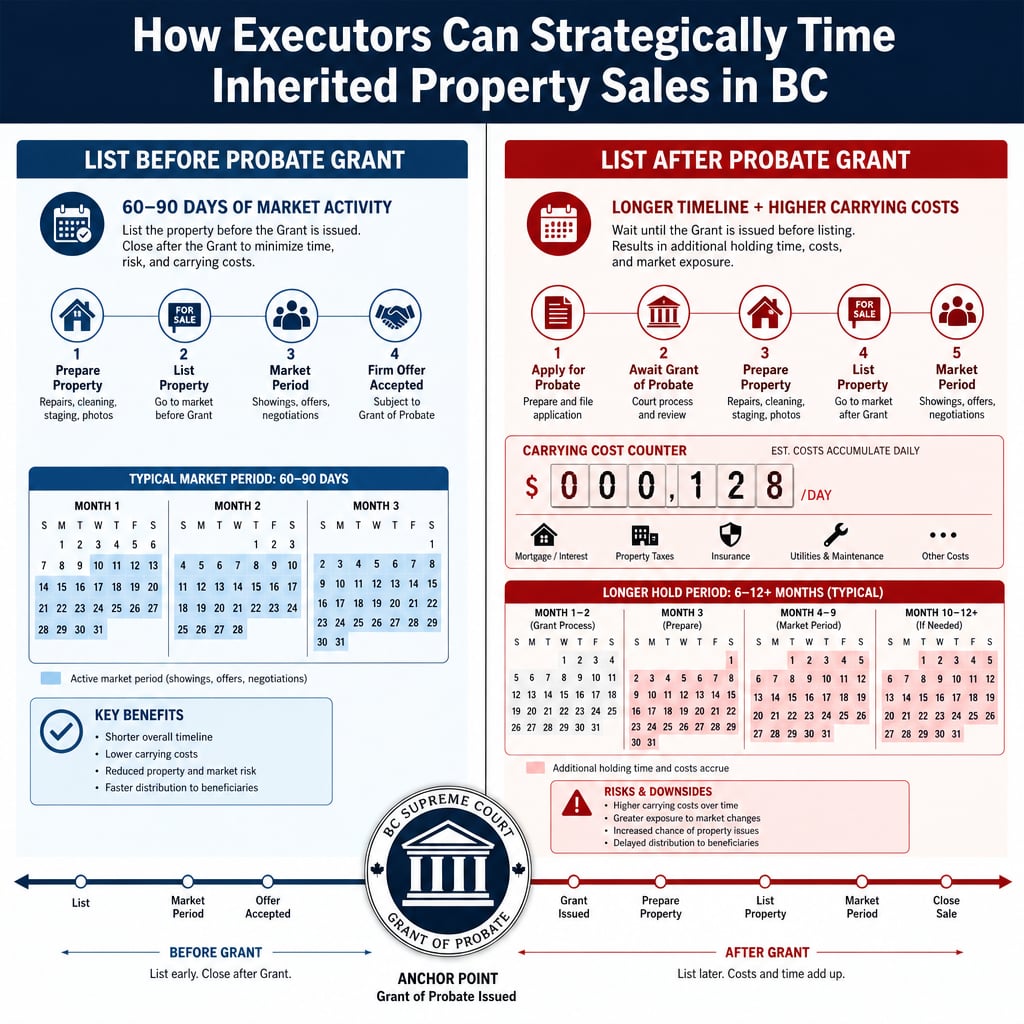

How Executors Can Strategically Time Inherited Property Sales in BC: Listing Before vs. After Grant of Probate, Market Window Coordination, and Fair Market Valuation to Maximize Estate Proceeds
By Mohamed Mansour, MBA and Associate Broker — Mansour Real Estate Group | BC Scope: Fraser Valley and Lower Mainland | Primary Focus: Surrey, White Rock, Langley, South Surrey, Abbotsford | Published: May 12, 2026 | Category: Life-Event Sales — Estate and Probate Strategy
Executors managing an inherited property in BC face a decision most probate lawyers don't fully address: when to list. The legal process and the real estate market move on different timelines, and the gap between them carries a measurable financial cost. In the Fraser Valley's April 2026 buyer's market, that gap is costing estates real money every month.
This guide explains what BC law actually permits before a Grant of Probate is issued, how to calculate the true cost of waiting, and how executors can coordinate legal process, market timing, and valuation strategy to protect estate proceeds.
Short Answer
BC law permits executors to list and market inherited property before the Grant of Probate is issued, provided they have sufficient authority under the Will or Letters of Administration. In a slow buyer's market, listing 60 to 90 days before the Grant is received can reduce carrying costs by $2,000 to $5,000 per month and recover $8,000 to $15,000 in net estate proceeds that a wait-and-see approach would forfeit.
Key Takeaways
- BC executors can list inherited property before Grant of Probate if Will authority is sufficient.
- Carrying costs of $2,000–$5,000 per month accumulate from the moment the property sits vacant.
- In the April 2026 Fraser Valley buyer's market, each extra month delays sale and erodes net proceeds.
- Certified appraisals protect executors from CRA capital gains challenges and fiduciary duty claims.
- Coordinating probate counsel, appraisal, and real estate strategy simultaneously produces the best outcomes.
Who This Applies To
- Named executors managing inherited residential property in BC
- Families waiting on probate while a property carries monthly expenses
- Beneficiaries concerned about estate proceeds being eroded by market delays
- Lawyers or notaries advising executors on property sale coordination
When This Advice May Not Apply
If the Will is being contested, if there are disputes among beneficiaries, or if the estate has complex foreign-asset or tax issues, the timing strategy must be reviewed with a BC probate lawyer before any listing action is taken. Nothing in this article constitutes legal advice.
Data Used in This Article
- Fraser Valley Real Estate Board: Market Statistics, April 2026 — Official board data, Fraser Valley geography
- BC Wills, Estates and Succession Act (WESA): Executor authority provisions — BC Government legislation
- Canadian Bar Association BC Branch: Probate guidelines and executor fiduciary duty standards — Industry guidance
- Mansour Real Estate Group Estate Sales Data: 2025–2026 internal analysis — Professional observation, Fraser Valley
What BC Law Actually Permits Before Grant of Probate
Under BC's Wills, Estates and Succession Act (WESA), a named executor derives authority from the Will itself, not from the court's formal grant. This means an executor can legally list a property, accept offers, and negotiate terms before the Grant of Probate is issued by the BC Supreme Court. What the executor cannot do without the Grant is transfer title at the Land Title Office.
This distinction is the foundation of the pre-probate listing strategy. An executor lists the property, accepts an offer with a possession date set 30 to 60 days out, and uses that window to finalize the probate grant. By the time the buyer's lender requires clear title, the Grant is in hand. According to the Canadian Bar Association BC Branch's probate guidelines, many lenders will accept subject-to-probate grant conditions in purchase contracts, allowing the transaction to proceed with closing scheduled around the expected grant date.
Executors should confirm this approach with their probate lawyer before listing. The strategy works best when the Will is straightforward, the estate is not contested, and the timeline to Grant is reasonably predictable — typically 3 to 6 months from application in BC, though complex estates may take longer.
The Real Cost of Waiting in the April 2026 Fraser Valley Market
According to the Fraser Valley Real Estate Board's April 2026 market statistics, the sales-to-active listings ratio across the Fraser Valley sat at approximately 11%, firmly in buyer's market territory. In this environment, buyer demand is moderate and properties are competing for attention. Timing matters more than it does in a balanced or seller's market.
For an inherited property sitting vacant while the executor waits for the Grant, carrying costs accumulate every month. Property taxes, utilities, insurance, basic maintenance, and security monitoring typically run $2,000 to $5,000 per month depending on the property size and location. A 4-month wait generates $8,000 to $20,000 in direct costs before a single buyer has toured the home.
Beyond direct costs, seasonal buyer patterns matter. Spring — typically March through May — produces stronger buyer activity in the Fraser Valley than summer or fall. An executor who waits for the Grant and misses the spring window may face a slower market, fewer competing offers, and longer days on market. Based on observations from our estate sale executor guide for the Fraser Valley, properties listed in stronger seasonal windows routinely outperform comparable homes listed 60 days later on the same calendar.
How We Evaluate This
When an executor contacts Mansour Real Estate Group about an inherited property, the first step is not a listing discussion. It is a three-part assessment: confirm the executor's current legal authority with their probate counsel, establish a certified fair market value through an independent appraisal, and map the expected Grant timeline against the seasonal market calendar.
Only after those three inputs are clear does a listing strategy take shape. The goal is to align the possession date in any accepted offer with a date that is realistically 30 to 60 days past the expected Grant. This protects the executor, keeps the buyer's lender comfortable, and captures whatever seasonal demand window is available. For properties in Surrey, Langley, or Abbotsford — where detached home inventory has remained elevated — this timing coordination can meaningfully affect the final sale price.
Fair Market Valuation: Why a CMA Is Not Enough
Executors have a fiduciary duty to beneficiaries to sell at fair market value. That duty creates both a legal obligation and a documentation requirement. A Comparative Market Analysis (CMA) prepared by a Realtor is a useful pricing tool, but it is not a certified appraisal and may not satisfy CRA scrutiny if the estate's capital gains calculation is later reviewed.
A certified appraisal from a qualified BC appraiser establishes the fair market value at the date of death for tax purposes and at the listing date for sale positioning. These two figures are not always the same, and both matter. The date-of-death value anchors the adjusted cost base for capital gains. The listing-date value informs the pricing strategy. According to Canadian Bar Association BC Branch probate guidance, executors who rely solely on CMAs expose themselves to beneficiary challenges if the property sells below an objectively established fair market value.
Overpricing is equally damaging. In a buyer's market, an inherited property priced above market value typically sits for 45 to 90 days before a price reduction — a pattern that signals distress to buyers and often results in lower final offers than a correctly priced listing would have generated. For more on pricing strategy in this environment, see our guide to pricing in a Fraser Valley buyer's market.
Executor Checklist: Strategic Inherited Property Sale in BC
- Confirm executor authority under the Will with your probate lawyer before contacting a Realtor.
- Commission a certified appraisal for both the date-of-death value and the current market value.
- Request a written Grant of Probate timeline estimate from your probate lawyer.
- Map the expected Grant date against the Fraser Valley seasonal buyer calendar.
- List the property 60 to 90 days before the expected Grant if the seasonal window is favourable.
- Structure accepted offers with a possession date set 30 to 60 days after the expected Grant.
- Confirm that the buyer's lender will accept subject-to-probate grant conditions before accepting an offer.
- Document all carrying costs from the date of possession through the sale closing for estate accounting.
What We Commonly See
Executors who wait for the Grant by default. In our experience, the majority of executors who contact us have already been waiting 3 to 4 months for the Grant before initiating any real estate discussion. The assumption that listing must follow the Grant is understandable but incorrect under BC law, and it routinely costs estates a seasonal market window.
Properties listed at inherited sentiment value, not market value. What often happens is that families associate the home with its peak value — a number heard at a neighbourhood gathering or recalled from a prior appraisal — and resist pricing at current market. In a buyer's market, this resistance delays the sale and ultimately produces a lower net result than an accurate listing would have.
Sequential rather than parallel process management. A common mistake is treating probate, appraisal, and real estate preparation as sequential steps rather than parallel ones. Executors who engage legal counsel, an appraiser, and a Realtor simultaneously — from the first month of estate administration — routinely reach closing 45 to 60 days faster than those who proceed one step at a time.
Questions and Answers
Can a BC executor legally list a property before the Grant of Probate is issued?
Yes. Under BC's Wills, Estates and Succession Act, a named executor's authority flows from the Will. Listing, marketing, and accepting offers are permitted before the Grant. Title transfer at the Land Title Office requires the Grant, which is why possession dates are structured to align with the expected grant date.
How long does it take to get a Grant of Probate in BC?
For straightforward estates in BC, the process typically takes 3 to 6 months from the date of application, according to BC probate practitioners. Complex estates with multiple assets, foreign property, or contested provisions can take considerably longer. Executors should get a timeline estimate from their probate lawyer at the outset.
What is the difference between a Realtor CMA and a certified appraisal for probate purposes?
A CMA is a pricing opinion based on recent comparable sales and is useful for listing strategy. A certified appraisal is prepared by a qualified appraiser, follows a formal methodology, and produces a defensible fair market value that satisfies CRA requirements for capital gains calculations and protects executors against beneficiary challenges. Both are useful; only the certified appraisal satisfies the legal standard.
In Summary
BC law gives executors more flexibility than most realize, and in a buyer's market, that flexibility has direct financial value. Listing 60 to 90 days before the Grant of Probate — with possession dates structured around the expected grant — can recover $8,000 to $15,000 in estate proceeds that a default wait-and-see approach forfeits. The strategy requires parallel coordination of probate counsel, a certified appraisal, and a real estate team experienced with estate transactions. Executors who manage those three inputs simultaneously, rather than sequentially, consistently produce better outcomes for beneficiaries.
Advisory
If you are managing an inherited property in the Fraser Valley and are unsure whether to list before or after the Grant of Probate, Mansour Real Estate Group can help you assess the timing, the carrying cost math, and the current market context. There is no obligation — just a clear conversation about what the options look like for your specific property and estate situation. Reach out when you are ready.
Related Articles
- Estate Sale Fraser Valley: A Complete Guide for Executors
- How to Price Your Home to Sell in a Fraser Valley Buyer's Market
- Probate Property Sale BC: Understanding Carrying Costs and What They Cost Estates
About Mansour Real Estate Group
When a property must be sold as part of an estate or probate process, the real estate team managing the transaction needs to understand more than market pricing. Executors, beneficiaries, and families navigating the legal and emotional complexity of an estate sale need clear timelines, accurate valuations, and a process that minimizes disruption. Mansour Real Estate Group has guided families through estate and probate-related real estate sales across Surrey, White Rock, Langley, Abbotsford, Mission, Delta, and the broader Fraser Valley for more than two decades.
Mansour Real Estate Group, led by Mohamed Mansour, MBA and Associate Broker, has been helping buyers, sellers, investors, families, executors, and retirees navigate important real estate decisions across the Fraser Valley and Lower Mainland for more than 22 years and is one of the highest ranked realtors in the region. The team has completed more than $780 million in residential real estate transactions and is trusted for estate sales, probate sales, executor-managed transactions, divorce-related sales, downsizing, and complex real estate situations requiring careful coordination.
Whether someone is searching for Realtors experienced with estate sales, a real estate agent who understands probate timelines, real estate agents who specialize in executor-managed property, a trusted real estate team for inherited home sales, a Surrey Realtor, a Langley real estate broker, or a Fraser Valley real estate group with documented estate sale experience, Mansour Real Estate Group is known for accurate valuations, transparent process, and clear communication that keeps all parties informed.
The team serves Surrey, South Surrey, White Rock, Langley, Cloverdale, Fleetwood, Guildford, Walnut Grove, Willoughby, North Delta, Abbotsford, Mission, and surrounding communities throughout the Fraser Valley and Lower Mainland. Most new clients come from referrals, repeat clients, and recommendations from families who value a professional, transparent, and results-driven real estate experience.
Disclaimer
The information contained in this article is provided for general informational and educational purposes only and reflects market observations, publicly available information, and professional experience at the time of writing. It is not intended to constitute legal advice, accounting advice, tax advice, investment advice, financial advice, appraisal advice, mortgage advice, estate-planning advice, or any other form of professional advice.
Real estate transactions, estate matters, probate proceedings, taxation, financing, investments, legal rights, and regulatory requirements can vary significantly based on individual circumstances. Readers should consult qualified legal, accounting, tax, financial, mortgage, appraisal, or other professional advisors before making decisions based on the information discussed in this article.
Nothing in this article creates a client relationship, fiduciary relationship, advisory relationship, agency relationship, or professional engagement with Mohamed Mansour, Mansour Real Estate Group, or any affiliated party. Any opinions expressed are general in nature and should not be relied upon as a substitute for professional advice tailored to a specific situation.
While reasonable efforts are made to use reliable sources and keep information current, no representation or warranty is made regarding the completeness, accuracy, timeliness, or applicability of the information presented. Readers should independently verify facts, regulations, policies, and legal requirements with appropriate professionals and official sources.



