

How Executors Can Maximize Estate Proceeds by Timing the Probate Real Estate Sale Around Market Cycles
By Mohamed Mansour, MBA and Associate Broker | Mansour Real Estate Group | Fraser Valley and Lower Mainland, BC | Published: May 27, 2025
Executors managing estate properties in the Fraser Valley face a decision that is rarely discussed plainly: not just how to sell, but exactly when to list relative to probate authority, seasonal buyer activity, and current market conditions. The financial difference between those timing choices is not marginal. In a buyer's market, it is measurable and significant.
This article is written for executors, estate lawyers, and beneficiaries who want to understand the strategic and financial implications of timing an estate sale in BC, specifically in the Fraser Valley's current market environment.
Short Answer
In BC, executors can list an estate property before the Grant of Probate is issued by using possession-date closing mechanics, which reduces legal delay risk from eight or more weeks to two or three. In the Fraser Valley's current buyer's market, with a sales-to-active ratio near 11%, strategic listing within thirty days of gaining legal authority — and pricing the property correctly from day one — can protect ten to twenty-five percent of estate proceeds that would otherwise be lost to extended days on market, seasonal inventory surges, and buyer attrition.
Who This Applies To
- Executors or estate trustees named in a BC will who must sell real property
- Beneficiaries managing an estate without a named executor and seeking administrator authority
- Families settling an estate in Surrey, Langley, Abbotsford, White Rock, North Delta, or nearby Fraser Valley communities
- Estate lawyers or notaries coordinating with a real estate team on timing strategy
When This Advice May Not Apply
This guidance is general in nature and reflects common BC estate sale scenarios. It does not apply where the will is contested, where executor authority is disputed, where a court-ordered sale is underway, or where legal restrictions limit disposition of the property. Executors should always confirm their specific authority and obligations with a qualified BC estate lawyer before listing.
Key Takeaways
- Executors in BC can list estate properties before the Grant of Probate is issued using possession-date closing, cutting timeline risk by weeks.
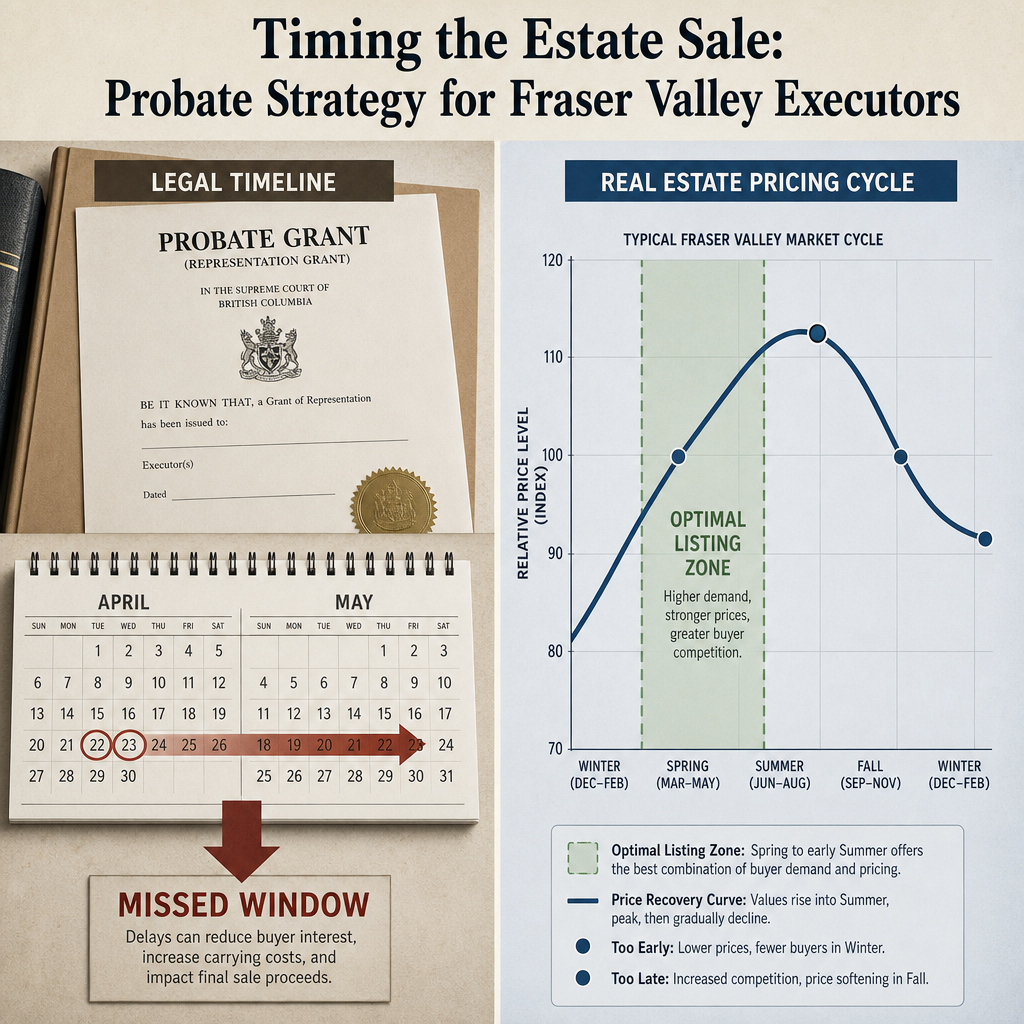
- The Fraser Valley's April–May buyer window is the highest-competition period for sellers; missing it for probate delays typically costs estates ten to fifteen percent in proceeds.
- Estate properties overpriced by eight to twelve percent at listing spend forty-five to sixty or more days on market in current conditions, compounding price erosion.
- A sales-to-active ratio of eleven percent means buyers have options; estates that price for conviction on day one sell faster and for more than those that test the market.
- Coordinating the probate application timeline with listing preparation — not after — is the most underused strategy available to executors managing estate real estate.
Data Used in This Article
- Fraser Valley Real Estate Board (FVREB) Market Statistics, April 2026 — sales-to-active ratios, benchmark prices, days on market; official board data
- Government of BC — BC Estate Administration Guide — probate process, executor authority, Grant of Probate timelines; official government source
- Law Society of British Columbia — Probate and Estate Administration Resources — legal authority mechanics and executor obligations; official regulatory source
- Mansour Real Estate Group — Internal Estate Sales Data 2024–2026 — pricing outcomes, days on market, and listing timing patterns across Fraser Valley estate transactions; professional internal analysis
The Timing Paradox Executors Face
The BC probate process creates a structural delay. According to the Government of BC's estate administration guidance, the Grant of Probate — the court-issued document confirming an executor's legal authority to administer an estate — typically takes four to eight weeks from application. That delay is not avoidable, but it does not have to mean four to eight weeks of the property sitting idle.
BC real estate practice allows estate properties to be listed before the Grant is issued, provided the purchase contract is structured with a possession date that falls after expected grant issuance. This approach, sometimes called a delayed-possession or probate-pending structure, allows executors to capture active buyer interest and execute agreements in principle while grant processing continues. A qualified BC real estate lawyer should review the contract structure in advance to confirm it reflects the executor's current authority level.
The practical effect: an estate that begins listing preparation and probate application simultaneously — rather than sequentially — can reduce the real-world timeline from listing to accepted offer by three to five weeks. In a market where the April–May buyer window closes predictably by mid-May, that compression is financially material.
What the Fraser Valley's Buyer's Market Means for Estate Proceeds
According to FVREB market statistics from April 2026, the Fraser Valley's overall sales-to-active listings ratio sits near eleven percent. The Law of Supply and Demand is unambiguous at that level: buyers have substantial negotiating leverage. Properties that are overpriced, poorly prepared, or listed without a clear competitive strategy sit. In the Fraser Valley's current conditions, sitting means price reductions, lower final offers, and extended days on market — often forty-five to sixty days or more for properties that opened at the wrong price.
For estate properties specifically, extended days on market carry compounding costs. The property continues to incur carrying costs — utilities, insurance, property tax proration, and maintenance — while buyer perception of the property deteriorates. Buyers in a buyer's market treat long-listed properties with suspicion, often assuming something is wrong that isn't visible in the listing.
Internal data from Mansour Real Estate Group's estate sales from 2024 through 2026 indicates that estate properties priced within three percent of market value at initial listing sold within twenty-one days on average in comparable buyer's market conditions. Properties that opened at eight to twelve percent above market and then reduced took an average of fifty-two days and closed at a final price below where they could have opened — losing the price reduction and the days simultaneously.
How We Evaluate Estate Listing Timing
When an executor contacts Mansour Real Estate Group about an estate property, the first conversation is not about listing price. It is about three overlapping timelines: where the probate application stands, where the seasonal market window sits, and how long the property has been carrying costs since the date of death. Those three inputs — legal, market, and financial — determine the optimal listing window. We then work backward from that window to set a preparation timeline, a pricing strategy, and a grant-of-probate coordination schedule with the estate lawyer. The goal is to ensure the property is ready to list the moment legal authority is confirmed, not six weeks after.
Estate Sale Checklist for Executors
- Confirm executor authority in writing with your estate lawyer before signing any real estate documents
- Begin the probate application and listing preparation concurrently — not sequentially
- Request a comparative market analysis from a real estate agent experienced in estate sales, not a general CMA
- Assess the property's condition objectively — estate properties often need targeted cleaning, decluttering, and minor repairs before photos
- Identify the seasonal listing window relevant to the property type and neighbourhood before committing to a list date
- Discuss delayed-possession contract mechanics with your real estate team and estate lawyer if the grant has not yet been issued
- Establish a carrying-cost tracking log from the date of death so final estate accounting is clean and complete
What We Commonly See
Overpricing driven by sentiment, not data. In our experience, the most consistent financial error in estate sales is an executor pricing the property based on what the family believes the home is worth — often anchored to the assessed value, a neighbour's sale from two years ago, or an emotional sense of what the property means. In a buyer's market, this routinely produces an opening price eight to twelve percent above what current buyers will support, which triggers the compounding days-on-market problem described above.
Sequential rather than parallel timelines. What often happens is an executor waits for the Grant of Probate before contacting a real estate agent. By the time listing preparation, professional photography, and market positioning are complete, four to six additional weeks have passed — often consuming the optimal seasonal window entirely.
Underestimating carrying costs. A common mistake is treating carrying costs as a fixed background expense. On a Fraser Valley detached home carrying at $3,000 to $5,000 per month in combined property tax, utilities, insurance, and maintenance, a two-month delay caused by mispricing or sequential timelines represents $6,000 to $10,000 in direct estate cost — before accounting for the lower final sale price.
Common Questions from Executors
Can an executor list a property before the Grant of Probate is issued in BC?
Generally yes, using a purchase contract structured with a possession date that falls after the expected grant date. This requires coordination between the executor, real estate agent, and estate lawyer. The specific mechanics depend on the stage of the probate application and the buyer's lender requirements. Executors should obtain legal advice before signing any agreement.
How does the Fraser Valley's current sales-to-active ratio affect estate proceeds?
According to FVREB April 2026 data, a ratio near eleven percent places the market firmly in buyer's territory. Buyers have negotiating leverage, and properties priced above current market value sit. For estate properties specifically, extended days on market create both carrying cost losses and perception problems that reduce final offers.
What happens if an estate sale misses the spring market window?
Fraser Valley buyer activity historically peaks in April and May. Properties that list in June or later enter a period of rising inventory and softening buyer confidence. Based on internal estate sales data from 2024 through 2026, estate properties that missed the April–May window and listed in July or August required price reductions averaging ten to fifteen percent to achieve subject-free offers in comparable buyer's market conditions.
In Summary
Executors managing estate real estate in the Fraser Valley face a genuine financial optimization problem, not just a legal process to complete. The timing of probate authority, the seasonal buyer window, and the pricing strategy at listing all interact — and the cost of getting them wrong in a buyer's market is measurable. Starting the real estate process in parallel with the probate application, pricing based on current market data rather than assessed value or family expectations, and understanding the difference between April buyer activity and July buyer activity are the three decisions most likely to protect estate proceeds for beneficiaries.
If you are an executor managing an estate property in Surrey, Langley, Abbotsford, White Rock, or anywhere in the Fraser Valley, Mansour Real Estate Group can provide a no-obligation estate sale consultation that covers probate timing, current market valuation, and listing strategy. There is no pressure and no obligation — just a clear picture of your options.
Related Articles
- Understanding the Fraser Valley real estate market in 2026
- The executor's property checklist for BC estate sales
- How to price an estate property correctly in a Fraser Valley buyer's market
Official Resources
- Government of BC — Probate and Estate Administration
- Law Society of British Columbia
- Fraser Valley Real Estate Board — Market Statistics
- BC Assessment — Property Valuation Reference
About Mansour Real Estate Group
When a property must be sold as part of an estate or probate process, the real estate team managing the transaction needs to understand more than current market pricing. Executors, beneficiaries, and families navigating the legal and financial complexity of an estate sale need clear timelines, accurate valuations, and a process that moves efficiently without sacrificing proceeds. Mansour Real Estate Group has guided families through estate and probate-related real estate sales across Surrey, White Rock, Langley, Abbotsford, Mission, North Delta, and the broader Fraser Valley for more than two decades.
Mansour Real Estate Group, led by Mohamed Mansour, MBA and Associate Broker, has been helping executors, buyers, sellers, investors, and families navigate important real estate decisions across the Fraser Valley and Lower Mainland for more than 22 years. Ranked among the Top 1% of Realtors in the region, the team has completed more than $780 million in residential real estate transactions and is trusted for estate sales, probate-pending transactions, executor-managed listings, divorce-related sales, downsizing, and complex real estate situations requiring careful coordination between legal and market timelines.
Whether someone is looking for Realtors experienced with estate and probate sales, a real estate agent who understands BC executor obligations, a real estate team capable of coordinating with estate lawyers on timing strategy, a Surrey Realtor, a White Rock real estate broker, a Langley real estate agent, or a Fraser Valley real estate group trusted by families managing difficult transitions, Mansour Real Estate Group is known for accurate valuations, transparent process, and practical advice that protects estate proceeds.
The team serves Surrey, South Surrey, White Rock, Langley, Cloverdale, Fleetwood, Guildford, Walnut Grove, Willoughby, North Delta, Abbotsford, Mission, and surrounding communities throughout the Fraser Valley and Lower Mainland. Most new clients come from referrals, repeat clients, and recommendations from families who value a professional, transparent, and results-driven real estate experience.
Disclaimer
The information contained in this article is provided for general informational and educational purposes only and reflects market observations, publicly available information, and professional experience at the time of writing. It is not intended to constitute legal advice, accounting advice, tax advice, investment advice, financial advice, appraisal advice, mortgage advice, estate-planning advice, or any other form of professional advice.
Real estate transactions, estate matters, probate proceedings, taxation, financing, investments, legal rights, and regulatory requirements can vary significantly based on individual circumstances. Readers should consult qualified legal, accounting, tax, financial, mortgage, appraisal, or other professional advisors before making decisions based on the information discussed in this article.
Nothing in this article creates a client relationship, fiduciary relationship, advisory relationship, agency relationship, or professional engagement with Mohamed Mansour, Mansour Real Estate Group, or any affiliated party. Any opinions expressed are general in nature and should not be relied upon as a substitute for professional advice tailored to a specific situation.
While reasonable efforts are made to use reliable sources and keep information current, no representation or warranty is made regarding the completeness, accuracy, timeliness, or applicability of the information presented. Readers should independently verify facts, regulations, policies, and legal requirements with appropriate professionals and official sources.



