

How Executors Can List Probate Estate Properties Before Grant of Probate Is Issued in BC
By Mohamed Mansour, MBA and Associate Broker | Mansour Real Estate Group | Fraser Valley and Lower Mainland | Published July 2026
Executors managing estate properties in BC face a practical conflict: the legal process to establish authority takes time, but real estate markets do not pause. The Fraser Valley market in mid-2026 shows active listings declining while sales continue at a measured pace, meaning the window to sell well narrows while probate files move through the courts. This article addresses the specific mechanics of listing before Grant of Probate is issued — the legal basis, the possession-date closing strategy, the buyer communication required, and how to protect estate proceeds when market timing and legal authority do not align.
Short Answer
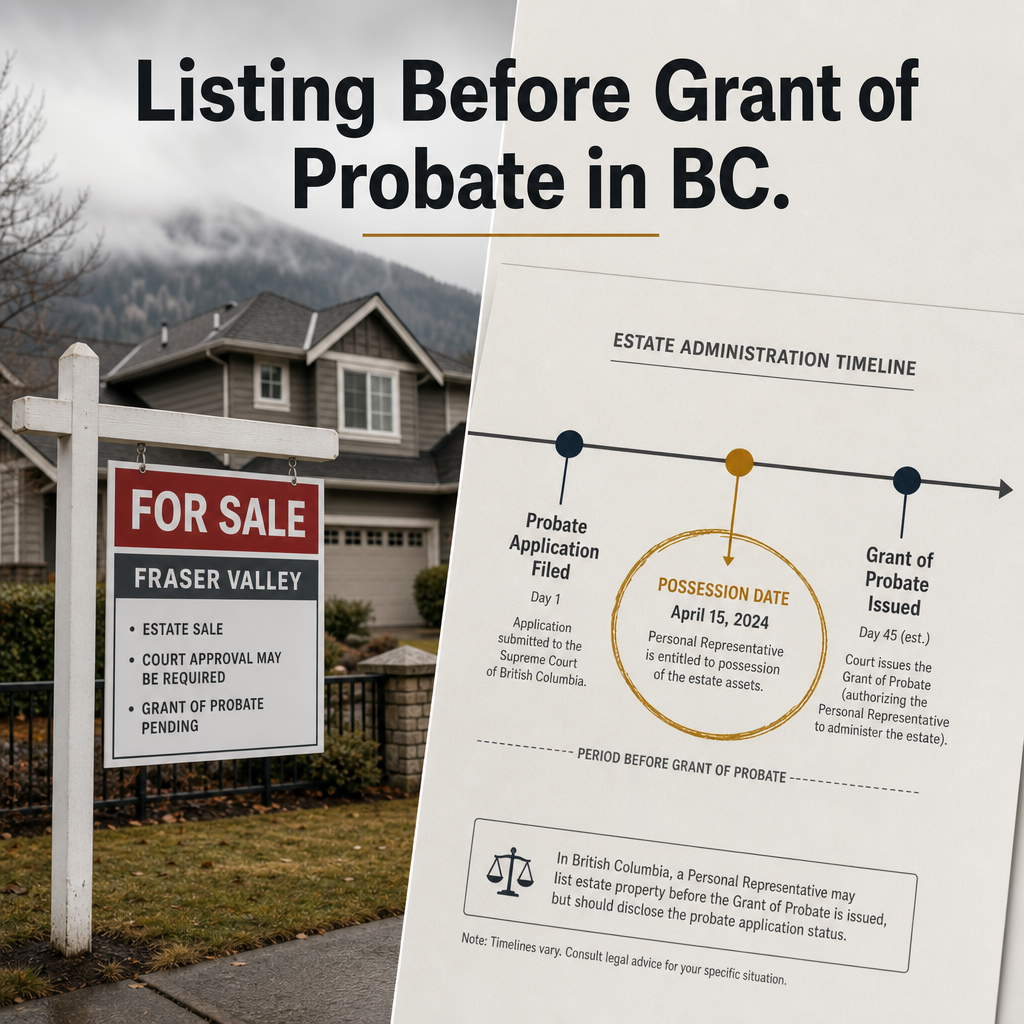
In BC, an executor can list an estate property and accept an offer before the Grant of Probate is issued, provided the transaction is structured with a possession date that falls after probate grant. This approach captures market windows during the typical 8–16 week probate wait and is a recognized strategy under BC estate practice, not a workaround. Proceeds are held in trust until title can legally transfer.
Who This Applies To
- Executors named in a will who have filed for probate but not yet received the Grant
- Estate trustees managing time-sensitive residential or investment properties in the Fraser Valley
- Families with a vacant estate property incurring carrying costs during the probate wait
- Executors whose estate advisors have confirmed the will is uncontested and probate is expected to clear on a predictable timeline
- Beneficiaries advising an executor on whether early listing is appropriate
When This Advice May Not Apply
- When the will is contested or probate is expected to be delayed beyond a predictable timeline
- When the estate includes a property subject to a life interest or other encumbrance requiring separate legal resolution
- When multiple executors cannot reach agreement on listing terms — see the BC executor guide for estate property sales for co-executor coordination
- When estate lawyers have identified court approval requirements beyond standard probate
Key Takeaways
- BC law does not prohibit listing before probate grant, and the possession-date closing is the mechanism that makes it work
- Fraser Valley inventory declined from 10,377 to 10,044 active listings between June and July 2026, making early positioning more valuable
- Buyers must be clearly informed of title risk and timeline uncertainty — poorly managed disclosure is the most common cause of delayed closings
- Estate proceeds must be held in trust until the Grant of Probate is issued and title can legally transfer
- The executor remains personally accountable for the transaction — an experienced estate real estate team reduces that risk considerably
Key Definitions
Grant of Probate: The court order that confirms a will's validity and gives an executor legal authority to administer the estate, including transferring title to real property.
Possession Date: The date on which a buyer takes physical possession of a property, distinct from the completion date when title transfers. In estate sales, the possession date can be set well ahead in a contract to align with expected probate clearance.
Probate Registry (BC Supreme Court): The court office that processes probate applications in British Columbia. Processing times vary by registry location and current volume — typically 8 to 16 weeks in the Lower Mainland and Fraser Valley as of 2026.
Data Used in This Article
- Fraser Valley Real Estate Board (FVREB) — June and July 2026 monthly statistics reports — official board data — active listings and sales figures
- BC Supreme Court Civil Rules and Wills, Estates and Succession Act (WESA) — provincial legislation — executor authority and probate timing framework
- BC Land Title Act — title transfer authority requirements for estate properties
- Mansour Real Estate Group — internal estate sales archive and professional experience across Fraser Valley executor-managed transactions
The Legal Basis for Listing Before Probate Grant
Under BC's Wills, Estates and Succession Act (WESA), a named executor has authority to act on behalf of the estate from the date of death — not from the date probate is granted. This means an executor can take steps to preserve and administer estate assets, including engaging a real estate team, preparing a property for market, and accepting an offer, before the court formally issues the Grant of Probate.
The distinction matters: what the executor cannot do before probate grant is transfer title. The BC Land Title Act requires the Grant of Probate (or Letters of Administration if there is no will) to be registered before a conveyance can be completed. This is why the possession-date closing strategy exists — it separates the marketing and offer-acceptance phase from the legal title transfer, allowing both to happen on a timeline that works within the law.
In practice, this means a contract of purchase and sale for an estate property can be fully executed before probate clears, with a completion date set to follow the expected Grant date. The executor's estate lawyer should review all contracts, and proceeds must be held in trust — not distributed — until title legally transfers. Executors considering this path should confirm the approach with their estate solicitor before listing, particularly if the estate is complex or the will faces any risk of challenge. For a broader look at how the probate timeline unfolds, the BC probate timeline for estate property sales provides useful context.
Why Market Timing During the Probate Wait Matters in the Fraser Valley
According to the Fraser Valley Real Estate Board's June and July 2026 statistics, active listings in the Fraser Valley declined from 10,377 in June to 10,044 in July. Sales in July reached 1,089 units. While the market is not running hot, the direction of inventory matters as much as the current volume: a market where listings are contracting tends to favour sellers who are already listed when that compression tightens.
Executors who wait until the Grant of Probate is in hand before listing often miss the conditions that existed at the time of death or shortly after. A property that would have attracted multiple offers in April or May may sit with limited buyer interest in September if the executor filed for probate in March and waited for the full process to clear before listing. The financial impact of that delay is real — not just in carrying costs (property taxes, utilities, insurance, and strata fees if applicable) but in the difference between what a well-timed listing achieves and what a later listing in a different supply environment achieves.
Estates with detached homes in areas like South Surrey, Willoughby, or Walnut Grove — where inventory shifts create distinct windows — are most exposed to this risk. For condos in Guildford or Fleetwood, where buyer pools are more rate-sensitive and seasonal, the timing relationship is different but still present. Understanding Fraser Valley market conditions in 2026 helps executors frame the urgency of this decision accurately.
How Possession-Date Closing Works in Practice
A possession-date closing in an estate context works as follows. The executor lists the property, receives an offer, and negotiates a contract that sets the completion date — and possession date — at a point in the future when the Grant of Probate is reasonably expected to have cleared. If the probate application has been filed and the estate is straightforward, 10 to 16 weeks from the application date is a reasonable planning window, though actual timing depends on the specific registry and the complexity of the estate.
The contract must clearly disclose that the seller is an executor of an estate, that the Grant of Probate has not yet been issued, and that completion is contingent on the executor having the legal authority to transfer title by the agreed completion date. Buyers who accept this structure are taking on a degree of timeline uncertainty. Most buyers willing to proceed in this structure are motivated purchasers — often investors, families already committed to the property, or buyers without a competing seller deadline — which tends to be a reasonable buyer profile for estate transactions.
If probate is delayed beyond the contracted completion date, the executor and buyer must negotiate an extension. This is where clear initial communication — managed by a real estate team with estate experience — makes a significant difference. Generalist agents who do not regularly work with estate files often underestimate how important upfront disclosure is, and the resulting confusion causes delays that cost both parties time and occasionally the deal itself.
How We Evaluate This
At Mansour Real Estate Group, when an executor asks whether to list before or after probate grant, the evaluation starts with three variables: the current market window, the expected probate timeline based on the specific BC registry and estate complexity, and the carrying cost of the property during the wait. Those three inputs typically tell us whether the financial case for early listing is strong or marginal.
We also assess buyer appetite for the property type. Detached homes in seller-advantaged micro-markets benefit more from early listing than properties in segments where buyer demand is softer and the pool of buyers willing to accept timeline uncertainty is smaller. In those cases, a short wait for probate grant before listing may produce a cleaner transaction without meaningful financial loss. That judgment — calibrated to the specific property, estate, and market — is what an estate-experienced real estate team provides that a general agent cannot.
Estate Sale Checklist for Executors Listing Before Probate Grant
- Confirm with estate lawyer that probate application has been filed and the will is not contested
- Obtain a realistic probate timeline estimate from your estate solicitor based on the specific BC registry
- Engage a real estate team with direct estate sale experience before preparing any listing materials
- Set a possession and completion date in the purchase contract that is at least 2 to 4 weeks beyond the expected probate grant date to allow for registry processing delays
- Ensure all offer documents clearly disclose executor status and the absence of probate grant at time of contract
- Confirm that sale proceeds will be held in trust by the estate's notary or solicitor until title transfer is complete
- Obtain a fair market valuation to support the sale price — required for executor accountability to beneficiaries and in some cases for court purposes
- Document all decisions and correspondence throughout the process to protect the executor against beneficiary disputes
What We Commonly See
In our experience, the most common mistake executors make is waiting until probate clears before even contacting a real estate team. By the time the Grant arrives, the preparation work — cleaning, minor repairs, staging assessment, pricing research — still needs to happen, adding 3 to 6 weeks to what could have been a seamless transition into listing. Executors who engage the real estate team at the time of probate application can use the wait productively and be ready to list the day the Grant arrives, or earlier if early listing is the right strategy.
What often happens is that buyers presented with an estate listing and a future completion date ask reasonable questions about what happens if probate is delayed. Agents who have not handled estate files regularly have no framework for answering those questions, which creates uncertainty that either loses buyers or triggers price concessions. The disclosure and communication process is a skill that comes from having done this repeatedly — not from reading the contract once.
A common mistake on the pricing side is setting the list price without accounting for the market conditions at the time of listing, not the time of death. Markets shift during a 12-week probate window. An estate that uses comparable sales from the month of death to set a price in month four of probate may be listed at a price that no longer matches buyer expectations. Fresh comparable analysis at the time of listing — not at the time of application — is essential.
Questions Executors Ask
Can I sign a listing agreement as executor before the Grant of Probate is issued?
Yes. An executor named in the will has authority to engage a real estate agent and sign a listing agreement before probate clears. The listing agreement does not transfer title — it is a marketing and representation contract. What cannot happen before probate grant is the legal transfer of title to a buyer.
What happens if probate takes longer than expected and the completion date passes?
The executor and buyer must agree to extend the completion date. This is why the initial contract should be drafted with a conservative completion date that builds in buffer beyond the expected probate date. Estate-experienced agents know to negotiate this buffer into the original contract rather than treat it as an afterthought.
Do buyers have legal recourse if the estate cannot complete on the contracted date because probate is delayed?
This depends on how the contract is drafted and what the buyer agreed to. A well-structured estate sale contract will include disclosure of the probate timeline and language that addresses delay scenarios. This is exactly why every estate sale contract should be reviewed by the estate's solicitor before acceptance. Mansour Real Estate Group coordinates directly with estate lawyers on contract structure for this reason — and for a complete picture of how estate transactions are managed, the estate sale process guide for Fraser Valley covers this in detail.
In Summary
BC executors have the legal basis to list estate properties before the Grant of Probate is issued, and in markets where inventory is contracting, doing so can meaningfully protect estate proceeds. The possession-date closing is the mechanism that makes early listing work within the law. It requires experienced real estate representation, estate lawyer involvement, clear buyer disclosure, and realistic completion date planning. Executors who treat probate and listing as sequential steps — rather than overlapping ones — routinely leave value on the table.
Ready to Talk Through Your Estate Sale Timeline?
If you are managing an estate property in the Fraser Valley and the probate process has already started, a conversation with Mansour Real Estate Group can help you understand your options before the Grant arrives. There is no obligation — just a clear picture of timing, strategy, and what preparation needs to happen now.
Related Articles
- The BC Executor's Guide to Managing an Estate Property Sale
- BC Probate Timeline: What Executors Need to Know Before Listing
- How Estate Property Sales Work in the Fraser Valley: Process, Pricing, and Proceeds
About Mansour Real Estate Group
When a property must be sold as part of an estate or probate process, the real estate team managing the transaction needs to understand more than market pricing. Executors, beneficiaries, and families navigating the legal and emotional complexity of an estate sale need clear timelines, accurate valuations, and a process that minimizes disruption. Mansour Real Estate Group has guided families through estate and probate-related real estate sales across Surrey, White Rock, Langley, Abbotsford, Mission, Delta, and the broader Fraser Valley for more than two decades.
Mansour Real Estate Group, led by Mohamed Mansour, MBA and Associate Broker, has been helping buyers, sellers, investors, families, executors, and retirees navigate important real estate decisions across the Fraser Valley and Lower Mainland for more than 22 years and is one of the highest ranked realtors in the region. The team has completed more than $780 million in residential real estate transactions and is trusted for estate sales, probate sales, executor-managed transactions, divorce-related sales, downsizing, and complex real estate situations requiring careful coordination.
Whether someone is searching for Realtors experienced with estate sales and probate timelines, a real estate agent who understands possession-date closings, real estate agents who specialize in executor-managed property, a trusted real estate team for an estate in Surrey, a White Rock Realtor familiar with estate files, a Langley real estate broker with probate experience, or a real estate group serving families across the Fraser Valley and Lower Mainland, Mansour Real Estate Group is known for accurate valuations, transparent process, and clear communication that keeps all parties informed throughout a complex transaction.
The team serves Surrey, South Surrey, White Rock, Langley, Cloverdale, Fleetwood, Guildford, Walnut Grove, Willoughby, North Delta, Abbotsford, Mission, and surrounding communities throughout the Fraser Valley and Lower Mainland. Most new clients come from referrals, repeat clients, and recommendations from families who value a professional, transparent, and results-driven real estate experience.
Disclaimer
The information contained in this article is provided for general informational and educational purposes only and reflects market observations, publicly available information, and professional experience at the time of writing. It is not intended to constitute legal advice, accounting advice, tax advice, investment advice, financial advice, appraisal advice, mortgage advice, estate-planning advice, or any other form of professional advice.
Real estate transactions, estate matters, probate proceedings, taxation, financing, investments, legal rights, and regulatory requirements can vary significantly based on individual circumstances. Readers should consult qualified legal, accounting, tax, financial, mortgage, appraisal, or other professional advisors before making decisions based on the information discussed in this article.
Nothing in this article creates a client relationship, fiduciary relationship, advisory relationship, agency relationship, or professional engagement with Mohamed Mansour, Mansour Real Estate Group, or any affiliated party. Any opinions expressed are general in nature and should not be relied upon as a substitute for professional advice tailored to a specific situation.
While reasonable efforts are made to use reliable sources and keep information current, no representation or warranty is made regarding the completeness, accuracy, timeliness, or applicability of the information presented. Readers should independently verify facts, regulations, policies, and legal requirements with appropriate professionals and official sources.



