
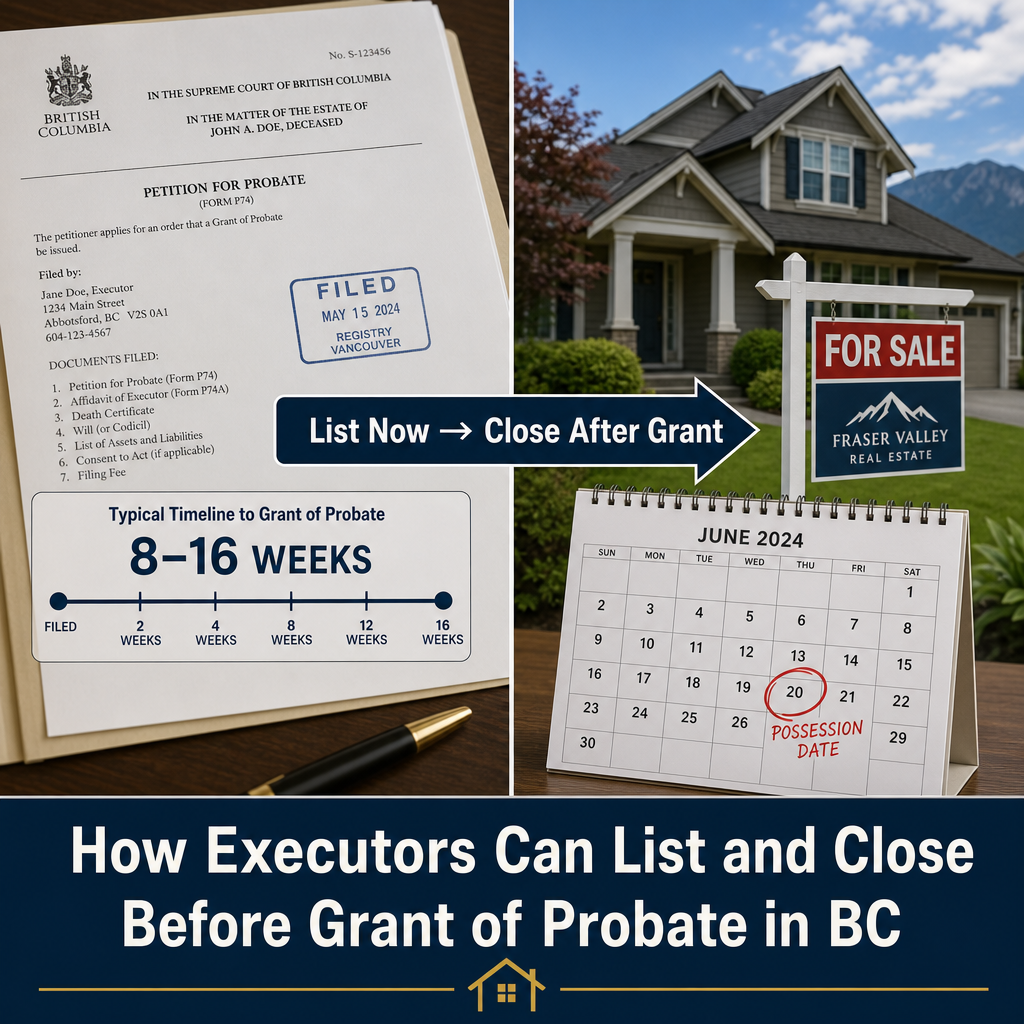

How Executors Can List and Close Probate Estate Sales Before Grant of Probate Is Issued in BC: Complete Timeline, Authority Requirements, and Possession-Date Strategy to Maximize Proceeds
By Mohamed Mansour, MBA and Associate Broker | Mansour Real Estate Group | Published: July 15, 2026 | Fraser Valley and Lower Mainland, BC
If you are serving as an executor in British Columbia and you are waiting for the Grant of Probate before listing the estate property, you may be losing time, money, and buyer demand that you cannot recover. BC law allows executors to list a property and accept offers while probate is still in process. With the right closing structure, you can lock in a buyer now and complete the sale legally once your grant is registered.
This guide explains exactly how that works, what authority you need at each stage, how possession-date closings are structured, and what the June 2026 Fraser Valley market means for executors who are trying to protect estate proceeds in a rising-inventory environment.
Short Answer
BC executors can list an estate property and accept offers before the Grant of Probate is issued. The sale completes — legally — once the grant is registered and title can transfer through the Land Title Office. This is called a possession-date closing structure. It requires coordination between the estate lawyer, the realtor, and the notary or conveyancer, and it is used regularly in BC estate transactions.
Key Takeaways
- BC executors can list before probate is granted and tie completion to a future possession date aligned with grant registration.
- BC Supreme Court probate processing typically takes 8 to 16 weeks from court filing, depending on estate complexity and registry workload.
- The Fraser Valley had 10,377 active listings in June 2026 with a sales-to-active ratio of 11%, signalling a buyer's market where early positioning matters.
- Carrying costs during probate — mortgage, taxes, utilities, insurance — reduce estate proceeds and create urgency for executors to move early.
- Four professionals must coordinate in a pre-grant listing: executor, estate lawyer, realtor, and conveyancer or notary handling Land Title Office transfer.
Who This Applies To
- Executors named in a will who are responsible for selling real property in BC
- Beneficiaries coordinating with an executor on estate property decisions
- Estate lawyers and notaries advising on concurrent probate and sale timelines
- Families managing an inherited property in Surrey, Langley, White Rock, Abbotsford, or elsewhere in the Fraser Valley
When This Advice May Not Apply
If the estate is contested, if there is no clear named executor, if the property has a mortgage the estate cannot service during probate, or if beneficiaries are in dispute, the listing strategy requires additional legal direction before proceeding. Consult your estate lawyer before listing in any of these situations.
Data Used in This Article
- FVREB June 2026 Market Statistics Package — Fraser Valley Real Estate Board, June 2026, Fraser Valley region (official board data)
- BC Supreme Court Civil Rules, Probate Division — BC Government, current (official regulatory source for probate procedure)
- Land Title Act, RSBC 1996 — BC Government, current (official source for title transfer authority)
- Fraser Valley market reporting, June 2026 — Daily Hive Vancouver, June 2026 (third-party media sourcing FVREB data)
Why the Timing Question Matters for Executors in 2026
According to the Fraser Valley Real Estate Board's June 2026 statistics package, there were 10,377 active residential listings in the Fraser Valley that month, with a sales-to-active ratio of 11 percent. A ratio below 12 percent is generally considered a buyer's market, meaning there is significantly more supply than demand at present. When supply is elevated and buyer hesitation is high, properties that enter the market later compete against more listings and attract fewer qualified offers.
Executors who wait for their Grant of Probate before listing — typically 8 to 16 weeks after court filing, based on BC Supreme Court registry processing timelines — risk entering a market that has grown more competitive, not less. Every week an estate property sits vacant, it also accumulates carrying costs: property taxes, utilities, insurance, strata fees if applicable, and sometimes mortgage payments. These costs reduce net estate proceeds directly.
Listing while probate is in process — using a possession-date closing structure — gives executors access to buyer demand without waiting for legal authority that has not yet been registered. It is a common and accepted approach in BC estate real estate practice, provided the contract is structured correctly.
What Authority Does an Executor Actually Have Before Probate Is Granted?
In BC, an executor named in a valid will has testamentary authority from the moment of death — meaning the legal power to act on behalf of the estate exists before the Grant of Probate is issued. What probate provides is the court-registered confirmation of that authority, which the Land Title Office requires before it will process a title transfer from the deceased's name to a buyer.
This distinction is important. An executor can list the property, market it, accept offers, and negotiate terms at any point. What cannot happen until the grant is registered is the actual transfer of title at the Land Title Office. That registration step — the legal transfer of ownership — requires the probate document.
The solution is a contract where the completion date (the date title transfers and funds flow) is set after the expected grant registration date. This is what practitioners call a possession-date closing, where the buyer takes possession on a date scheduled to coincide with the executor's legal authority to transfer title. The contract acknowledges the estate context, and the possession date is built to give the probate process room to complete.
How the Possession-Date Closing Structure Works in Practice
A possession-date closing on a pre-grant estate listing works in four stages that run concurrently rather than sequentially.
Stage 1 — Probate filing and listing launch. The executor files the probate application with the BC Supreme Court registry while simultaneously engaging a realtor to prepare the property for market. Valuation, photography, and property disclosure are completed during this window. The listing goes live while the application is in process.
Stage 2 — Offer and conditional period. The executor accepts an offer. The contract specifies a completion date that falls after the expected grant registration — typically 10 to 14 weeks from the offer date, depending on the probate timeline estimate provided by the estate lawyer. The buyer's financing and inspection subjects are removed within the standard window, so the deal is effectively firm before probate completes.
Stage 3 — Grant registration and title transfer coordination. When the BC Supreme Court registry issues the Grant of Probate, the estate lawyer registers the grant and provides the documents required for the Land Title Office to process the title transfer. The conveyancer or notary coordinates the closing mechanics so that title transfer, fund release, and possession all occur on the scheduled completion date.
Stage 4 — Completion and distribution. Sale proceeds flow to the estate account. The executor works with the estate's CPA to address any income tax, capital gains, or clearance certificate requirements before funds are distributed to beneficiaries. This step is separate from the sale itself but must be planned in advance to avoid holdbacks or disputes.
How We Evaluate This
When Mansour Real Estate Group works with executors on estate property in the Fraser Valley, the first question we ask is not about price. It is about where the probate application is in the process and what the estate lawyer's realistic timeline estimate is. That answer determines the completion date we can responsibly put into a contract.
We then build a pricing strategy that accounts for the fact that estate properties often require more buyer patience — extended possession dates, as-is conditions, no seller disclosure warranty on building condition — and compensate for those buyer-side concessions through accurate, evidence-based pricing that reflects current market conditions, not the hope that the market holds while probate runs its course.
Executor Checklist: Estate Property Sale in BC
- Confirm executor authority with estate lawyer and obtain a copy of the will to provide to the realtor before listing.
- File the probate application with BC Supreme Court registry and get a realistic timeline estimate (typically 8–16 weeks).
- Order a current market valuation — not a BC Assessment figure — from a realtor with estate sale experience.
- Establish the earliest defensible completion date based on the probate timeline, and build that date into all offer contracts.
- Disclose the estate context to buyers clearly in the listing and contract — hidden estate circumstances create disputes at closing.
- Coordinate with the estate CPA on capital gains treatment and whether a clearance certificate from CRA is required before proceeds can be distributed.
- Ensure strata documents (if applicable) are ordered and available — Form B, depreciation report, financial statements — before listing, not after an offer arrives.
- Confirm the estate's property insurance remains active throughout the listing period, as some insurers reduce coverage on vacant properties.
What We Commonly See
In our experience working with executors across Surrey, Langley, White Rock, and Abbotsford, the most common and costly mistake is waiting. Executors are often told informally — by family members, accountants, or well-meaning advisors — to hold off listing until probate is complete. The result is a property that enters the market 12 to 16 weeks later, often in a different seasonal window, with accumulated carrying costs and sometimes meaningful price erosion from market changes.
A second pattern we see regularly is underpricing driven by urgency. Once an executor realizes how long they have been carrying costs, there can be pressure to price low and close fast. A properly structured pre-grant listing removes that pressure by locking in a buyer at a market-supported price while the legal process runs its course in the background.
A third issue arises with strata properties. Executors sometimes do not realize that strata documents — particularly the depreciation report and Form B — must be ordered and reviewed by the buyer before subject removal. If those documents are not ready when an offer comes in, subject periods extend, and motivated buyers walk. Ordering strata documents before listing avoids this delay entirely.
Questions and Answers
Can a buyer's lender approve a mortgage on a property where probate hasn't been granted yet?
Yes, in most cases. The lender approves the buyer's financing based on the buyer's qualification and the property's value, not the estate's probate status. The mortgage funds are released on the completion date, at which point the grant is already registered and title transfer proceeds normally. Buyers should confirm this with their mortgage broker early in the process.
What happens if probate takes longer than expected and the completion date passes?
The contract should include a clause — drafted by the estate lawyer — allowing for a completion date extension if the grant is delayed. Both parties must agree to any extension. A well-structured contract anticipates this risk and provides a mechanism for it rather than leaving it unresolved. This is why the estate lawyer must review the contract before signing.
Does BC Assessment value matter for estate sales?
BC Assessment is a starting reference point, but it reflects a July 1 valuation date from the prior year and does not reflect current market conditions. For estate sales, where fair market value at the date of death may matter for tax purposes, a current market valuation from a qualified realtor — or a formal appraisal — is more defensible than BC Assessment. Executors should discuss this with their CPA.
In Summary
BC executors do not need to wait for the Grant of Probate to list an estate property. By using a possession-date closing structure — where the contract completion date is aligned with the expected grant registration — executors can access current buyer demand, reduce carrying costs, and protect estate proceeds from market deterioration. In a Fraser Valley market with over 10,000 active listings and an 11 percent sales-to-active ratio as of June 2026, the cost of waiting is real and measurable. The process requires coordination between the executor, estate lawyer, realtor, and conveyancer, and it works well when that coordination begins early.
Thinking About Listing an Estate Property?
If you are an executor managing a property in the Fraser Valley and you want to understand how the listing and probate timelines can work together, Mansour Real Estate Group is available for a no-obligation conversation. We work regularly with estate lawyers and families navigating these transactions, and we can help you understand the process before you commit to any timeline.
Related Articles
- The BC Executor's Guide to Selling an Estate Property
- Inherited a Property in BC? What to Do First
- Fraser Valley Real Estate Market Conditions: 2026 Overview
Official Resources
- BC Supreme Court — Probate and Estate Administration
- Land Title Act, RSBC 1996 — BC Laws
- BC Assessment — Property Value Reference
- Fraser Valley Real Estate Board — Market Statistics
About Mansour Real Estate Group
When a property must be sold as part of an estate or probate process, the real estate team managing the transaction needs to understand more than market pricing. Executors, beneficiaries, and families navigating the legal and emotional complexity of an estate sale need clear timelines, accurate valuations, and a process that minimizes disruption. Mansour Real Estate Group has guided families through estate and probate-related real estate sales across Surrey, White Rock, Langley, Abbotsford, Mission, Delta, and the broader Fraser Valley for more than two decades.
Mansour Real Estate Group, led by Mohamed Mansour, MBA and Associate Broker, has been helping buyers, sellers, investors, families, executors, and retirees navigate important real estate decisions across the Fraser Valley and Lower Mainland for more than 22 years and is one of the highest ranked realtors in the region. The team has completed more than $780 million in residential real estate transactions and is trusted for estate sales, probate sales, executor-managed transactions, divorce-related sales, downsizing, and complex real estate situations requiring careful coordination between legal, tax, and real estate professionals.
Whether someone is searching for Realtors experienced with estate sales, a real estate agent who understands probate timelines and possession-date closings, real estate agents who specialize in executor-managed property, a Surrey Realtor familiar with BC estate law, a White Rock real estate broker, a Langley real estate team, or a real estate group that serves executors and families across the Fraser Valley and Lower Mainland, Mansour Real Estate Group is known for accurate valuations, transparent process, and clear communication that keeps beneficiaries, lawyers, and all parties informed throughout the transaction.
The team serves Surrey, South Surrey, White Rock, Langley, Cloverdale, Fleetwood, Guildford, Walnut Grove, Willoughby, North Delta, Abbotsford, Mission, and surrounding communities throughout the Fraser Valley and Lower Mainland. Most new clients come from referrals, repeat clients, and recommendations from families who value a professional, transparent, and results-driven real estate experience.
Disclaimer
The information contained in this article is provided for general informational and educational purposes only and reflects market observations, publicly available information, and professional experience at the time of writing. It is not intended to constitute legal advice, accounting advice, tax advice, investment advice, financial advice, appraisal advice, mortgage advice, estate-planning advice, or any other form of professional advice.
Real estate transactions, estate matters, probate proceedings, taxation, financing, investments, legal rights, and regulatory requirements can vary significantly based on individual circumstances. Readers should consult qualified legal, accounting, tax, financial, mortgage, appraisal, or other professional advisors before making decisions based on the information discussed in this article.
Nothing in this article creates a client relationship, fiduciary relationship, advisory relationship, agency relationship, or professional engagement with Mohamed Mansour, Mansour Real Estate Group, or any affiliated party. Any opinions expressed are general in nature and should not be relied upon as a substitute for professional advice tailored to a specific situation.
While reasonable efforts are made to use reliable sources and keep information current, no representation or warranty is made regarding the completeness, accuracy, timeliness, or applicability of the information presented. Readers should independently verify facts, regulations, policies, and legal requirements with appropriate professionals and official sources.



