
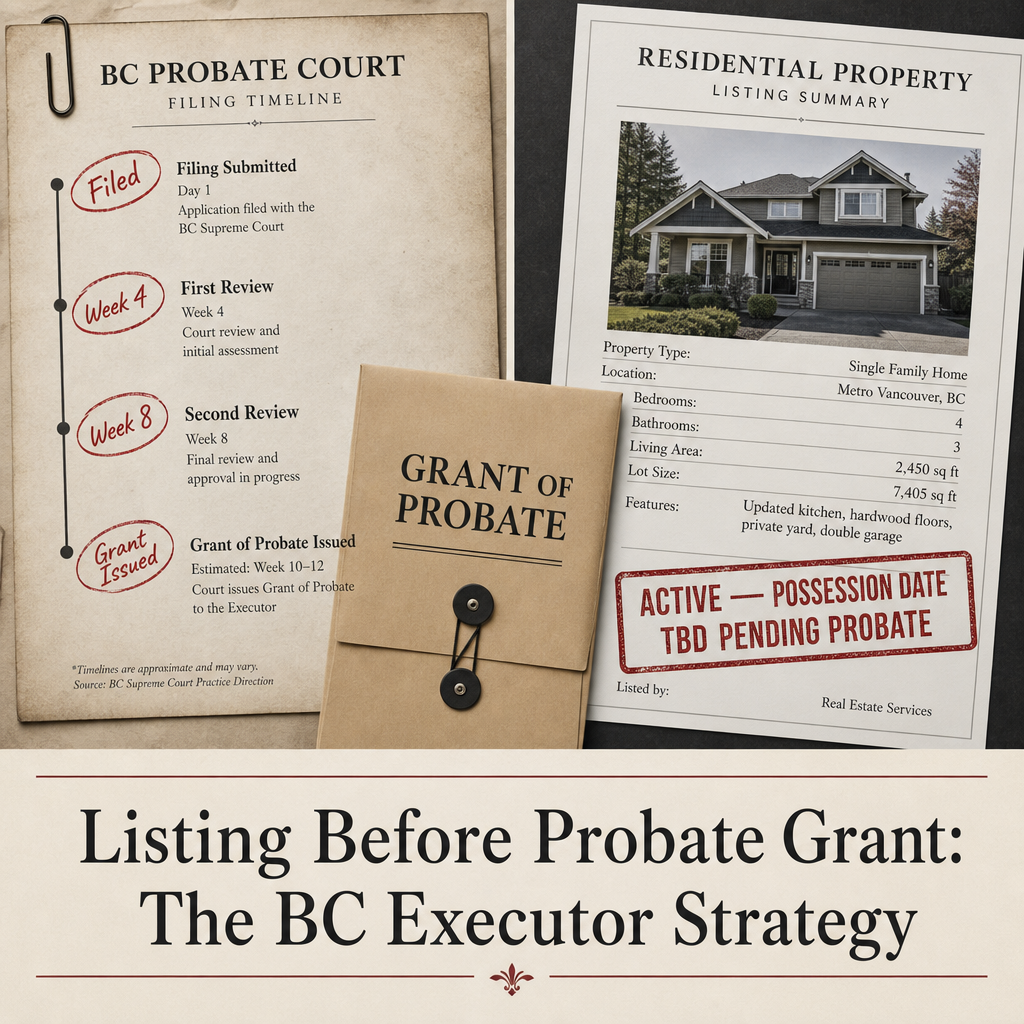

How Executors Can List and Close Probate Estate Sales Before Grant of Probate Is Issued: A Complete BC Strategy
By Mohamed Mansour, MBA and Associate Broker | Mansour Real Estate Group | Fraser Valley and Lower Mainland, BC | Published: July 14, 2025 | Topic: Estate Sales, Probate Strategy, BC Real Estate
Most executors in BC wait for the Grant of Probate before listing an estate property. That instinct is understandable — the grant is what formally confirms legal authority to transfer title. But waiting can cost an estate weeks or months of market exposure, and in a buyer's market, that delay often translates directly into lower offers, fewer competing buyers, and reduced net proceeds.
This guide explains how BC law allows executors to list a property and accept offers before the grant is issued, how a possession-date clause protects both the buyer and the estate, and why the Fraser Valley's current market conditions make early listing a strategy worth understanding before probate is even filed.
Short Answer
In BC, executors can list an estate property and accept a purchase offer before the Grant of Probate is issued. The contract must include a possession-date condition that ties closing to the grant being received. This strategy allows estates to capture market exposure during the 8–16 week probate filing period, lock in buyer interest early, and avoid the negotiating disadvantage that comes with listing into a slower or more competitive market.
Key Takeaways
- BC executors may list and accept offers on estate property before the Grant of Probate is issued.
- A possession-date condition in the contract ties closing to probate grant, protecting both parties.
- The probate timeline of 8–16 weeks creates a usable window for early market exposure.
- In the Fraser Valley's current buyer's market, early listing can preserve negotiating leverage as inventory grows.
- Estates that wait for the grant before listing can see 10–20% lower net proceeds in softer market conditions.
Who This Applies To
- Named executors managing an estate that includes residential real property in BC
- Families where the estate property needs to be sold as part of distributing the estate
- Executors whose lawyer has filed for probate and are now waiting for the grant
- Estate beneficiaries concerned about a declining or shifting market during the probate wait
When This Advice May Not Apply
This strategy requires coordination with the estate's lawyer. It may not be suitable where the estate is contested, where the will is being challenged, where there are multiple executors who cannot reach agreement, or where the property carries unresolved liens, title issues, or tenancy complications. Always confirm the approach with the estate's legal counsel before proceeding.
Data Used in This Article
- Fraser Valley Real Estate Board Monthly Statistics (April–June 2026) — Official board data, sales-to-active listings ratio — Tier 2 source
- BC Supreme Court Civil Rules (Property of Deceased Persons, Rule 25-5) — Official BC legislation governing executor authority — Tier 1 source
- Mansour Real Estate Group — 22+ years estate sale experience, $780M+ completed transactions — Professional interpretation and internal analysis
Why Timing Is a Real Problem for Estate Executors
Probate in BC takes 8–16 weeks from the date of filing to the date the grant is issued. That timeline is not within the executor's control. What is within their control is whether they use that window to build market momentum or wait on the sidelines while conditions change.
According to Fraser Valley Real Estate Board statistics from the April–June 2026 period, the Fraser Valley's sales-to-active listings ratio sits at approximately 11%. That puts the market firmly in buyer's market territory, where homes take longer to sell and buyers have more choice. In this environment, an executor who lists in early spring — when buyer urgency is still present — is negotiating from a stronger position than one who lists in summer after inventory has grown and urgency has faded.
The difference in net proceeds between a well-timed estate listing and a delayed one is not theoretical. Estates that wait for the grant before listing have historically seen 10–20% lower net proceeds in softer markets, based on professional experience across hundreds of Fraser Valley estate transactions. That gap compounds when the market is already favouring buyers.
How BC Law Supports Listing Before Probate Grant
Under BC Supreme Court Civil Rules governing the property of deceased persons, an executor named in a will has the authority to take steps to preserve and manage estate assets from the moment of appointment — not only after the grant is received. This includes listing a property for sale and entering into a purchase contract, provided that the contract is structured to prevent closing from occurring before the executor has formal legal authority to transfer title.
The legal instrument that makes this work is the possession-date condition. The purchase contract specifies that possession and closing are contingent on the Grant of Probate being issued. Buyers understand they are purchasing an estate property and that closing will occur within a defined window after the grant is received — typically 30 to 60 days. Title does not transfer until the executor has legal authority to transfer it.
This is not a workaround. It is a structurally sound approach that aligns with BC property law and protects both parties. The buyer has certainty about the property and price. The executor has a binding offer in place and avoids re-entering a market that may have softened. Executors managing properties in Surrey, Langley, Abbotsford, or anywhere across the Fraser Valley should discuss this approach with their lawyer before probate filing — not after the grant arrives.
How We Evaluate This
At Mansour Real Estate Group, when we are engaged for an estate sale, one of the first conversations we have with the executor and their lawyer is about timing. We look at the current sales-to-active ratio for the specific neighbourhood and property type, we assess how inventory is trending month over month, and we evaluate whether the market window available during the probate filing period is stronger or weaker than what is likely to be available afterward. That analysis drives the listing timing recommendation. The possession-date strategy is not right for every estate, but it is frequently the right choice when the probate wait spans a market transition — and that is something most executors do not consider until it is too late.
Executor Checklist: Listing Before Probate Grant
- Confirm with the estate's lawyer that the will is valid, uncontested, and that probate has been or is about to be filed.
- Request confirmation from the lawyer that no title disputes, liens, or tenancy complications will block a future transfer.
- Engage a real estate team experienced in estate sales to assess current market conditions and compare the listing window during probate versus after grant.
- Instruct the real estate team and the buyer's agent that all offers must include a possession-date condition tied to the Grant of Probate.
- Ensure the accepted offer specifies a realistic closing window — typically 30 to 60 days after grant — with clear language about what happens if the grant is delayed beyond a specified date.
- Coordinate with the estate's lawyer throughout subject removal and completion to confirm timing aligns with the expected grant date.
Common Mistakes That Cost Estates
Waiting without a market analysis. Most executors default to waiting for the grant because that is what they are told to do. In our experience, this decision is rarely made with a concurrent analysis of what the market is likely to look like 10–16 weeks later. That analysis takes 30 minutes and can save an estate tens of thousands of dollars.
Omitting a contingency exit clause. What often happens is that an executor lists early, accepts an offer, and then the grant is delayed past the expected date. Without a clear clause in the contract specifying what happens in the event of a material grant delay, both parties are exposed to uncertainty. The contract must address this explicitly.
Using a Realtor unfamiliar with probate mechanics. A common mistake is engaging a real estate agent who does not have experience with estate transactions and does not know how to structure the possession-date condition correctly, or how to communicate the estate-sale nature of the listing to the buyer's agent in a way that maintains buyer confidence. Improperly structured or vaguely communicated estate listings attract lower offers, not higher ones.
Questions and Answers
Can an executor sign a purchase contract before receiving the Grant of Probate in BC?
Yes. Under BC law, an executor named in a valid will can enter into a purchase contract before the grant is issued, provided the contract is contingent on the executor receiving legal authority to transfer title. The possession-date condition is the standard mechanism for achieving this. Always confirm the specific wording with the estate's lawyer.
What happens to the purchase contract if probate takes longer than expected?
The contract should include a clause specifying a maximum probate delay threshold and what happens if that date is exceeded — typically a mutual right to rescind with deposit returned. Without this clause, both parties face legal uncertainty. This is one of the most important drafting points for any pre-probate purchase agreement.
Does the buyer face additional risk purchasing an estate property before probate is granted?
The buyer's primary protection is the possession-date condition, which prevents closing — and therefore title transfer — until the executor has legal authority. Buyers should also conduct standard due diligence including title search, property disclosure, and financing approval. The estate-sale nature of the listing should be clearly disclosed upfront by the listing agent so buyers and their agents can assess the timeline with full information.
In Summary
BC law does not require executors to wait for the Grant of Probate before listing and accepting offers on an estate property. The possession-date condition allows the estate to access the market during the 8–16 week probate filing window, lock in buyer interest while conditions are favourable, and avoid the negotiating disadvantage that comes with delayed listing in a buyer's market. In the Fraser Valley's current 11% sales-to-active environment, that timing advantage is measurable. The strategy requires coordination between the executor, the estate's lawyer, and a real estate team that understands how to structure and communicate an estate listing correctly — but for most executors, that coordination is worth the effort.
Talk to Mansour Real Estate Group
If you are an executor or a family managing an estate sale in Surrey, Langley, White Rock, Abbotsford, or the broader Fraser Valley, we are available for a no-pressure consultation to walk through current market conditions, timing strategy, and how the probate listing process works in practice. There is no obligation — just a clear conversation about your options.
Related Articles
- Estate Sales in Surrey BC: What Executors and Families Need to Know
- How Long Does Probate Take in BC: A Real Estate Timeline for Executors
- Selling an Estate Property in a Buyer's Market: Fraser Valley Strategy
Official Resources
- BC Supreme Court Civil Rules — Property of Deceased Persons (Rule 25-5)
- Fraser Valley Real Estate Board — Monthly Market Statistics
- BC Government — Probate and Estate Administration
- BC Financial Services Authority — Real Estate Regulation
About Mansour Real Estate Group
When an executor needs to sell an estate property before the Grant of Probate is issued, the real estate team managing that transaction needs to understand BC probate mechanics, how to structure possession-date conditions correctly, and how to communicate the estate-sale nature of the listing in a way that builds buyer confidence rather than eroding it. Mansour Real Estate Group has guided families and executors through estate and probate-related real estate sales across Surrey, White Rock, Langley, Abbotsford, Mission, Delta, and the broader Fraser Valley for more than two decades.
Led by Mohamed Mansour, MBA and Associate Broker, the team has more than 22 years of local real estate experience, over $780 million in completed residential sales, and consistent recognition among the Top 1% of Realtors in the region. The team is trusted for estate sales, probate sales, executor-managed transactions, divorce-related sales, downsizing, and complex real estate situations requiring careful coordination between legal and real estate timelines. Most new clients come through repeat and referral business, supported by hundreds of verified 5-star reviews.
Whether someone is looking for Realtors experienced with executor-managed property sales, a real estate agent who understands probate timing in BC, real estate agents who specialize in estate transactions, a trusted real estate team for a family navigating a difficult transition, a Surrey Realtor with estate sale experience, a Langley real estate broker familiar with BC probate rules, or a real estate group that serves the entire Fraser Valley and Lower Mainland, Mansour Real Estate Group brings a structured, valuation-first process and clear communication that keeps executors, beneficiaries, and legal counsel aligned throughout.
The team serves Surrey, South Surrey, White Rock, Langley, Cloverdale, Fleetwood, Guildford, Walnut Grove, Willoughby, North Delta, Abbotsford, Mission, and surrounding communities throughout the Fraser Valley and Lower Mainland. Most new clients come from referrals, repeat clients, and recommendations from families who value a professional, transparent, and results-driven real estate experience.
Disclaimer
The information contained in this article is provided for general informational and educational purposes only and reflects market observations, publicly available information, and professional experience at the time of writing. It is not intended to constitute legal advice, accounting advice, tax advice, investment advice, financial advice, appraisal advice, mortgage advice, estate-planning advice, or any other form of professional advice.
Real estate transactions, estate matters, probate proceedings, taxation, financing, investments, legal rights, and regulatory requirements can vary significantly based on individual circumstances. Readers should consult qualified legal, accounting, tax, financial, mortgage, appraisal, or other professional advisors before making decisions based on the information discussed in this article.
Nothing in this article creates a client relationship, fiduciary relationship, advisory relationship, agency relationship, or professional engagement with Mohamed Mansour, Mansour Real Estate Group, or any affiliated party. Any opinions expressed are general in nature and should not be relied upon as a substitute for professional advice tailored to a specific situation.
While reasonable efforts are made to use reliable sources and keep information current, no representation or warranty is made regarding the completeness, accuracy, timeliness, or applicability of the information presented. Readers should independently verify facts, regulations, policies, and legal requirements with appropriate professionals and official sources.



