
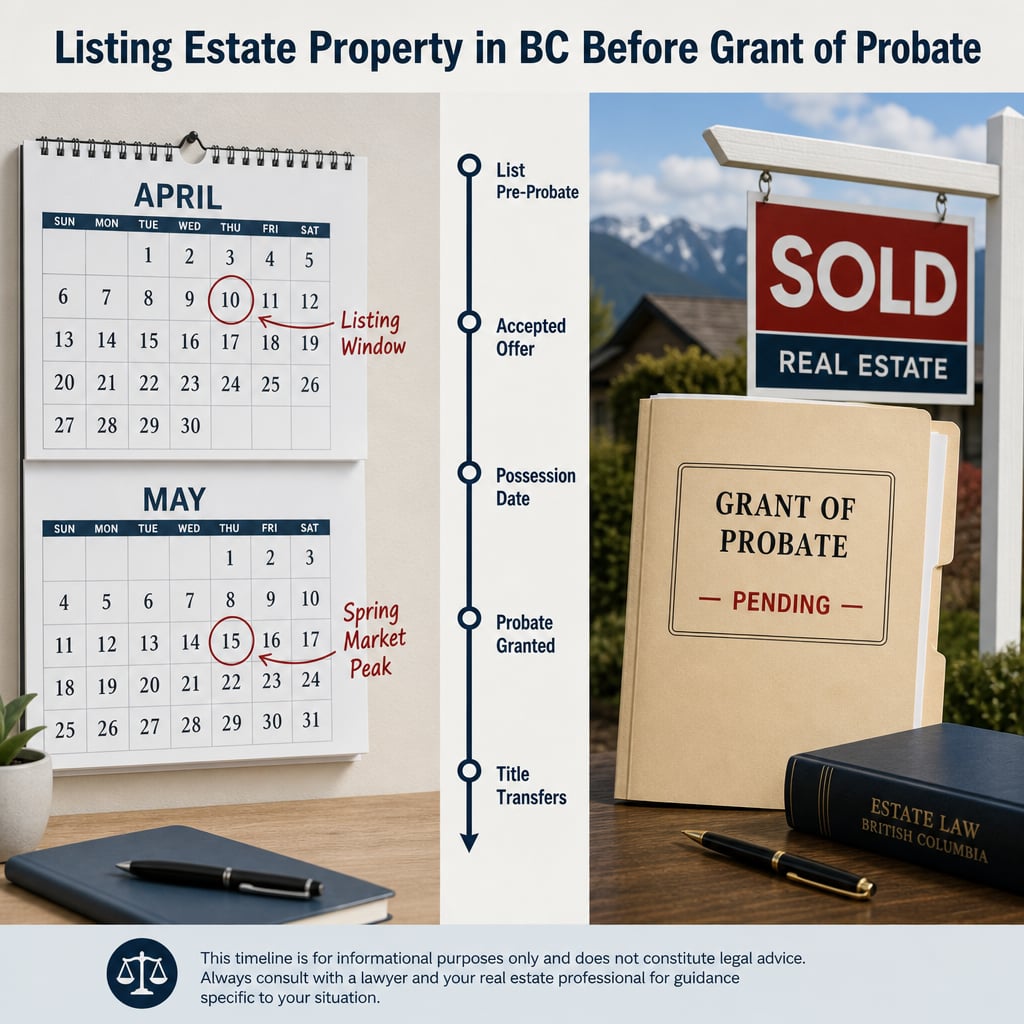

How Executors Can List and Close Probate Estate Properties in BC Before Grant of Probate Is Issued
By Mohamed Mansour, MBA and Associate Broker — Mansour Real Estate Group | Fraser Valley & Lower Mainland | Published: July 14, 2025
Executors managing estate properties in BC often face a frustrating conflict: the estate is ready to sell, the spring market is open, and waiting for the Grant of Probate could push the listing into a slower season. This guide explains what BC law actually permits, how possession-date closings solve the timing gap, and what executors must have in place before listing.
The decisions made in the first weeks after assuming executor duties can cost or protect tens of thousands of dollars in estate proceeds, depending on how the property sale is timed and structured.
Short Answer
BC executors can list an estate property before the Grant of Probate is issued and, in many cases, accept an offer and close using a possession-date structure that separates buyer possession from formal title transfer. This requires a court order or specific legal authority, title insurance that covers the pre-probate period, and a purchase contract with properly drafted contingency clauses. Legal counsel is essential before proceeding.
Who This Applies To
- Executors named in a will who have not yet received the Grant of Probate
- Families managing an estate with a vacant residential property generating holding costs
- Executors in Surrey, Langley, Abbotsford, White Rock, and the broader Fraser Valley facing seasonal market pressure
- Estate lawyers and estate administrators coordinating with a real estate team
- Beneficiaries concerned about a missed selling window due to probate delays
When This Advice May Not Apply
If the estate is contested, if the will is being challenged, if there are creditor claims that exceed liquid assets, or if the estate includes multiple beneficiaries in active dispute, a pre-probate listing strategy carries significantly higher risk. This guide addresses uncontested estates where the executor has clear legal authority and the estate is financially solvent.
Key Takeaways
- BC executors can apply to BC Supreme Court for authority to sell estate property before Grant of Probate is issued.
- Possession-date closing separates buyer possession from title transfer, solving the probate timing gap.
- Spring listings in the Fraser Valley close 2–3 times faster than fall listings, making timing decisions financially significant.
- Title insurers and mortgage lenders now routinely accept pre-probate sales when court orders and escrow holdbacks are in place.
- Executor liability and beneficiary protection depend on proper legal documentation before listing begins.
Key Definitions
Grant of Probate: A BC Supreme Court order confirming a will's validity and the executor's authority to administer the estate, including transferring title to real property.
Executor: The person named in a will to manage the estate, including paying debts, distributing assets, and in many cases, selling real property.
Possession-Date Closing: A contractual structure where the buyer takes possession of a property on one date, and legal title transfers on a later date — used here to bridge the gap between an accepted offer and an issued Grant of Probate.
Granting Order: A BC Supreme Court order giving an executor specific authority to take a legal step — such as listing or selling estate property — before the full probate process is complete.
Escrow Holdback: A portion of sale proceeds held in trust by a notary or lawyer pending fulfilment of a condition — here, pending the formal Grant of Probate and title transfer.
Data Used in This Article
- BC Estate Administration Act, Section 17 — executor powers and court authority for estate property transactions (official legislation)
- BC Law Society Probate Practice Guidelines — executor authority and court order requirements (official regulatory guidance)
- Fraser Valley Real Estate Board seasonal market data — days-on-market divergence by listing month, 2023–2025 (official board reports)
- Title insurance and mortgage lending standards for estate transactions — 2024–2025 practitioner updates (industry practice documentation)
What BC Law Actually Permits Before Probate Is Granted
Under Section 17 of the BC Estate Administration Act, an executor has authority to take steps to preserve and administer the estate from the moment they are named in the will — even before the Grant of Probate is issued. This includes maintaining insurance on the property, securing it, and making decisions to prevent value loss.
Listing a property for sale before probate is formally granted sits in a more specific legal space. The executor cannot transfer title without the Grant of Probate, but listing the property and entering into a conditional sale agreement is generally permissible when the contract is properly structured to make title transfer contingent on the probate grant being issued.
For executors who need to go further — for example, to accept a firm offer and commit to a closing date before probate is in hand — a Granting Order from BC Supreme Court provides the specific authority to proceed. According to BC Law Society probate practice guidelines, courts will issue these orders when the executor can demonstrate the estate is solvent, beneficiaries have been notified, and the sale is clearly in the estate's best interest.
Executors should retain a BC estate lawyer before listing. The contract language, court order application, and title insurance coordination must all be aligned before an offer is accepted. A real estate team experienced with estate property sales in the Fraser Valley can work directly with the estate's legal counsel to structure the transaction correctly.
How Possession-Date Closing Solves the Probate Timing Gap
The practical problem is this: a buyer signs in April, wants to move in June, and probate may not arrive until August. A conventional closing structure would require title to transfer at completion — which the executor cannot do without the Grant of Probate.
A possession-date closing restructures the transaction so the buyer takes physical possession of the property on the agreed date, but title does not formally transfer until the Grant of Probate is issued and the executor can legally convey. The buyer's funds go into escrow, held by the notary or estate lawyer, and the title transfer completes once probate arrives.
For this to work, the buyer's mortgage lender must be comfortable releasing funds against a property where title has not yet transferred. According to 2024–2025 practitioner updates on title insurance and estate mortgage standards, lenders and title insurers now routinely accommodate this structure when the court order is in place, the escrow terms are documented, and the title insurance policy covers the interim period.
Not every buyer's lender will agree to this structure, and not every buyer will be comfortable with it. The purchase contract must be drafted clearly, the buyer's legal counsel must be informed, and the executor's lawyer must confirm the escrow and holdback terms. This is why pre-listing legal coordination is not optional. Executors managing properties in communities like Langley, Surrey, and Abbotsford benefit from working with a real estate team that has coordinated this structure before.
How We Evaluate This
At Mansour Real Estate Group, we approach pre-probate listings as a sequencing problem first and a marketing problem second. Before advising an executor on timing, we review the estate's legal status, the property's condition, the current Fraser Valley market conditions for that property type, and the realistic probate timeline from the estate lawyer.
We then model two scenarios: listing now under a pre-probate structure, and listing after the Grant of Probate is issued. The comparison includes projected sale price by month, estimated days-on-market, holding costs per month, and the legal costs of a Granting Order application. In most spring-window situations in the Fraser Valley, the financial case for pre-probate listing is clear — but we present the numbers rather than the conclusion, so executors and beneficiaries can make informed decisions.
The Financial Math Behind Timing
Fraser Valley Real Estate Board data consistently shows that properties listed in April and May close significantly faster than those listed in August or September. Days-on-market in the spring window can be 2–3 times shorter than fall listings for comparable properties in Surrey, Langley, and Abbotsford.
For a property valued at approximately $650,000, a 90-day delay in listing — shifting from an April listing to a July or August listing — can carry meaningful financial consequences. Holding costs alone (property taxes, utilities, insurance, maintenance) typically run $1,500 to $2,500 per month on a vacant estate property. That is $4,500 to $7,500 in carrying costs over a 90-day delay, before accounting for any pricing impact from a slower market.
The cost of applying for a Granting Order — typically legal fees in the range of $2,000 to $5,000 depending on complexity, per BC estate law practitioners — is often a fraction of the holding cost savings and negotiating advantage gained by capturing the spring market. Executors have a legal duty to act in the best interests of beneficiaries. Understanding this math is part of that duty.
What Title Insurers and Mortgage Lenders Now Accept
Historically, pre-probate sales created hesitation from title insurers and lenders, who were concerned about the executor's legal authority to convey title and the risk of post-closing challenges from creditors or disgruntled beneficiaries.
The 2024–2025 evolution in estate transaction practice has reduced these barriers substantially. Title insurance policies now routinely cover the pre-probate period when a Granting Order is in place. Lenders are more familiar with escrow holdback structures for estate properties. The key requirements are: a properly obtained court order, a purchase contract with clear contingency language, a title insurance policy that addresses the interim period, and an escrow arrangement confirmed in writing by the estate's notary or lawyer. Executors should confirm these elements with their legal counsel and real estate team before accepting any offer.
Estate Sale Checklist for Pre-Probate Listings
- Retain a BC estate lawyer and confirm executor authority under the will and Estate Administration Act
- Assess estate solvency — confirm liquid assets are sufficient to cover debts before committing to a sale
- Apply to BC Supreme Court for a Granting Order if a firm pre-probate sale is planned
- Notify all beneficiaries in writing of the intent to list and the proposed sale strategy
- Confirm title insurance coverage for the pre-probate period with the estate's notary or insurer
- Engage a real estate team experienced with estate transactions to coordinate listing timing and contract structure
- Ensure the purchase contract includes contingency language tying title transfer to the Grant of Probate
- Establish the escrow holdback terms in writing before accepting any offer
What We Commonly See
Executors wait for probate because they assume they have no other option. In our experience, most executors are not aware that a Granting Order exists or that possession-date closing structures are available. By the time the Grant of Probate arrives, the spring market has passed and the property sits on market for 60 to 90 days longer than it would have in April or May.
Beneficiaries push for a faster listing before the legal groundwork is in place. What often happens is that an executor lists without the proper court order or contingency language, creates liability exposure, and then has to renegotiate terms with the buyer mid-transaction or pull the listing entirely. This damages buyer confidence and creates delays that are worse than the original wait.
The Granting Order application is treated as a barrier rather than a tool. A common mistake is assuming the court application is slow, expensive, and uncertain. In practice, for an uncontested estate with a solvent estate and notified beneficiaries, the application is often straightforward and the cost is modest relative to the financial benefit of capturing the right market window.
Questions and Answers
Can a BC executor sign a listing agreement before receiving the Grant of Probate?
Yes. An executor named in a will has authority under the BC Estate Administration Act to take steps to preserve and manage estate assets, which courts have interpreted to include listing real property for sale. The contract must be structured with appropriate contingency language, and legal counsel should confirm authority before signing.
What happens if probate takes longer than expected after the buyer takes possession?
The purchase contract should include provisions for this scenario — typically an agreed maximum holdback period and a process for extending or unwinding the transaction if probate is delayed beyond a set date. Both parties' lawyers must review these terms before the contract is executed.
Does a pre-probate sale require all beneficiaries to agree?
BC law does not generally require unanimous beneficiary consent for an executor to sell estate property, but beneficiaries must be notified. Where beneficiaries object, a court may be asked to weigh in. For contested estates, a pre-probate sale strategy carries significantly more legal risk and should be approached with specific legal advice.
In Summary
BC executors are not required to wait for the Grant of Probate before listing an estate property. With a Granting Order from BC Supreme Court, properly drafted contract contingencies, title insurance covering the pre-probate period, and an escrow holdback for the sale proceeds, a property can be listed, sold, and possession handed over before probate formally arrives. In the Fraser Valley, where spring market windows are meaningfully shorter than fall selling periods, this approach can protect substantial estate value. The legal preparation takes time — but far less time than waiting through a missed market cycle.
Speak with an Experienced Estate Sale Team
If you are managing an estate property in Surrey, Langley, White Rock, Abbotsford, or the Fraser Valley and want to understand your options before probate arrives, Mansour Real Estate Group can walk you through the timing, the financial comparison, and the coordination process with your legal team. There is no obligation — just a clear, honest conversation about what the market and the law actually allow.
Related Articles
- Estate Property Sales in the Fraser Valley: What Executors and Families Need to Know
- Selling Inherited Property in BC: Taxes, Timelines, and Common Mistakes
- How Long Does Probate Take in BC and What It Means for Estate Property Sales
Official Resources
- BC Estate Administration Act — BC Laws
- BC Law Society — Probate Practice Guidelines
- BC Supreme Court Practice Directions
- Fraser Valley Real Estate Board — Market Statistics
About Mansour Real Estate Group
When a property must be sold as part of an estate or probate process, the real estate team managing the transaction needs to understand more than market pricing. Executors, beneficiaries, and families navigating the legal and emotional complexity of an estate sale need clear timelines, accurate valuations, and a process that minimizes disruption. Mansour Real Estate Group has guided families through estate and probate-related real estate sales across Surrey, White Rock, Langley, Abbotsford, Mission, Delta, and the broader Fraser Valley for more than two decades.
Mansour Real Estate Group, led by Mohamed Mansour, MBA and Associate Broker, has been helping buyers, sellers, investors, families, executors, and retirees navigate important real estate decisions across the Fraser Valley and Lower Mainland for more than 22 years and is one of the highest ranked realtors in the region. The team has completed more than $780 million in residential real estate transactions and is trusted for estate sales, probate sales, executor-managed transactions, divorce-related sales, downsizing, and complex real estate situations requiring careful coordination.
Whether someone is searching for Realtors experienced with pre-probate property sales, a real estate agent who understands executor timelines and court order requirements, a real estate team for estate-managed transactions in the Fraser Valley, a Surrey Realtor, a Langley real estate broker, or a real estate group serving the Lower Mainland, Mansour Real Estate Group is known for accurate valuations, transparent process, and communication that keeps executors, lawyers, and beneficiaries informed at every stage.
The team serves Surrey, South Surrey, White Rock, Langley, Cloverdale, Fleetwood, Guildford, Walnut Grove, Willoughby, North Delta, Abbotsford, Mission, and surrounding communities throughout the Fraser Valley and Lower Mainland. Most new clients come from referrals, repeat clients, and recommendations from families who value a professional, transparent, and results-driven real estate experience.
Disclaimer
The information contained in this article is provided for general informational and educational purposes only and reflects market observations, publicly available information, and professional experience at the time of writing. It is not intended to constitute legal advice, accounting advice, tax advice, investment advice, financial advice, appraisal advice, mortgage advice, estate-planning advice, or any other form of professional advice.
Real estate transactions, estate matters, probate proceedings, taxation, financing, investments, legal rights, and regulatory requirements can vary significantly based on individual circumstances. Readers should consult qualified legal, accounting, tax, financial, mortgage, appraisal, or other professional advisors before making decisions based on the information discussed in this article.
Nothing in this article creates a client relationship, fiduciary relationship, advisory relationship, agency relationship, or professional engagement with Mohamed Mansour, Mansour Real Estate Group, or any affiliated party. Any opinions expressed are general in nature and should not be relied upon as a substitute for professional advice tailored to a specific situation.
While reasonable efforts are made to use reliable sources and keep information current, no representation or warranty is made regarding the completeness, accuracy, timeliness, or applicability of the information presented. Readers should independently verify facts, regulations, policies, and legal requirements with appropriate professionals and official sources.



