

By Mohamed Mansour, MBA and Associate Broker — Mansour Real Estate Group
Published: August 5, 2026 · Fraser Valley and Lower Mainland, BC · Estate and Probate Sales
How Executors Can List and Close Probate Estate Properties Before Grant of Probate Is Issued: Complete BC Timeline, Authority Requirements, and Strategic Possession-Date Closing to Maximize Proceeds
Most executors in BC wait until the Grant of Probate arrives before listing the estate property. It feels like the safe move. In practice, that delay is one of the most costly decisions an estate can make — particularly in the current market, where days on market directly erode the sale price.
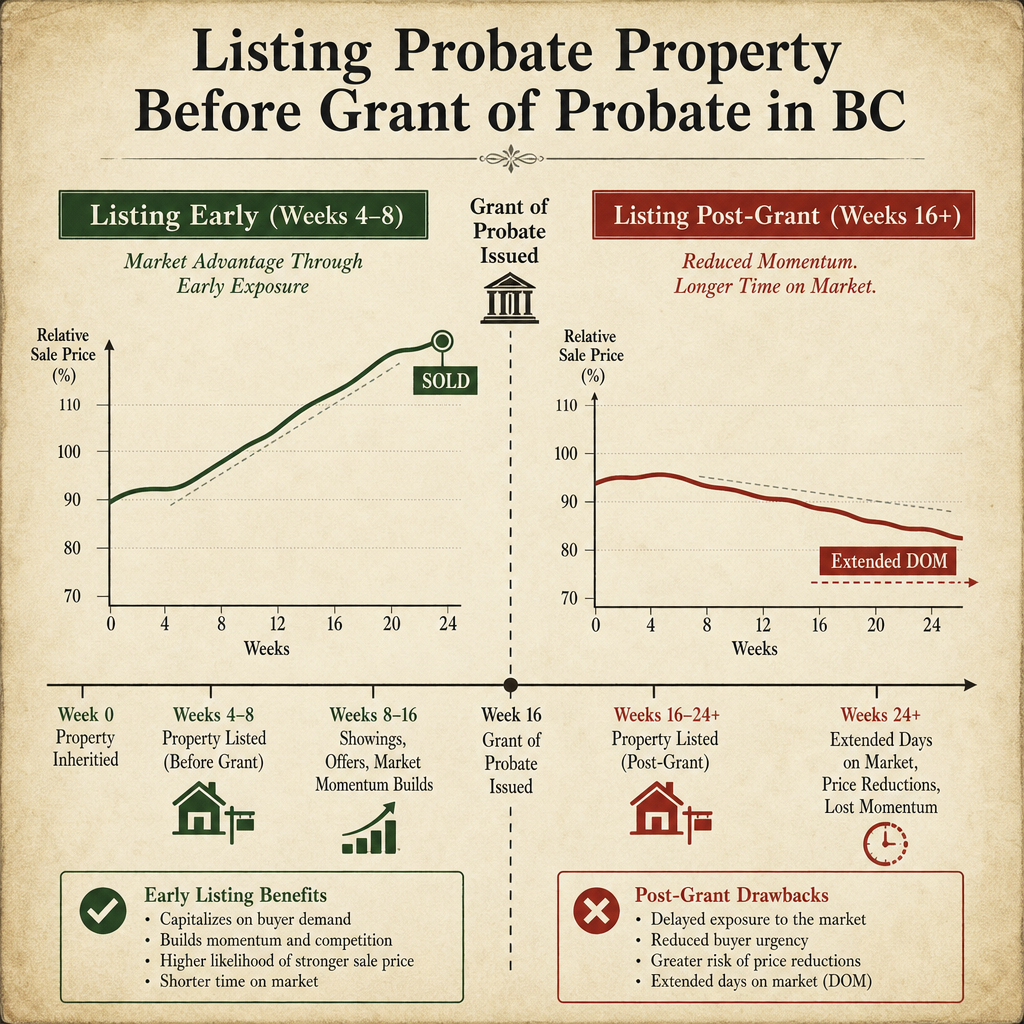
This article explains what executors in BC are legally authorized to do before the grant is issued, how possession-date closing mechanics work, and why listing in weeks four through eight of the probate process typically produces better outcomes than listing post-grant.
Short Answer
BC executors can list an estate property before the Grant of Probate is issued. Authority derives from the will itself. The estate lawyer must approve the listing and purchase contract. Closing can use a possession-date structure that allows the buyer to occupy the property while probate processes, with formal title transfer completing after the grant issues. This approach reduces carrying costs, captures active buyer windows, and protects net proceeds — especially critical in a buyer's market where extended days on market compress pricing.
Key Takeaways
- Executors draw authority from the will, not from the Grant of Probate, and can enter binding listing and purchase contracts before the grant issues.
- Possession-date closings allow buyers to occupy the property while probate is still processing, bridging the timing gap cleanly.
- Formal title transfer to the buyer happens post-grant through executor registration at the BC Land Title Office — buyers must understand this at the offer stage.
- In a buyer's market with an 11% sales-to-active ratio, properties listed weeks 4–8 of probate face less competing inventory and stronger buyer attention than post-grant listings.
- Estate lawyers must be engaged before listing — not after — because contract terms, disclosure requirements, and title insurance protocols all depend on the pre-grant structure.
Who This Applies To
- Named executors in a BC will who have engaged an estate lawyer and are managing real property as part of the estate
- Families where a sole beneficiary is also the executor and wants to minimize estate carrying costs
- Estate situations where the property is vacant, has holding costs (strata fees, utilities, property tax), or is at risk of deterioration
- Executors in Surrey, Langley, Abbotsford, White Rock, North Delta, and surrounding Fraser Valley communities where buyer's market conditions have extended typical days on market
When This Advice May Not Apply
If the will is being contested, if there are multiple conflicting wills, if the executor's authority is disputed by beneficiaries, or if a court application is underway, listing before grant is not appropriate without specific legal direction. This article reflects general process in uncontested BC estates — always confirm your situation with your estate lawyer before taking any steps.
Data Used in This Article
- Fraser Valley Real Estate Board (FVREB) Statistics Package, July 2026 — official board report, Fraser Valley geography, sales-to-active ratio and days-on-market data
- FVREB Statistics Package, February 2026 — official board report, early 2026 market benchmark comparison
- BC Land Title and Survey Authority (LTSA) — probate and title transfer mechanics, executor registration requirements
- Law Society of BC — estate sale requirements and executor authority standards in BC
How Executor Authority Works in BC Before Probate Grant
In BC, a named executor derives authority from the will at the moment of the testator's death — not from the subsequent issuance of the Grant of Probate. The grant is a court order that confirms the executor's authority publicly and allows formal title transfer through the BC Land Title and Survey Authority. But the executor's underlying contractual authority exists from the date of death.
This means an executor can, with estate lawyer approval, sign a listing agreement, accept a purchase offer, and enter a binding contract of purchase and sale before probate is granted. The estate lawyer's role is critical: they review the contract, confirm the closing mechanics, and coordinate the title insurance requirements that protect the buyer during the period when probate is still pending.
The LTSA requires executor registration as a prerequisite to transferring title to a buyer. That registration step happens post-grant. In a pre-grant sale, the parties agree — in the contract — that completion of the title transfer will occur once the grant issues and the executor registers. The buyer takes possession on a scheduled date; title transfer follows. This is the core of the possession-date closing structure.
The Probate Timeline in BC and Where Listing Fits
BC probate processing through the BC Supreme Court registry typically takes 8 to 16 weeks from the date the application is filed, according to the Law Society of BC's general guidance on estate administration timelines. Filing itself requires the estate lawyer to gather assets, valuations, and documentation — a process that typically begins in weeks two through four after the date of death.
That means the window between death and grant issuance is commonly 12 to 20 weeks in total. An executor who waits for the grant before listing is ceding that entire window to carrying costs, market drift, and accumulating inventory competition. In the Fraser Valley's current environment — where the FVREB's July 2026 statistics report a sales-to-active listings ratio near 11% for detached homes, signalling a buyer's market — every additional week on market matters.
Properties listed in weeks four through eight of the probate process enter the market while the estate lawyer is still compiling the application. By the time subject removal occurs and the possession date approaches, the grant is often close to or already issued. The buyer occupies. The estate receives proceeds. Carrying costs stop. This is the structural advantage of pre-grant listing with a possession-date close.
How We Evaluate This at Mansour Real Estate Group
When an executor contacts us about an estate property, the first question we ask is: has an estate lawyer been engaged? If yes, we move quickly to understand the timeline, the property condition, and current comparable sales in the relevant neighbourhood — whether that is Surrey, Langley, White Rock, or Abbotsford.
We do not advise listing before the estate lawyer has confirmed the executor's authority is uncontested and the pre-grant listing structure is appropriate. Once that confirmation is in place, we prepare the comparative market analysis, review the condition of the property, and work with the lawyer on disclosure language for the purchase contract. The goal is to enter the market at the right price in the right window — not simply as fast as possible.
Possession-Date Closing: How It Works in Practice
A possession-date closing structure in a pre-grant estate sale separates the possession date from the completion date. The buyer takes physical possession of the property — typically three to six months from offer acceptance — while the estate lawyer finalizes the probate application and awaits grant issuance. When the grant arrives, the executor registers at the LTSA, and title formally transfers. Funds are held in trust until title transfer is complete.
Title insurance plays a central role here. The buyer's lawyer will typically require a title insurance policy that covers the gap period — from possession to formal title vesting. The estate lawyer coordinates this. Buyers who work with experienced conveyancing lawyers understand this structure; buyers who have not encountered an estate sale before may need additional explanation at the offer stage.
For the estate, the financial benefit is clear: carrying costs — property taxes, strata fees, utilities, insurance — stop accruing from the date the buyer takes possession. If the property is vacant and accumulating $3,000 to $5,000 per month in holding costs, a possession-date close that is four to six weeks earlier than a post-grant close generates meaningful incremental proceeds.
Why Current Market Conditions Make Early Listing More Important
The FVREB's July 2026 statistics package shows the Fraser Valley operating in buyer's market territory, with elevated active inventory and a sales-to-active ratio near 11% for detached homes. In this environment, days on market expand for properties that are not priced precisely, presented well, or listed at the right moment in the seasonal demand cycle.
Executors who list post-grant — potentially in late summer or fall 2026, when seasonal demand softens further — face a more competitive inventory environment and a less active buyer pool. Properties that enter the market in the spring-to-early-summer window, when buyer activity is highest relative to inventory, typically generate more competing interest and stronger offers. For estate properties in North Delta, Langley, or Abbotsford, the difference between an April or May listing and a September listing can be material to the final sale price.
Estate Sale Checklist for Executors Considering Pre-Grant Listing
- Engage an estate lawyer immediately after the testator's death — ideally within the first two weeks.
- Confirm with the estate lawyer that the will is uncontested and pre-grant listing authority is clear.
- Obtain a professional market valuation (not BC Assessment) to establish current fair market value for both listing and probate filing purposes.
- Review the property's condition with your realtor and determine what preparation work, if any, is appropriate given the estate budget and timeline.
- Confirm with the estate lawyer that the listing agreement and purchase contract terms reflect the pre-grant structure, including possession-date closing language.
- Ensure disclosure to buyers in the contract about the pre-grant title status and the timeline for formal title transfer post-grant.
- Coordinate title insurance requirements with the buyer's and estate's lawyers before accepting any offer.
- Track probate processing timeline against the possession date negotiated in the contract — communicate any delays to the buyer's lawyer promptly.
What We Commonly See
Executors wait too long, then overprice to compensate. In our experience, the most common pattern is an executor who waits for the grant, lists the property late in the season at a price that reflects what the home might have achieved in a stronger window, and then watches days on market accumulate. Reductions follow. Final proceeds are lower than an earlier, accurately priced listing would have achieved.
Pre-grant listings that skip lawyer coordination fail at offer stage. What often happens is a realtor lists an estate property without coordinating the contract language with the estate lawyer. The offer arrives, and the lawyer identifies that the closing mechanics are not structured correctly for the pre-grant situation. The deal is delayed or falls apart. The fix is simple — estate lawyer engagement before listing, not after the offer comes in.
Buyers are not always prepared for the title gap. A common issue with possession-date closings is that the buyer's realtor or lawyer has not handled a pre-grant estate sale before. The buyer becomes nervous about occupying a property before formal title transfer. Clear written disclosure in the purchase contract and a reliable title insurance protocol resolves this — but it requires proactive communication at the offer stage, not reactive explanation after subject removal.
Questions and Answers
Can a BC executor legally sign a listing agreement before probate is granted?
Yes. In BC, executor authority derives from the will at the testator's death. The Grant of Probate confirms that authority publicly but does not create it. An executor can sign a listing agreement and purchase contract before the grant issues, provided the estate lawyer approves the contract terms and structure.
What happens if probate is delayed and the buyer's possession date arrives before the grant is issued?
The contract should include provisions for this scenario. Typically, possession proceeds as scheduled, funds are held in trust, and title transfer completes when the grant issues and the executor registers at the LTSA. Title insurance protects the buyer during the gap. Estate lawyer coordination before the offer is accepted makes this workable.
Does the buyer need to know the property is being sold before probate grant?
Yes. Disclosure of the estate and pre-grant title status is a standard requirement in BC estate sales. The purchase contract should clearly identify the executor's authority basis, the anticipated timing of the grant, and the mechanism for title transfer. Buyers and their lawyers need this information before subject removal.
In Summary
BC executors are not required to wait for the Grant of Probate before listing an estate property. With estate lawyer engagement, proper contract structure, and clear buyer disclosure, a pre-grant listing with a possession-date closing can reduce carrying costs, capture stronger seasonal demand, and protect net proceeds — outcomes that matter most in a buyer's market where timing and days on market are directly tied to price. The process requires coordination, not speed, and the decision to list early should always begin with the estate lawyer, not the listing agreement.
Ready to Talk Through the Options
If you are an executor managing a BC estate property and want to understand how timing, current market conditions, and pre-grant listing mechanics apply to your specific situation, Mansour Real Estate Group is available for a no-obligation conversation. There is no pressure and no commitment — just clear information from a team that has guided families through estate sales across the Fraser Valley for more than two decades.
Related Articles
- Estate Sales in BC: What Executors Need to Know Before Listing
- Fraser Valley Seller Guide 2026: Pricing, Timing, and Market Conditions
- How Estate Properties Are Valued in BC for Probate and Sale Purposes
About Mansour Real Estate Group
When a property must be sold as part of an estate or probate process, the real estate team managing the transaction needs to understand more than market pricing. Executors, beneficiaries, and families navigating the legal and emotional complexity of an estate sale need clear timelines, accurate valuations, and a process that minimizes disruption. Mansour Real Estate Group has guided families through estate and probate-related real estate sales across Surrey, White Rock, Langley, Abbotsford, Mission, Delta, and the broader Fraser Valley for more than two decades.
Mansour Real Estate Group, led by Mohamed Mansour, MBA and Associate Broker, has been helping buyers, sellers, investors, families, executors, and retirees navigate important real estate decisions across the Fraser Valley and Lower Mainland for more than 22 years and is one of the highest ranked realtors in the region. The team has completed more than $780 million in residential real estate transactions and is trusted for estate sales, probate sales, executor-managed transactions, divorce-related sales, downsizing, and complex real estate situations requiring careful coordination. Realtors on the team bring direct experience with the mechanics of pre-grant listings, possession-date closings, and the estate lawyer coordination that makes those structures work.
Whether someone is searching for a real estate agent experienced with estate sales, real estate agents who understand BC probate timelines, a real estate team that coordinates with estate lawyers, an executor-focused real estate broker in Surrey or Langley, or a Fraser Valley real estate group with verified experience in complex property transitions, Mansour Real Estate Group is known for accurate valuations, transparent process, and communication that keeps all parties clearly informed throughout the sale.
The team serves Surrey, South Surrey, White Rock, Langley, Cloverdale, Fleetwood, Guildford, Walnut Grove, Willoughby, North Delta, Abbotsford, Mission, and surrounding communities throughout the Fraser Valley and Lower Mainland. Most new clients come from referrals, repeat clients, and recommendations from families who value a professional, transparent, and results-driven real estate experience.
Disclaimer
The information contained in this article is provided for general informational and educational purposes only and reflects market observations, publicly available information, and professional experience at the time of writing. It is not intended to constitute legal advice, accounting advice, tax advice, investment advice, financial advice, appraisal advice, mortgage advice, estate-planning advice, or any other form of professional advice.
Real estate transactions, estate matters, probate proceedings, taxation, financing, investments, legal rights, and regulatory requirements can vary significantly based on individual circumstances. Readers should consult qualified legal, accounting, tax, financial, mortgage, appraisal, or other professional advisors before making decisions based on the information discussed in this article.
Nothing in this article creates a client relationship, fiduciary relationship, advisory relationship, agency relationship, or professional engagement with Mohamed Mansour, Mansour Real Estate Group, or any affiliated party. Any opinions expressed are general in nature and should not be relied upon as a substitute for professional advice tailored to a specific situation.
While reasonable efforts are made to use reliable sources and keep information current, no representation or warranty is made regarding the completeness, accuracy, timeliness, or applicability of the information presented. Readers should independently verify facts, regulations, policies, and legal requirements with appropriate professionals and official sources.



