

How Executors Can List and Close Probate Estate Properties Before Grant of Probate Is Issued: Complete BC Timeline, Authority Requirements, and Strategic Possession-Date Closing to Maximize Proceeds
By Mohamed Mansour, MBA and Associate Broker | Mansour Real Estate Group | Fraser Valley, BC | Published: July 14, 2026
Most executors assume they must wait for a full probate grant before listing an estate property. In BC, that assumption typically adds months of carrying costs, unnecessary market exposure, and missed buyer demand. There is a better path, and it is legally grounded in how BC estate and property law actually works.
This guide explains exactly how executors can list a property before the Grant of Probate is issued, how to structure conditional offers that protect both the estate and the buyer, and how to plan possession dates that allow a clean close shortly after court authority is confirmed.
Short Answer
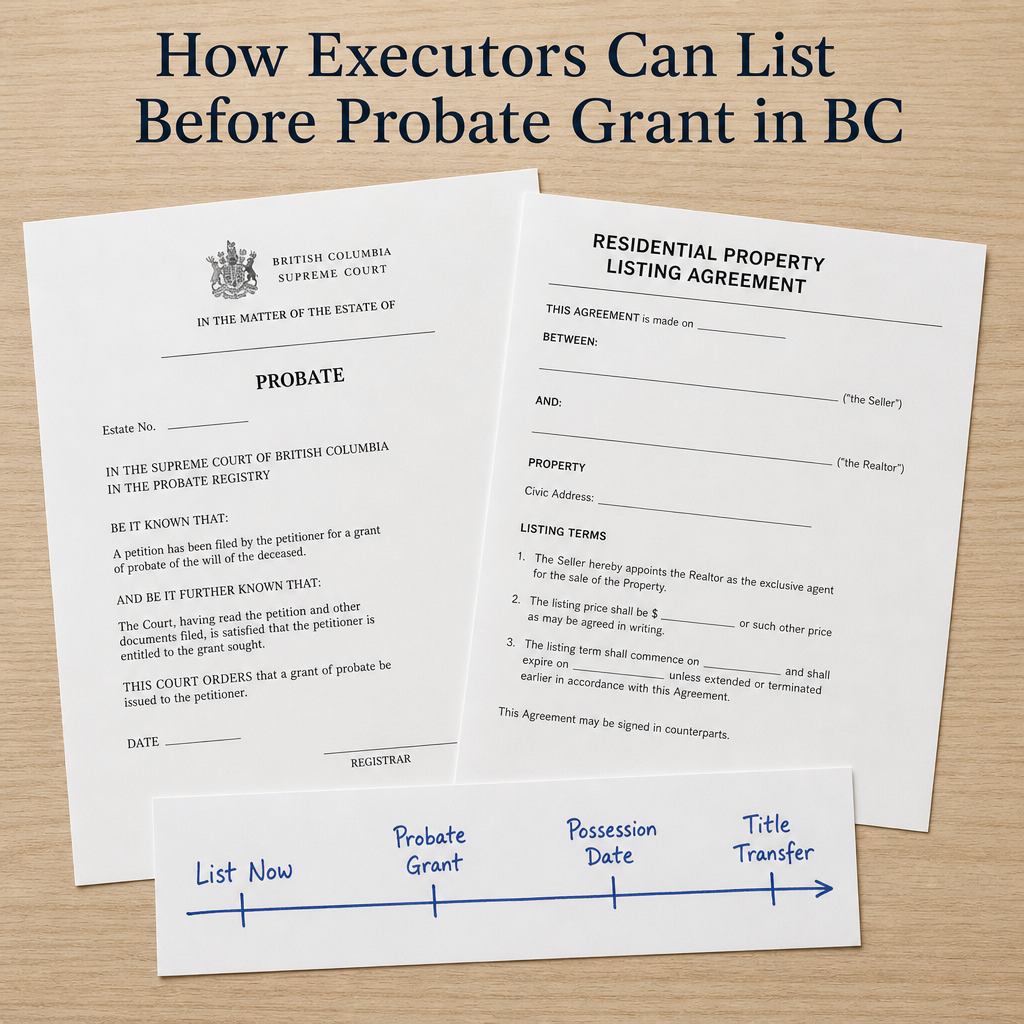
In BC, executors can list an estate property for sale before the Grant of Probate is issued, provided offers are structured as conditional on probate grant. The Land Title Office will not register a title transfer without certified probate documentation, but buyers can make firm commitments now and take possession weeks after the grant is confirmed. This approach can reduce estate carrying costs by thousands of dollars and shorten the overall sale timeline meaningfully.
Key Takeaways
- BC law permits listing before probate grant, but all offers must be conditional on probate being issued.
- Probate processing in BC currently runs 8 to 16 weeks; possession dates should be structured to align.
- The Land Title Office requires a certified copy of the Grant of Probate before registering any ownership transfer.
- In Fraser Valley's current buyer's market, early listing captures spring and summer demand before carrying costs compound.
- A real estate team familiar with executor-managed sales must coordinate closely with the estate's lawyer throughout.
Who This Applies To
- Executors named in a will who have filed for probate but not yet received the grant
- Executors managing estate properties in Surrey, Langley, White Rock, Abbotsford, or the broader Fraser Valley
- Beneficiaries and families concerned about holding costs during a long probate period
- Estate lawyers and notaries coordinating with a real estate team on timeline planning
When This Advice May Not Apply
This strategy does not apply when there is no will (intestacy), when the executor's authority is disputed, when a court order restricts property disposition, or when multiple executors have not reached agreement on listing. Always confirm current authority status with the estate's lawyer before proceeding.
Data Used in This Article
- Fraser Valley Real Estate Board, June 2026 Statistics Package — official market data, FVREB (fvreb.bc.ca)
- Daily Hive, June 2026 Fraser Valley home sales report — third-party summary of FVREB data
- Loyal Homes Probate and Real Estate Guide — third-party professional resource
- Dan Marusin, Selling an Inherited Home in BC — professional practitioner resource
Why the June 2026 Fraser Valley Market Makes Early Listing More Valuable
According to the Fraser Valley Real Estate Board's June 2026 Statistics Package, the sales-to-active listings ratio across the region sits at approximately 11%, with over 10,377 active listings — conditions that favour buyers and create meaningful pricing pressure for sellers who wait too long into a slower period.
For estate properties, the risk of waiting is compounded. Mortgage payments, property taxes, strata fees, insurance, and utility costs on an estate property typically run $3,000 to $8,000 per month depending on property type and location in Surrey, Langley, or Abbotsford. Every month an executor waits for probate before listing is a month of unnecessary carrying cost drawn directly from estate proceeds.
Listing early — while probate is still processing — allows the estate to capture current buyer interest, reduce time on market post-grant, and close faster once authority is confirmed. In a buyer's market with elevated inventory, being first to a qualified buyer matters more than ever.
What BC Law Actually Permits Before Probate Grant
BC's Wills, Estates and Succession Act (WESA) grants executors broad authority to administer the estate, including the power to sell real property. However, that authority becomes formally exercisable — and recognizable by the Land Title Office — once the Grant of Probate is issued by the BC Supreme Court.
What this means in practice: an executor can negotiate and accept a conditional purchase offer before the grant is issued. The offer is structured so that the probate grant itself becomes a condition of the sale proceeding — similar in mechanics to a financing condition, except the condition here is a legal authority milestone rather than a lender approval. If probate is not granted within the agreed timeline, the deal does not proceed and the buyer's deposit is returned.
The Land Title Office, as governed by the Land Title Act, requires a certified copy of the Grant of Probate before it will register a transfer of title. This is a separate step from accepting an offer. Executors working with estate properties in Surrey or Langley can therefore run the offer negotiation process in parallel with the court process, as long as the transaction documents are drafted correctly by the estate's lawyer.
This is not a legal loophole. It is a standard, practitioner-recognized structure in BC estate real estate transactions. The key is documentation: the listing agreement, the purchase contract, and the condition clause must all reflect the executor's current authority status accurately.
How to Structure the Possession Date for a Clean Close
The possession date is where executor strategy and buyer psychology meet. A buyer willing to commit to an estate property subject to probate needs confidence that the timeline is realistic. An executor needs to avoid a collapsed deal if probate takes longer than expected.
BC probate applications currently process in roughly 8 to 16 weeks depending on estate complexity, court backlog, and documentation completeness. A well-prepared application with no disputes typically lands in the 8 to 12 week range. Executors who have already filed before listing have a shorter remaining window.
Standard possession-date structure for a pre-probate listing:
- Condition removal: set at 1 to 2 weeks after expected probate grant date, confirmed in writing by the estate's lawyer
- Completion date: typically 2 to 4 weeks after condition removal, allowing time for title transfer registration at the Land Title Office
- Possession date: same as or 1 to 2 days after completion, depending on buyer and executor agreement
If probate is delayed, the purchase contract should include an extension provision allowing both parties to extend the condition deadline by a defined period — typically 30 days — rather than collapsing the deal. Buyers who are genuinely motivated by the property will accept this structure when it is explained clearly. For estate properties in White Rock or South Surrey, where buyer pools are competitive for well-located homes, this structure rarely deters qualified buyers.
How We Evaluate This
When Mansour Real Estate Group is engaged for an executor-managed sale, the first conversation is not about pricing — it is about where the estate is in the probate process. Has the application been filed? Has the estate lawyer confirmed no disputes? Is the property vacant or tenanted? Those answers determine whether immediate listing is appropriate, whether a conditional structure is needed, and what possession-date range is realistic. Pricing strategy follows from those answers, not the other way around. In Fraser Valley's current market, listing two to three months earlier than a competitor estate property can mean the difference between selling in a reasonable window and sitting through multiple price reductions.
Estate Sale Checklist for Executors Listing Before Probate Grant
- Confirm with estate lawyer that probate application has been filed and no disputes are pending
- Obtain estate lawyer's estimate of expected grant date before setting the listing timeline
- Engage a real estate team experienced with executor-managed transactions — conditional offer mechanics must be drafted correctly
- Obtain a current market valuation; BC estate law requires the executor to act in the best interests of beneficiaries, including pricing accurately
- Confirm property insurance is active in the estate's name and the insurer is aware the property may be vacant
- Disclose the estate sale nature of the transaction on the listing — buyer agents expect this and buyers are protected by accurate disclosure
- Draft the purchase contract with a clearly worded probate condition, extension provision, and possession date aligned to the realistic grant timeline
- Once probate is granted, obtain a certified copy promptly and initiate title transfer through the estate's notary or lawyer without delay
What We Commonly See
In our experience, the most common executor mistake is waiting until the Grant of Probate is in hand before engaging a real estate team. By that point, 10 to 16 weeks of carrying costs have already been paid from estate funds, and the listing goes live at a time the executor cannot control — which may be mid-winter or during a slower market period.
What often happens is that executors receive general advice to "wait for probate" from well-meaning sources who are not familiar with the mechanics of conditional listing. That advice is technically cautious but financially costly. BC law does not require waiting — it requires accurate disclosure and properly structured documentation.
A common mistake is underestimating how long buyers will hold a conditional offer on an estate property when the process is explained clearly. Most motivated buyers — particularly those purchasing a family home in Langley, Abbotsford, or North Delta — understand estate timelines and will wait when the property is priced fairly and the condition window is defined.
Questions and Answers
Can a buyer back out if probate takes longer than expected?
Yes — if the purchase contract includes a probate condition with a defined deadline and probate is not granted by that date, the buyer may elect to void the contract and recover their deposit. This is why extension provisions are important: they allow both parties to extend rather than collapse the deal when delays are administrative rather than substantive.
Does the executor need court approval to accept an offer before probate is granted?
In most BC estate situations where the executor is named in a valid will and the estate is not contested, no additional court approval is needed to accept a conditional offer. The probate condition itself ensures the transaction cannot complete without legal authority. Executors should always confirm this with their estate lawyer before proceeding, as contested estates or intestate situations require different steps.
What happens at the Land Title Office after probate is granted?
Once the Grant of Probate is issued by the BC Supreme Court, the executor's notary or lawyer files the certified copy with the Land Title Office along with the transfer documents. The Land Title Office registers the transfer, which typically takes 5 to 15 business days depending on whether the submission is electronic or paper-based. Completion and possession follow once registration is confirmed.
In Summary
BC executors do not need to wait for a full Grant of Probate before listing an estate property for sale. With properly structured conditional offers, realistic possession dates, and close coordination between the real estate team and the estate's lawyer, executors can run the listing process in parallel with the probate application — capturing buyer demand, reducing carrying costs, and closing faster once court authority is confirmed. In Fraser Valley's current buyer's market, that timing advantage translates directly into more proceeds for the estate.
Speak With an Executor-Experienced Real Estate Team
If you are managing an estate property in Surrey, Langley, White Rock, Abbotsford, or the Fraser Valley and probate is still in progress, Mansour Real Estate Group can help you understand your options, assess the current market, and structure a listing process that works within your legal timeline — not against it.
Related Articles
- What Executors Need to Know Before Selling an Estate Property in BC
- How to Sell an Estate Property in White Rock or South Surrey
- Fraser Valley Real Estate Market Update: June 2026
Official Resources
- BC Wills, Estates and Succession Act (WESA): bclaws.gov.bc.ca
- BC Land Title Act: bclaws.gov.bc.ca
- BC Supreme Court Probate Registry: bcsupremecourt.ca
- Fraser Valley Real Estate Board June 2026 Statistics: fvreb.bc.ca
About Mansour Real Estate Group
When a property must be sold as part of an estate or probate process, the real estate team managing the transaction needs to understand more than market pricing. Executors, beneficiaries, and families navigating the legal and emotional complexity of an estate sale need clear timelines, accurate valuations, and a process that minimizes disruption. Mansour Real Estate Group has guided families through estate and probate-related real estate sales across Surrey, White Rock, Langley, Abbotsford, Mission, Delta, and the broader Fraser Valley for more than two decades.
Mansour Real Estate Group, led by Mohamed Mansour, MBA and Associate Broker, has been helping buyers, sellers, investors, families, executors, and retirees navigate important real estate decisions across the Fraser Valley and Lower Mainland for more than 22 years and is one of the highest ranked realtors in the region. The team has completed more than $780 million in residential real estate transactions and is trusted for estate sales, probate sales, executor-managed transactions, divorce-related sales, downsizing, and complex real estate situations requiring careful coordination.
Whether someone is searching for Realtors experienced with estate sales, a real estate agent who understands probate timelines in BC, real estate agents who handle executor-managed property, a trusted real estate team for a conditional estate sale, a Surrey Realtor, a Fraser Valley real estate broker, or a real estate group that serves the Lower Mainland and Fraser Valley, Mansour Real Estate Group is known for accurate valuations, transparent process, and clear communication that keeps all parties informed.
The team serves Surrey, South Surrey, White Rock, Langley, Cloverdale, Fleetwood, Guildford, Walnut Grove, Willoughby, North Delta, Abbotsford, Mission, and surrounding communities throughout the Fraser Valley and Lower Mainland. Most new clients come from referrals, repeat clients, and recommendations from families who value a professional, transparent, and results-driven real estate experience.
Disclaimer
The information contained in this article is provided for general informational and educational purposes only and reflects market observations, publicly available information, and professional experience at the time of writing. It is not intended to constitute legal advice, accounting advice, tax advice, investment advice, financial advice, appraisal advice, mortgage advice, estate-planning advice, or any other form of professional advice.
Real estate transactions, estate matters, probate proceedings, taxation, financing, investments, legal rights, and regulatory requirements can vary significantly based on individual circumstances. Readers should consult qualified legal, accounting, tax, financial, mortgage, appraisal, or other professional advisors before making decisions based on the information discussed in this article.
Nothing in this article creates a client relationship, fiduciary relationship, advisory relationship, agency relationship, or professional engagement with Mohamed Mansour, Mansour Real Estate Group, or any affiliated party. Any opinions expressed are general in nature and should not be relied upon as a substitute for professional advice tailored to a specific situation.
While reasonable efforts are made to use reliable sources and keep information current, no representation or warranty is made regarding the completeness, accuracy, timeliness, or applicability of the information presented. Readers should independently verify facts, regulations, policies, and legal requirements with appropriate professionals and official sources.



