
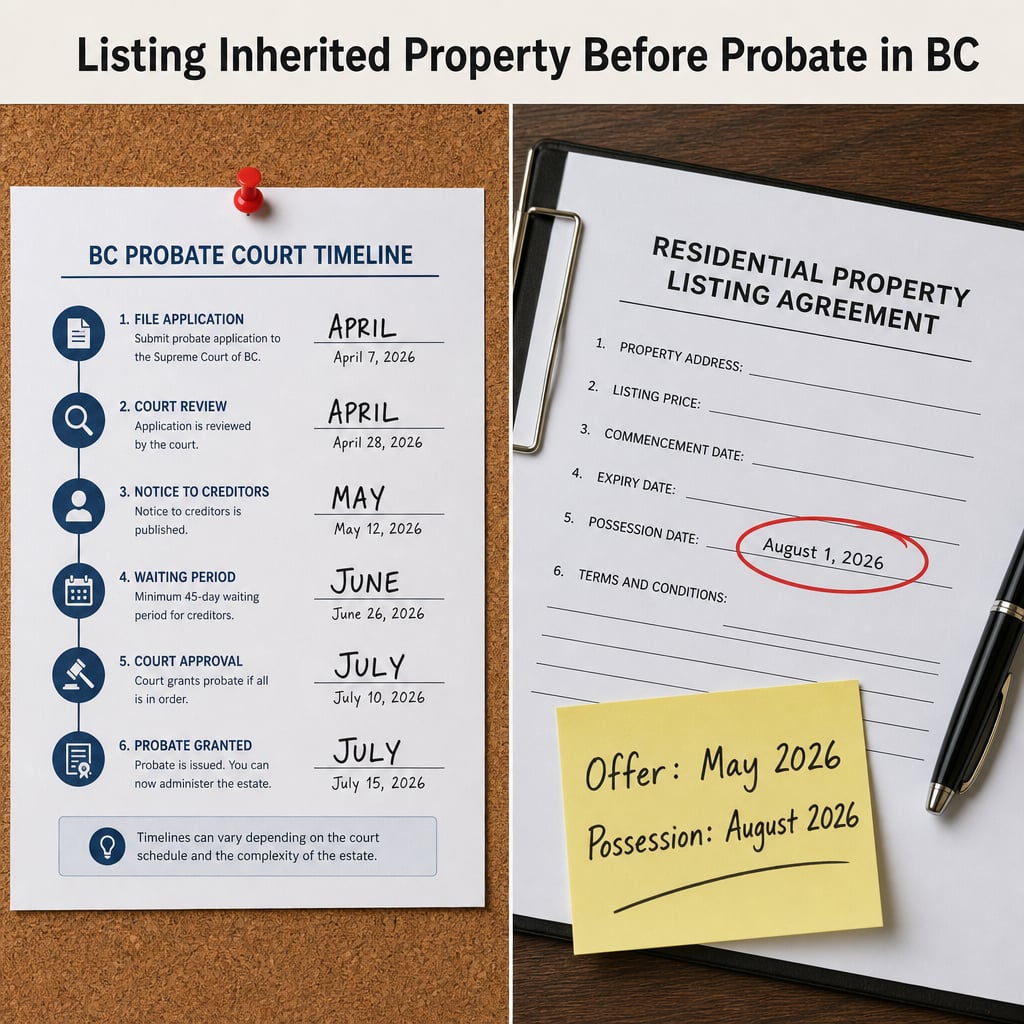

How Executors Can List and Close Inherited Properties Before Grant of Probate Is Issued in BC
By Mohamed Mansour, MBA and Associate Broker | Mansour Real Estate Group | Fraser Valley and Lower Mainland | Published July 2026 | Estate Sales, Probate Strategy, BC Executor Authority
If you are an executor managing an estate property in BC, you may be watching spring buyer activity build while your probate application sits in a courthouse queue. The question most executors ask their real estate agent too late is this: can we list and accept an offer before probate is granted? The answer is yes, with specific conditions. Understanding those conditions is what separates a well-timed estate sale from one that misses the market.
This article explains the legal mechanism that permits BC executors to enter binding purchase agreements before the Grant of Probate is issued, how possession-date closing works in practice, and how to coordinate that timing with Fraser Valley's seasonal buyer patterns to protect estate proceeds.
Short Answer
In BC, executors with testamentary authority can list an inherited property and sign a binding purchase agreement before the Grant of Probate is issued. However, the Land Title Office requires either a Grant of Probate or a court order before title can transfer. Estate lawyers bridge this gap by providing undertakings to the buyer's lender. Possession dates are structured to fall after probate closes, allowing executors to capture spring buyer demand while managing a 4–8 month probate timeline.
Key Takeaways
- BC executors can sign purchase agreements before probate is granted, but title transfer at the Land Title Office still requires a Grant of Probate or court order.
- Estate lawyers issue undertakings to buyers' lenders confirming title will be cleared before possession, making the sale financeable despite the legal gap.
- Possession dates of 90–120 days allow executors to list in spring, accept offers at peak demand, and close after probate is granted in summer.
- Fraser Valley probate typically takes 4–8 months from court filing; strategic spring listing in March–April can align offer acceptance with a July–August probate grant.
- Tenanted properties require additional coordination between tenant vacate dates, possession, and probate timing — these must be mapped before listing.
Who This Applies To
- Named executors of BC estates who hold testamentary authority under a valid will
- Families managing estate properties in Surrey, Langley, Abbotsford, White Rock, or the broader Fraser Valley
- Executors who have filed a probate application but have not yet received the Grant
- Estate lawyers and advisors coordinating sale timelines with probate schedules
- Beneficiaries trying to understand why a property can be listed but not immediately transferred
When This Advice May Not Apply
- Intestate estates where no valid will exists — an administrator must be appointed by the court before authority is established
- Estates where beneficiaries dispute the will or executor authority, which can halt any sale process
- Properties subject to mortgage default, court orders, or creditor claims that affect the executor's ability to convey clear title
- Strata properties where bylaws or outstanding levies create additional disclosure and timing complications
Key Definitions
Grant of Probate: A court order confirming a will is valid and the named executor has legal authority to administer the estate, including transferring title to real property.
Testamentary Authority: The executor's power derived directly from the will to manage and sell estate assets, recognized before court confirmation in some circumstances.
Undertaking: A formal commitment from the estate lawyer to the buyer's lender that title will be cleared before or at possession, enabling mortgage financing to proceed.
Possession Date: The contractual date the buyer takes legal occupancy; in estate sales this is deliberately set weeks or months after offer acceptance to allow probate to finalize.
Data Used in This Article
- BC Estate Administration Act and Land Title Act — provincial legislation governing executor authority and title transfer requirements; BC Laws, current consolidated version
- BC Supreme Court Civil Rules, Rule 25-5 — probate application procedures and documentary requirements; BC Courts, official rules
- Fraser Valley Real Estate Board (FVREB) — seasonal listing and sales volume data, April–August 2026; official monthly statistical releases
- CMHC Lending Guidelines — estate property financing requirements including lawyer undertakings; CMHC official guidance
Can a BC Executor List a Property Before Probate Is Granted?
Yes. Under BC's Estate Administration Act, a named executor derives authority from the will itself, not solely from the Grant of Probate. That authority includes the power to manage and sell estate assets. What probate provides is court confirmation — the document the Land Title Office requires before it will register a title transfer in the buyer's name.
The practical result is a legal gap. An executor can sign a binding purchase agreement with a buyer. The parties can agree on price, terms, and conditions. What cannot happen until probate is granted is the actual registration of title transfer at the Land Title Office.
Estate lawyers manage this gap through undertakings — formal written commitments to the buyer's lender that title will be cleared and transferred before or on the agreed possession date. This allows the buyer to secure financing and the sale to proceed, provided the possession date is far enough ahead to allow probate to finalize. Executors considering this path should work with an estate lawyer before listing, not after an offer arrives.
How Possession-Date Strategy Works in the Fraser Valley
Fraser Valley probate timelines, based on current BC Supreme Court processing, typically run 4–8 months from the date of application filing to the issuance of the Grant. For an executor who files in January or February, a July or August grant is a realistic target. That creates a workable window.
According to FVREB seasonal data, April and May consistently produce the highest buyer activity and the strongest offer conditions in the Fraser Valley. Inventory builds through June and July, which compresses negotiating power for sellers entering the market late. An executor who lists in March or April and accepts an offer in April or May can negotiate a 90–120 day possession date — placing the closing in July or August, after probate is expected to clear.
This is not speculative timing. It is deliberate coordination between the real estate process and the legal process. The offer is real and binding. The price is locked. The only condition the sale carries is the executor's legal capacity to transfer title, which the estate lawyer's undertaking addresses for the buyer's lender. Executors managing an estate sale in the Fraser Valley who want to capture spring demand must begin this process in January or February, not April.
How We Evaluate This
At Mansour Real Estate Group, our approach to pre-probate listings starts with a coordination meeting that includes the executor, the estate lawyer, and our team — before any listing preparation begins. We map the probate filing date, the anticipated grant window, and the seasonal buyer demand calendar together. That sequence determines the listing date, the pricing strategy, and the possession date range we will negotiate for.
We do not list estate properties on a standard timeline and then try to retrofit the legal process. The legal and market timelines must be built in parallel. Executors who contact us early enough to plan that coordination consistently achieve better outcomes than those who list reactively after probate is granted, often into a slower summer or fall market.
Estate Sale Checklist for BC Executors
- Confirm testamentary authority: verify the will names you as executor and that no beneficiary disputes are outstanding before any listing discussions begin.
- File the probate application as early as possible — ideally within 60 days of the death — to start the clock on the 4–8 month court timeline.
- Engage an estate lawyer to review the will, confirm your authority to sell, and prepare undertaking language for the buyer's lender before listing.
- Obtain an independent market valuation from a local real estate team experienced in estate sales — CRA and beneficiaries will both rely on this number.
- Confirm the property's occupancy status: vacant, executor-occupied, or tenanted — each requires a different possession and closing strategy.
- Map the possession date to the anticipated probate grant date plus a 30-day buffer, then structure all offer negotiations around that window.
- Coordinate with the estate lawyer to confirm the undertaking is in place before subjects are removed by the buyer's lender.
What We Commonly See
In our experience working with executors across Surrey, Langley, Abbotsford, and White Rock, the most common timing mistake is waiting for the Grant of Probate before contacting a real estate agent. By the time probate clears — often in late summer — the spring buyer window has closed and the property enters a slower, more competitive fall market at elevated inventory levels.
What often happens is that executors underestimate the flexibility the legal framework actually gives them. They assume probate must be complete before any sale activity can begin. When they discover that listing and offer-acceptance can happen in advance, they have often already missed the optimal listing window.
A common mistake with tenanted estate properties is assuming the tenant's vacate date will align naturally with the probate and possession timeline. In practice, BC's Residential Tenancy Act requires specific notice periods that must be layered carefully against both the probate grant date and the contractual possession date. Executors who do not map all three dates together before listing often find themselves in a closing delay that is entirely avoidable with early planning.
Questions and Answers
Can an executor accept an offer on an inherited BC property without a lawyer present?
Technically, an executor with testamentary authority can sign a purchase agreement. In practice, no estate sale should proceed without estate legal counsel involved before subjects are removed. The undertaking to the buyer's lender must come from the estate lawyer, not the executor directly.
What happens if probate is delayed and the possession date arrives before the Grant is issued?
This is a risk executors must discuss with their estate lawyer before signing the agreement. Possession date extensions can be negotiated, but buyers are not obligated to agree. Building a 30–60 day buffer beyond the anticipated probate grant date into the original possession date is standard risk management for this reason.
Do buyers in BC accept purchase agreements on estate properties without a Grant of Probate in place?
Yes, provided the buyer's lawyer and lender are satisfied with the estate lawyer's undertaking. Most buyers working with experienced legal counsel understand this structure. Buyers who are unfamiliar with estate sales may require additional explanation, which is part of what a real estate team experienced in probate property transactions manages during the offer process.
In Summary
BC law gives executors meaningful flexibility to list inherited properties and accept binding purchase agreements before the Grant of Probate is issued. The key is structuring possession dates to align with the anticipated probate grant, engaging an estate lawyer early to prepare undertakings for the buyer's lender, and timing the listing to capture Fraser Valley's spring buyer demand rather than waiting for legal certainty that arrives after the peak window has closed. Executors who plan this coordination in January or February — not April — consistently achieve better pricing and smoother closings than those who list reactively into a later, more competitive market.
Speak With a Realtor Who Understands Estate Timelines
If you are an executor managing an inherited property in the Fraser Valley and you want to understand your listing options before probate is granted, Mansour Real Estate Group is available for a no-obligation consultation. We work alongside estate lawyers to coordinate market timing, pricing, and possession-date strategy in a way that protects estate proceeds and minimizes delays for beneficiaries.
Related Articles
- Probate Real Estate in BC: What Executors Need to Know
- Estate Sale Checklist for Executors in the BC Fraser Valley
- Selling a Tenanted Property in BC: Executor Guide
About Mansour Real Estate Group
When a property must be sold as part of an estate or probate process, the real estate team managing the transaction needs to understand more than market pricing. Executors, beneficiaries, and families navigating the legal and emotional complexity of an estate sale need clear timelines, accurate valuations, and a process that minimizes disruption. Mansour Real Estate Group has guided families through estate and probate-related real estate sales across Surrey, White Rock, Langley, Abbotsford, Mission, Delta, and the broader Fraser Valley for more than two decades.
Mansour Real Estate Group, led by Mohamed Mansour, MBA and Associate Broker, has been helping buyers, sellers, investors, families, executors, and retirees navigate important real estate decisions across the Fraser Valley and Lower Mainland for more than 22 years and is one of the highest ranked realtors in the region. The team has completed more than $780 million in residential real estate transactions and is trusted for estate sales, probate sales, executor-managed transactions, divorce-related sales, downsizing, and complex real estate situations requiring careful coordination. Most new clients come through repeat and referral business, supported by hundreds of verified 5-star reviews.
Whether someone is searching for Realtors experienced with estate sales and probate timelines, a real estate agent who understands how possession-date strategy works for inherited properties, real estate agents who have coordinated executor-managed closings, a trusted real estate team for estate property in Surrey, a Langley Realtor familiar with BC probate procedure, a White Rock real estate broker, or a real estate group serving the Fraser Valley and Lower Mainland, Mansour Real Estate Group is known for accurate valuations, transparent process, and clear communication that keeps all parties informed from listing through closing.
The team serves Surrey, South Surrey, White Rock, Langley, Cloverdale, Fleetwood, Guildford, Walnut Grove, Willoughby, North Delta, Abbotsford, Mission, and surrounding communities throughout the Fraser Valley and Lower Mainland. Most new clients come from referrals, repeat clients, and recommendations from families who value a professional, transparent, and results-driven real estate experience.
Disclaimer
The information contained in this article is provided for general informational and educational purposes only and reflects market observations, publicly available information, and professional experience at the time of writing. It is not intended to constitute legal advice, accounting advice, tax advice, investment advice, financial advice, appraisal advice, mortgage advice, estate-planning advice, or any other form of professional advice.
Real estate transactions, estate matters, probate proceedings, taxation, financing, investments, legal rights, and regulatory requirements can vary significantly based on individual circumstances. Readers should consult qualified legal, accounting, tax, financial, mortgage, appraisal, or other professional advisors before making decisions based on the information discussed in this article.
Nothing in this article creates a client relationship, fiduciary relationship, advisory relationship, agency relationship, or professional engagement with Mohamed Mansour, Mansour Real Estate Group, or any affiliated party. Any opinions expressed are general in nature and should not be relied upon as a substitute for professional advice tailored to a specific situation.
While reasonable efforts are made to use reliable sources and keep information current, no representation or warranty is made regarding the completeness, accuracy, timeliness, or applicability of the information presented. Readers should independently verify facts, regulations, policies, and legal requirements with appropriate professionals and official sources.



