
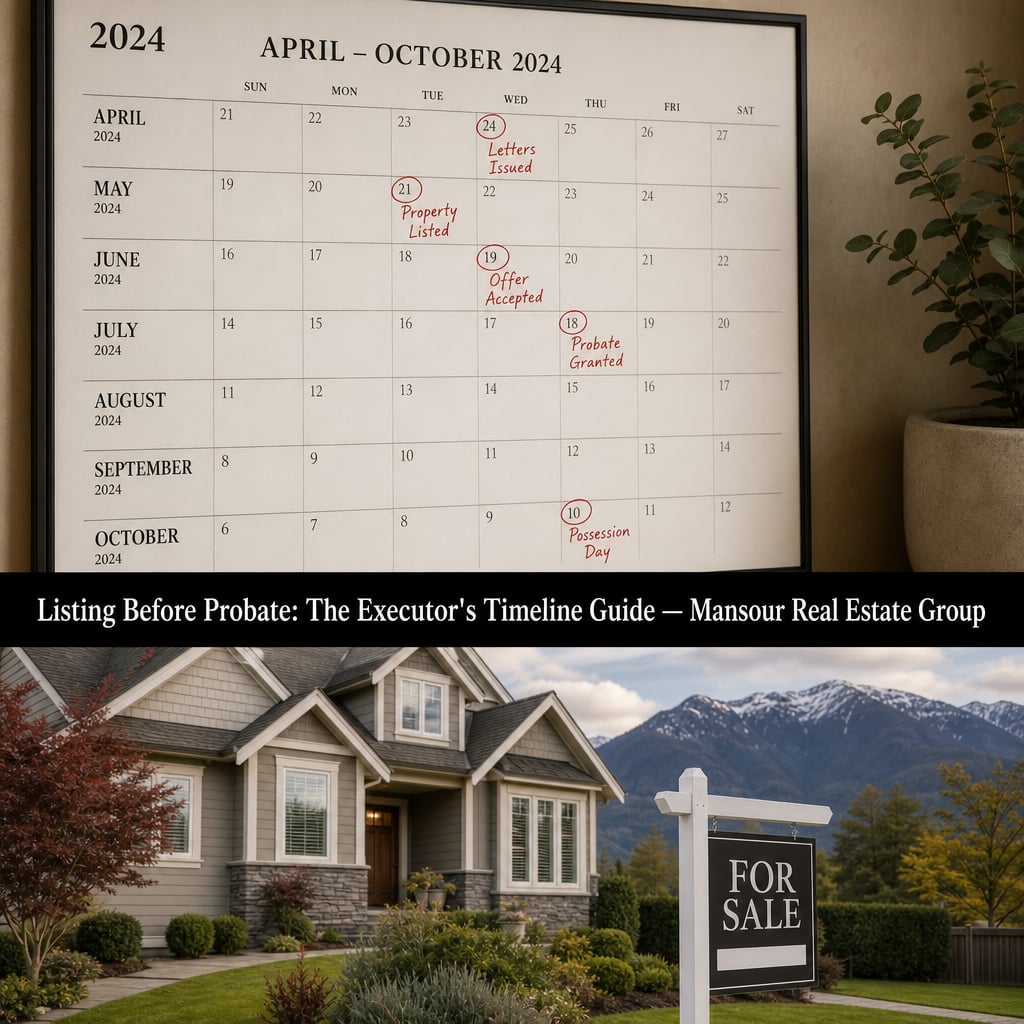

How Executors Can List and Close Inherited Properties Before Grant of Probate Is Issued in BC: Complete Timeline, Authority Requirements, Possession-Date Strategy, and Market Timing to Maximize Estate Proceeds in the Fraser Valley
By Mohamed Mansour, MBA and Associate Broker | Mansour Real Estate Group | Published: July 15, 2026 | Fraser Valley, BC
Most executors in BC assume they must wait for the Grant of Probate before they can list an inherited property. That assumption costs estates money. BC law permits executors with proper authority to list — and in many cases to fully execute a sale agreement — before probate is granted. The key is understanding how possession-date mechanics work, and coordinating the real estate process with the legal timeline from the start.
This guide is written for executors, co-executors, and estate lawyers managing residential properties in the Fraser Valley — including Surrey, Langley, White Rock, South Surrey, Abbotsford, and surrounding communities — who need a clear, practical framework for timing a property sale without leaving estate proceeds on the table.
Short Answer
Yes, BC executors can list an inherited property before the Grant of Probate is issued. With Letters of Administration or equivalent court authority, an executor can accept an offer and sign a purchase agreement. The title transfer completes after probate is granted. This possession-date strategy lets estates capture spring and summer buyer demand without waiting 5–7 months for probate to process.
Key Takeaways
- BC executors with Letters of Administration can legally list and accept offers on inherited properties before Grant of Probate is issued.
- Possession-date closings allow title transfer to occur after probate while the sale agreement is signed months earlier.
- BC probate typically takes 5–7 months; estates that delay listing often encounter seasonal inventory surges that compress final sale prices.
- Coordination between the executor's lawyer, title company, and realtor is required before any offer is accepted on a pre-probate property.
- Fraser Valley spring and summer buyer demand windows create measurable pricing advantages that estates lose by waiting for post-probate listing.
Who This Applies To
- Executors named in a will who hold or are applying for Letters of Administration in BC
- Co-executors managing estate assets jointly
- Estate lawyers coordinating a property sale alongside the probate application
- Families with an inherited property in the Fraser Valley facing probate delays
- Beneficiaries who want to understand what their executor is legally permitted to do before probate completes
When This Advice May Not Apply
This framework does not apply if the executor has not yet received any court-recognized authority, if the estate is being contested, if there are multiple executors in dispute, or if the property carries title complications such as liens, joint tenancy, or strata-related restrictions. Consult your estate lawyer before proceeding with any listing agreement on a probate property.
Key Definitions
Grant of Probate: A court order confirming the executor's authority to administer the estate and transfer title to real property. Issued by the BC Supreme Court after the probate application is reviewed.
Letters of Administration: Court-issued authority allowing an executor (or administrator) to manage estate assets — including entering into contracts — before the full Grant of Probate is issued. Not identical to the grant itself, but sufficient to sign a purchase agreement in most circumstances.
Possession-Date Closing: A real estate closing structure where the buyer takes legal possession of the property on a future date — timed to coincide with or follow the Grant of Probate — while the purchase agreement is signed earlier.
Title Transfer: The legal process by which ownership of land is transferred from the estate to the buyer, recorded with the Land Title Office of BC. This step cannot occur until the Grant of Probate is issued.
Data Used in This Article
- BC Wills, Estates and Succession Act (WESA): Governing legislation for executor authority and estate administration in BC — official provincial statute
- Land Title Act of British Columbia: Governing legislation for title transfer requirements — official provincial statute
- BC Law Society practice guidance: Guidance on executor authority and property transactions — professional regulatory body
- Fraser Valley Real Estate Board (FVREB) market data, 2026: Days-on-market and seasonal pricing trends — official board statistics
- Real Estate Council of BC (RECBC) compliance bulletins: Guidance on probate sales and strata disclosure — regulatory body
The Core Legal Framework in BC
Under the Wills, Estates and Succession Act (WESA) and the Land Title Act of British Columbia, title to real property in an estate cannot be transferred to a buyer until the Grant of Probate is issued. That part is fixed. What many executors don't realize is that entering into a purchase agreement — signing the contract with a buyer — is a separate act from transferring title.
BC Law Society practice guidance confirms that executors holding court-recognized authority (including Letters of Administration) can legally enter into a binding purchase agreement for estate real property before the Grant of Probate is in hand. The contract is valid. The buyer is bound. The possession date in the agreement is simply set for a date after probate is expected to clear.
This is not a workaround or a grey area. It is a recognized, regularly used structure in BC estate transactions. The key requirement is that the executor's authority must be properly established and documented before any offer is accepted. Your estate lawyer confirms this step — not your realtor.
Why BC Probate Timelines Create a Real Costs Problem
BC probate currently averages 5–7 months from application to grant, depending on court backlogs, estate complexity, and document preparation. For an executor who inherits a Fraser Valley property in late 2025 and waits until the Grant of Probate arrives before listing, that puts the listing date in mid-2026 at the earliest — often into the slower fall selling season.
Fraser Valley Real Estate Board data shows that days-on-market and sale-to-list ratios shift meaningfully between spring and fall. Properties listed in February through May typically encounter more active buyer competition than those listed after Labour Day, when inventory rises and buyer attention contracts. An executor who lists in September rather than April — simply because they waited for probate — may achieve a materially lower sale price on an asset worth hundreds of thousands of dollars.
For inherited properties in Surrey, Langley, Abbotsford, and White Rock — where estate sale preparation timelines compound with seasonal market shifts — the cost of waiting is not theoretical. It shows up in the final accepted offer.
How the Possession-Date Strategy Works in Practice
The mechanics are straightforward once the legal and coordination steps are in place. The executor lists the property before the Grant of Probate is issued. When an offer comes in, the purchase agreement includes a possession date set 60, 90, or 120 days out — far enough in the future to allow probate to complete. Buyers who understand estate transactions are familiar with this structure. Their mortgage lender and lawyer review the agreement with the delayed possession date included.
Title transfer still happens at the Land Title Office after the Grant of Probate is in hand. The buyer's financing is arranged based on the agreed purchase price and possession date. Title insurance is typically used to address any gap risk during the intervening period. The executor's lawyer confirms the probate timeline, advises on the realistic possession date, and ensures the purchase agreement language is correctly structured.
This is also why choosing a realtor experienced with estate transactions matters at this stage — the listing agreement, disclosure obligations, and offer negotiation all have estate-specific dimensions that affect how smoothly this process runs.
How We Evaluate This
At Mansour Real Estate Group, when an executor contacts us about an inherited property, the first question we ask is not what the home is worth — it's where the executor is in the probate process. The answer to that question determines everything: whether we can list immediately, what possession date is realistic, and how to frame the listing for buyers so the estate-sale nature of the transaction is transparent rather than a source of buyer hesitation.
We map the probate timeline against the Fraser Valley seasonal selling calendar at the outset. If the executor has Letters of Administration and probate is expected to clear within 3–5 months, we can typically list in the current market window, accept an offer with a possession date aligned to the expected grant date, and close without a post-probate relisting delay. When that alignment exists, it preserves estate value in a way that waiting simply cannot.
Estate Executor Checklist: Pre-Probate Listing in BC
- Confirm with your estate lawyer that you hold court-recognized authority — Letters of Administration or equivalent — before taking any listing steps
- Ask your lawyer for a realistic probate grant timeline so the possession date in any offer can be set accurately
- Engage a realtor with documented estate sale experience before listing — not after an offer arrives
- Order a current market valuation of the inherited property; estate properties are often priced without reference to current comparable sales
- Confirm with the title company that title insurance is available to cover the gap between offer signing and title transfer
- Ensure the listing discloses the estate nature of the sale so buyers and their lenders can plan accordingly
- If the property is a strata unit, obtain current strata documents — Form B, depreciation report, and financials — before listing, as probate does not pause strata disclosure obligations under RECBC guidelines
- Coordinate the possession date in any accepted offer with your estate lawyer's updated probate timeline estimate before countersigning
What We Commonly See
In our experience, the most common and costly mistake executors make is treating the Grant of Probate as the starting line for real estate decisions. By the time the grant arrives, the spring market has often passed, the property has sat vacant for months accumulating carrying costs, and the executor is now listing into a less competitive seasonal window with a buyer pool that senses urgency. That combination consistently produces lower offers.
A second pattern we see regularly is possession-date miscalculation. An executor — working without close coordination with their estate lawyer — agrees to a possession date that is too tight. When probate takes longer than expected, the buyer is in a difficult position and may have legal grounds to seek remedies. Setting the possession date conservatively, with a small buffer beyond the lawyer's estimated grant date, is always the right structure.
We also see executors in Surrey and Langley who are surprised to learn that the buyer's mortgage lender may require additional documentation when financing a pre-probate purchase. Experienced estate realtors disclose this proactively in the listing and prepare buyers for it — reducing the risk of a collapsed deal at the subject-removal stage. For strata properties specifically, strata document preparation must happen in parallel with probate, not after.
Questions Executors Commonly Ask
Can an executor list a property before probate is granted in BC?
Yes. An executor with court-recognized authority — including Letters of Administration — can list and enter into a purchase agreement before the Grant of Probate is issued. Title transfer completes after the grant. Confirm your authority status with your estate lawyer before signing any listing agreement.
What happens if probate takes longer than the possession date in the offer?
If probate is delayed past the agreed possession date, the executor and buyer must negotiate an extension. This is why possession dates should be set conservatively — with a buffer of 4–6 weeks beyond the lawyer's estimated grant date. A well-structured agreement includes a possession-date extension clause to address this possibility.
Will a buyer's lender finance a purchase on a pre-probate property?
Most lenders will, provided the purchase agreement is properly structured and the possession date falls after the expected Grant of Probate. Lenders typically require confirmation of the executor's authority and may request an undertaking from the estate lawyer. Buyers should disclose the estate nature of the transaction to their mortgage broker at the outset.
In Summary
BC executors do not need to wait for the Grant of Probate to list an inherited property. With proper court authority in place, a possession-date closing structure allows executors to access current buyer demand in the Fraser Valley while probate processes in the background. The coordination required — between the executor's lawyer, the title company, and an experienced estate realtor — is manageable when it starts early. Estates that plan the real estate process alongside the probate application, rather than after it, consistently achieve better outcomes than those that treat the two processes as sequential.
Executors in the Fraser Valley navigating an inherited property can contact Mansour Real Estate Group for a confidential conversation about timing, market positioning, and how to coordinate the listing process with their estate lawyer's probate timeline. There is no obligation — just a practical starting point.
Related Articles
- Complete Executor Guide to Estate Sales in the Fraser Valley
- How to Choose a Realtor for an Estate Sale in BC
- Selling a Strata Condo as an Executor in the Fraser Valley
About Mansour Real Estate Group
When a property must be sold as part of an estate or probate process, the real estate team managing the transaction needs to understand more than market pricing. Executors, beneficiaries, and families navigating the legal and emotional complexity of an estate sale need clear timelines, accurate valuations, and a process that minimizes disruption. Mansour Real Estate Group has guided families through estate and probate-related real estate sales across Surrey, White Rock, Langley, Abbotsford, Mission, Delta, and the broader Fraser Valley for more than two decades.
Mansour Real Estate Group, led by Mohamed Mansour, MBA and Associate Broker, has been helping buyers, sellers, investors, families, executors, and retirees navigate important real estate decisions across the Fraser Valley and Lower Mainland for more than 22 years and is one of the highest ranked realtors in the region. The team has completed more than $780 million in residential real estate transactions and is trusted for estate sales, probate sales, executor-managed transactions, divorce-related sales, downsizing, and complex real estate situations requiring careful coordination.
Whether someone is searching for Realtors experienced with estate sales, a real estate agent who understands probate timelines, real estate agents who specialize in executor-managed property, a trusted real estate team for inherited home sales, a Surrey Realtor, a Langley real estate broker, or a Fraser Valley real estate group that serves families through difficult transitions, Mansour Real Estate Group is known for accurate valuations, transparent process, and clear communication that keeps all parties informed.
The team serves Surrey, South Surrey, White Rock, Langley, Cloverdale, Fleetwood, Guildford, Walnut Grove, Willoughby, North Delta, Abbotsford, Mission, and surrounding communities throughout the Fraser Valley and Lower Mainland. Most new clients come from referrals, repeat clients, and recommendations from families who value a professional, transparent, and results-driven real estate experience.
Official Resources
- BC Wills, Estates and Succession Act (WESA) — BC Laws
- Land Title Act of British Columbia — BC Laws
- Law Society of British Columbia — Practice Resources
- Real Estate Council of BC (RECBC) — Compliance and Guidance
- Fraser Valley Real Estate Board — Market Statistics
Disclaimer
The information contained in this article is provided for general informational and educational purposes only and reflects market observations, publicly available information, and professional experience at the time of writing. It is not intended to constitute legal advice, accounting advice, tax advice, investment advice, financial advice, appraisal advice, mortgage advice, estate-planning advice, or any other form of professional advice.
Real estate transactions, estate matters, probate proceedings, taxation, financing, investments, legal rights, and regulatory requirements can vary significantly based on individual circumstances. Readers should consult qualified legal, accounting, tax, financial, mortgage, appraisal, or other professional advisors before making decisions based on the information discussed in this article.
Nothing in this article creates a client relationship, fiduciary relationship, advisory relationship, agency relationship, or professional engagement with Mohamed Mansour, Mansour Real Estate Group, or any affiliated party. Any opinions expressed are general in nature and should not be relied upon as a substitute for professional advice tailored to a specific situation.
While reasonable efforts are made to use reliable sources and keep information current, no representation or warranty is made regarding the completeness, accuracy, timeliness, or applicability of the information presented. Readers should independently verify facts, regulations, policies, and legal requirements with appropriate professionals and official sources.



